Search criteria
Section: H1
Task: INS
Alignment into HAM2
Locked JAC with RF at 1W. IMC WFS was centered in IOT2L and IMC started working. As we steered JM3 MC2 TRANS responded as expected (i.e. JM3 PIT -> MC2 YAW and vice versa though there's a significant cross coupling). Sheila had to recenter the WFS once again at some point as the WFS started to get off-centered as we turned JM3, but as far as the WFSs were centered, things worked.
In the end, MC2 TRANS was centered reasonably well (right before the cursor in the attached), JM3 DAC output was O(1e7) while a 28 bit DAC's range is +-134e6.
Apparently we made the last step of JM3 PIT adjustment in the wrong direction at the time (we didn't notice because the WFS is very slow) and overshot. I steered it back later, now H1:SUS-JM3_M1_OPTICALIGN_P_OFFSET is -39 instead of -19 (second screen shot).
Anyway, this means that the alignment into HAM2 is good with more than a comfortable range left for JM3. No need to further refine.
One caveat is that the IM4 trans is totally off in PIT. But that's a downstream problem which we'll have to deal with later in HAM2. That should not prevent us from moving forward to close down the chamber.
The tasks listed below are described in different alogs.
JAC TRANS PD calibration
Last beam dump (alog 89249)
ALS beam path check
Summary: JAC TRANS PD well aligned, rough power budget done, ALS beam from PSL does not hit any wires or components before reaching its intended steering mirror in HAM1.
POWER BUDGET
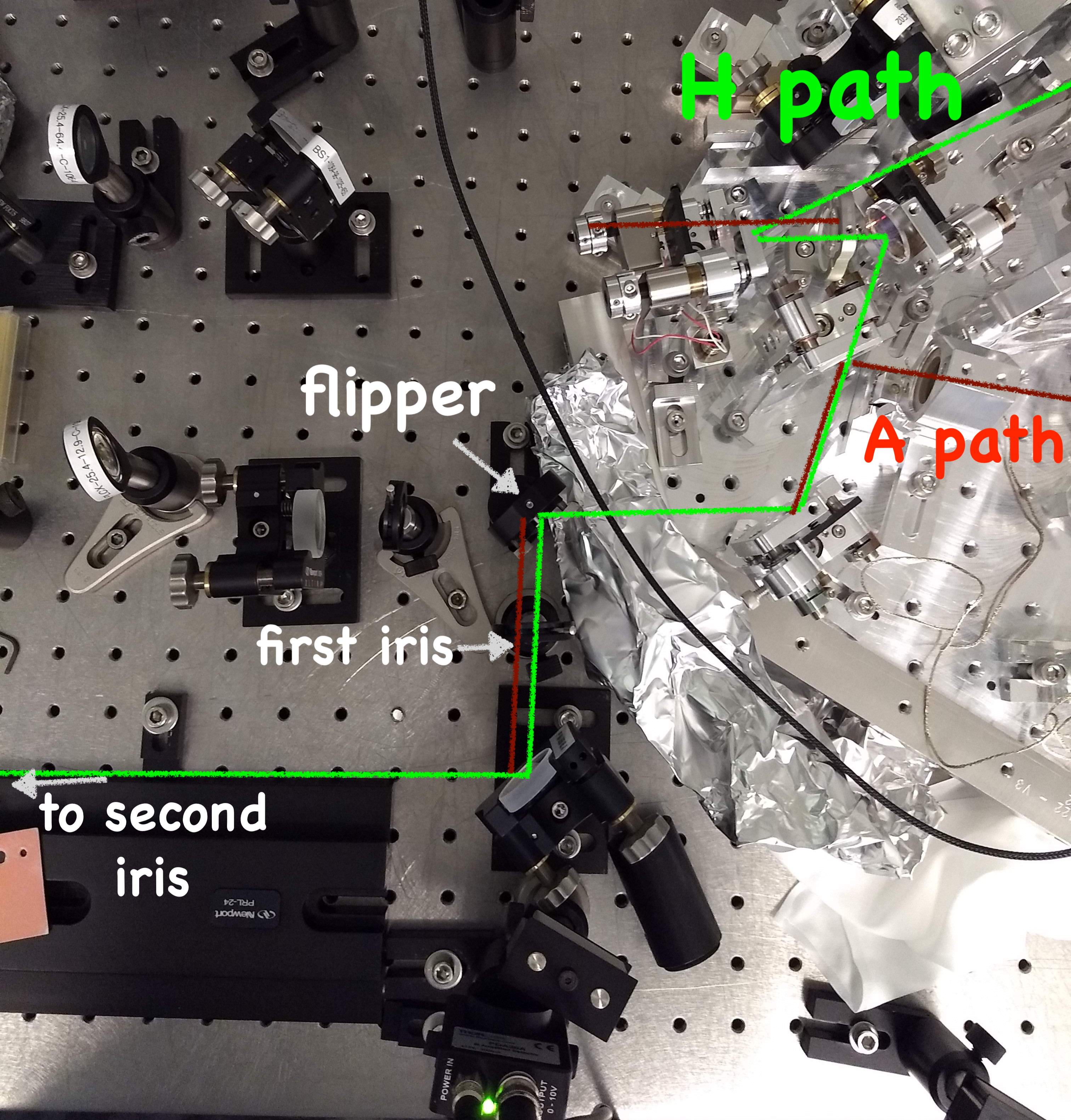
Jason and I went into do some measurements on the TRANS PD path after 11am. We were unsure yesterday that this PD was well aligned after the laser window installation.
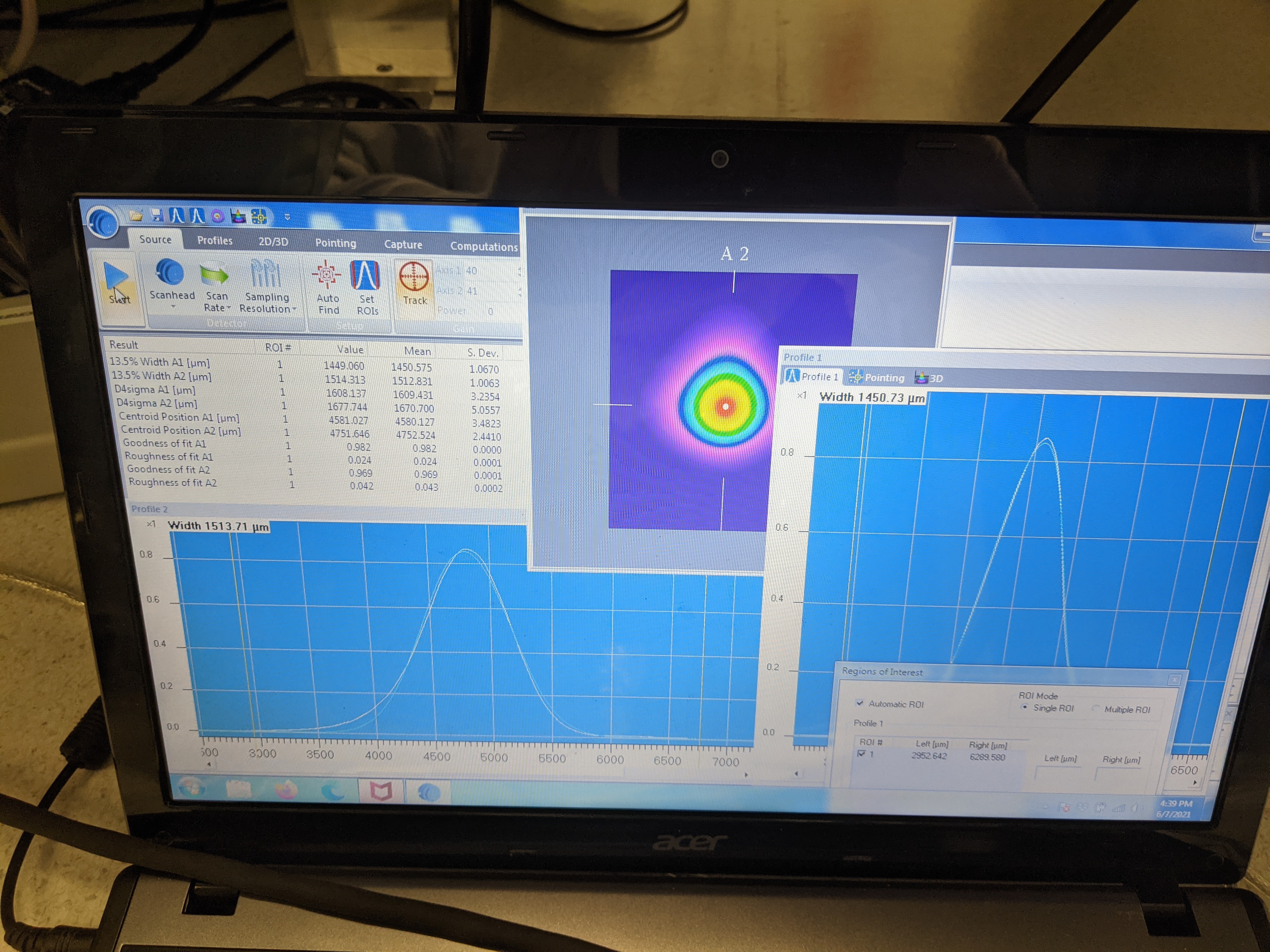
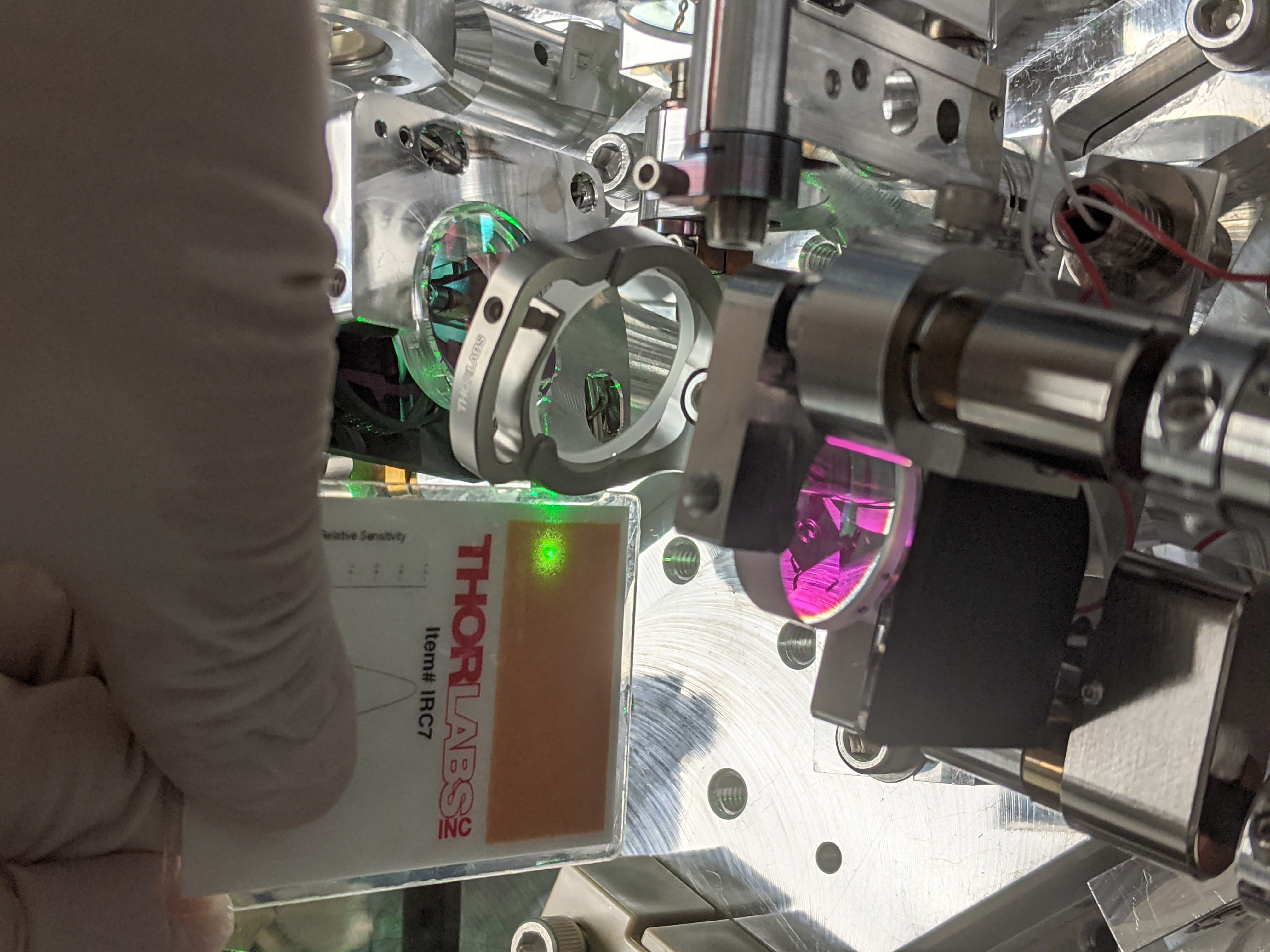
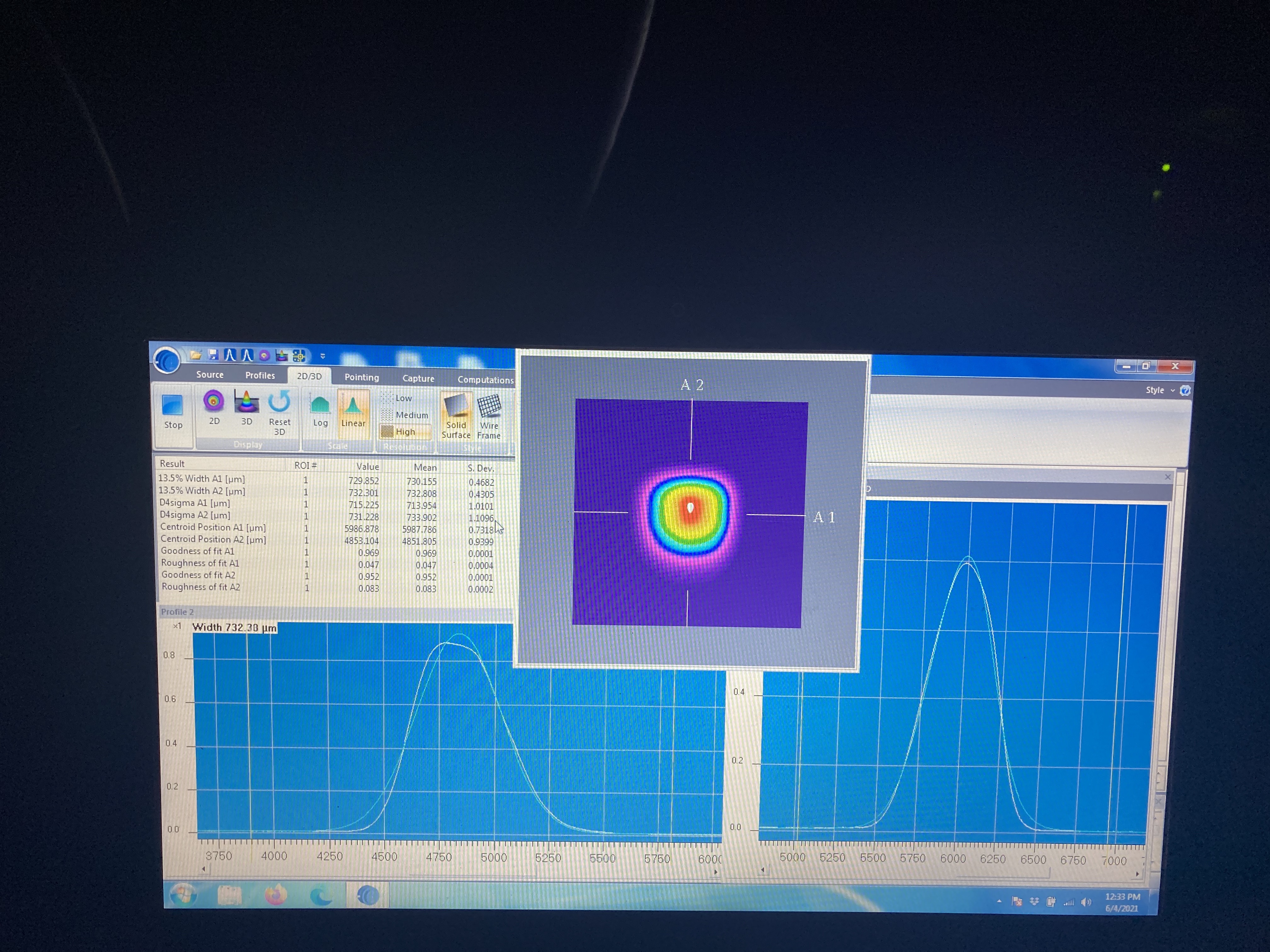
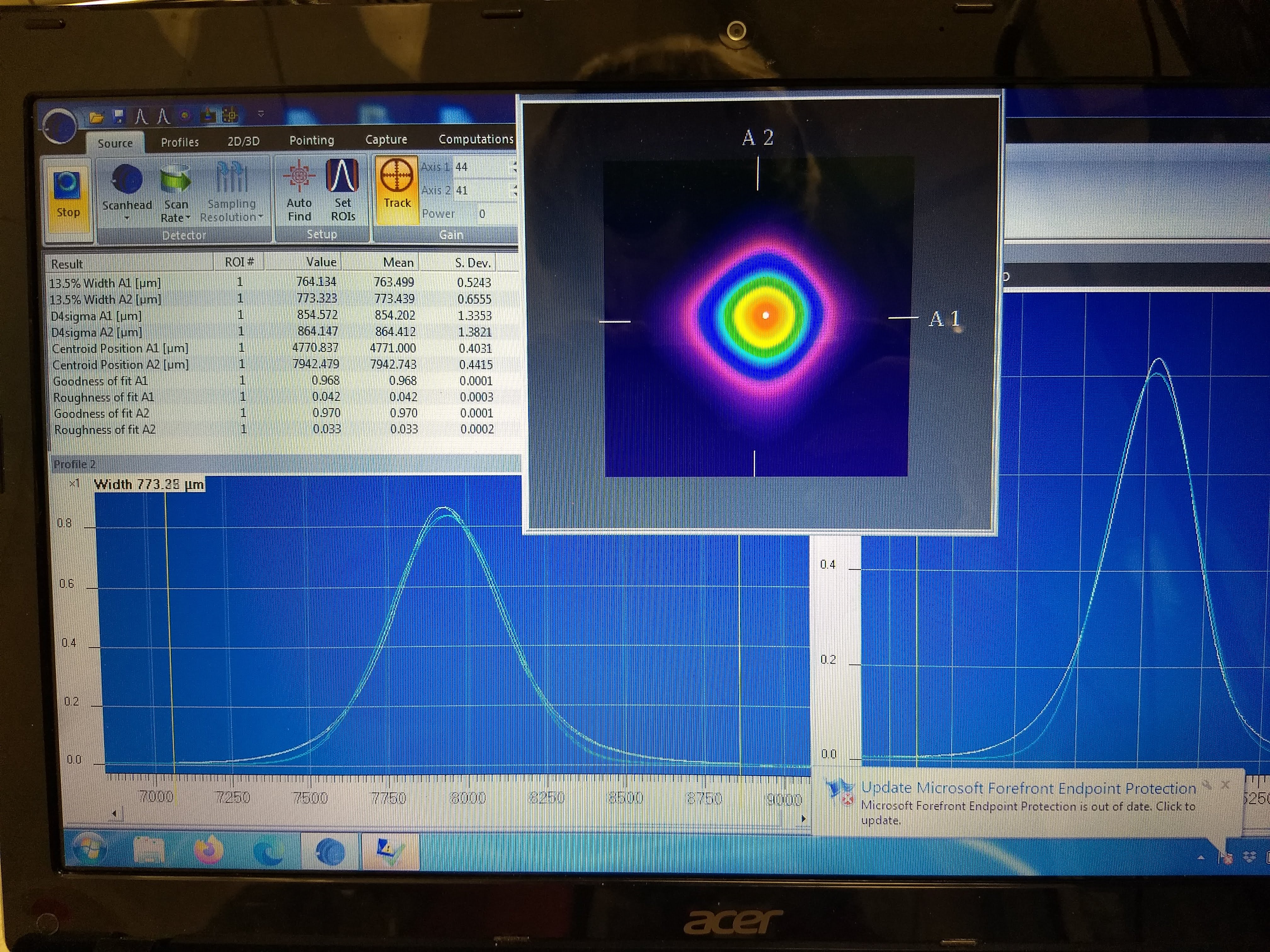
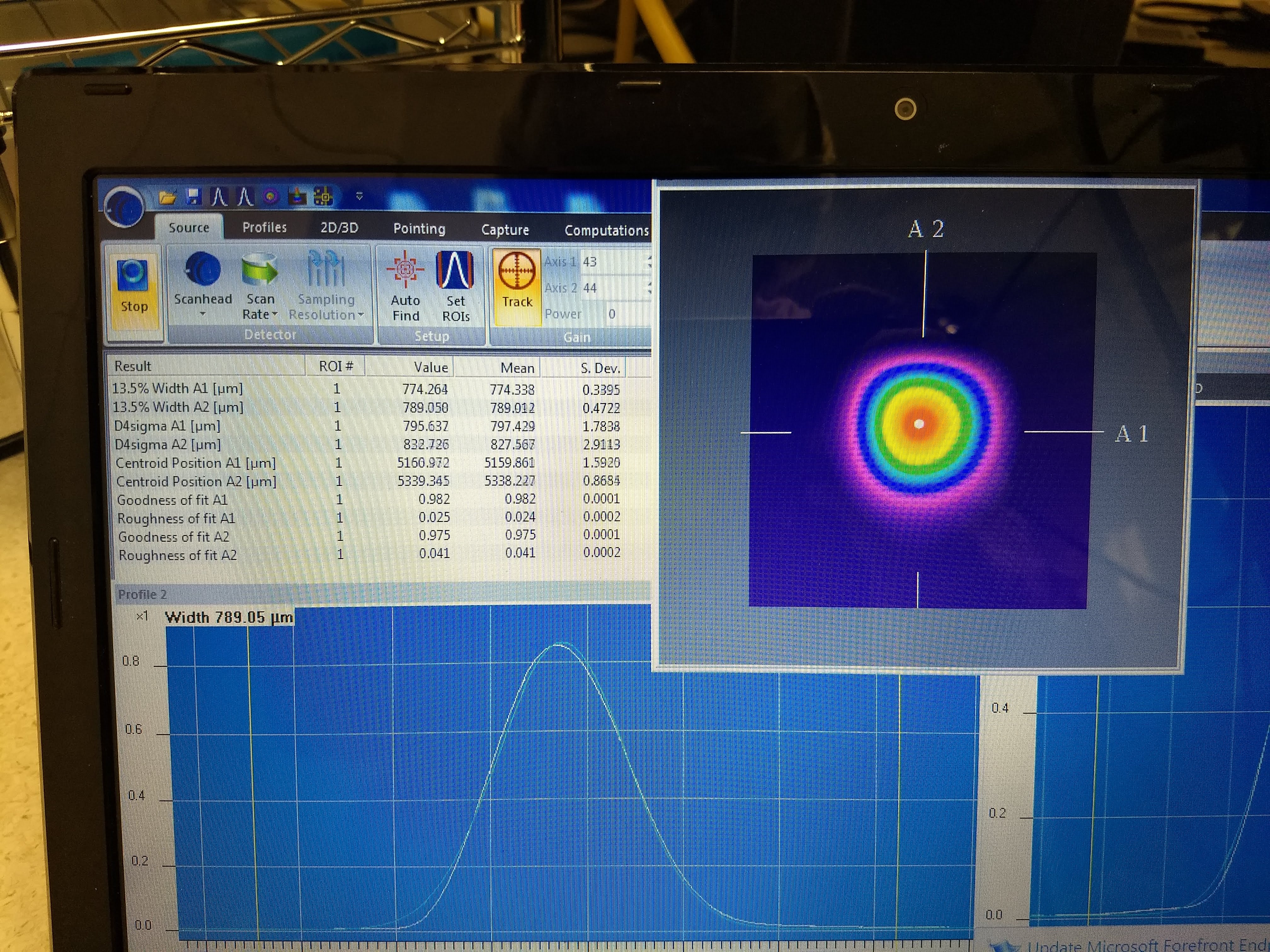
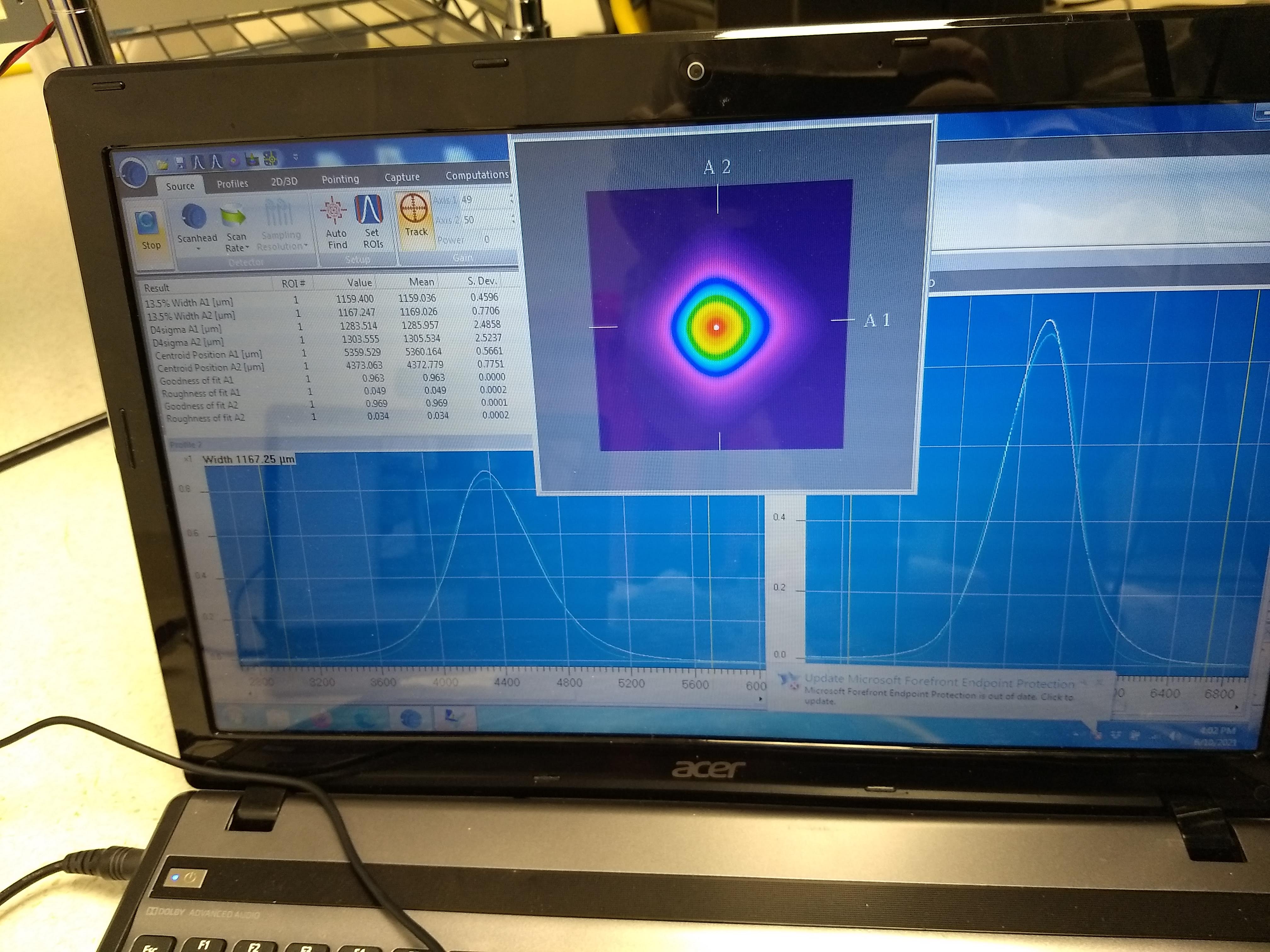
The beam going to the TRANS PD matches roughly what we expect with the uncoated laser window we now have as BS1. Here is a photo showing the power Keita and Jason were getting after swapping in the laser from yesterday (in the lower left plot).
There was approx 0.03 on TRANS PD. Previously with a HR mirror in place of BS1 we had ~ 3 on TRANS PD (see lower left plot on ndscope).
Keita did a calculation of the rough power reflected from BS1, assuming an AOI of both 40 degrees or 35 degrees (AOI should be around 39 degrees according to layout).
rp=tan(theta-phi)/tan(theta+phi)
theta is the AOI and phi is the angle of refraction,
phi = asin(sin(theta)/n),
n=1.4496 for fused silica at 1064nm.
rp(theta=40deg)^2 = 1.14%
rp(theta=35deg)^2 = 1.63%
This means that the beam is likely not clipping on the TRANS PD as the power on it seems to have scaled as we expect with the laser window installation.
To double check this and provide a calibration for this PD we did some power meter measurements in chamber.
We measured the output from the input side curved mirror of the JAC (Te2), with the PSL set to 1W output using the rotation stage (otherwise it is hard to see this beam on the card).
JAC Te2 = 2.7 mW
JACT_BS1 transmitted beam = 2.4 mW
JAC TRANS PD beam = 37 microW
This leaves us with 0.263 mW unaccounted for in transmission, this puzzles me.
We put the power out of the PSL down to 100 mW to measure the input power and output power in HAM1.
JAC input power = 115 mW
HAM2 input power/after HAM1 output periscope= 96mW
ALS BEAM CHECK
Jason opened the light pipe and checked that beam does not intersect anything int he new installed path before reaching its SM that directs it towards ISCT1.
We installed JM1, balanced it and aligned it. A beam dump was placed behind it though we could not see the transmission with 1W input.
After this, JAC locked with RF without any problem though the input was wobbly when the purge was up.
We searched for unexpected ghost beams (also with 1W input) and didn't find any.
We uninstalled many (but not all) temporary dog clamps and irises.
We revisited the IMC alignment because it's been off in PIT since Thursday or Friday. We locked JAC using dither (because we wanted to turn down the purge air). We enabled the IMC WFS just for MC optics and steered JM3, but weren't able to center the MC2 trans. Steering JM3 just made the IMC transmission worse while making not much impact on the desired degree of freedon (JM3 PIT -> MC2 trans YAW, JAM3 YAW -> MC2 trans PIT).
Tomorrow, we'll revisit the IMC alignment. We'll also measure the power coming into JAC TRANS PD as well as the actual transmission of JAC while locking it with RF so we can use JAC trans PD as the measure of the power into HAM1.
Modulation index measurement for 45M and 9M, they're healthy.
1W into JAC, no WFS for IMC, ITMY single bounce. Scanned OMC with both 45MHz minimal power (~4dBm) and 9MHz full (~27dBm), then both in full power, then only 45MHz in full (see screen shot).
Jennie will post the modulation index later, but the peaks look healthy to me.
The alignment into IMC was rather off in PIT and the guardian had a hard time locking IMC (I changed the lock threshold in the guardian). We didn't move MC, didn't bother to do any thorough investigation, but either JAC or MC mirrors moved. Maybe we have to lock IMC, use WFS for MC, and steer JM3 and see if the MC mirrors will be driven far from where they are. If they are we might have to touch up in-chamber alignment again.
JAC TRANS BS was swapped with the real one (laser window with AR only on one surface).
We replaced the JAC TRANS BS (which was a temporary high reflector until today) with the real one that is just a bare glass (the reflectivity is 7% or so depending on AOI).
We locked JAC with RF, was able to see the beam coming to the TRANS PD but wasn't able to see the reflection of PD, so we raised the power to 1W.
Initially the beam was missing the PD because the new optic is thinner than the temporary one. We realigned the optic to steer the beam back to PD. Since we could not directly see the PD surface, we just steered the beam up and down, left and right until the PD output starts to drop, and put the beam roughly in the middle.
We were able to see the PD reflection using an IR card and an IR viewer. There were two reflection blobs (which was the case before, too), and I moved the JAC TRANS BD in +X direction by 1/4~3/8" to catch both.
See results here (alolg #89230).
Beam dump for HAM1-HAM2 septum window AR reflection.
This was installed.
Beam dump for the -Y door viewport reflection.
Jason and Betsy installed it. There seems to be a discussion as to whether or not something else needs to be done.
EOM and JAC power budget again.
We measured the power at various places. While Jason held the power meter head still, I ran the statistics function of the power meter for a few seconds. I only list the mean and the standard deviation.
Wrong pol is king of large, ~0.2% of the main beam power coming out of EOM. That's 200mW when 100W goes through the EOM.
JAC throughput of 92% is not great, but Jason says the alignment and the matching are not really optimised.
| JAC input | 112mW+-462uW | |
| EOM input = JAC output | 103mW+-6.3mW |
JAC OUT/IN = 0.92+-0.06 |
| EOM front AR reflection | 57uW+-4.4uW |
EOM AR/IN = (5.5+0.5)*1e-4 |
| EOM output (including the wrong pol beam) | 96.9mW+-1.4mW | |
| EOM wrong pol beam | 226uW+-17uW |
EOM wrong pol/IN = (2.2+-0.2)*1e-3 |
| EOM main pol (= out total - wrong pol) | 96.7mW +-1.4mW |
EOM main pol/IN = .9978+-2e-4 |
Afternoon work, REFL path aligned, RF lock works (Jennie, Jason, Betsy, Daniel, Keita)
It seemed as if what was supposed to be TFP after HWP was not really TFP, it was temporarily set aside.
REFL path to the JAC REFL RFPD was aligned without TFP. 100mW into JAC was enough to see the REFL beam there.
DC responded as expected.
There was a confusion about which demod chassis was used for JAC, which was sorted out by Daniel who subsequently set the demod phase. I zero-ed the dark offset.
I copied the JAC lock filter from dither path to JAC-L_SERVO path, locked JAC with dither, disabled the input to the dither servo and enabled RF locking in parallel, which worked just fine. I made rough changes to the RF servo to bump up the UGF to ~400Hz without too much gain peaking, I haven't tried anything aggressive to squash the residual motion below 200Hz, you might want to tweak it further.
I didn't disable the dither itself for the JAC PZT so we can compare the spectrum of RF and dither side by side. See attached, this was measured with 100mW into JAC, note that the dither error signal is scaled. References are with the purge air on and current traces are with the purge air completely turned down.
Guardian needs to be changed to allow smooth locking with RF.
We locked JAC with 1W input to find ghost beams. Details will come after we're done with the septum window reflection, but anyway here is the list:
None of the new beam dumps are interfering with the main beam and JAC refl/trans.
We refined the alignment from JAC to IMC by iterating small amount between JM2 and JM3. It was hard due to purge air and the suspended JM3, instead of relying on the IMC scan and minimize 1st order modes, we locked IMC and minimized the IMC REFL DC on average. After that the beam was still centered on JM3 well.
We closed the chamber and turned down the purge all the way and the alignment was indeed good. There was almost no 01 (PIT) mode power, 10 (YAW) mode power was less than 1% of 00 mode power, and the 20/02 mode power was 0.23 to 0.24%. See MM.png.
(To identify which mode is what, I intentionally misaligned JM3 in YAW (that causes PIT misalignment for IMC. See mode_identification.png.)
This morning we have pushed the JAC EOM by about 0.6mm (using ~25 thou thick washers) in -Y direction, following the finding of last Friday (alog 89158).
After that the beam was good on the input side plate (the beam is offset in +Y direction by 0.1mm) and was OK on the output side plate (0.5mm offset in -Y direction).
The beam position on the crystal itself should be ~0.13mm in +Y direction on the input face and ~0.36mm in +Y direction on the output face. The angle between the nominal path and the actual path outside of the crystal is about 0.6 degrees. See pictures and cartoon.
Calculation depends on the refractive index, I assumed n~1+deflection/wedge=1+2.35/2.85~1.85, but using 1.85+-0.5 instead won't change anything in a meaningful manner.
This is acceptable, the beam is more than 1.5mm away from the side face of the crystal, cannot remember the beam radius but it should be smaller than 600um if FDR is still valid, so it might be 2.5 beam radius or maybe more.
IFO REFL beam check was done.
After Jennie restored the IMC alignment to post-IMC axes check state, IMC was locked, PRM was alignmed and the IFO refl beam in HAM1 was quickly checked to see if the REFL air path somehow interferes with the new POP periscope stiffener. It didn't.
JM3 swap is ongoing.
Partly in the interest of time, I asked others to go ahead. Rahul and the team are working on it right now.
Yet to be done items:
I calculated the mode-matching before we replaced JM3 and got a limit of 0.26 % for the mode-mismatch as the TM20 mode was hidden in the noise at 100mW input power. We turned up the whitening gain to 42 dB from 30dB to have a better chance and still couldn't see it.
This plot shows the zoomed out ndscope of the TM00 modes and this one shows the max value for TM20.
After JM3 was installed and its position, pitch and yaw had been tuned by Rahul and Betsy to optimise the pointing through our HAM1 irises, Keita, Jenne and I tried to tweak up the alignment with JM3 sliders.
I have left the sliders near here and could not get them much better.
I measure the mode-matching to be 0.43 % with this alignment which is worse by at least a factor of two.
See photo of TM20 mode here.
The 10 and 01 modes are much higher than they were previously, so we will need to do some alignment of the fixed JM2 or JAC_M3 mirrors.
Note for the MM measurement we were accidentally scanning with the MC2 length and the PSL laser frequency so this might make the measurement confusing.
I closed the light pipe and turned up the purge air before going home.
Let me point out that the term “mode matching” used in Jennie’s post is not exactly accurate in this case; it would be more precise to refer to it as the TEM20/02 mode peak fraction. Since there is a large misalignment, the second-order modes are also enhanced. Therefore, that contribution should be subtracted before attributing the remaining fraction to mode mismatch.
T. Sanchez, J. Oberling
This afternoon we took a look at the JAC Refl path and positioning of IOT1. We ended up pushing IOT1 in the +X direction by ~1"; new marks were made on the floor to represent this position.
From here we used JACR-M1 and JACR-M2 to align the beam through the viewport simulator and onto the top periscope mirror of IOT1. This only took a couple of iterations before things looked mostly OK. The beam is currently a little low in the viewport simulator, maybe 0.5" to 1" (rough measurement by eye) and is hitting the top periscope mirror. We finished by measuring the beam height at 2 places on the ISI table roughly 28" apart, to give us an idea of how the beam is pitched.
This seems OK for now, but on some reflection while sitting in my office typing this alog we may want to briefly revisit this. The beam is slightly pitched down and is high on JACR-M2 (~0.5" on a 2" diameter optic), so I think there is some room to improve this, to get the beam closer to center on JACR-M2 while still passing through the viewport simulator and onto the top periscope mirror of IOT1. More to come.
Following alog 89115, we found that the old batch crystal from that alog (S/N10252003) had a big chip at one corner. It is pretty bad we don't want to use that.
Betsy found another old batch (S/N10252007, "inspected 12/21/11" and UF tag dated 4/21/09), so we A-B-ed that one with the spare new batch (S/N B1913108).
The beam path was made as level as possible at 3" height using a beam leveling tool (a black metal thing with a tiny aperture at each inch of height).
We put the crystal on a platform that is roughly 2" 29/32 (which is about 2.4mm lower than 3"). The crystal is 4x4x40mm so that's about the right height.
We spent some time to make YAW alignment as good as we can for each of the crystals.
We scanned the beam in PIT from top to bottom (or bottom to top), each extreme is where the beam is almost clipped (but not actually clipped) by the top or the bottom face of the crystal.
Look at the attached, the new batch (left column) clearly shows multiple beams even though the focus is not as sharp as the old batch photos. As we misalign in PIT, the dark place moves relative to the main beam and the contrast changes too, but multiple ghost never went away. At the extrema (very close to the top or bottom edge) it looked as if the beam is better but I'm not sure it actually was.
The old batch (right) didn't show such a behavior. The beam shows something like a diffraction pattern but no separate ghost beams. Everything moved with the main beam. Not sure if the diffraction pattern came from the aluminum surface or EOM, but clearly this is MUCH better than the new batch.
Note, due to the apparatus (the steering mirror is 20" upstream of the EOM), we haven't searched in a huge PIT angle space, it's actually roughly +-4mrad or so, the angle is not negligible but it's more parallel displacement scan than an angle scan.
Also note, when the crystal was put in place it seems that there's some vertical deflection which was different for the old and the new. On the top two pictures, there's no change in the input alignment into the crystal.
Based on this observation, I'd say using the old batch makes sense. LHO people (Jennie, Rahul, Betsy and myself) had a brief conversation with Masayuki and MichaelL and we all agreed that that's the way to go.
Attached is the picture of the chip on the spare "older" crystal S/N10252003 The other picture shows the box labels of the EOM crystals and stat at LHO, namely: 10252003 chipped 10252007 to be swapped into the JAC EOM 2 newer ones which are having some scatter issues as Keita has written about
It took much longer than expected but we set up the beam path for the RTP test in the OSB optics lab.
Since more power makes it easier to see the ghost beams, I removed the beam dump that used to receive most of the red power (~530mW) and directed the beam to the front of the table (red path in the attached). I stole the steering mirror that used to be used for the low power P-pol path (circled in red). The low power p-pol path is now simply blocked. No other change was made to low power S-pol path (orange) as well as green path (green), but the beams are blocked by beam dumps. If you want to use these, simply unblock.
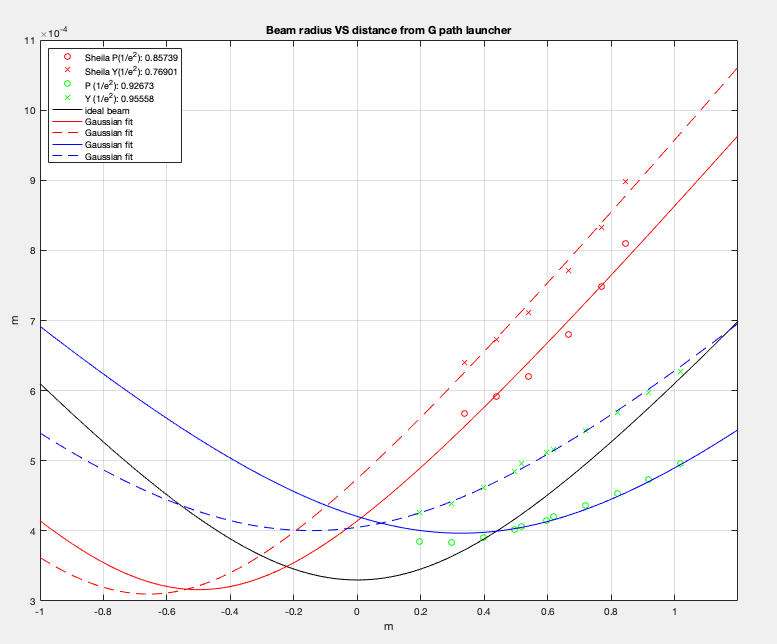
The beam radius will be 300~400 um or so at the location we plan to put the RTP (represented by a green rectangle in the second attachment). Elenna will post the plot of the beam size measurement.
The third picture shows the containers for different RTP. Left is the one for the crystal in HAM1. The middle seems to be from the same batch. Right looks different, on the bottom of the container there's a label saying "I/O something something 2017" so this is likely the old one.
We didn't have time to actually test the crystals, wait for tomorrow's udpate.
I made a mistake when providing calculations to Keita about the beam profile- I incorrectly input our distances as mm instead of cm. However, I think it's ok overall.
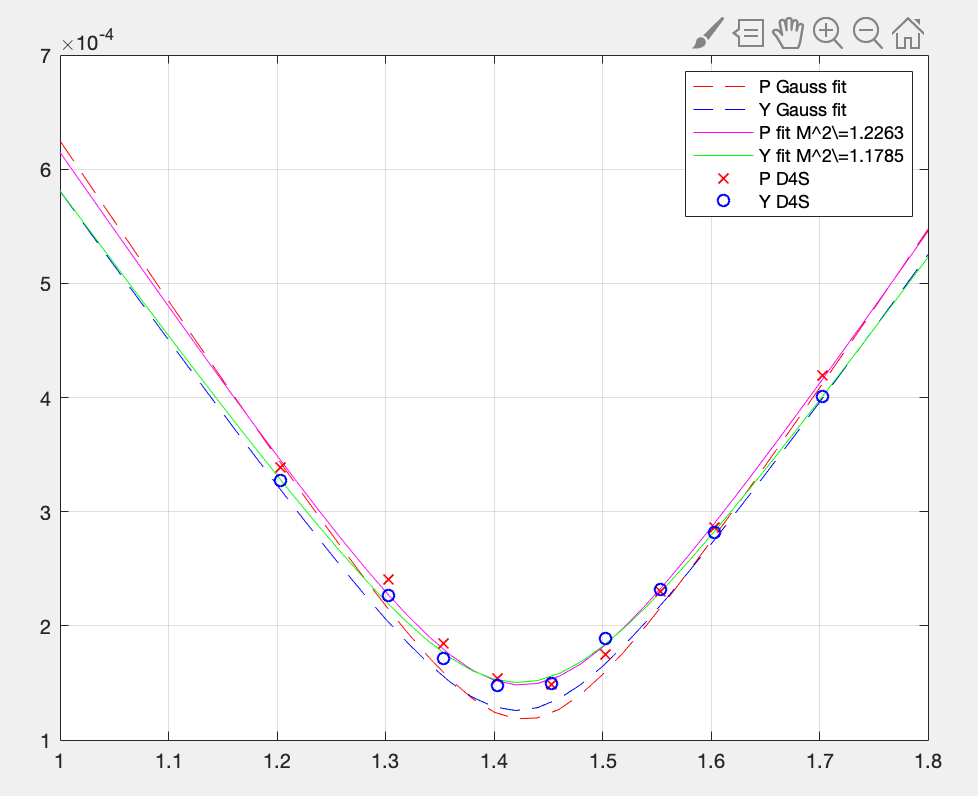
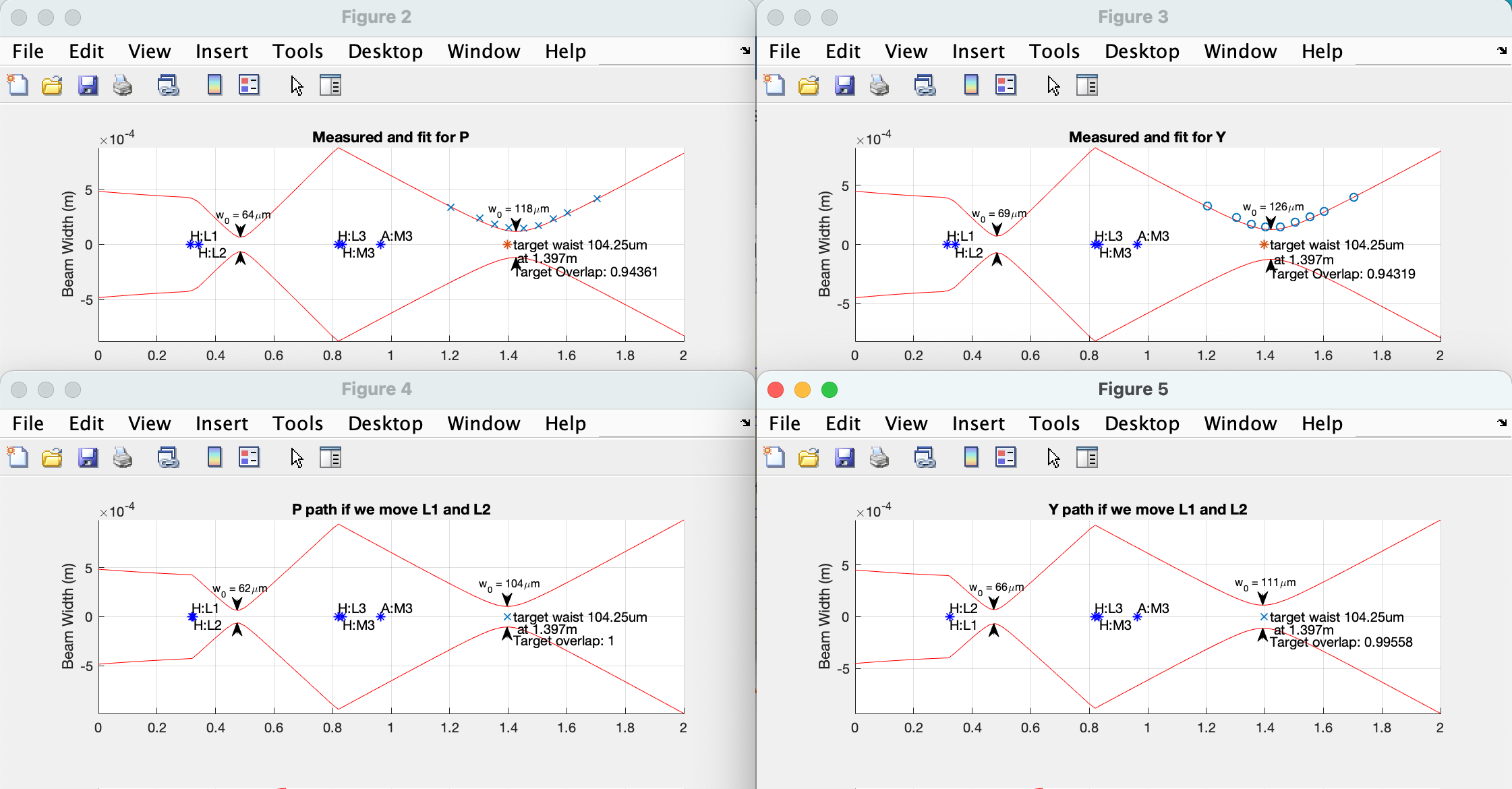
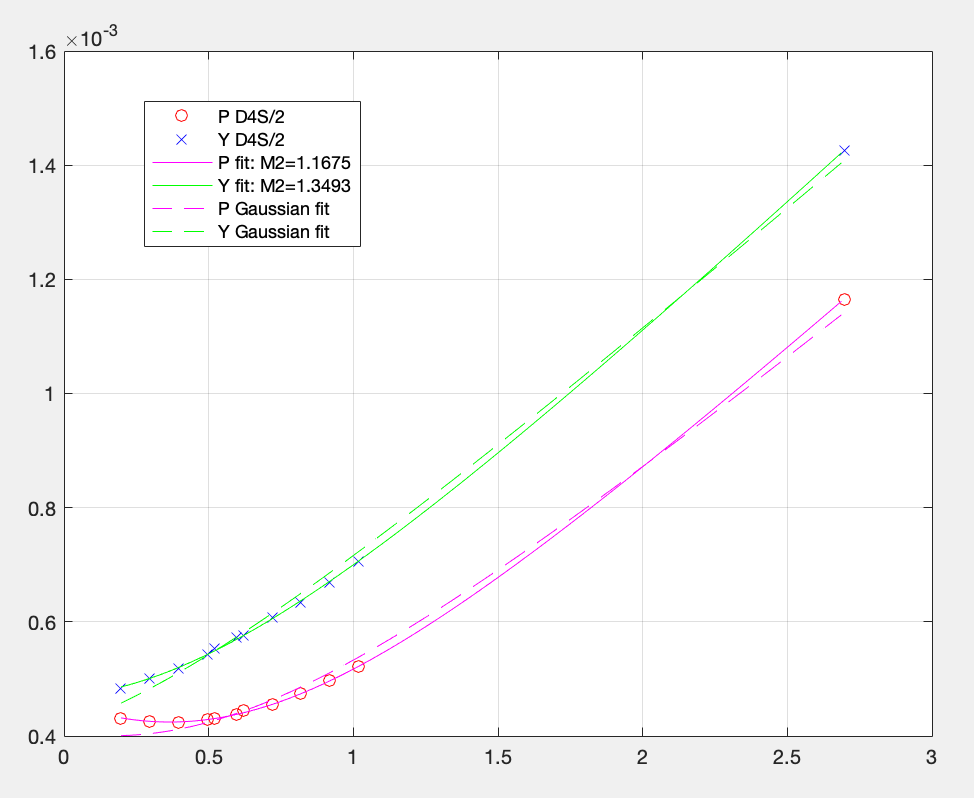
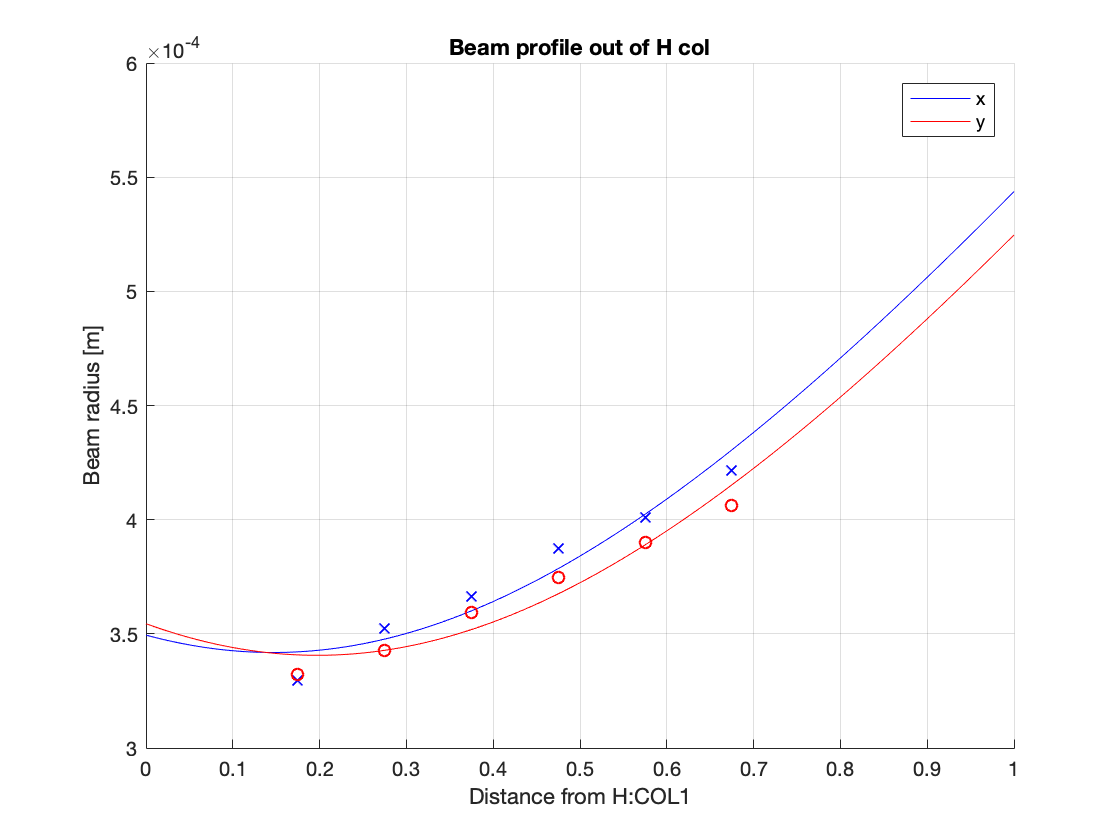
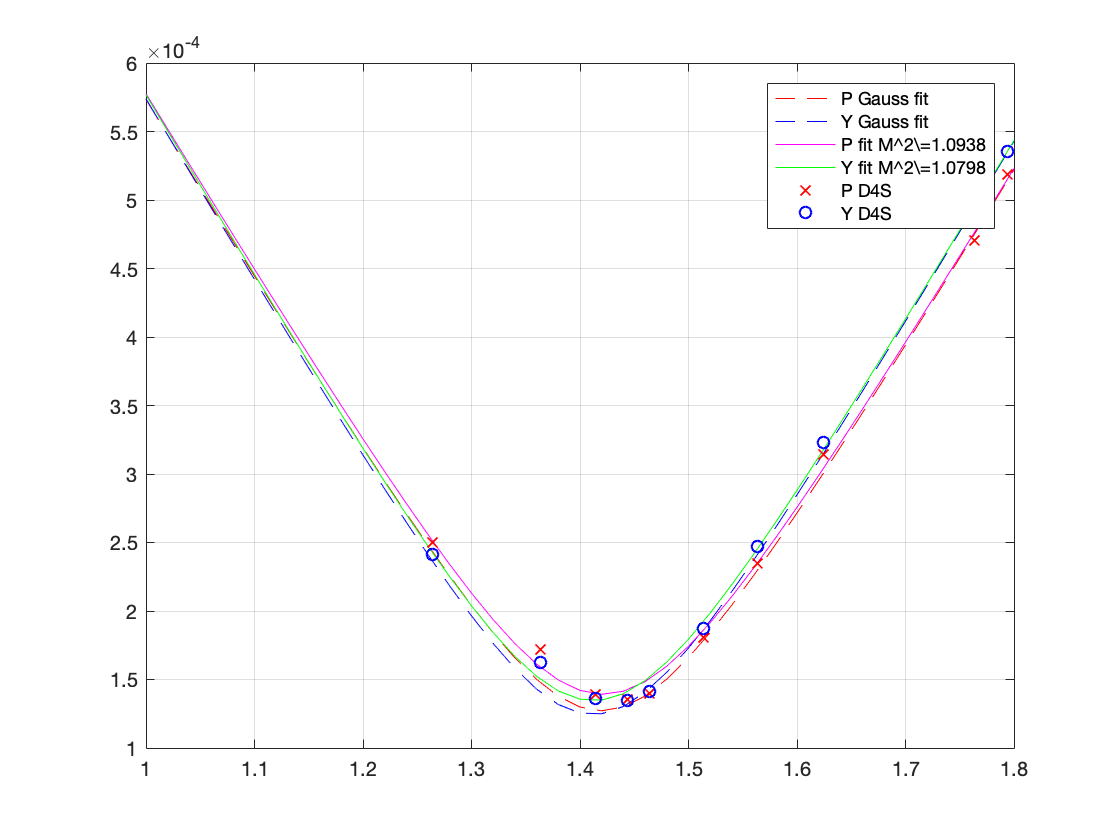
Keita and I put an available lens (f = 286.5 mm) into the beam path, and then used a thorlabs profiler on a rail to profile the resulting beam at five points. We measured distances from the lens to the profiler and accounted for the set back of our profiler from the edge of the mount, etc. This measurement allowed us to measure that the beam waist is roughly around the location of the laser, and is about 130 um in the x direction and 202 um in the y direction. Unfortunately, the beam quality isn't great, this is the best we could do. (Note, because of my mistake we chose not to use this particular lens, but it probably would have been fine for our measurements after all).
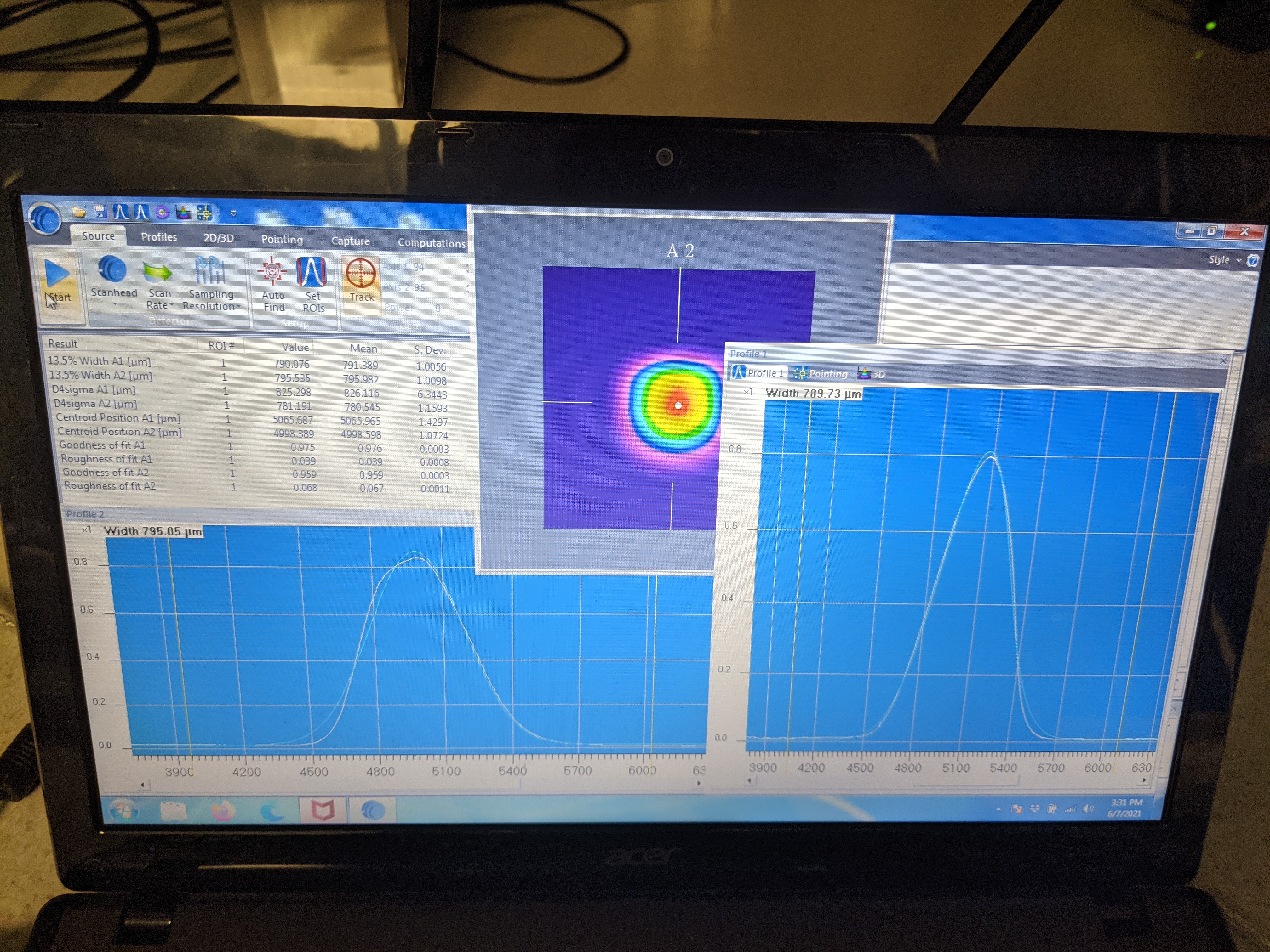
After some iteration, we determined that a f=401 mm lens was suitable, and we ended up placing it pretty close to the original lens location. We ran another profile measurement and found that we could achieve a beamsize of about 313 um in the y direction and 251 um in the x direction (different than Keita's reported numbers above because I originally fit an incorrect seed waist).
I have attached two plots. The first shows the profile of the beam with the original lens, and the second with the resulting lens that we have now used to measure the EOM crystal.
So, the beam is maybe a bit smaller than the beamsize on HAM1 that goes into the EOM crystal (around 350 um).
Jennie W, Jason O, Keita K.
As reported in this alog (#89073) from Masayuki and Keita, after we turned the power in HAM1 up to 1W we found a series of vertically spread ghost beams aroubnd the main beam after the EOM and before JM3.
These could not be removed by translating, yawing or pitching the EOM position relative to the beam. It was decided in a larger meeting with EOM design personnel that we would first check if the crystal was cracked or damaged anywhere in case this is the cause.
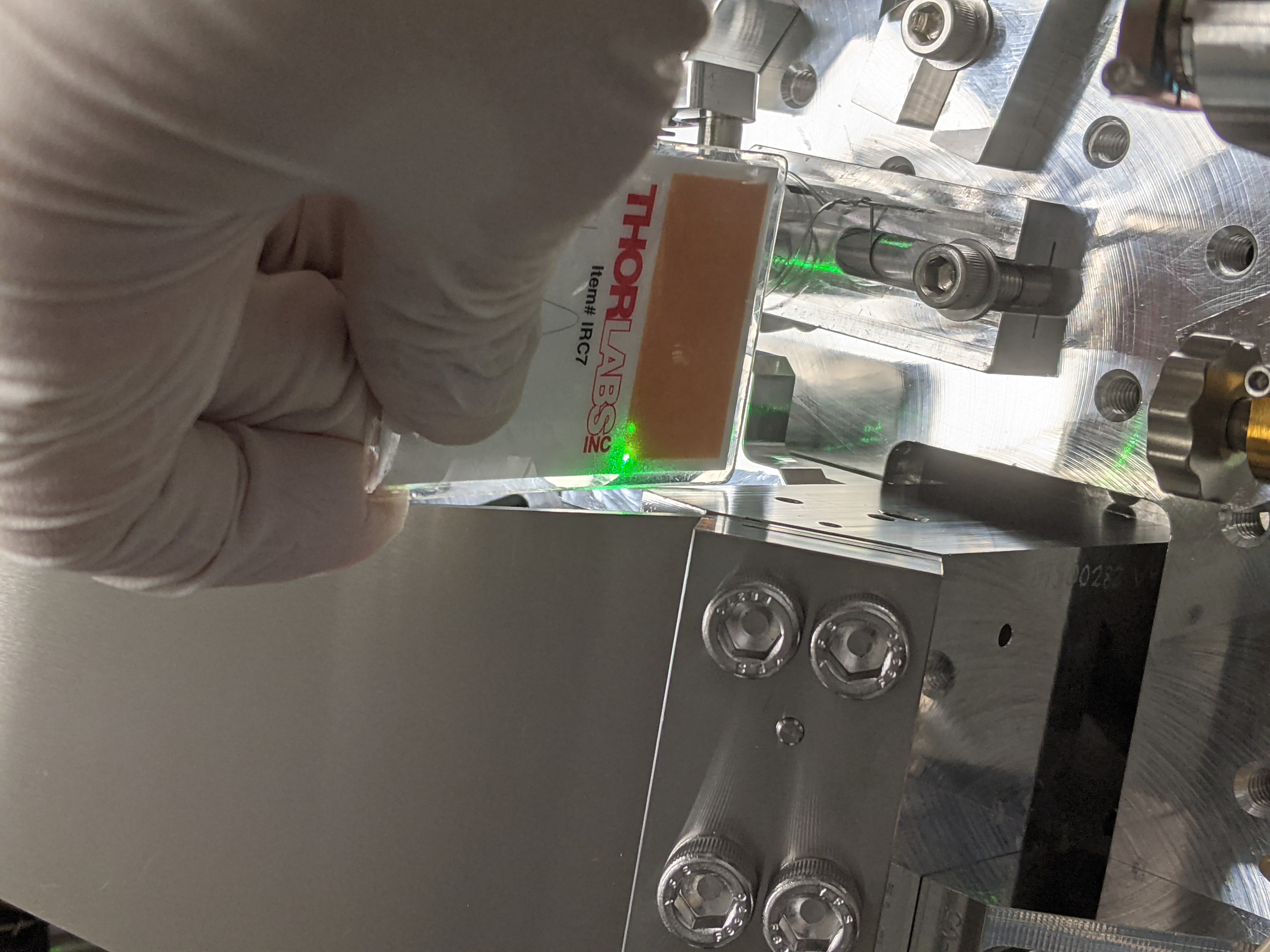
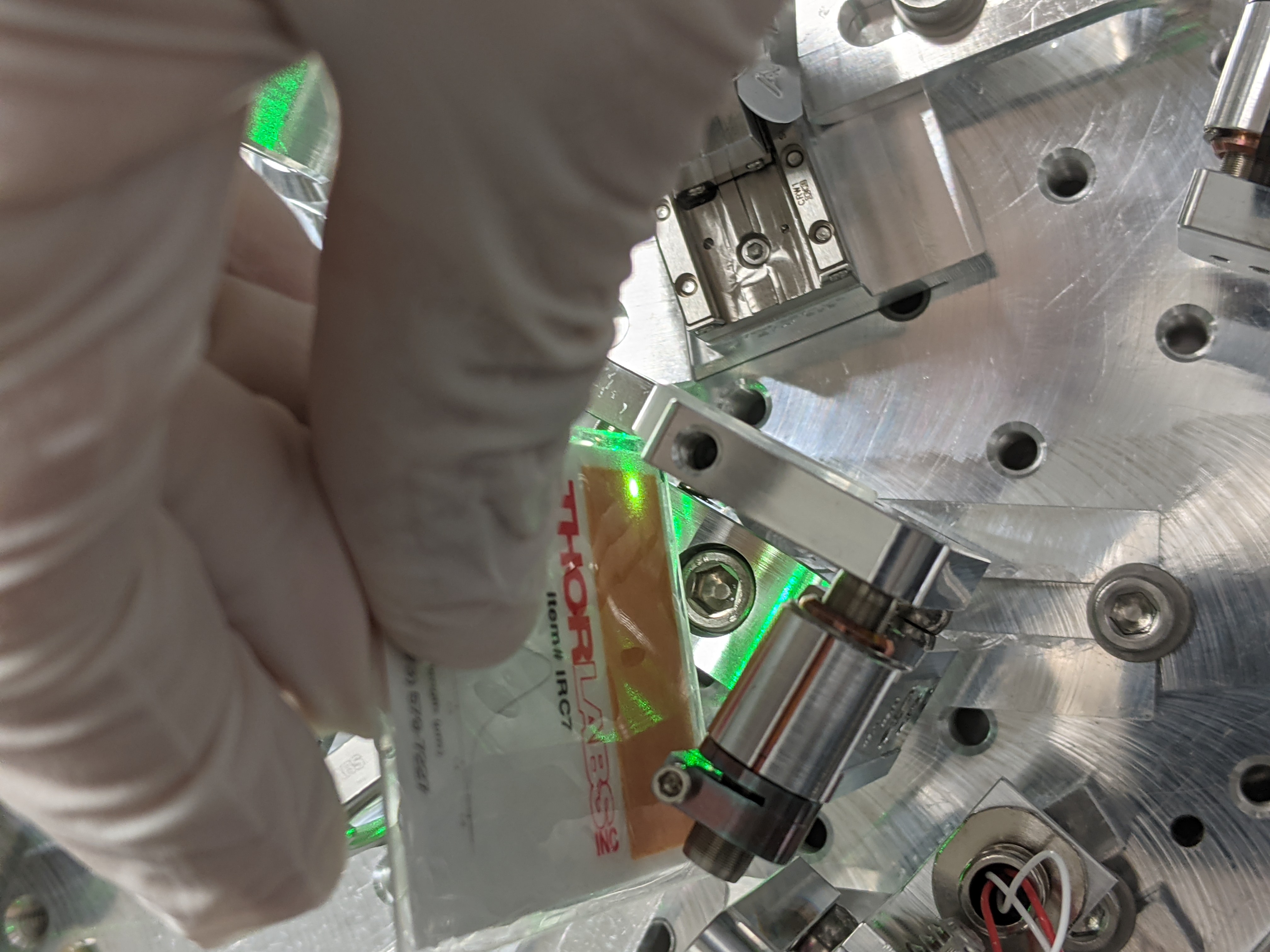
First photo shows the EOM from above, using a green torch to illuminate the beam path. I can't see any scatter from defects or cracks in the crystal.
Second photo shows possibly a chip at the corner, but this should not affect the beam as its right at the edge.
Third and fourth show side view with illumination from the top at an angle.
In summary we did not see any 'smoking gun' to cause these ghost beams.
Very rough power estimate for the ghost beam(s) is ~O(1%)
Jennie and Jason set up another temporary iris between JM2 and JM3, centered it with 1W into HAM1 to carefully block the ghost beams without blocking the main beam, then changed the power to 100mW (for safety) and measured the power at various places. Measurement accuracy cannot be great (Jennie and Jason says the numbers were jumping around as it was difficult to hold the power meter head at a fixed position mid-air) but I would say the power in the ghost beams is ~O(1%).
| JAC out | ~105mW |
| Between JM2 and the iris (includes wrong-pol beam) | 104~105mW |
| After the iris (wrong pol as well as ghosts blocked) | 99~100mW |
| Wrong-pol beam | 1~3mW |
| Background light (no beam) | 1~2uW |
Where do they go?
After opening the temporary iris that we just put in all the way, the iris just downstream of JM3 was already blocking some of the ghost beams as well as the wrong polarization beam (JM3iris.jpg). Vertical beams don't look vertical because the iris is not a flat plane and we have a large parallax here. Anyway, it seems that we can block further if we want to from the top and the bottom.
The picture of the last iris on HAM1 shows that something is blocked on the left (+Y) side (outputiris.jpg). Looks like the iris is clipping something on the right but the camera couldn't be positioned to have a good view for both sides.
The last picture (after_last_iris.jpg) shows the beam right after the last iris on HAM1. You can see that some ghost beams are still coming through.
With this beam injected into HAM2 and misaligning MC2, we looked into IOT2L to see the MC REFL beam. We weren't able to find ghost beams there, though Jason and I felt that the beam is not super clean.
One question Jason had was whether or not the diverging beams that originate from the EOM location are supposed to keep diverging after lenses.
The beam after the second lens is actually not diverging. According to this plot, we suppose to be able to find the splitted beams in the IOT2 table.
EPO taggin'.
Summary of investigation into the vertically split beam from the EOM
First, we confirmed that the vertical beam splitting observed yesterday originates from the EOM itself. To check the possibility of multiple reflections from lenses, we inspected the back-reflection port of the JAC output mirror. Two reflected beams were observed, most likely originating from the planar and curved surfaces of the lens, and they were mainly separated in yaw. Since the space between the EOM and the lens was blocked during this test, these reflections were conclusively identified as lens reflections. No vertically split beams were observed from this source.
A knife-edge–like test was performed by slowly lowering a metal ruler from the top at both the EOM input and output. At the EOM input, the entire beam disappeared simultaneously, whereas at the output the beam disappeared gradually from the top. This behavior confirmed that the vertical splitting is generated inside the EOM.
To accurately determine the beam positions at the EOM input and output, beam positions were measured from photographs. Taking refraction and geometry into account, it was found that the beam is slightly displaced in the horizontal direction. Details of this analysis will be documented in Keita’s alog.
Based on this result, the EOM was rotated in yaw. Dog clamps were placed at the ±y projection points of the EOM input and output, in contact with the base plate. One 0.5-mm shim was inserted between the base plate and each dog clamp to rotate the EOM counterclockwise. However, the beam pattern did not change. Additional shims were tested, but no significant change was observed. The EOM was fixed with one 0.5-mm shim at each position.
Next, pitch adjustments were explored. The original shim configuration (two shims on the +y side and one on the −y side) was changed by moving shims to the +x side (one location at center) and the −x side (two locations, upper and lower). Each location initially had two shims, and by adding or removing shims, it was observed that the vertical positions of the split beams changed. When the +x (downstream) side was raised, the vertically split beams appeared in the upper part of the beam profile (approximately 5–7 beams; Keita will upload photos). Conversely, when shims were added to raise the −x side, the split beams moved toward the lower part of the beam. With the downstream side lowered by approximately 0.25 mm, about two beams were observed in the upper part and one in the lower part.
1W input power shows 6 or more beams, but 2-3 beams can be observed even with 100mW.
With the last configuration, we proceeded the IMC scan measurement after alignment. The 2nd order mode peak was the same level as we observed when we sim up the EOM first time.
In summary, the EOM shows highly questionable and nontrivial behavior. Possible causes include diffraction due to crystal defects or multiple reflections at the AR-coated surfaces. However, identifying the exact mechanism is challenging at this stage.
Horizontal beam position offset on the EOM input and output aperture on the side plates.
We realized that the nominal beam position on the EOM input and output aperture is NOT centered on the crystal cross section projected onto the side plate face, the beam is horizontally offset in +Y direction.
Look at the first cartoon (cartoon.jpg) and references therein. The beam spot offsets are 0.91mm on the input side plate and 0.54mm on the output side plate, respectively, assuming that the beam deflection angle per surface of EOM is 2.35 degrees as implied in D2500130.
0.91mm is not a small offset, it's almost 1/4 of the crystal thickness (it's 4x4x40mm).
This means that the beam should be (see nominal_sideplate.png, note that the drawing scale of the input aperture in this is twice that of the output aperture):
~3.9mm from the left (+Y) edge of the visual alignment aid notch on the input side plate,
~3.2mm from the right (again +Y) edge of the aperture hole on the output side plate.
Measurements, adjustments and measurements made the beam closer to the nominal location.
Based on the above knowledge, we took pictures of the beam position on the input/output aperture, paying attention to the errors that could arise from the parallax (which is unavoidable), i.e. the sensor card should be as close to the face of the side plate as possible and the beam spot on the sensor card should be as close to the sentor of the camera sensor as possible. This was a tougher job than you think.
Anyway, in the first round of measurements, we convinced ourselves that the beam was:
off in -Y direction by 0.7mm relative to the nominal beam position on the input plate of the EOM,
off in +Y direction by 0.5mm on the output,
give or take 0.2mm or so (the error is based on two pictures for the input beam position with random variation in parallax coming from camera position and the distance between the side plate surface and the viewer card).
We rotated the entire EOM base by using two dog clamps against the EOM base and inserting appropriate shims (EOM_rotation.png). We didn't use the YAW adjustment feature for the EOM pivot plate because there's no way to rotate it in a controlled manner.
After the first adjustment we thought that the beam coming out of the EOM looked better (which might have been false). On the second adjustment the beam looked the same or slightly worse (which might have been false) and we reverted back to the same position as the first adjustment.
Multiple beams mostly in PIT coming out of EOM (pictures and history)
1W into HAM1, otherwise it's hard to photograph these clearly.
The first picture is right after the YAW adjustment was made but before adjusting PIT. The card is held just ABOVE the main beam, you can see four blobs that look like some kind of ghost beams. (If you try to picture the main beam, it's so bright these ghosts become hard to capture.)
The second picture is after the first PIT adjustment. You can only see maybe two blobs, but later we found that the rest went below the main beam (sorry no "below" picture).
So, to recap the history of the beam quality,
Other things.
Just to make sure, we turned down the 9MHz and 45MHz RF power to 3dBm and disconnected the 118MHz and 24MHz cables and nothing changed.
We know that the crystal wedge is supposed to be horizontal and we know that the wedge orientation is correct. When we first installed the EOM in chamber, the EOM transmission was deflected horizontally in +Y direction.
Curoius thing about the EOM dimensions
Crystal length L=40mm, thickness T=4mm=L/10, wedge angle w=2.85 deg, and tan(2w) = 0.09981 ~ 1/10.
Though this is probably not related to the ghost beams in PIT direction, when the beam is perfectly aligned with the EOM (i.e. the light traveling the center of the crystal), the internal AR reflection of at the output face of the crystal hits the side of the crystal and the specular reflection will hit the input surface of the crystal and almost exactly comes back on top of the main beam with only 0.0272mm offset. See the 1st cartoon.
Note that the side surfaces are not polished (though the AOI is 84.3 deg so most of the power is reflected back into the crystal due to total internal reflection).
If you displace the beam in horizontal direction, the AR path is displaced in the opposite direction by about the same amount (i.e. if the main beam moves by 0.5mm toward the short face of the crystal, the AR-side-AR beam moves by about 0.5mm toward the long face). If you continue tracing the AR-side-AR beam, it turns out that the AR-side-AR-AR-side-AR beam will come back exactly on the main beam. See the 2nd cartoon (which is actually to scale, the main beam is off by 0.5mm and the 1st ghost is off by 0.5272 in the opposite direction, and the 2nd ghost is on top of the main beam).
Interesting design choice.
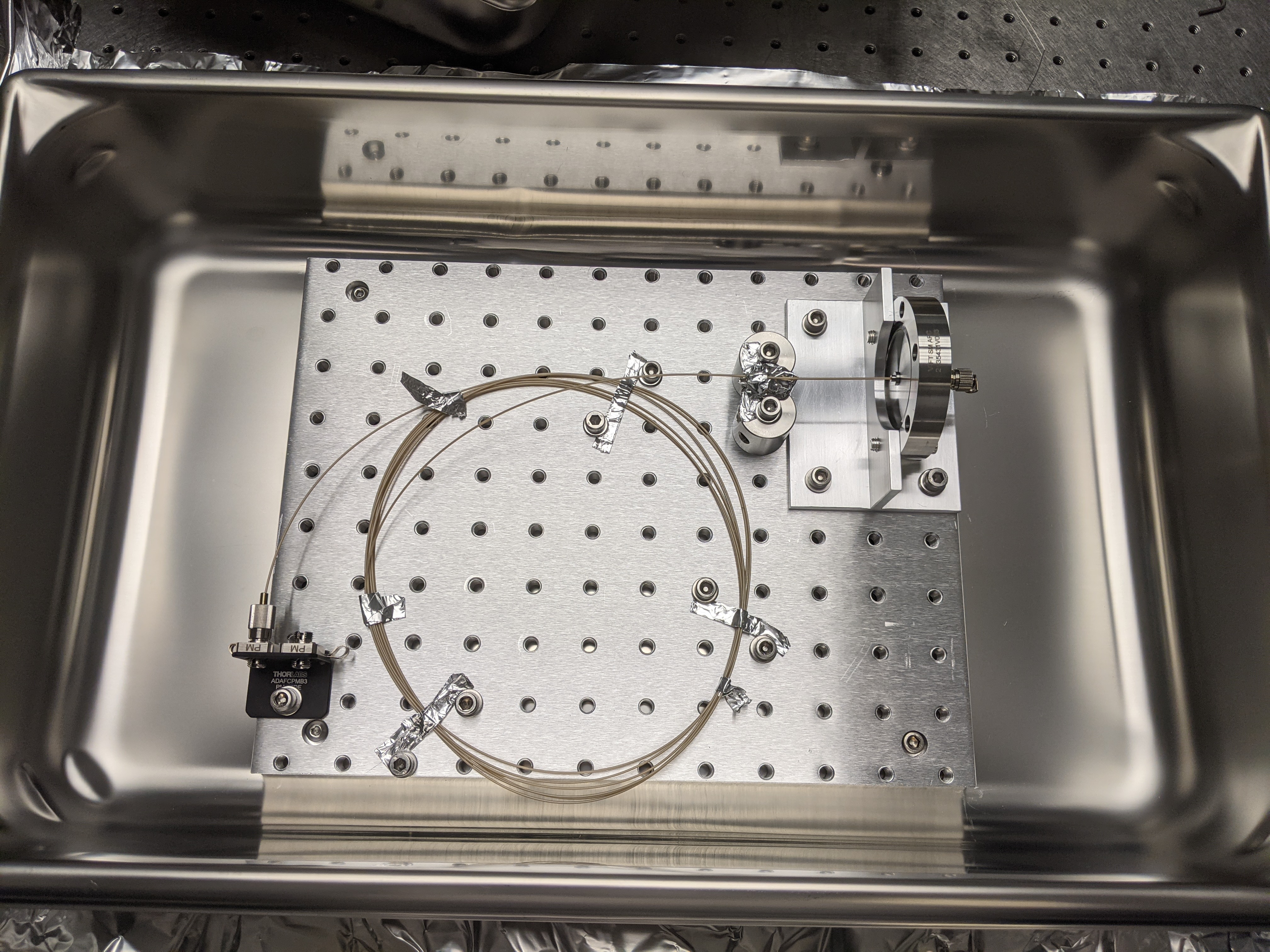
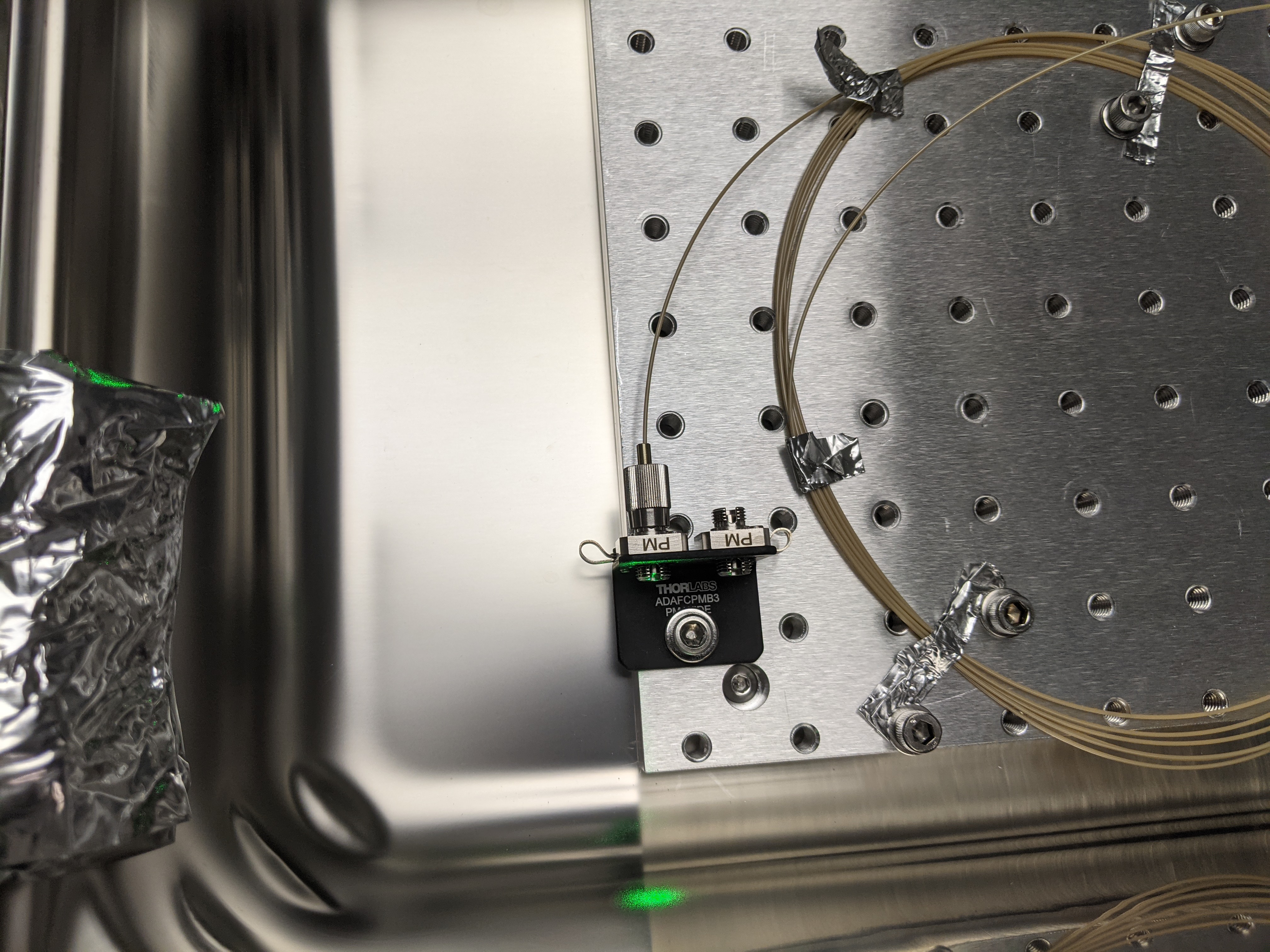
J. Kissel - D2500175 :: S3228003 . D2100573 . E2300345 - D2400281 I'm finally back in the optics lab, taking the next steps towards assembling the SPI. Specific to this entry -- I'm assembling the Class A clean components of the fiber-coupled seed laser light. In other words, I'm integrating (1) S3228003*** -- One of the 4.5" (inch) 1064nm V-FT Optical Fiber Feedthrough (Feedthru) Conflat Flange (DIAMOND) (D2500175) -- which includes the "off the shelf" (OTS) feedthru and integrated 3 [m] patch cord (the industry jargon for fiber optic cable), and its MIT-designed strain relief assembly D2100573 -- all delivered to LHO after class-A cleaning and assembly at Caltech per E2400159. (2) the ANU-designed Fiber Storage Spool assembly, D2400281, of which we have two. Sina characterized the power transmission of all three of the feedthrus at Stanford before the clean-n-bake process, and identified that S3228003 had 100% transmission, so I've chosen that to be assigned to the MEAS path, where we need the most input power (as it's distributed through the most number of beam splitters). I plan to further integrate the patch cord into the SuK fiber collimator S0272503 for no better reason that to "pair the S[...]03 feedthru with the S[...]03 fiber collimator." ***The serial numbers for the OTS feedthrus (D2500175) are of the alpha-numeric form 2153228V00n, where n = 1, 2, 3. That full version of the serial number is indicated in their ICS record, but in order to conform to the mold of the DCC S-numbers, I truncated the format to be numeric, S322800n, i.e. removing the identical leading 215 and misleading/unnecessary V character in the middle. Pictured here is - The pre-assembly components of the fiber storage spool (First) - The completed assembly of the spool with S3228003's patch cord wound up within it (Second and Third) The feedthru's patch cord still has a Thor Lab Narrow-Key Mating sleeve (but NOT polarization maintaining) ADAFCB3 that is not intended to be a part of the final assembly, just there for fiber storage during shipment. I'd yet to detach it in these pictures. Commentary: - Coiling the fiber within the spool was nerve racking. It feels like you're trying to coerce dry spaghetti into a curve without it snapping. If you let it go, it "sproings" into a wild relatively straight mess. In the end, holding it all mid-air with both hands, I used the weight of the mating sleeve to slowly pull the coil tighter as I rotated the coil nudging the rest of the coil into the newer smaller circle, until I met the radius of the storage spool. I had the goal of coiling it with one end "on top" and the other "on the bottom" of the stack, but I gave up on that. Once to the desired radius and no smaller, I used the securing cross, resting loosely across only 1/4 of the spool to hold the bulk of the coil of fiber in place while I tucked the rest of the length into the guiding channel. This is doable with a chair and patience in the open space of the optics lab, but I'm not looking forward to ding this in chamber. - Thinking through the install, my current plan is as follows :: WHAM3 D5 is currently a 12 inch blank with no 4.5 inch flange adapters. So it *needs* to be replaced by a 12 inch to 3x 4.5 inch flange adapter. So let's create the full 12 inch flange assembly with the 2x, MEAS and REF, fiber feedthroughs and 1x 4.5 blank -- and spool the fibers -- in the optics lab. Then we bring and install the whole 12 inch assembly on to HAM3 as a whole.
(Randy Thompson, Corey Gray)
In preparation for the upcoming Bigger BeamSplitter Suspension (BBSS) Installation at BSC2 in a few weeks (~midMarch), a new type of cleanroom infrastructure was needed too allow for more vertical space for the cartridge to be craned in/out of BSC2. Instead of using our standard large mobile cleanroom (which are used for HAM & BSC chamber work), a smaller clean space will be attached to the elevated work platform for BSC2. There will be a "cleanroom tent" on this platform (here's the platform [white] with 2-sets of 4 "tent poles") and a new array of (qty-4) HEPA Filters Fans (same type as the ones on top of the large mobile cleanrooms which blow down) will be on the side of this cleanroom tent to push air flow horizontally for this elevated workspace for the BBSS install.
Randy designed a unistrut framework for this 4-HEPA fan Array (weighs 377lbs). This morning this assembly was carefully craned into place on top of 3 unistrut brackets attached to the BSC work platform (in between BSC1 & BSC2). For added support, this afternoon, Randy added a "leg support" on both ends of this HEPA Filter Fan Array (here is a photo of one of these legs that is in the Beer Garden).
Note, the HEPA bank wall is intended to be moved from platform to platform when needed, so any interference of other areas due to them is somewhat temporary.
Details to follow.
EOM tuning results
It's worth noting that we haven't done any tuning after EOM was transported from the lab to HAM1. Frequencies changed a bit but nothing to worry about.
Below is a table of the dip frequencies and S11 coefficients when the EOM was placed in its final location. They aren't bad, 9 and 45 are as good as anybody can do.
(We also measured them when EOM was placed at the edge of the table, there were measurable differences but nothing disastrous.)
| nominal / measured center frequency [MHz] | measured S11 coeff [dB] at nominal / center frequency |
| 9.100230 / 9.1015282 | -21.96 / -22.29 |
| 24.078360 / 24.074976 | -25.84 / -26.74 |
| 45.501139 / 45.499614 | -23.19 / -23.15 |
| 118.30299 / 118.294670 | -25.29 / -26.0 |
Connection
FieldFox network analyzer was connected to the modulation patch panel at the bottom of PSL rack (which is kind of hard to find, see the first picture). Back of that panel is connected to the in-air cable that runs all the way to the vacuum feedthrough on HAM1.
By connecting 50 Ohm terminator to each in-vac cable, we confirmed from FieldFox that ISC_RF5-B1, B2, B3 and B4 correspond to 9, 45, 118 and 24MHz as specified in D1900511-v12 page 43 and 24.
Before connecting the cables to the EOM, we performed S11 calibration by connecting a short plug, 50 Ohm plug and nothing to the SMA connector of in-vac cables via class B SMA elbow.
After the EOM was relocated to its final location, RF sources were connected to the front of the patch panel.
RF levels of the signals directly coming from the 118MHz and 24MHz RF patch panel were: 10.76dBm for 118MHz, 14.2dBm for 24MHz according to FieldFox.
45MHz and 9MHz come from the EOM driver and I didn't bother to measure the power.
Other things
In three_persons_untangling.jpg, Jennie, Jason and Elena (left to right) are untangling JAC EOM cables together.
About the cable strain relief posts:
The four SMA cables were connected to the SMA elbow connectors on the EOM. The strain relief posts appear to be designed such that each cable is sandwiched between the two viton pieces, with one screw above and one screw below. I was a bit confused about how exactly to use the screws with hex nuts attached. I instead used the third bottom screw to loosen to slide the cable in, and then tighten. It was helpful to have someone else pinch the viton at the top while I tightened the screw. This is how it looks.
The two cables on the right hand side of the EOM mount feed straight through the strain relief into the SMA connection, this is fine. However, the placement of the post on the left hand side is a bit short of where the SMA connections are, so the cable bends a bit to make it through the strain relief post and go to the connector. This is tricky because the SMA cable is also very stiff. I don't know if this is a problem. I took several pictures of how this looks just in case. You can see how one side is straight and the other side is "S" shaped through here.
There are two more angled shots of the EOM in its place on the table.
About EOM placement:
Jason and I lifted and placed the EOM carefully together while Jennie held the cables. We roughly dog-clamped the cables to the table for now. Jason fine-tuned the EOM alignment by lining up the mechanical mount to holes on the table.
Overall, not bad for placement. We opened the light pipe after placement, locked the JAC and saw the beam go in to the EOM and then come out of the EOM on the other side!
To confirm, we used the thorlabs power meter to check. We measured about 82-84 mW before the EOM, and then 79-80 mW coming out of the EOM.
Further alignment work:
We proceeded to try to realign the beam from JM2 to JM3, given the significant deflection of the beam due to the EOM crystal. There are two irises between the mirrors to guide the alignment. Jason found it very tricky to align the beam to both. During the process, JM2 was knocked over and now has some scratching and cracks near the edge of the mirror. It is fine to use it for alignment now, but the mirror will need to be replaced. The team is working on finding a spare now.
EPO Tagged.
Nothing wrong with our previous reflection dip measurements with alumina.
We (MichaelL, StephenA, MattH, Gabriele, Elenna and myself) had a meeting in the morning.
Looking at the "with the alumina" reflection screen shots, Michael didn't see any serious problem so we decided that the electrode-crystal-face plate capacitance is OK. We won't worry about that, we'll just make sure that there's no visible gap.
Third mounting method ("in-between") was proposed and tested.
Stephen proposed an in-between method where we use washers between the input side plate and the front plate (bottom of three_methods.png cartoon). After the washer contacts the face plate AND the input side plate, screws are gently tightened in a balanced manner like in Appert method. (In a retrospect this is not that different from Laxen method except the way screws are tightened and that the input side plate contacts with the face plate at two points.)
We first tried to use a presicion thickness shim washer for 1/4-20 screws but I didn't like that they're too big. We ended up using smaller stamped washers that is 0.039" or 0.99mm thick (according to the caliper). That's not flat but seems OK to me.
This in-between method worked in that it was doable and gave us a reasonable reflection dips.
Mechanical stability test of Appert method and in-between method. The latter is better, we'll use that for the real RTP.
My original concern for the original Appert method (middle of three_methods.png cartoon) was that somehow the screw gets loose during transport or after a large change in the in-chamber temperature and the tuning will be off. Upon hearing this, Stephen proposed a test to loosen one screw and see if the tuning changes. We performed this test for both Stephen method and the in-between method. (Spoiler: yes.) We measured all four dip frequencies right after the alumina piece was mounted but only tracked the frequency change of 118MHz peak.
Loosening one screw changes the frequency, but the frequency change for the in-between method is an order of magnitude smaller (10 to 30kHz) than the original Appert method (300kHz) when the FWHM (or rather the width between the points where reflection is 6dB larger than the bottom of the dip) is about 70kHz or so. This is just one trial but I'm convinced that in-between method (or maybe Laxen method too though we haven't tried) is better, so that's what we'll do for the real crystal.
We only loosened the screws on the output side for both mounting methods.
| Initial four frequencies | Shaking? | Loosen 1st screw | Loosen 2nd screw | |
| In-between method |
9.142, 24.110, 45.972, somewhat smaller than 118.214kHz |
changed to 118.214kHz, unclear why. (Something like 10k or 20kHz change, couldn't cause another change by gentle tapping.) |
118.214 -> 118.240 (+26kHz) |
118.240 -> 118.251 (+11kHz) |
| Original Appert method | 9.14685, 24.107, 46.066, 118.322 |
118.322 -> 118.592, caused by gentle tapping. (+270kHz) |
118.592 -> 118.876 (+284kHz) |
118.876 -> noman's land (>1MHz) |
Shake and it will shift, we need to measure it again in chamber?
It's good to know that the in-between method can somewhat withstand the loosening of the second screw (because the tighter screws still support the face plate). However, it's disappointing to find that the assembly is susceptible to shaking.
In the in-between method, we couldn't record the initial 118MHz dip because it jumped up by 10kHz or so in front of our eyes when we were moving around the table. Not sure what happened but I assumed that it was some kind of shaking. However, I gently tapped the front and side plates and couldn't cause another shift.
In the original Appert method, since we knew something could happen, I tapped the front and side plates and there was a huge jump. See the difference between initial_118.jpg and taptap_118.jpg.
Even though we'll use in-between mounting method, it's plausible that the frequency shifts during transport or when the EOM lands on the ISI surface. I'm thinking we'll have to measure it in situ after everything is tuned in the lab.
What's to come tomorrow.
We'll install RTP and tune. Before doing that, though, I'll discuss inserting indium foil between the crystal and the front plate with Masayuki. Michael suggested that (and even between the crystal and the electrode, though that would be tricky) today, Masayuki and I talked about the possibility briefly last week, it just sounds like a good thing as a buffer to absorb gaps here and there.
Other things.
In the previous alog (88886) in one of the pictures (gap.jpg), there was a time when it looked as if the circuit board was slightly bowed. We took a picture of the electrode today (electrode_contactpoint.jpg) and it looks as if the electrode is more abraded close to the outside edge of the crystal, so maybe the board bowing is real.
Why (change in) the gap might matter.
Gabrilele asked me why a tiny gap matters so I made a quick calculation.
Suppose that we can ignore the edge effect at the edge of the electrode for convenience, we can replace the 4x4x40mm crystal with an infinitely wide and long crystal that is 4mm thick, and replace the capacitance with the capacitance per area.
In the attached, the electrode, the crystal and the face plate are all inifnitely larger in a plane orthogonal to the surface of my log book. Thickness of the crystal is d (4mm). There's a gap of delta between the electrode and the crystal, and there's no gap between the crystal and the face plate (but it's not important where exactly the gap is).
Under such a configuration, if you do the math, the capacitance per area is equal to the no-gap capacitance per area multiplied by 1/(1+epsilon*delta/epsilon_0/d) where epsilon and epsilon_0 are the permittivity of the alumina and vacuum, respectively, and the former is 10 times the latter.
In the end, the capacitance with the gap is a factor of
1/(1+10*delta/4mm)
smaller than without the gap.
The capacitance with a 0.1mm gap is 80% of that without the gap, 0.2mm and it's 67%, 0.3mm (12 thou) and it's 57%. If the gap doesn't change, maybe that's OK. If the gap changes it will change the tuning via capacitance change. There are other effects (like coil winding) but the capacitance change via the gap change cannot be ignored/dismissed.
10-32x0.375" SHCS that was blocking the access to one 1/4-20 screw was replaced with a low profile 10-32 SHCS.
"Issue 2" in alog 88862 was solved.
See picture, Mitch found a 10-32x0.5" SHCS with a low profile head. 0.5" seemed to be OK in that it's not too long, but we used two washers to make sure that the scrwe doesn't bottom out.
EOM crystal mounting practice part 2 (with a remote help from Michael)
Summary:
Laxen method test.
In alog 88862 we left the EOM module with the alumina piece mounted using Laxen method (no gap between the input side plate and the front plate, a big gap for the output side).
Shining flashlight into the iput or output aperture in the side plates is useful to see the gap between the electrode plate and the alumina piece, and we found that there was indeed a small gap only on one side (i.e. the "crystal" was pinched at the edge).
I loosened the screws for the face plate and repeated the mounting procedure, but this time being extra careful to tighten the screws by tinier amount (than my previous attempts) at a time while applying a gentle pressure from the top. As soon as I got much tighter than finger-tight, I stopped. This resulted in what was seemingly a good contact between the alumina and the electrode, no light visible between them.
See nogap.jpg, this is a representative picture of GOOD contact (even though I cannot prove that the contact is really plane-to-plane not just plane-to-one edge of the crystal).
Another picture gap.jpg is an example of BAD contact. It's hard to see but there's no gap at either edges closer to input/output faces, the gap is only in the middle. I don't have a good explanation for this.
Appert method tests.
We also tested Stephen's suggestion to make a gap on both sides of the front plate. This was trickier but doable by using two Allen keys. The third attachment (EOMassembly.jpg) shows the EOM placed on top of the EOM mount parts just for picture AFTER the alumina was mounted. During the mounting process, the face plate is facing down, and two allen keys will tighten two screws with green (or red) arrows in the picture with tiniest rotation at a time. Green, red, green, red, repeat it until it feels reasonably tight but much, much looser than you'll usually do for tight mechanical connection. After this was done, neither Matt nor I were able to undo the screws by finger.
We did this twice, both times no gap between the alumina and the board, and alumina didn't slip out.
Output side plate might be warped?
In the assembly picture, can you see that the gap between the face plate and the output side panel (right on the picture) is uneven, but the gap for the input (left on the picture) is fairly even? I don't think this is an optical illusion. This might be related to the reason why the crystal ALWAYS slips out when the face plate is tightened down to the output side plate, see my alog (88862). Quoting myself, "no matter what we did, the alumina piece (i.e. fake RTP for excercize) slid out of the assembly but only after tightening the screws". Maybe it's the output side plate.
Reflection measurement.
For each of the above three practices (one with Laxen method, two with Appert method), S11 coefficient was measured for all four ports.
What we found was that all four reflection dips were higher than they are supposed to be. According to Michael, alumina should give us similar results to RTP. I don't list results for all three sets (3x4=12 numbers) because numbers were pretty consistent across the sets, maybe give or take 10kHz or so.
| Nominal LHO/LLO (MHz) | 9.100230 / 9.099055 | 24.078360 / 24.078 | 45.50115 / 45.495275 | 118.30299/118.287715 |
| Measured (representative number) (MHz) | ~9.17 | ~24.10 | ~46.05 | ~119.8 |
In the attached pictures, green line is roughly where the center should be. 9.1 and 24.08 look reasonable to me. Not sure about 45.5MHz, it's 450kHz off. 118.3MHz is totally, totally off.
As I wrote in the summary, I tried bending the coil windings for the 118MHz (bendandsqueeze.jpg) because it was the worst but also because it was the one with the loosest of all four coils (118MHzWinding.jpg), and it had a huge effect. With just a few rounds of bending/squeezing I was able to go down to 118.53MHz (afterbending_118MHz.jpg). I could have passed 118.3 and gone to the other side easily but I stopped there.
Just in case somebody else must do this, here's what I did to measure S11 (reflection coefficient).
If you go to the optics lab, everything is already set up like in the attached cartoon except that the dirty cable is removed from the coupler and placed on top of the optics table. You might still do the calibration again (because we turned off the analyzer at the end of the day and I cannot remember if the calibration results are kept in the analyzer). Remember that EOM is class A but your cables are dirty (even though we wiped the connectors of the dirty cable using q-tips and IPA). We're using one sacrificial SMA elbow that used to be class A to connect your dirty cable to the EOM.
Anyway, calibration. Set the frequency range to whatever you want but make sure that it covers the frequency range of main interest, like at least 9MHz to 125MHz or so while performing S11 calibration.
Connect the BNC of the dirty cable to the INPUT connector of the directional coupler, like in the attached cartoon.
Press "cal" button and select S11 calibration. Don't connect anything to the SMA of the dirty cable and press "Open" button. Next attach a hand-made short circuit plug to the dirty cable via BNC male to SMA female connector. Press "Short". Then connect a 50Ohm SMA terminator to the dirty cable via SMA barrel. Press "Load". Then press "Done".
Now you're done with calibration. Press "Measure" and make sure that you're measuring S11.
Clean the SMA with IPA and q-tip again. Connect the dirty cable to the elbow, and the elbow to the EOM. Set the frequency range to whatever you want. That's it.
Quick Monday update.
I measured S11 coeff without the crystal/alumina but with the front panel.
Reflection dips with/without alumina are:
| ~9.17/9.192 | ~24.10/24.214 | ~46.05/47.106 | ~118.53/122.736 |
So the frequencies are consistently higher without the crystal/alumina.
EPO tagged
We have intalled the POP periscope stiffener.
Some dog clamps in the REFL path as well as the cable bracket for PM1 were relocated to accomodate. 1st and 2nd picture are "before" photo. 3rd one is after PM1 cable bracket relocation but before installing the stiffener. There are also three "after" photos showing how things look on the table.
POP beam clearance:
I took the picture of the bottom periscope mirror through dichroic (HR for IR, transmission for green) to see the beam clearance. In the first such photo (POP_beam_clearance.jpg), the camera is close to the center of the dichroic and the short stiffener beam is close to the edge of the optic but not occulting the mirror, so we're OK. Just to make sure that we're absolutely safe, I moved the camera closer to the -Y edge (right on the picture) of the dichroic (POP_beam_clearance_extreme.jpg) and it still looks OK.
If it's hard to understand what was done, look at the annotated photo (the last attachment After_stiffener_installed_annotated.jpg), the cellphone camera was inserted to "Camera" position.
REFL beam path:
I confirmed that the long stiffener beam doesn't interfere with the motion of the REFL beam diverter. Also, when the REFL beam diverter is open, I looked into the last steering mirror for the REFL air path from the viewport position to make sure that the short stiffener beam won't occult the REFL path.
Some hiccups:
We used D2500433 -11 variant S/N 4 and -1 variant S/N1 even though page 11 of T2500339 suggests it should be -10 and -2 variant, respectively. We didn't have -10 variant, and -2 variant was absolutely too short.
B&K
We performed B&K hammer measurements before/after the stiffener installation for POP periscope. Before, there was a 70Hz-ish peak. After, it was pushed higher up in frequency. The transducer was attached to the ISI table and Jim hammered the top of the periscope.
Likewise we did B&K test for the input periscope of the JAC even though it was not absolutely necessary.
We haven't done B&K for the JAC output periscope because it's not even fully clamped down (we will move it).
Jim will post the data.
Unused stiffener parts are in my office for now.
Tagging EPO for photos.
These are the measurements we got with the B&K of the POP periscope before and after adding the stiffener. For the POP periscope, we mounted the accel to the table, right at the foot of the periscope, and did the impacts at the top of the post. The accelerometer was mounted with the sensors Z aligned vertically, the Y axis was roughly parallel to the edge of the ISI, so it was mostly pointing along the IFO X arm. First and second images are impacts in the IFO X and Y dofs, you can pretty clearly see the 70hz post resonance. Third, fourth and fifth images are with the accelerometer in the same spot after adding the stiffener, it seems the mode has successfully been moved much higher to around 170hz. This should allow me to increase the ugf and loop gain quite a bit, to be more like the other ISI. I'll verify with tfs on the ISI after the vent.
Last 3 images are B&K measurements of the JAC periscope, accel for these measurements was mounted on the edge of the table, with x,y,z sensor dofs aligned to the IFO x,y,z dofs. This also looks pretty good, first features are over 200hz.
Attached zip contains the csv data exports of each of the measurements. Names indicate the direction of the hit with the hammer, relative to IFO x,y,z conventions.
As per Jeff's request we took osme zoomed out photos of the periscope today.
Since nobody seems to have made an alog, here it is.
We've steered the JAC transmission beam into HAM2 and removed the viewport cover on HAM2 on the +Y side to look inside. At first we had a hard time seeing anything. We steered the beam in YAW and PIT and still nothing.
After a while we found that if we position the IR viewer at a specific position and look into the baffle hole of the MC refl periscope (circled in yellow in the 1st attachment), we can see some kind of ugly IR that definitely comes from JAC, but no beam seemed to be coming out of the baffle hole.
2nd attachment shows the picture shot by an IR sensitive camra when we focused on the IR, and the 3rd attachment shows the same picture shot from the same position but focused on the baffle.
The distance from the sensor to the subject according to the lens' indicator was something like 4m for IR and 1.5-2m for the baffle. The indicator is only good for visible light and not for IR, but empirically the scale is not a factor of 2 off for IR, so we're looking at something that is far from the baffle (i.e. we're looking at the image of the source reflected by the periscope mirrors).
Another possibility that Masayuki points out is that it could be some IR beam (probably not the main beam) hitting the vertical metal pillar of the periscope behind the bottom periscope mirror and we're looking at that through the space between the baffle hole and the periscope mirror (see the 4th attachment). I think that unlikely because the pillar is merely inches away from the baffle and the distance indicator of the lens doesn't agree. But we'll see.
Tomorrow we intend to remove the septum window cover for IFO REFL and POP and look into HAM2 from there, that way hopefully it's easier to find where the JAC beam lands in HAM2.