
Jeff, Sheila, Jenne, Elenna
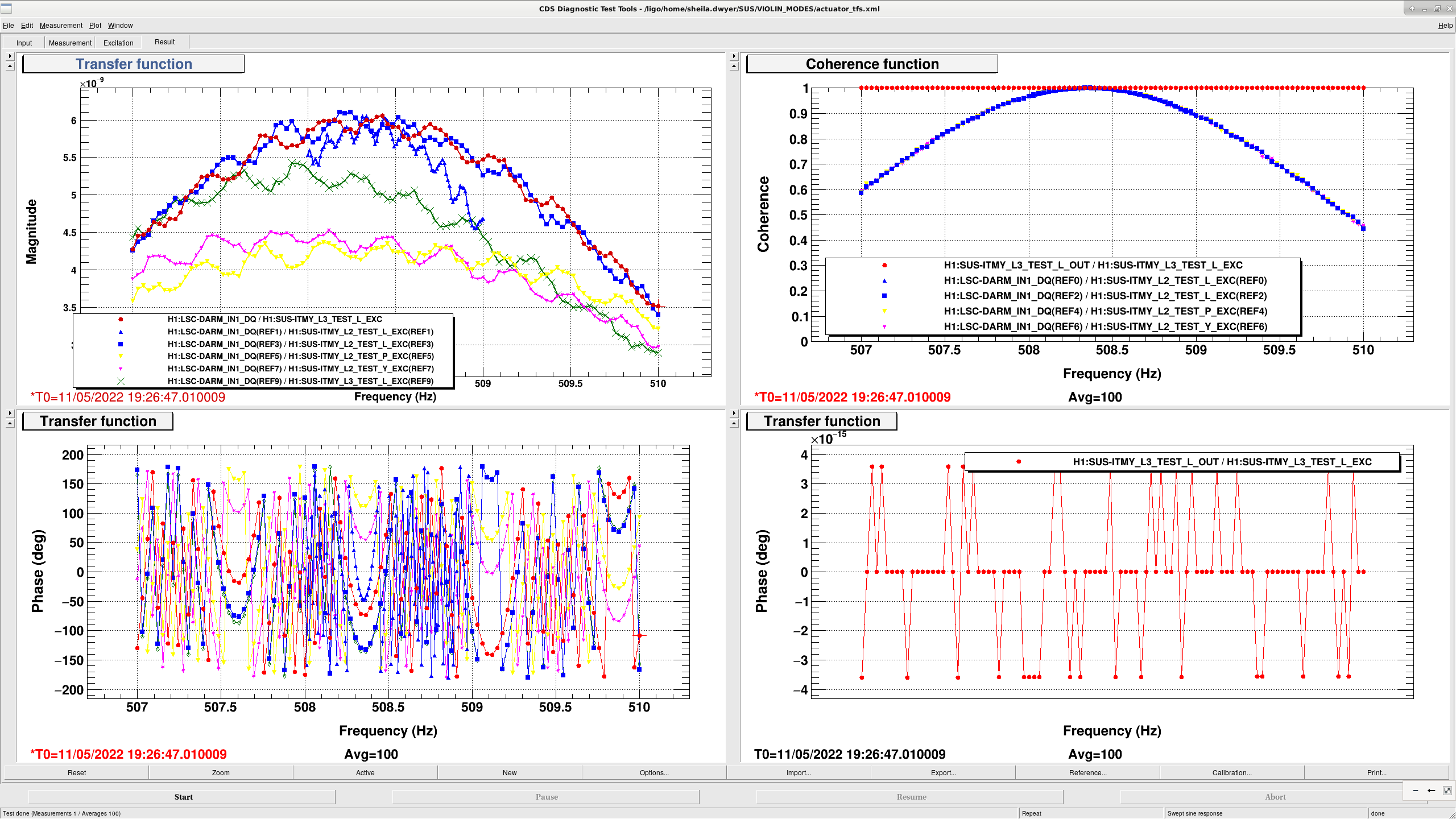
After a useful email conversation with Chris Wipf, we made an attempt this morning to compare our various options for ITM violin mode actuators. The idea was to measure the coupling from each actuator to DARM, this will be the sum of two actuationm paths, the first where the drive couples directly to DARM and the other is the drive coupling to the violin mode, and the violin mode coupling to DARM. We were expecting to see that the violin mode would be visible in those transfer functions, as it is in LLO alog 17654 The thought was that the coupling from the violin mode to DARM is the same no matter which actuator we use, so the transfer functions would show us which drive couples most strongly to the modes we are struggling with.
The attached screenshot shows this attempt. The result is confusing in a few ways. One thing to note is that the coherences look extremely similar for all these measurements, and it is an unusual result for coherence. The magnitudes of the transfer functions for the various actuators all seem fairly similar and don't show any sharp features due to violin modes. I don't understand why we would have such rapid phase evolution while the magnitude transfer function isn't eveloving rapidly. There is a time depedent gain fluctuations that is causing wiggles in the magnitudes, when taking the measurements with different resolutions the wiggles happen on the same timescale.
We were suspicous that there is a problem with using DTT for these fine resolution swept sine measurements, so also looked at the transfer function from excitation to the filter output. That has a magnitude of 1 and 0 degrees of phase, and a coherence of 1. So the problem isn't just a dtt bug.
Jenne and Jeff have moved on to attempting to measure this using a noise excitation on L2, in the meantime Elenna and I are attempting to damp the mode with the L3 drive.
Three reasons why this measurement looks very tough:
- The violin mode puts a huge line into DARM right at the frequency where you’re trying to measure TFs. This may interfere with DTT’s swept sine analysis, leading to weird results.
- The coupling you want to measure goes through the violin mode to DARM, so it’s filtered by that high Q resonance, which will require an extremely long settling time. Essentially you have to wait for the drive to ring up the violin mode, in order to see how strong that coupling is.
- There’s a second possible actuation path (the actuator’s direct displacement of DARM), which shows up without delay and could confuse the results.
My guess would be that the actuator that can move the ends of the fibers the most is the strongest for damping, and modeling might be the easiest way to determine that.
I very much suspect you're right Chris!
Or follow-up attempt using a broad band injection perhaps is supporting evidence to your suspicions (see LHO:63089)

I wonder -- can you describe in a bit more detail what you mean regarding the "modeling" you propose?

I know the Glasgow team, and specifically Alan Cumming (and the now departed Borja Sorazu) has done lots of FEA modelling of the full monotlithic system -- see e.g. G2001469.
I think he was asking the model different questions, though, about
    - what's the best Q they've gotten to get an estimate of whether the thermal noise will be good enough for future generations of detectors (the focus of P2000100)
    - the source of a single fiber's two dimensions of modes (causing what is colloquially referred to as "mode splitting" -- see discussion in G1701332. Note: that's what we're dealing with here: we ITMY MODEs 5 and 6 are the same fiber, and because this fiber's system is so cylindrically symmetric, those to DOF's mode frequencies are only 4 mHz apart).
    - if they can successfully reproduce the *an*harmonicity of the modes (see e.g. G1700038)

From, what I conclude from the Glasgow team's work on these other topics: the FEA model can be quite accurate in what it predicts, but in order to get there they've found that good results are highly dependent on the reality of any given monolithic system -- namely, for Alan's work, he's gathered the exact, real, weld shape informed by careful pictures of the final weld by the on-site welding team, and information from the initial in-air, 2D, fiber profile all folded in to the details into the FEA.

As such, I think any *modeling* of the system would likely require such a full FEA of the system, informed by pictures of the welds.

And, unfortunately, since we still cannot map in-air measurements of violin modes to in-vacuum values, we don't know exactly *which* fiber system has this problematic mode, so we'd have to blindly make an FEA model for all 4 of the new ITMY fibers.

BUT -- Alan already has some semblance of a model of these specific fibers -- see G2002021.

So -- I'll reach out to Alan, but if you've got any further clarification on what *you* meant by modelling, let us know!

Tagging a few other subsystems in case we trigger anyone else's curiosity...
What I had in mind for the ’easiest way’ of modeling is something like this:
- Use actuator force limits propagated through the suspension response to find how much each actuator can move the PUM and test mass stages (this must exist already)
- Use geometry to find the resulting motion of the ends of the fibers
- Guess: the actuator (or combination thereof) that makes the biggest motion at the fiber end points couples strongest to the violin modes
Maybe it turns out to be more subtle than that, in which case one could resort to higher levels of modeling detail (for example, model the fiber to study the mode’s response to motion of the end points). Or if it’s straightforward to run a full FEA and get the answer, that works too!