jeffrey.kissel@LIGO.ORG - posted 18:03, Wednesday 11 May 2022 (63089)
Attempt at Broadband Transfer Functions of ITMY Violin Modes
J. Kissel, S. Dwyer, T. O'Hanlon, E. Capote

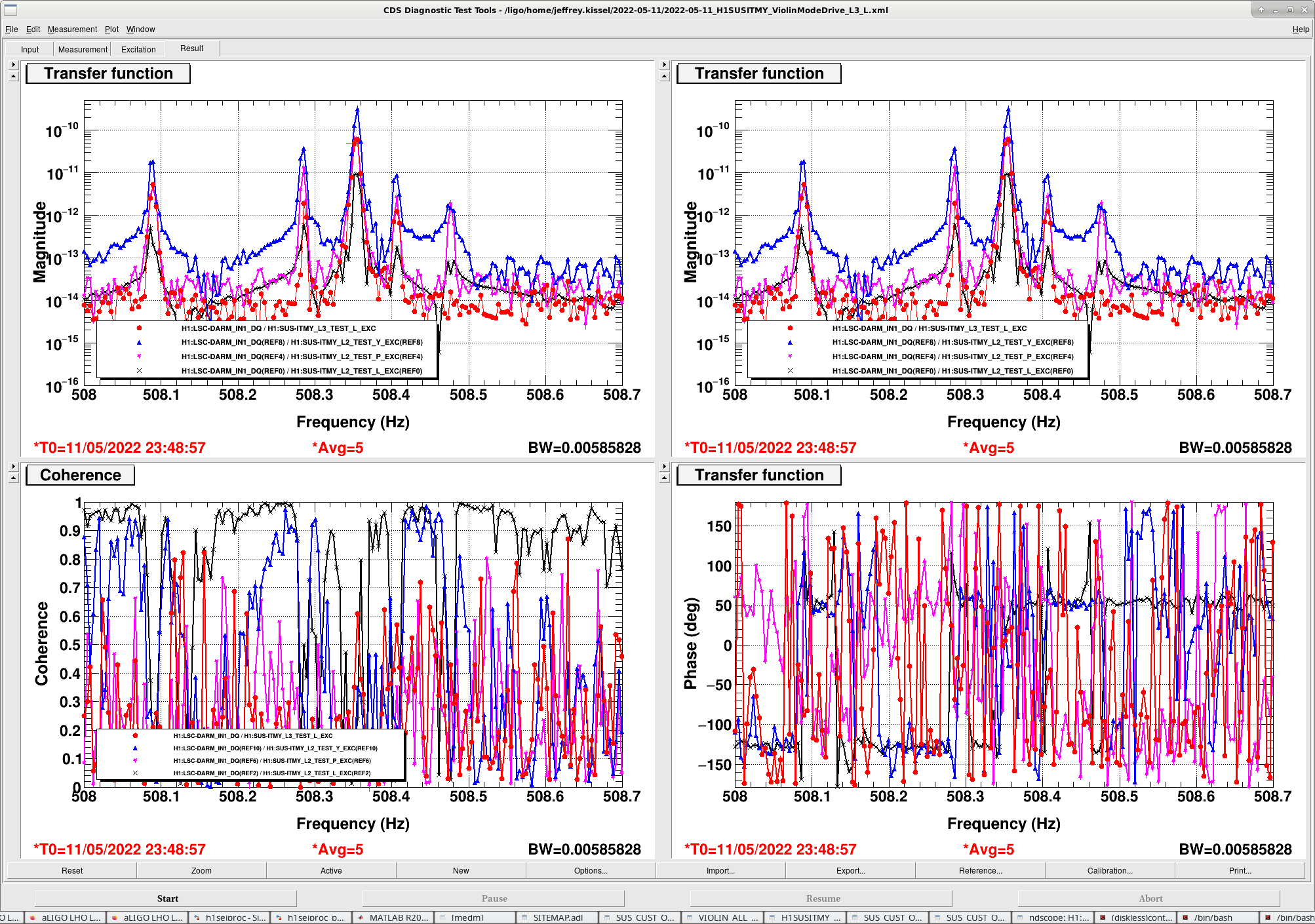
With the new TST stage drive path for violin mode damping (LHO:63078), we're making attempts to understand the relative actuation strength of our options via driven transfer function, rather than "guess and check" that we've been doing. Sheila tried a swept sine early today and had questionable success -- see LHO:63083. Jenne and I tried using broad band noise, which is posted here.

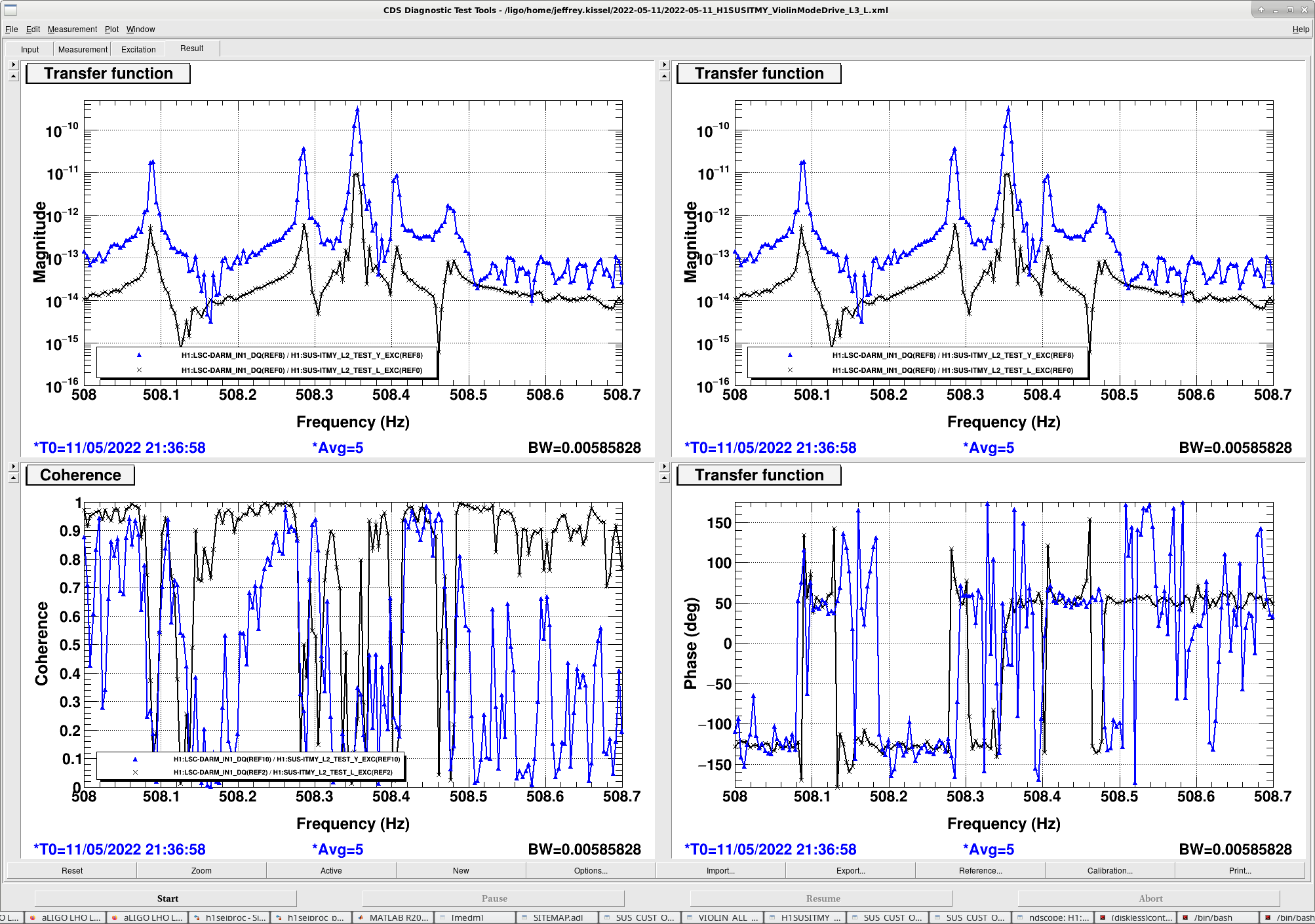
While L2 P and L3 L have little-to-no coherence anywhere, L2 L and L2 Y drive *do*, at least *around* the resonances. See the two attachments -- the first with all for drives on it, including the incoherent drives, and the second with only those with some appreciable coherence.

We take this to mean:
    - Using the off-resonance regions where the TFs are coherent -- the L2 Y drive is the strongest, and the L drive is weaker by at least ~1 order of magnitude.
    - Because there's no coherence, we assume that L2 P and L3 L drives are even weaker than L2 L.
    - We could wave our hands around all day for reasons as to why the measurement using the strong actuators *aren't* coherent on resonance, so pick your favorite reason.

Indeed, we *have* been driving ITMY MODE 5 and MODE 6 with L2 yaw so that's good.
Images attached to this report