
jeffrey.kissel@LIGO.ORG - posted 11:07, Wednesday 11 May 2022 - last comment - 16:38, Wednesday 18 May 2022(63078)
H1 SUS ITM QUAD Models Modified to Additionally Send Violin Mode Control to ESD / TST / L3 Stage
J. Kissel, S. Dwyer
WP 10435
Expanding on changes mentioned briefly in 63071.

As we continue to battle the new ITMY's new fiber's violin mode doublet with the existing active violin mode damping system, we're beginning to think of / remember things that we've never tried before. To-date, we've only ever driven the PUM stage to try to damp violin modes, either (Jeff's best guess) because
    - we assume that's the only way we'd be able to physically couple any drive to the violin modes of fibers, or
    - we initially started driving in pitch (in order to not create any parasitic DARM loops?), and ... because we assumed to use the same angular actuator that we do for global cavity alignment control, where there's substantial loop gain roll-off by 500 Hz?
Who knows why, really -- we inherited a prototype system and technique from Den Martynov and Matt Evans back in 2014 (LLO:14820), and have just been using and expanding it successfully ever since (see ECRs E1400396, E1700286).

Note that in this scheme, we have the ability to actuate any mode in L, P or Y of the PUM. However, because it takes so long to tune these active filters via gues-and-check, we typically start with P and if many trial settings don't work we try Y. Between all 4 quads, the drive is about 50/50 P and Y. *Only* one mode, ITMX MODE 6 (not the current problematic ITMY MODEs 5 and 6) uses Longitudinal drive.

So -- since we've run out of patience with the guess-and-check methods for this new problematic ITMY doublet, at 508.3532 Hz and 508.3561 Hz, assigned to the filter banks ITMY MODE5 and ITMY MODE6 -- we're going to try something new: drive from the ITMY electro-static drive (ESD) system on the TST / L3 / bottom /optic (whose electrodes are more accurately on the ITM QUAD's reaction chain's thin compensation plate "TCP").

As such, I've installed new prototype infrastructure to do so into the ITM QUAD's only front-end models,
    /opt/rtcds/userapps/release/sus/h1/models/
        h1susitmx.mdl
        h1susitmy.mdl
and really, I made no change the the above models, I really modified the library part that runs inside them,
    /opt/rtcds/userapps/release/sus/common/models/QUAD_ITM_MASTER.mdl

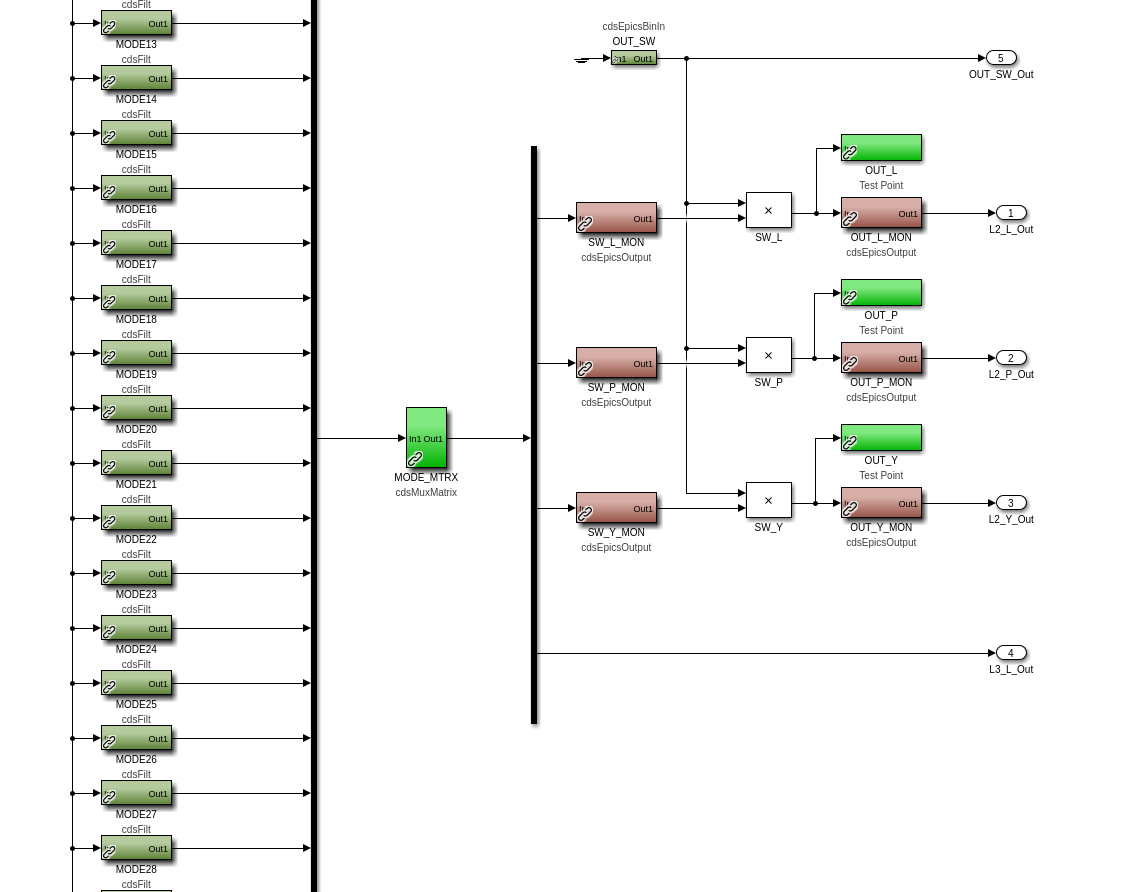
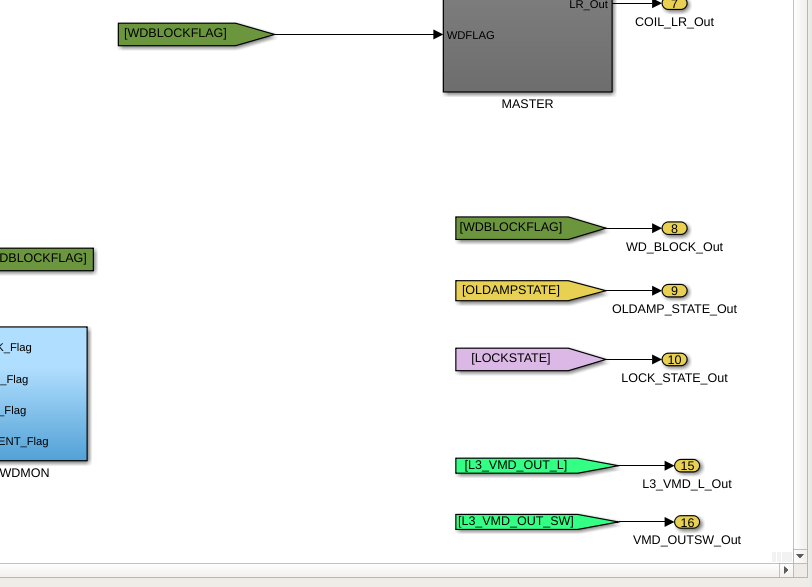
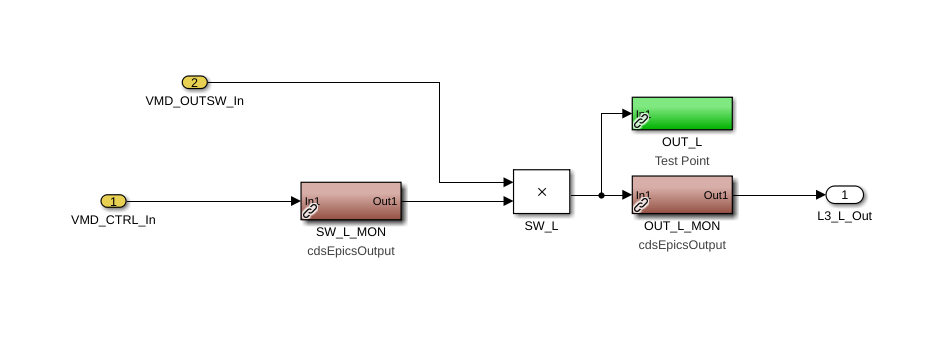
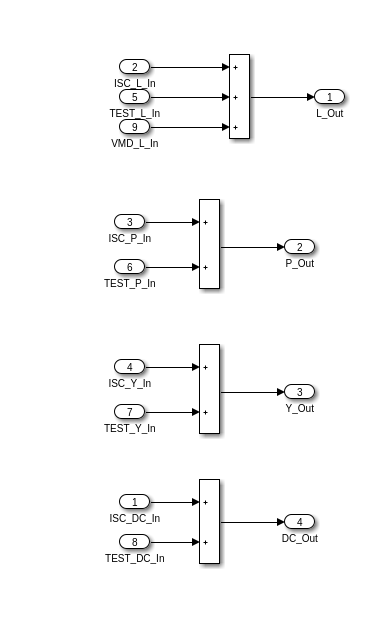
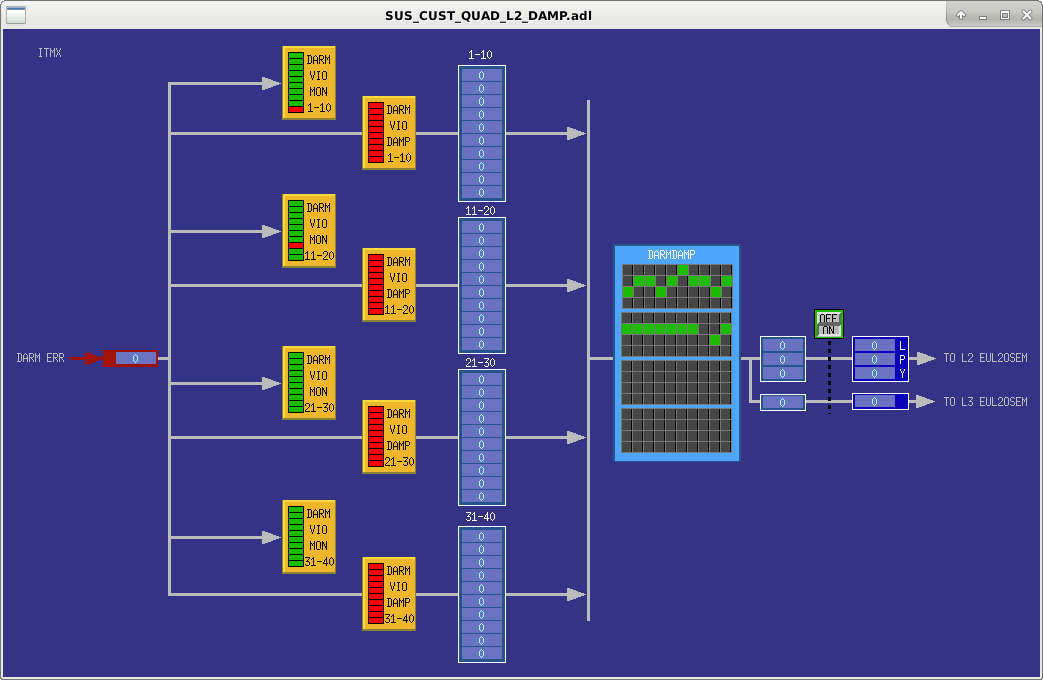
The changes made are better illustrated in the attached screnshots, but in short, I
    - Broke the internal link of the L2 stage (aka the PUM stage) from the
        /opt/rtcds/userapps/release/sus/common/models/FOUROSEM_DAMPED_STAGE_MASTER_WITH_DAMP_MODE.mdl
      library part,
    - Added an extra output from the DAMP_MODE_MTRX, creating a 4th row in the previously 3 x 40 matrix, and piped it up and out a level
    - Because we still want the overall kill switch, L2_DAMP_OUT_SW, to kill all violin mode damping, I piped that up and out a level too, then
    - Imported the matrix output and kill switch into the L3 (aka TST) block (which, unlike M0, R0, L1, or L2, is only a "library part" because it's in the QUAD_ITM_MASTER), and
    - Created a new L3_DAMP_L signal monitoring path, and applies the kill switch there, and sends the product out to be added in with the other Euler basis control signals just before the EUL2OSEM matrix.

Things of note:
    - Remember: Theoretically, there should be no coupling between driving the test mass stage and the violin modes. But -- also theoretically, there should be know coupling between pure center-of-mass PUM drive (be it L, P, or Y) either. This whole game relies on "dirt coupling," i.e. on the weak, real, physical, details and imperfections of the system that cause very-difficult-to-generically-model coupling between these drives and the violin modes. The thought with trying out this new scheme is that the ITM TST stage ESD driver actuator system is comparable if not stronger than the PUM driver + coil + magnet actuator system, *and* we'll be fighting one less stage of 1/f^2 mechanical filtering.
    - Remember: the ITM ESD system is weaker than the ETM ESD system -- compare figures in section 6 of T1100595, bit "nominally" still stronger than the PUM stage. HOWEVER, what's not shown in that 2014 document is that the mechanical L2 force (or torque) to L3 displacement transfer function of the PUM stage has "interesting" low-Q dynamical response that one doesn't naively expect (see, e.g. T1400587, and measured examples in LLO:17654). The *model* of this effect uses some single number average of all 8 of the violin modes for the 4 fibers on a given test mass, and of course the predicted sharp peak height of the feature completely depends completely on the resolution of your frequency vector, not on any real estimated height. So, the second collection of "real life things that are hard to predict" also motivates us to "just drive it and see."
    - Remember: the ITM ESD systems' driver only has one DAC channel, which takes the coherent sum of all requested DAC channels -- i.e. longitudinal. Inside the driver, there are analog switches that one can use to push that single DAC drive to combinations of UL, LL, UR, and LR quadrants -- but there's no choice of sign, so one cannot physically drive balanced pitch or yaw, only, say drive UL and UR for pitch or UR and LR for yaw.
    - We use a common MEDM screen for *all* quad's violin mode damping, whether they're an ITM (that will get the channels for this change) or and ETM (which won't). So as long as this change is in place, there'll be white unfound channels for the ETM violin mode damping (VMD) screens. C'est la vie.

So with all those "will it work? *shrugs*" caveats, we're just going for it.

The plan of attack: again, since the "guess and check" method is so infuriatingly slow, and we just added a 4th option, we're going to actually take transfer functions between each drive method (L2 L, L2 P, L2 Y, and L3 L) and compare the answer -- hoping that this reveals the exact gain and phase we'll need at each stage. If it doesn't do that, hoefully it'll at least tell us the ratio of gain between the stages and confirm whether we *actually* have more drive strength at L3 or not.

Wish us luck!
Images attached to this report




Comments related to this report
As a result of this prototyping work, the medm and model corners of userapps/sus/common/ repository is a mess.

This is a treacherous place to be in given the next-week Tuesday plans to upgrade the RCG on all front-ends.
And of course, because these are library parts common to both L1 and H1, there's a small risk that L1 will update their userapps repo and receive these changes, or *they'll* make "prototyping" style changes and later when we both like our prototypes, we'll have to painfully merge (see LHO:62124 if you need a recent example).

As such I've:
    - created a copy of the QUAD_ITM_MASTER library part updated with these changes that have been installed,
        /opt/rtcds/userapps/release/sus/common/models/
            QUAD_ITM_MASTER_temp_H1Only_L3VMDchanges_installed20220510.mdl
    and reverted / (updated to the repo version) the QUAD_ITM_MASTER.mdl our local directory structure. As such, if you open the h1susitmx or h1susitmy model right now on, they'll still point to a version of QUAD_ITM_MASTER that does *not* have the above change.
    - *not* done anything similar for the MEDM screens in question,
        /opt/rtcds/userapps/release/sus/common/medm/quad/
            SUS_CUST_QUAD_L2_DAMP.adl
            SUS_CUST_QUAD_L2_DAMP_MODE_MTRX.adl
    which still remain modified w.r.t. the repository.

So -- If we still like this prototype system by the end of the week, and we want it to remain through the RCG upgrade next week -- we'd need to:
    $ cd /opt/rtcds/userapps/release/sus/common/models/
    $ cp QUAD_ITM_MASTER_temp_H1Only_L3VMDchanges_installed20220510.mdl QUAD_ITM_MASTER.mdl
    $ ssh controls@h1build
    @ rtcds build h1susitmx h1susitmy
    @ rtcds install h1susitmx h1susitmy
all *before* the CDS team reboots the world.

*Hopefully* there won't be any *further* requested changes to the ITM's MEDM screens, or any incoming updates to these screens from L1, so we hopefully will be OK with having the MEDM screens remain local modified and uncommitted.
On Tuesday, we should modify the new L3 damping so that it also is turned off (multiplied by) the TRIG_VIO, so that if we happen to lose lock but the guardian is stuck and doesn't realize it, we aren't sending bogus signal to the L3 stage of ITMY and inadvertently ringing violin modes up. This is a pretty rare thing that can happen, so I think it's fine to wait until next Tuesday for the reboot that will be required to implement this change.