sheila.dwyer@LIGO.ORG - posted 21:15, Monday 19 December 2022 - last comment - 09:24, Tuesday 20 December 2022(66471)
calibration changed to improve pcal to DARM transfer function
I've multiplied the sensing function in CALCS by 1.06 to reduce the systematic error as reported by the PCAL to DARM dtt template. This has reduced the calibration error reported by this template as shown in the attachment.
This change was in place as of Dec 20 2022 04:51:43 UTC, allowing nearly 10 minutes of undisturbed time before the CO2 stepping test started at 5 UTC (66465). I set the undisiturbed bit after doing this, and turned it off a few minutes after the CO2 test started, this should be an OK time to use for cleaning.
The template is commited at /ligo/svncommon/CalSVN/aligocalibration/trunk/Runs/O3/H1/Measurements/FullIFOSensingTFs/2022-12-19_H1_PCALY2DARMTF_BB_3min.xml
Images attached to this report

Comments related to this report
Tagging CAL.
#Fudge

Saying it explicitly -- the *only* thing changed in DELTAL was multiplying the *inverse* sensing function (1/C) path by 1.06. I.e. H1:CAL-CS_DARM_ERR_GAIN = 1.06. This corresponds to a
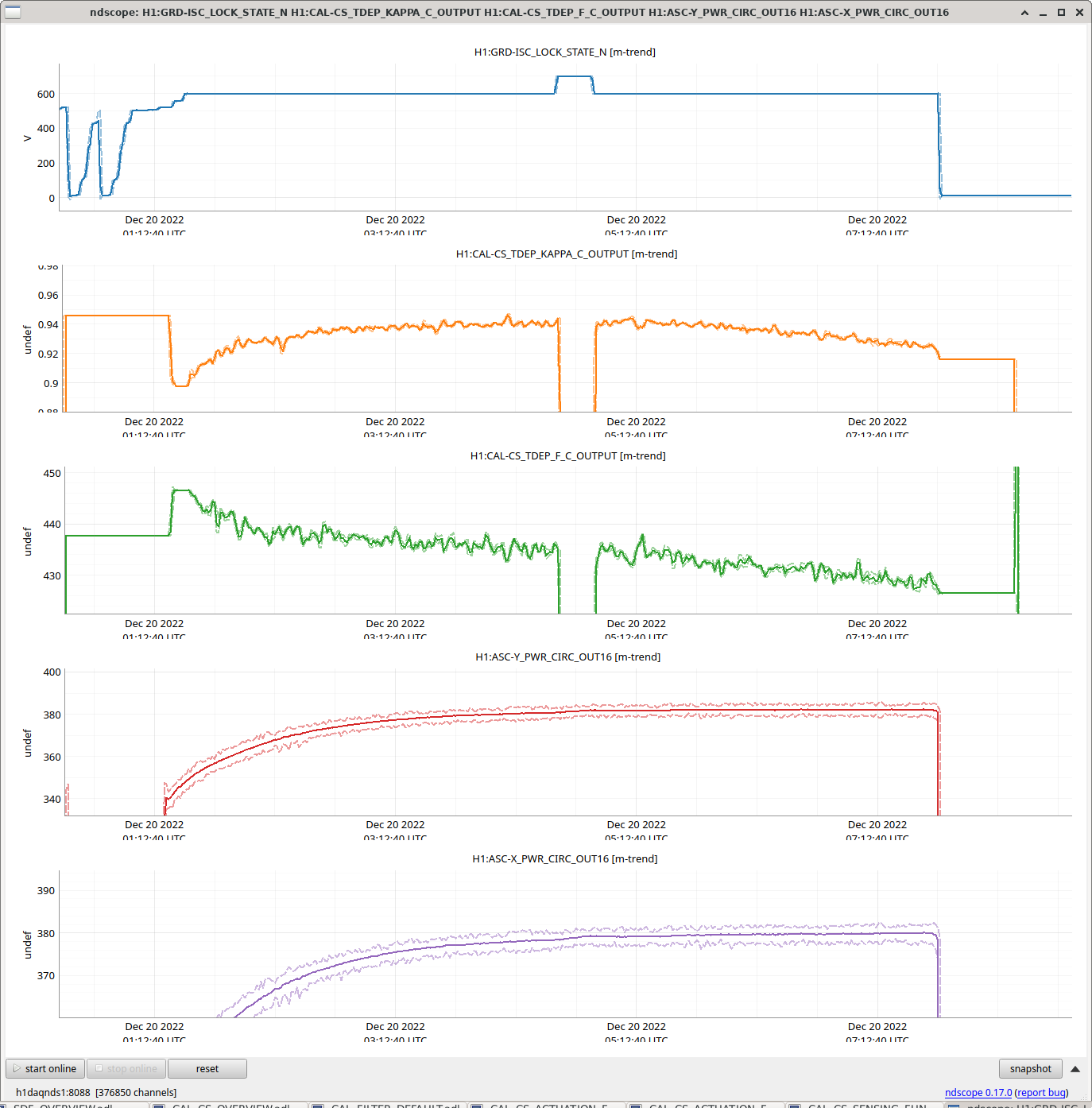
kappa_C of 0.94 -- consistent with what trends of the optical gain relative to what it was at 50 W input (starting out after power up as low as 0.91, and after hours of thermalization getting up to 0.96 -- this particular lock stretch seemed to land, after thermalization, at 0.94 -- see attached trend).

No change was made to the cavity pole or the actuator paths, so L1, L2, and L3 actuator strengths remain unmodified at 1.00. (It's impressive to me that the [inverse] sensing gain has this low-frequency an impact on the DELTAL / PCAL transfe function.)
Also no change was made to the time-dependent 1/C path, aka the CFTD sensing path to match the changes to the time-independent 1/C.

I accepted this value into the h1calcs SDF, since we're restarting the CALCS model today.

After trending time-dependent correction factors (TDCFs) surrounding Sheila's changes, I'm reminded (contrary to my quick guess when asked yesterday duringthe commissioning meeting): the TDCFs do not reflect this change; the estimated optical gain relative to the 50W value,
kappa_C, does not trend closer to the nominal value after correcting the path (nor does the estimate of the cavity pole frequency). Presumably, in order to have these track, then the DARM loop transfer functions at calibration line frequencies, aka the calibration group's "EPICS records", would have to be updated to reflect the change. That, needs a pydarm model parameter set to be updated.

This may also have consequences for the recently commissioned GDS-CALIB_STRAIN, but I'm not sure and would have to chase that down and make some plots there too.
Images attached to this comment