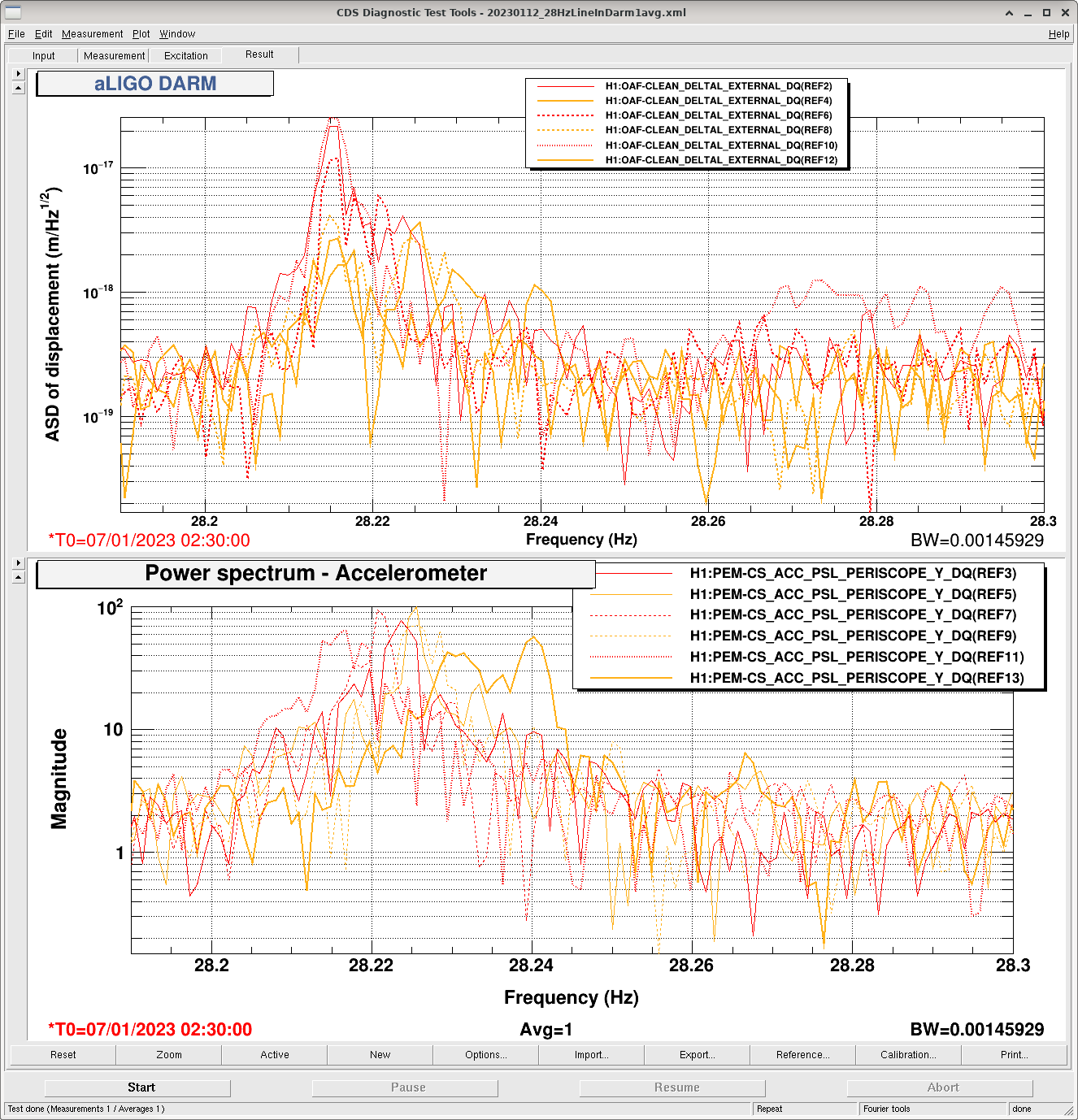
We have a breathing line at ~28.2 Hz that can be very large in DARM, and is coherent with many sensors. Zooming in in dtt the line is very fine with some shoulders (first attachment). Back in August I changed the PRCL gain but this had no effect on the line.
One thing to note is this frequency lines up the PR3 bounce mode. I looked at the coherence between the PR3 oplev (which has had a diminishing sum on its PD in the last few months so might not be super reliable) and DARM and there is some coherence (first attachment). I tried exciting PR3 M1 with broadband noise from 10-40Hz and looking at DARM to see if I could ring the line up, but since the line already sort of breathes it wasn't easy to tell if my excitation was ringing it up or it was just ringing up on its own (3rd attachments for the chop test of pr3 excitation on and off). So far this is inconclusive.
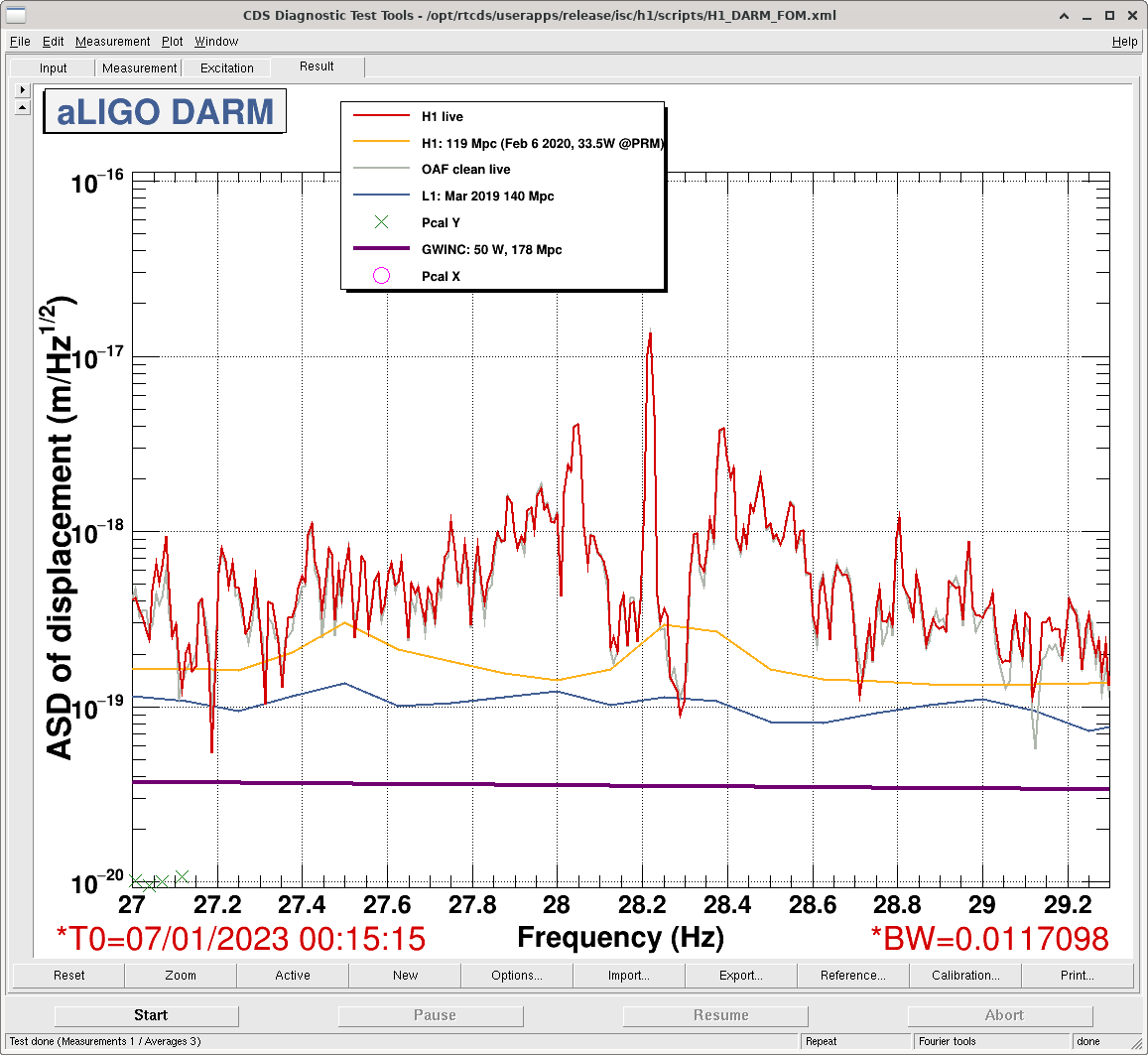

During our long lock on Saturday it's clear from the DARM spectrograms (here, or first attachment) that the 28Hz line was coming and going. Looking back at November's Bruco when the line was high, it's interesting that the line is coherent with some accelerometers in the PSL, so I dug a little deep there.
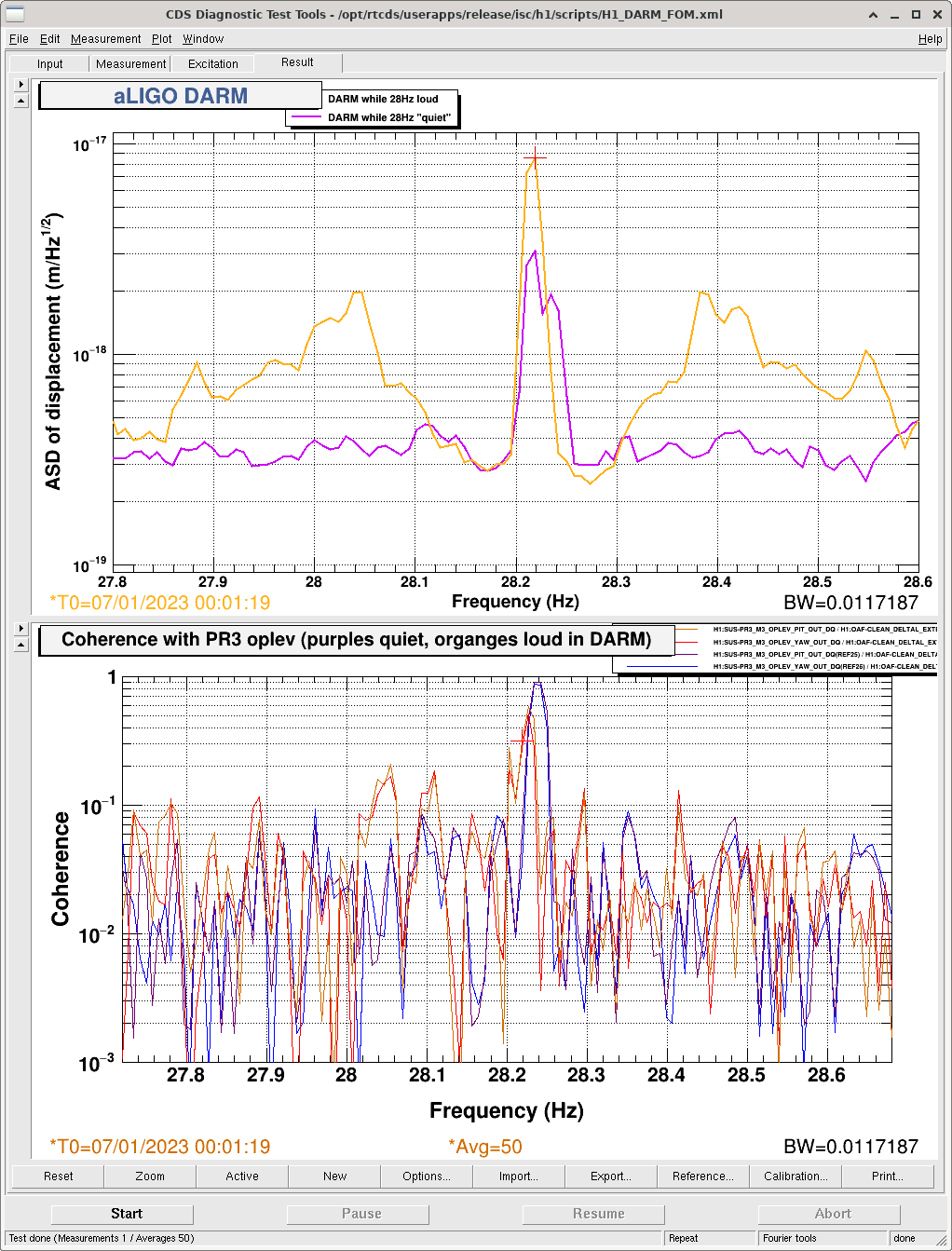
I looked at two times during the Saturday (Jan 7) lock, 10:00 UTC when the line was "quiet" in DARM, and 14:20 UTC when it was loud (the legend in the figure is slightly off with the time). In fig 2 I plot DARM, a bunch of sensors that also see the 28.25 Hz line, and coherence with a few of these channels. Here are a few things that jumped out.
- The line is prominent in the PSL accelerometers (here I've plotted one periscope and one table accelerometer). The line height in the accelerometers stays constant even while the height in DARM is changing (red, dashed purple, blue, and teal traces in the middle plot). This suggests that the line itself is always there, but the coupling to DARM is changing over time.
- The frequency of the line is shifting on the order of 0.02Hz between the two times shown here (clearest in the bottom coherence plot). There are a bunch of other lines around 27Hz in the PSL accelerometers that are also shifting in frequency.
- The line is also visible in the IMC WFS, and is also independent on whether the line is quiet or loud in DARM (green and brown traces in the middle plot).
- The line is visible in DHARD (and other ASC, including CHARD) and the magnitude of the line in DHARD follows the magnitude of the line in DARM (yellow vs black trace in the middle and bottom plots), so the ASC is sensitive to the change in coupling of the line.
Still a mystery is what is causing the change in coupling of the line.


Updates on the 28Hz line:
- Robert suggested that this line is from a 4-pole motor, shaking the ground in the LVEA, and then coupling to DARM through some suspension resonance which gets excited when the motor frequency (which drifts around) gets close enough to the resonance. So far all evidence points to this being correct.
- I took some very fine resolution spectra, single average, for times during Saturday's lock when the line was and low high in DARM (first attachment, yellow when the peak is low in DARM and red is when it is high in DARM). When the line in the accelerometers is below 28.225 Hz, a line at 28.215 Hz shows up in DARM, and when the line witnessed by the accelerometers is above that frequency the line is weak in DARM.
- I was originally suspicious that the line originated inside the PSL but it turns out the line is in many accelerometers in the LVEA (second attachment)
- I tried looking at the OSEMs on all the optics in the corner (IMs, MCs, PRs, BS, SRs, ITMs) and didn't see anything at the 28.215Hz, so I still don't know where that frequency in DARM originates
- While I was looking at the OSEMS I noted that IM3 M1 LL quadrant had some additional broadband noise (third attachment), is this ok??