craig.cahillane@LIGO.ORG - posted 17:21, Tuesday 21 February 2023 - last comment - 16:04, Thursday 23 February 2023(67539)
CSOFT P OLG at 60 W
On Feb 18, 2023 I was able to grab some low-coherence measurements of all of our ASC loops.

Here is the CSOFT Pitch OLG, and the associated digital filters for CSOFT_P and RPC_CSOFT_P at the time of the measurement.
At this time the RPC GAIN was set to zero, so only the regular controller path was feeding back to CSOFT P.

CSOFT P has four UGFs:
1) 0.12 Hz
2) 0.90 Hz
3) 1.37 Hz
4) 1.53 Hz

The second resonance here is pretty marginal, with some rapid phase loss at 1.5 Hz near to that fourth UGF.
The final UGF appears to have a phase margin of 12 degrees.

Raising the gain for this loop is not an option.
The phase zero-crossing at 1.70 Hz has a gain of around 0.6.

Digital filters
In this case the RPC is off.
The RPC is plotted with gain of 1 in the final plot, but the true controller is just the blue curve (the normal path through ASC-CSOFT_P).

Some will recall that we recently fought CSOFT P with 2.2 Hz instabilities after powering up.
We measured the loop at 10 W here: alog 67468.
At that time Elenna very slightly modified the loop to reduce the gain at 2.2 Hz, so that the tiny peak seen in https://alog.ligo-wa.caltech.edu/aLOG/uploads/67468_20230216152938_csoft_pitch_olg_at_POWER_10W_binwidth_0p01_Hz.pdf would not touch unity gain.
This slight modification did cost us some phase (around 15 degrees at 2 Hz), but we judged this to be okay based on the 10 W plot.

With the 60 W plot in hand, I reckon we are living on the edge.
The 2.2 Hz peak is not visible here at 60 W at all, even with the finest binwidth.
That feature is likely due to significant cross-coupling with other loop at 10 W.

My recommendation would be to strengthen the compensation for the suspension at 1.5 Hz, so that this CHARD_P FM6 ctrl2g dip at 1.5 Hz goes down slightly lower, pushing the second resonance below unity gain.
If this cannot be done, we should revisit our gain reduction strategy for CSOFT P, maybe by applying a very light, broad notch at 2.2 Hz designed to reduce gain in a localized region without killing our phase at 1.5 Hz (as much as we can avoid).
Non-image files attached to this report


Comments related to this report
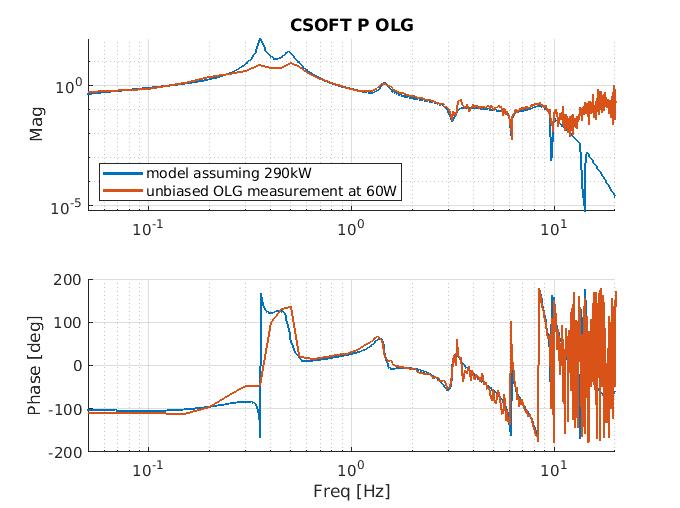
I have plot my model of CSOFT P alongside Craig's measurement. Similar to other ASC loops, the model that matches best uses 290 kW of circulating power. The measured optical gain of 1.6e4 ct/rad also matches with the measurement.
Images attached to this comment