Elenna had an alog about REFL WFS noise, and it seemed like PR3 vertical motion could be a source for 10-30 hz noise. I've looked at trying to improve the IHEPI to ISI Z feedforward and was able to get some pretty good improvements, something like a factor of 3x less motion over 5-30 hz.
I hadn't got much out of the z feedforward in the past because there is a sharp 15hz feature in the transfer function ratio that made the ISI go unstable if I fit it too closely. BrianL gives a stability criteria for the feedforward in SEI log 682, basically if the product of the backreaction transfer function of the FF witness (HEPI L4Cs here) to actuator with the ff filter is < 1, the feedforward should be stable. For the ISI the two transfer functions used for the feedforward design are the 1. HEPI L4C to St1 GS13 transmission in the damped state and 2. the damped actuator to St1 GS13 plant. The back reaction transfer function is a third transfer function that can be gathered when measuring #2, but you have to drive pretty hard to get anything useful for the HAM HEPIs.
First plot shows the new design I installed today and compares with a filter I tried a long time ago that was unstable. The TF ratio being fit is the thick blue, red is the new filter that I tried yesterday that works, yellow is the unstable filter, purple(?) is the backreaction tf * filter stability criterion for the new filter (max value about .25 at the 15hz feature) and green shows why the old filter was unstable, it goes up to about 2 at 15hz. The filter that was running untill yesterday only fit up the design tf ratio to about 10 hz, I'm not showing it here.
The extra fuzz on the stabilty tf products (green and purple) is because I couldn't drive hard enough to get a good backreaction transfer function, I was saturating the ISI actuators. I would have to try a swept sine measurement to do better.
Second plot shows asds of the improvement and compares to HAM4 and HAM7 in Z. Red and bright green are the HAM2 HEPI L4Cs for the old vs new ff test, basically the same for both times. Dark green is with HAM2 motion the old filter, dark blue is with the new filter, pink is HAM4 , light blue is HAM7. I didn't get a reference for a measurement I took with the HAM2 Z ff off, but it wasn't much worse than the dark green line, and only below 10 hz.
The big peak at 38ish hz on the light blue trace is a bending mode for the HAM7 support tubes. The 30hz and up region is where you see the most benefit from having HEPIs passive isolation.
As far as I remember, this was only really an issue for the Z direction, the other DOFs don't have the sharp 15hz feature.
When I get a chance I'll look at repeating this for HAM3. I have a measurement for HAM7, maybe I can get some improvement on the 38hz feature for that chamber


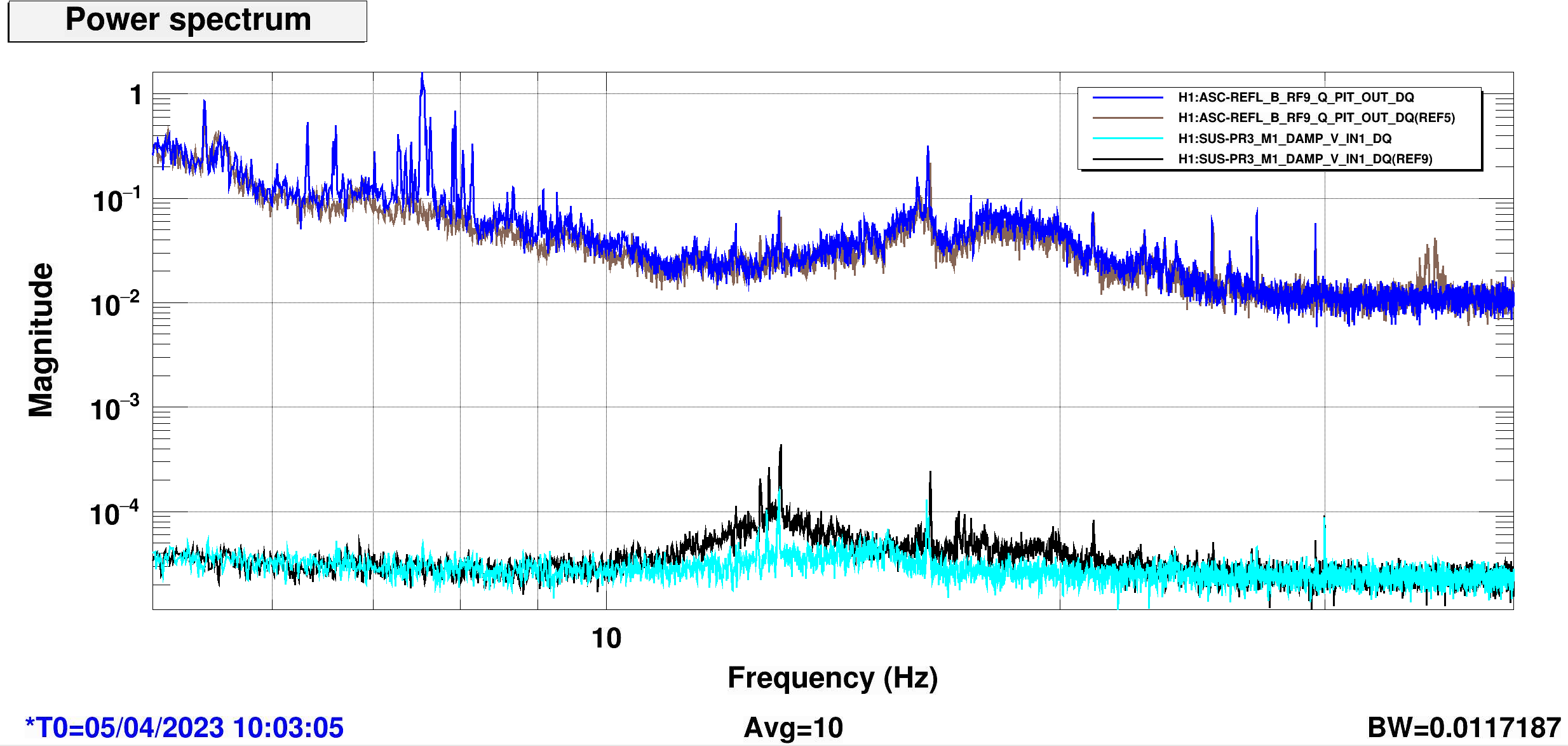
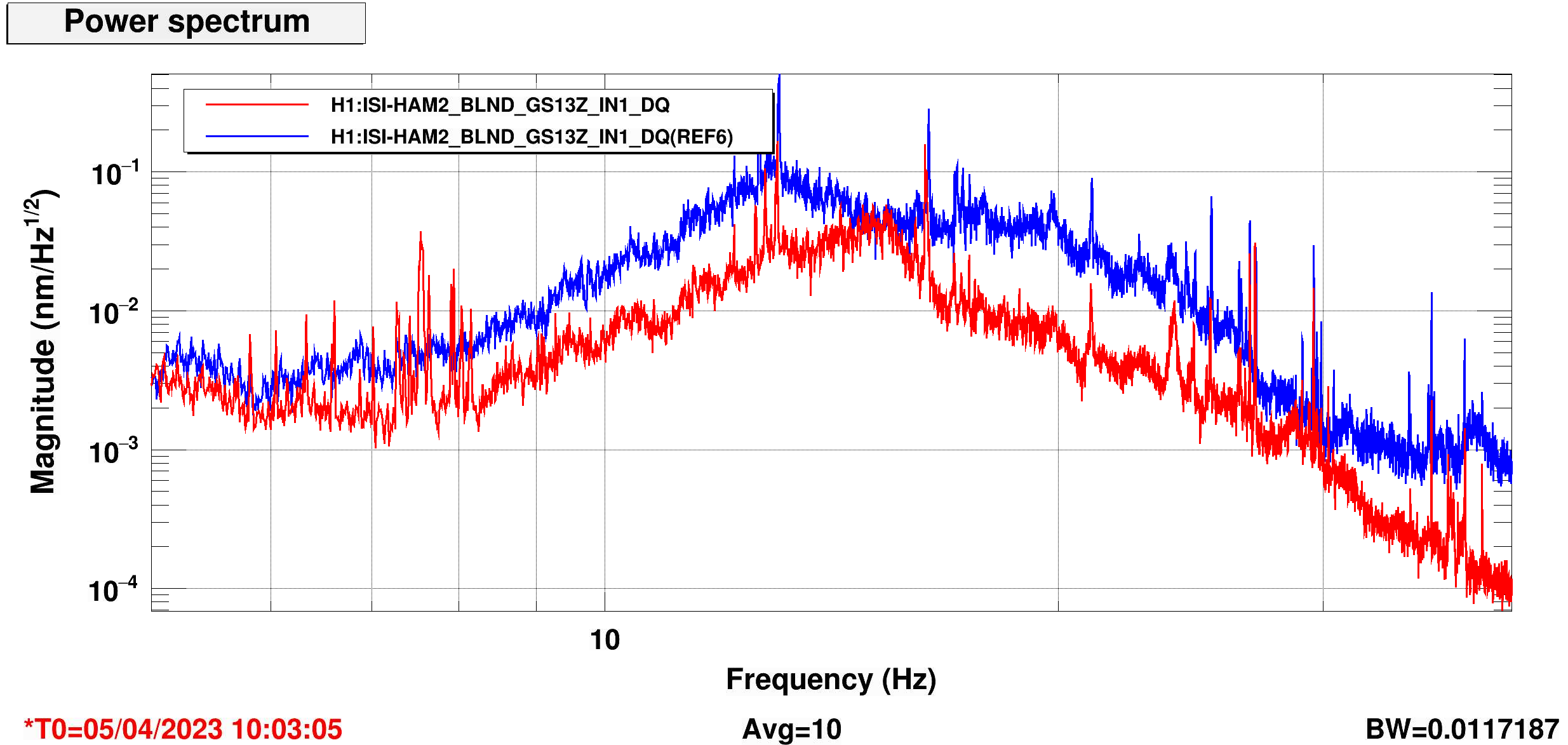
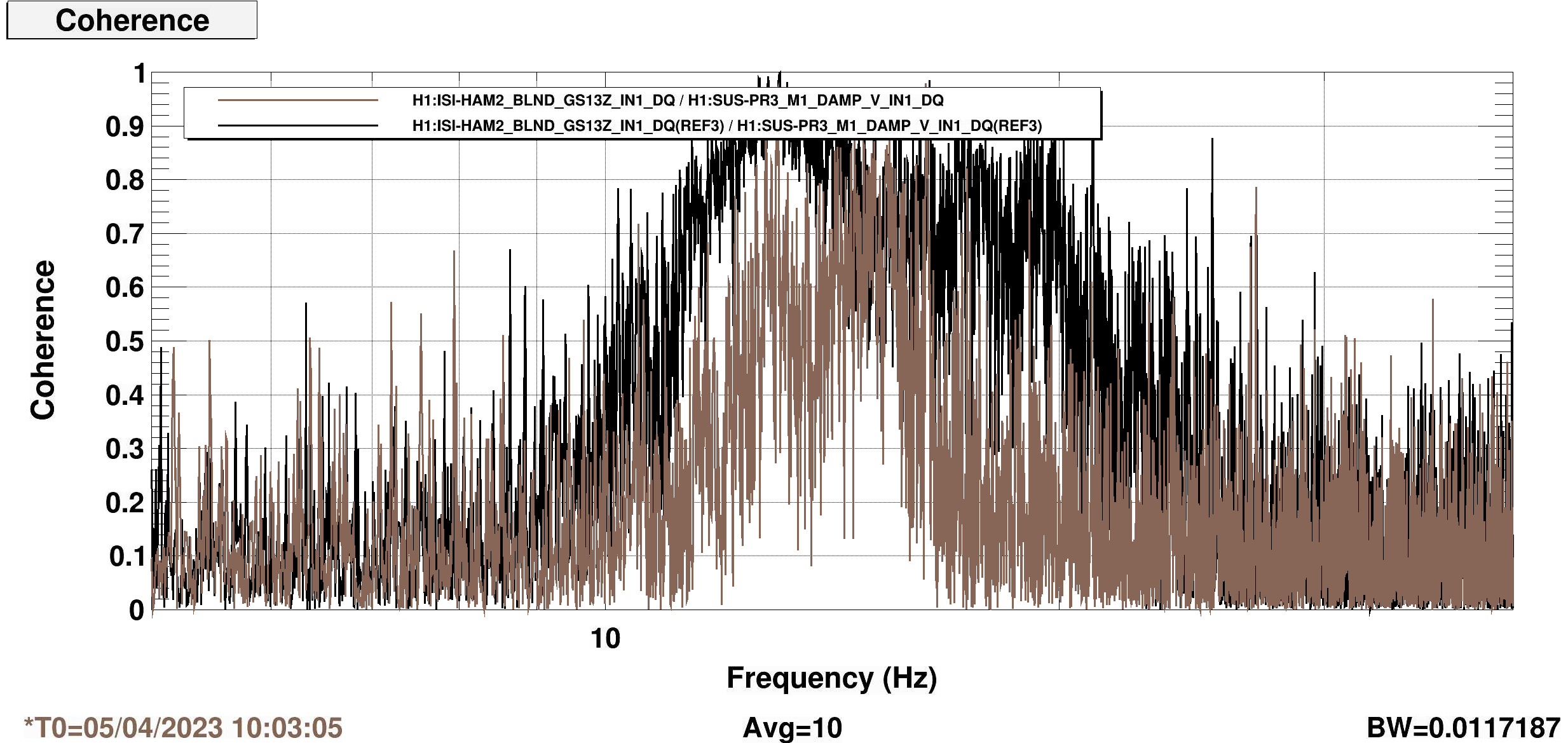
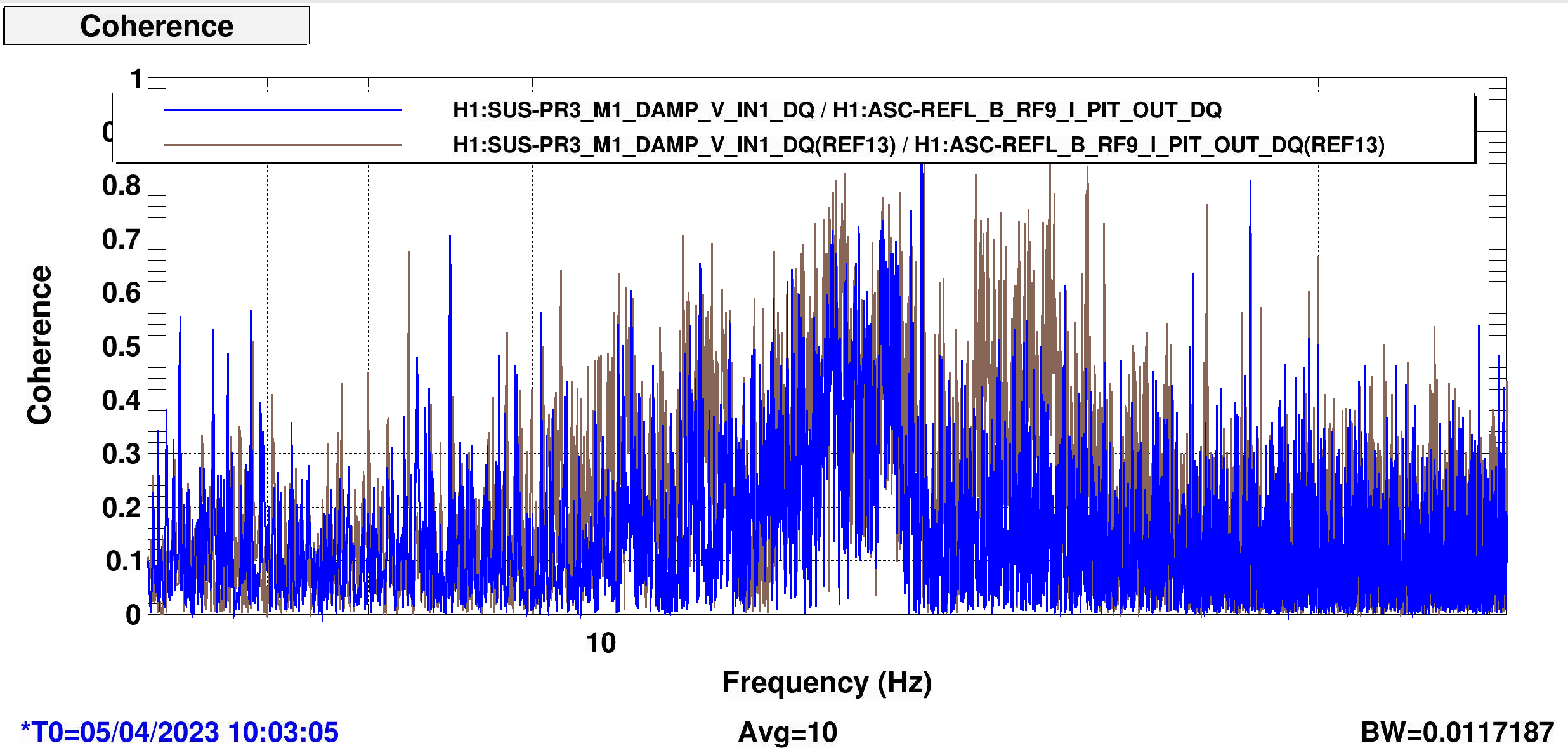
I've looked a little to see if this helped PR3 vertical motion or REFL 9 at all, and it did maybe a tiny bit. For all attached plots, the ref traces are from the before the HAM2 ff change, all the live traces are from a period last night. Curious to see if doing this on HAM3 will help.
First plot are asds for REFL B RF9 Q and PR3 M1 V damp in. The blue traces are from a lock last night, green and black are from a lock Sunday night. Clear improvement in the SUS osems 10-20hz, not clear that REFL is really better. I don't know what is haping in the dark blue below 10hz, but it also shows up in the ISI gs13s on HAM2 and 3. This was in the middle of the night.
Second plot are HAM2 Z GS13 asds, showing the improvement in the ISI motion. Except for the extra sub 10hz peaks, HAM3 was identical, before and after.
Third plot is the coherence between the SUS V damp and the HAM2 GS13s. Better in 10-20hz again, but not a lot.
Fourth plot is coherence between PR3 osems and REFL. Slightly less coherence here, maybe, but not a lot.