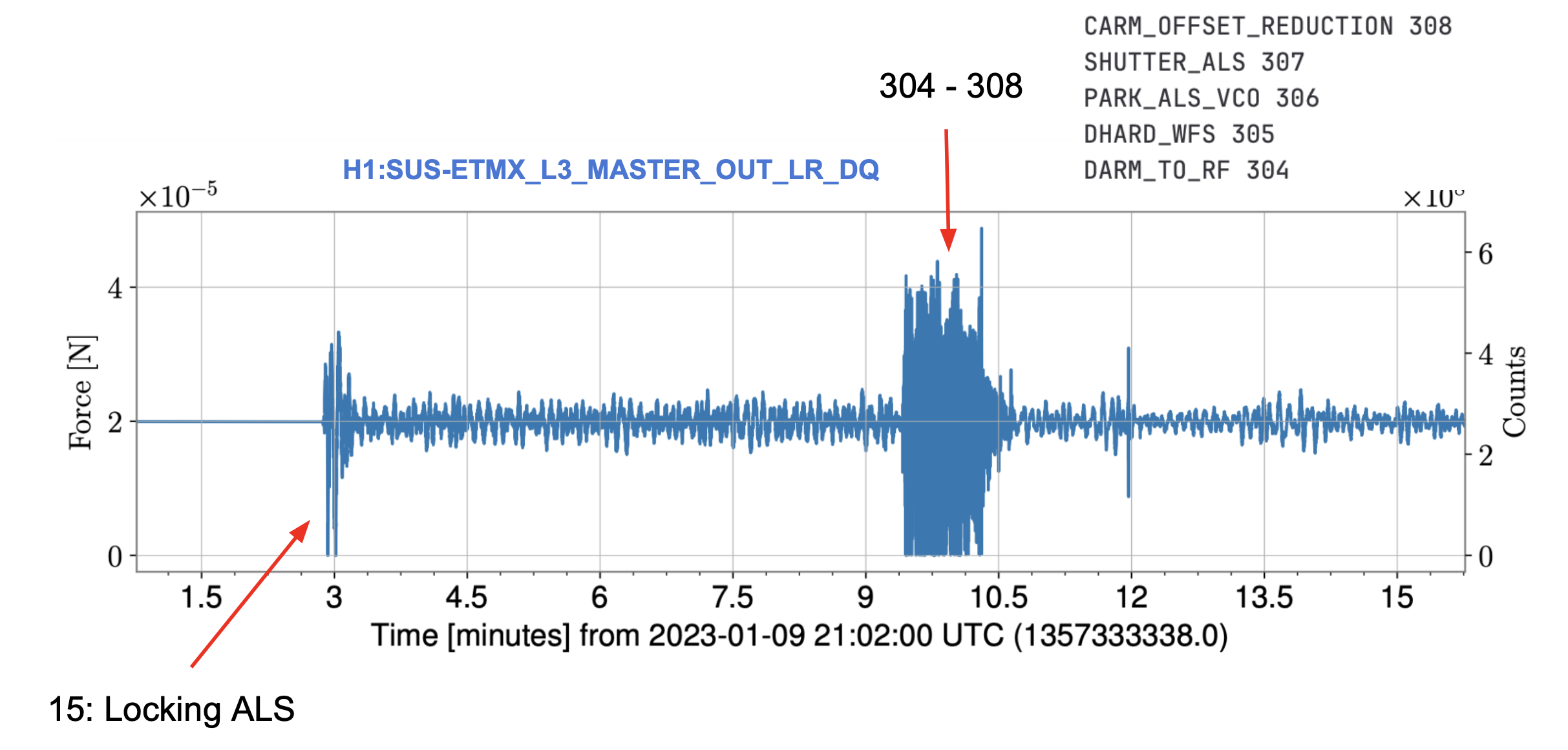
Sidd, Peter, Craig, Jeff This is a copy/paste of an email thread to the alog for the purpose of outside citations. Hey Sidd, Thanks for putting this study together, it was very interesting at the Heavy Sus meeting. I'm looking at the following two plots together: https://ldas-jobs.ligo-wa.caltech.edu/~siddharth.soni/ESD_study/GRD_states/H1_1354310689/zoomed_force_count_H1-ETMX-1354310689.pdf https://ldas-jobs.ligo-wa.caltech.edu/~siddharth.soni/ESD_study/GRD_states/H1_1354310689 /zoomed_grd_state_H1-1354310689.pdf Here are the names of the ISC_LOCK state numbers at HanfordLooks like the high noise starts in state 304 (DARM_TO_RF) at Hanford and slowly goes away during 308 (CARM_OFFSET_REDUCTION). I took a quick look at the DARM_TO_RF run state.
Here's the code from the state. It seems that the high noise begins after line 2182, which is when we turn off FM9 in the LSC-DARM2 filter bank "LP55", which is just a modest 55 Hz low pass filter with a two second ramp time:
So the excess noise we see is a direct result of us turning off some LP55 filter in LSC-DARM2. This filter never gets turned on again, and appears to go away in CARM_OFFSET_REDUCTION when we bring CARM closer to RESONANCE. This part of the guardian is some pre-conditioning for the CARM_OFFSET_REDUCTION state. The noise we witness is terrible sensing noise from locking on the fringe, having the transmitted power be in loop (from the power normalization), and not filtering it away because it's not really necessary. The conclusion from the meeting still stands in my opinion: if we had needed to we would have commissioned this excess noise away. Because we weren't hitting any saturations or locklosses here we've left it like this. We could even try locking CARM and DARM directly from ALS_COMM and DIFF at this point (as the powers that be intended), but that is extremely low priority. The real question of "how much maximum force is required to lock" is may be during state 15: LOCKING_ALS, which the ALS_DIFF guardian actually controls. I'm seeing a 300k count peak-to-peak initial swing in the EX UL MASTER OUT during the latest example lock there, afterwards it calms down significantly. Probably also possible to acquire ALS_DIFF more gently. Would be interesting if you compiled a bunch of these ALS_DIFF acquisitions similar to what you've already done for state 304, and maybe we can do a deeper dive into what ALS_DIFF acquisition is actually doing similar to this study. Craig P.S. We sometimes have trouble locking ALS_DIFF for ~hour in bad conditions. If we looked deeply at this, we may be able to improve IFO uptime.
Peter comments in reply to Craig's info above:

I assume that the 55 Hz low-pass filter is being turned off so that the DARM loop has more gain margin for the CARM offset reduction process, is that right? If so, it seems like it might also work to move up the LP, say to 200 Hz, rather than to remove it.
To understand the max force ESDs apply during the stage of locking, I had looked at a bunch of cases and found that as the state transitions from 304 to 305, there is an increase in the force/noise which goes away around the state 308 (CARM offset reduction). These examples are here. Now based on Craig’s suggestion, I looked at the ALS Locking (state 15) for several of these examples. Indeed apart from the 304-308 states, the next highest noise is during this ALS Locking stage. In most of the examples I looked at, the duration of this state is ~ 55 seconds.
As shown by the second zoomed in plot, there is an increase in noise a few seconds after the transition to state 15, the noise then settles down and unlike the states 304-308, it does not stay high throughout. So it looks more like a glitch.
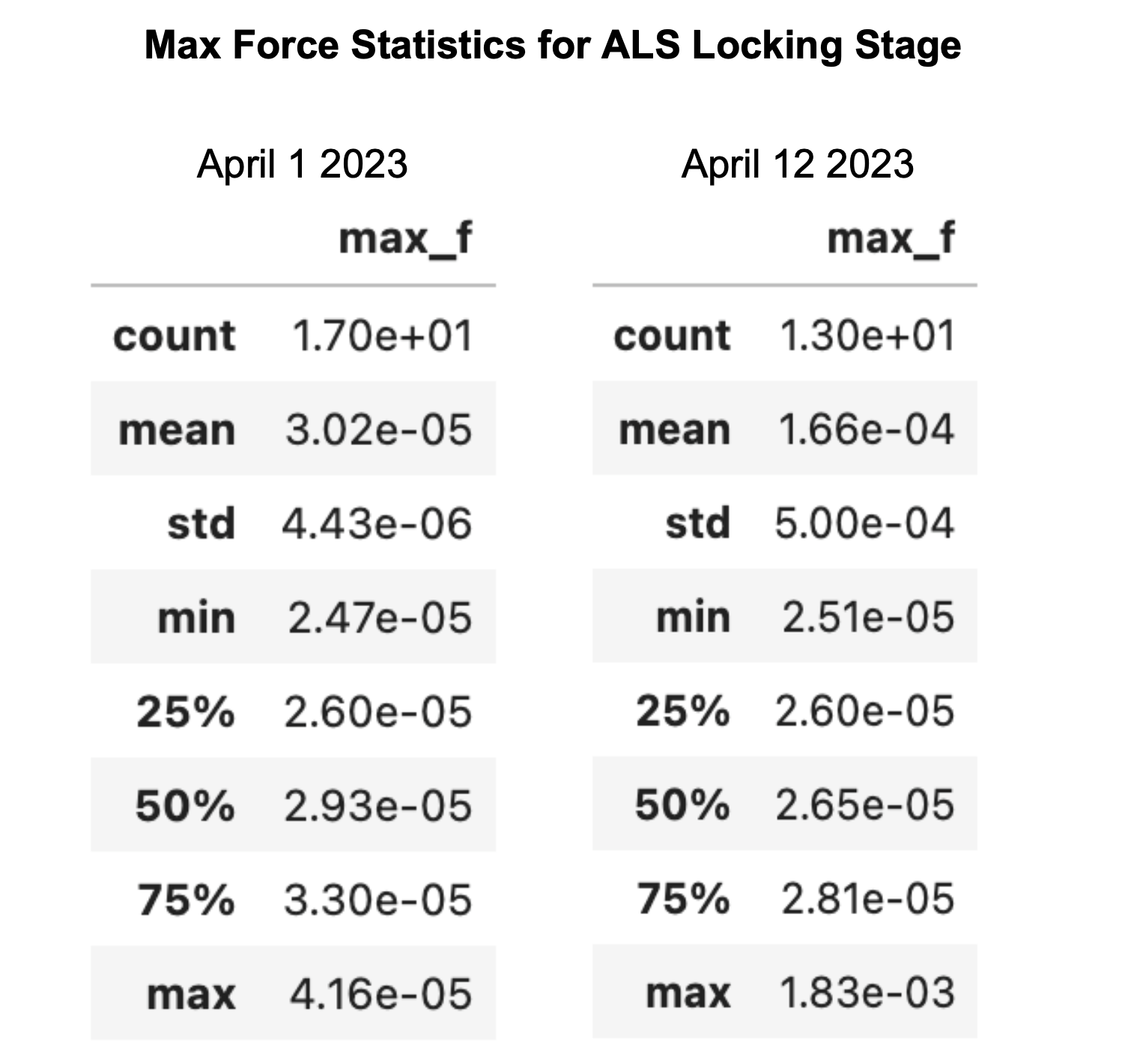
I analyzed the data for some of the Dec 2022 Jan 2023 locks at H1 for this state, the plots are here. I also looked at more recent data, specifically Apr 1 and Apr 12. On both of these days, there were a number of lock attempts. The plots for these days are here and here.
Max force statistics: For Apr 1 lock attempts, the median value during state 15 is 29.3 µN which is about 60% of the median force during the 305 state (48 µN) DCC. For Apr 12 lock attempts, its very similar with the median force being 26.5 µN.