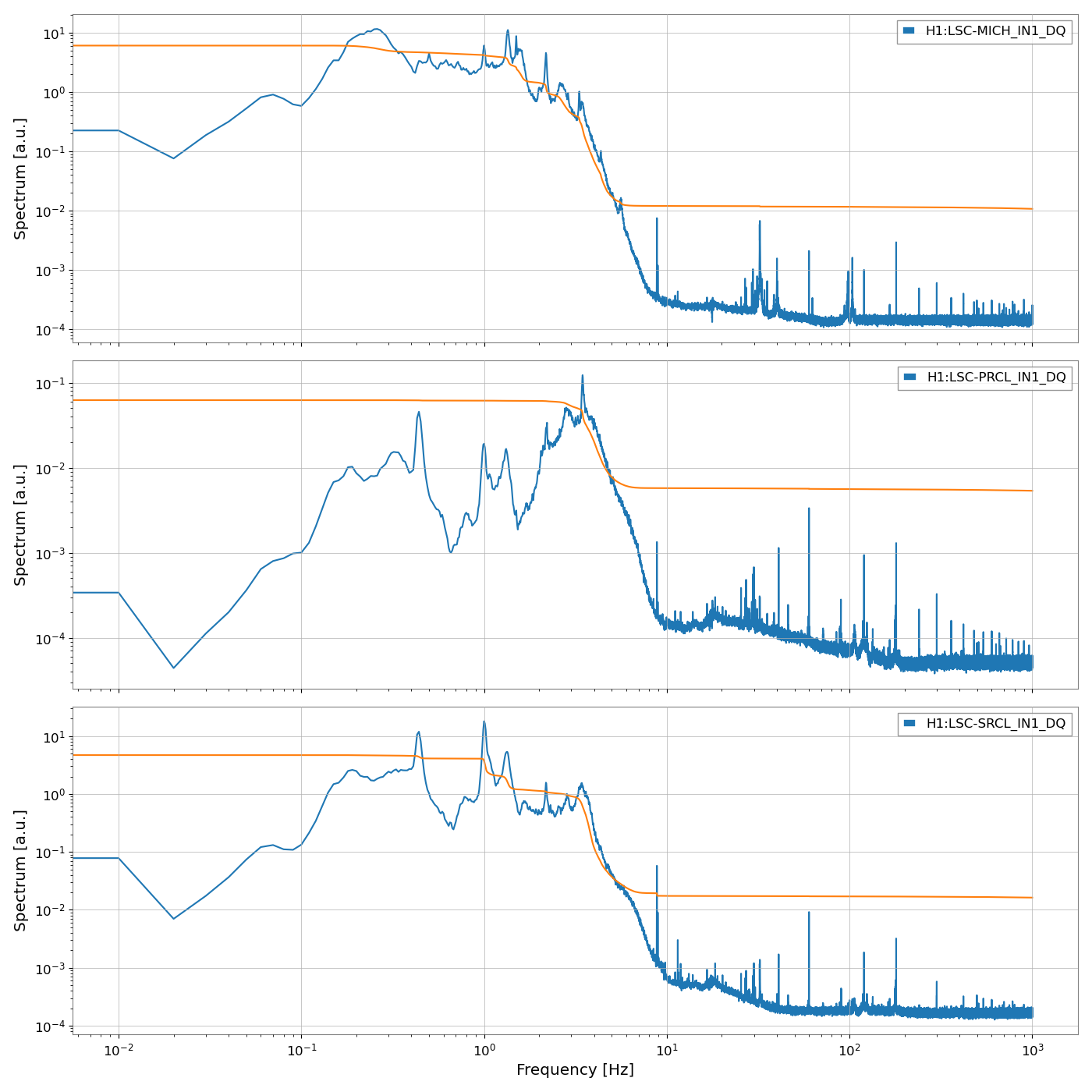
The MICH, PRCL and SRCL in-loop error signals have a fairly flat spectrum above 10 Hz, I assume mostly dominated by sensing noise, and they accumulate all their RMS below 10 Hz, mostly in the region between 0.5 and 5 Hz. I looked at the origin of the "motion" sensed by LSC error signals, by running a coherence analysis (BruCo) on them: MICH, PRCL, SRCL. I used one hour of data and run high resolution FFTs with a bin width of 50 mHz.
Most of the RMS is between 2 and 5 Hz. There is coherence with
- PRM M1 damping loops below 1 Hz: L, P and Y, with P being the only damping loop with some coherence above 3 Hz. I assume this could be real PRM motion below a few Hz
- PR2 M1 damping, mostly Y (especially at 3.4 Hz) but also P and L
- PR3 M1 damping seems to contribute most to the 4-9 Hz region: L and Y
- CHARD_Y is coherent between 4 and 8 Hz, and again between 15 and 50 Hz. It's not clear which way the coherence goes: this might well be PRCL control pulliting CHARD, since we know that CHARD is noisier when we do a PRCL injection.
Incidentally, there is still a significant 3.47 Hz peak, even with the corrrected offload for PRM. This is mostly coherent with PR2 Y damping
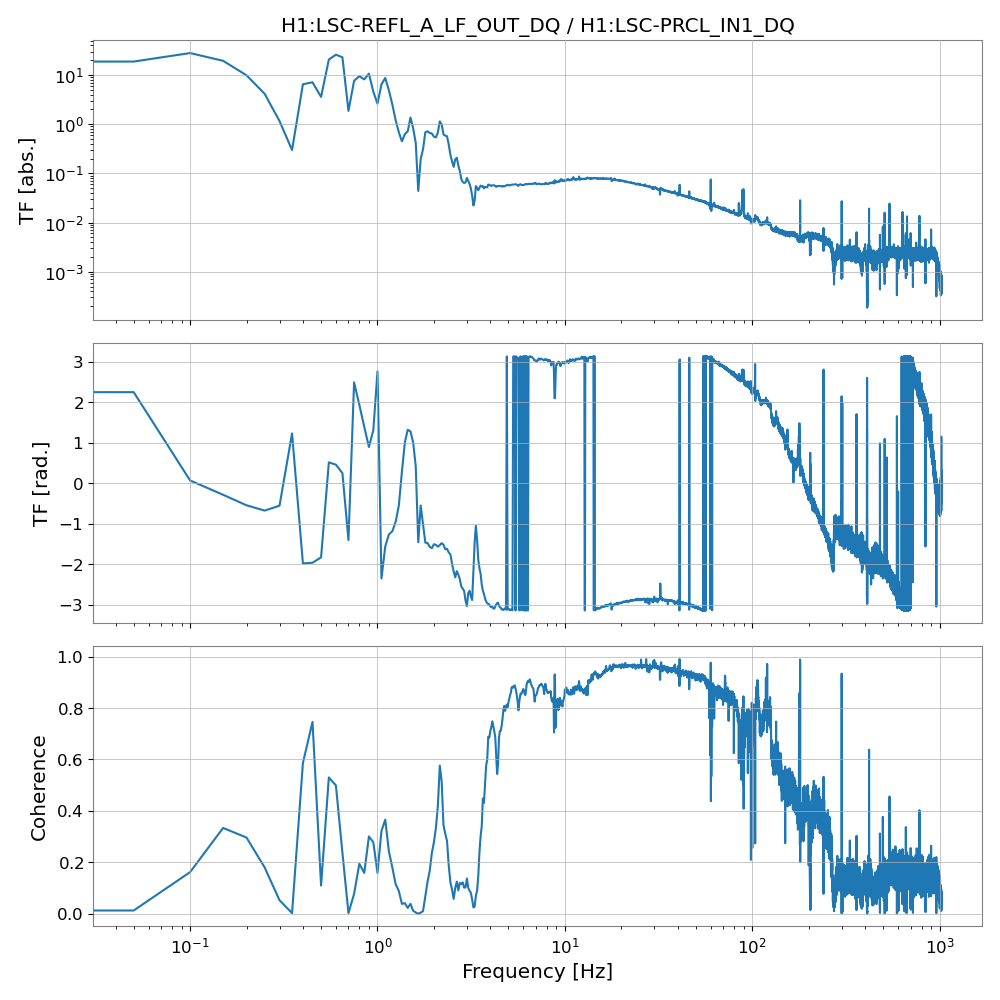
One interesting note: PRCL is highly coherent with LSC-REFL_A_LF_OUT between 4 Hz and 200 Hz: why do we see coherence between PRCL motion and power fluctuations in reflection?
Do we have a PRCL longitudinal offset? Coherence with POP_A_LF is lower, so this might be due to higher order modes. We didn;t have light on the POPAIR diodes, so we cannot see if there is coherence with the sideband powers, that could be another source of the coherence with REFL_A_LF.
In summary, I think that improving PRM and PR2 local damping, and/or improving the angle to length coupling of the M1 stages could reduce the amount of low frequency noise in PRCL. We should also investigate why PR2 damping shows a 3.47 Hz peak.
The SRCL loop has lower suppression than PRCL, so there is more RMS being accumulated below 1 Hz or so. There is coherence with
- SRM M1 damping below 2 Hz: P, Y, L. Coherence is high at the very large 1 Hz peak, so probably this is real motion of the SRC
- SR2 M1 damping: P is the largest contribution to the noise between 3 and 9 Hz
- There's coherence with SRC2, below 5 Hz and at a peak at 8.8 Hz. Not clear which way the coherence goes, from SRCL to SRC2 or from SRC2 to SRCL
SRCL is also coherent with power fluctuatiion in reflection, for example LSC-REFL_A_RIN, mostly bewteen 10 and 30 Hz, and lower than PRCL. This could be due to SRCL being contaminated by PRCL motion due to a non perfect sensing matrix decoupling.
Improving SR2 P damping and angle to length decoupling of the M1 stage should reduce the SRCL noise below 10 Hz.
MICH accumulates RMS bewteen 0.1 and 5 Hz. There is coherence with
- BS M1 damping as expected: L below 1 Hz, P and Y at lower frequencies
- ASC DC4_Y loop betweeen 2 and 5 Hz, P at lower frequencies
- ASC MICH_Y contributes a bit betwen 5 and 10 Hz
- DHARD_Y is a contributor below 10 Hz
- Not sure what this means, but there is coherence with SQZ-ASC_POS_Y between 1 and 5 Hz. Similar with other SQZ signals such as SQZ-ASC_ANG_Y
- MICH is coherent with SRCL and PRCL, probably again due to imperfect sensing matrix diagonalization
The 32 Hz peak shows coherence with many signals: ASC-OMC_A_PIT, ASC-AS_A_RF45_I_SUM.
Maybe the most interesting is PEM-CS_ACC_PSL_TABLE2_Z: this is coherent also at the 40.1 Hz peak and at the peaks at 98.3 Hz and 103.6 Hz. Similar coherence with PEM-CS_ACC_PSL_TABLE1_Z
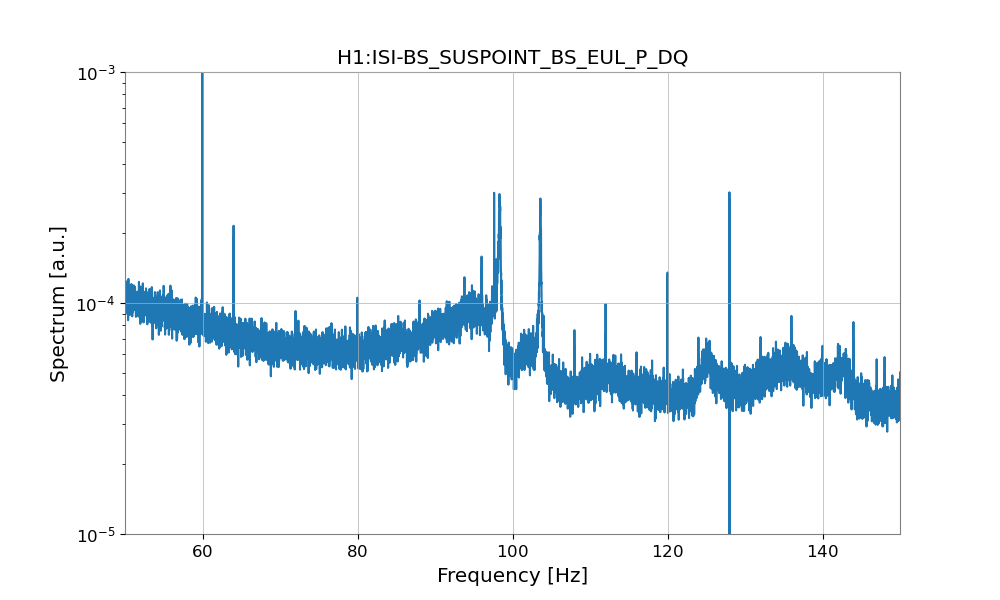
The peaks at 98.3 and 103.6 Hz are coherent with ISI-BS_SUSPOINT_BS_EUL_P and many more ISI-BS signals: is it some real motion of the ISI? This is also coherent around 32.2 Hz, which seems to be a smaller secondary peak near the larger 32.3 Hz peak.