On Monday we noticed a very large spike in DARM. This ended up being as a result of a truck delivery that occurred midday. It appears that the additional gournd motion from the truck rung up bounce modes of some of the mirrors (HSTS and HLTS bounce modes are located around 27-28 Hz). Once the truck left, the peak and excess noise in DARM calmed back down. However, this reminded me of previous times we saw a large, nonstationary peak in DARM around this frequency. When investigating what was causing this peak, I noticed that the mirrors in the PRC seemed to be the most affected by the truck motion. This was strange to me, as the HSTS all have similar bounce modes, and the truck delivery occurred closest to the asymmetric port (closest to SRC mirrors).
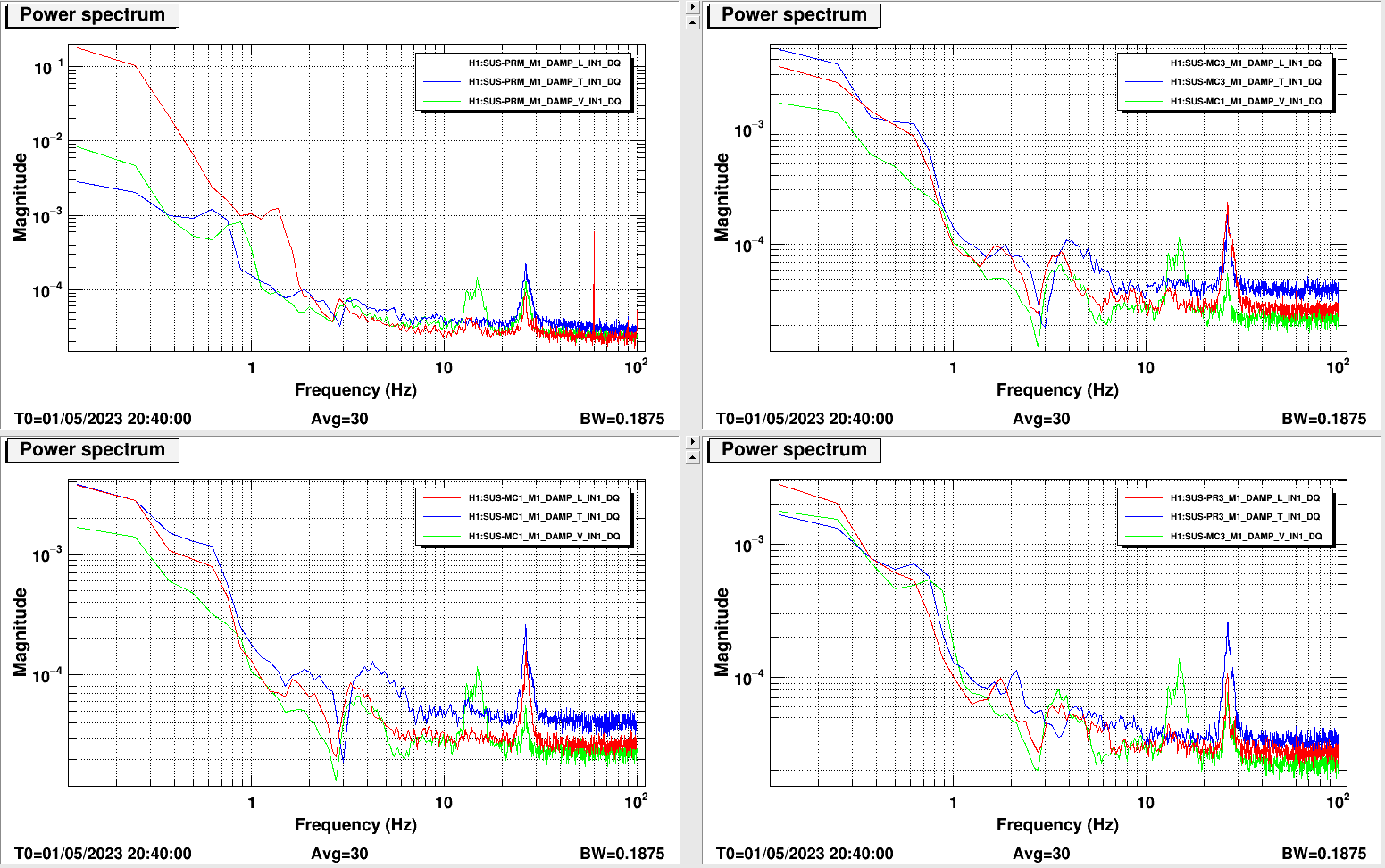
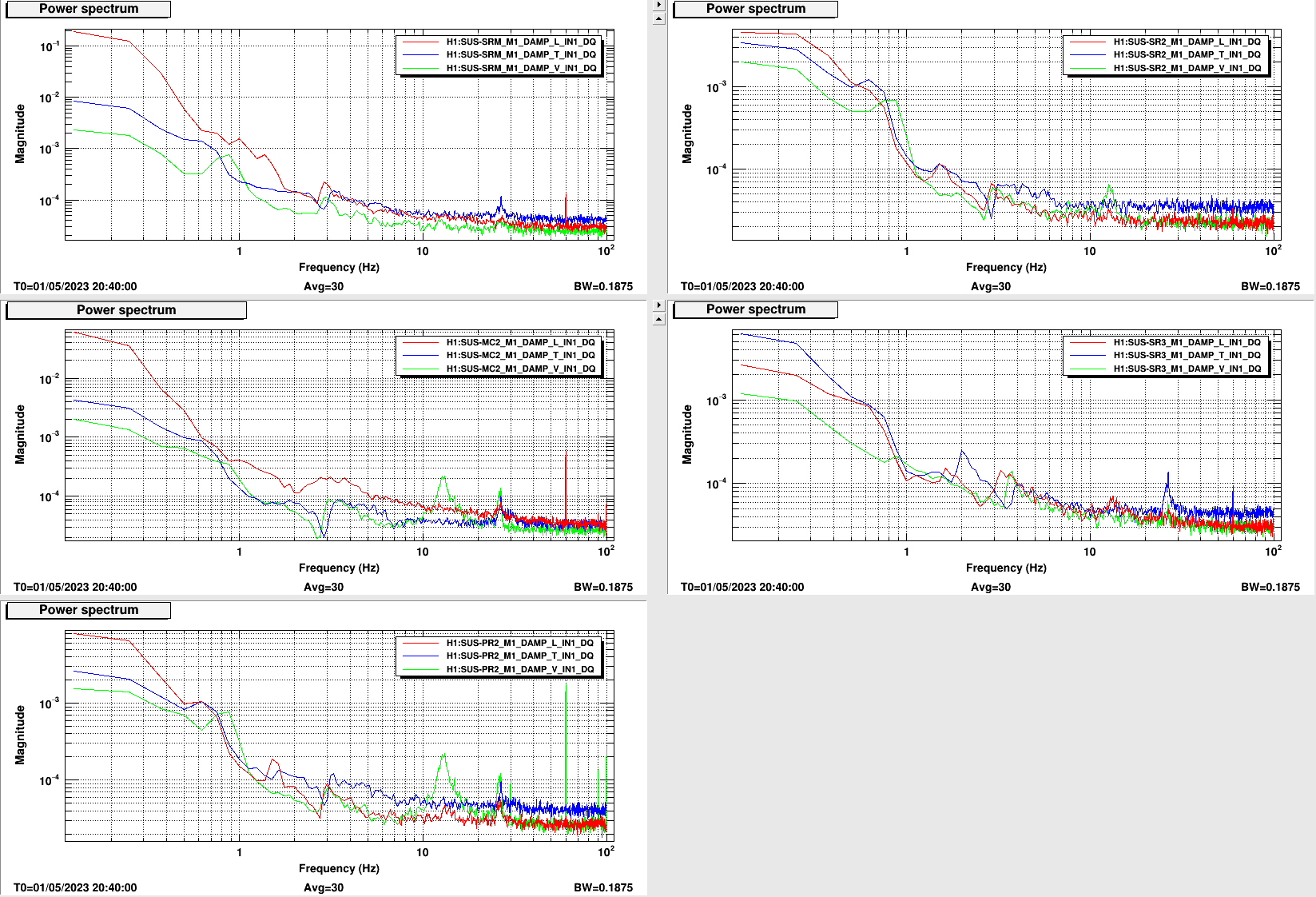
It turns out that during this time of excess ground motion, the mirrors most effected were the mirrors in HAM2: PRM, PR3, MC1 and MC3. I made this plot showing the top mass L, T, and V optic motion (damping loop error point) of the mirrors in HAM2. I made a similar plot for HSTS optics in HAM3, 4, and 5. Mirrors in HAM3 (MC2, PR2) saw excess motion too, as well as mirrors in HAM4 and HAM5 (SR2, SRM, SR3). However, the excess motion of the mirrors in HAM2 was about a factor of 10 above the noise floor, compared to perhaps a factor of 2 for the mirrors in other HAMs.
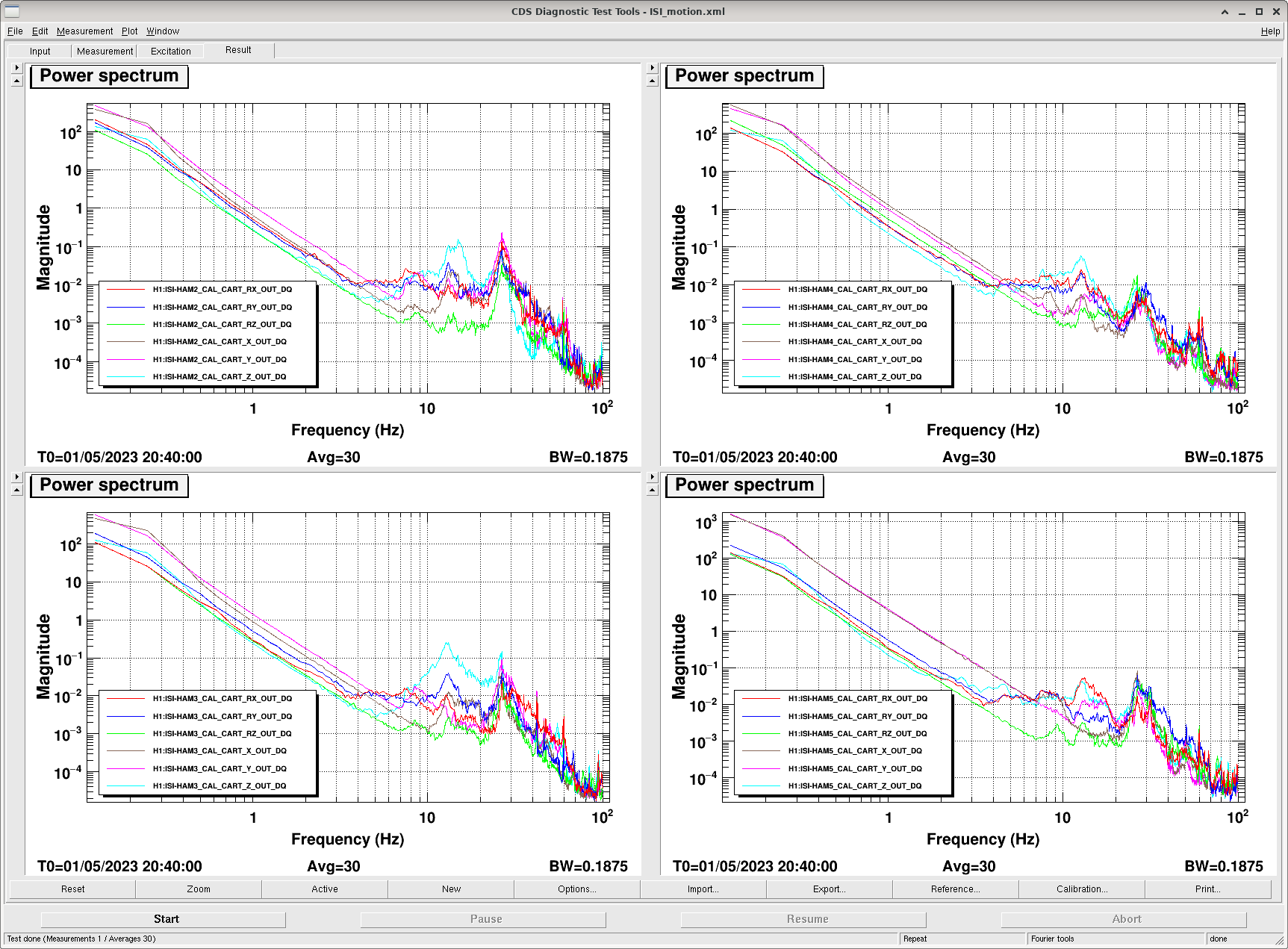
I made a plot of the ISI motion at this time as well. HAM2 and HAM3 have the most motion, HAM5 slightly less, and HAM4 motion is about a factor 10 lower. This reminds me of times in the past when Jim has told me that the isolation in HAM4 and HAM5 is much better than HAM2 and HAM3. I also know that Jim has been working on improving the isolation (via feedforward) of HAM2.
There have been a few alogs in the past noticing a large 27 or 28 Hz peak in DARM (66692, 67952). Georgia did some work to suggest that it was the PR3 bounce mode, possible rung up by a motor in the LVEA. Gabriele noticed a similar peak. It it worth looking at if we can mitigate whatever it is ringing up the bounce modes of the triple mirror suspensions, especially the ones in HAM2. Sometimes the peak is accompanied by extra broadband noise around the peak. I am tagging PEM, SUS, and SEI in this alog so we can look at if there is something locally (like the motor Georgia mentions) that rings up these bounce mode, while in parallel we can try to improve the HAM2 isolation.
The GPS time around when we noticed the massive peak in DARM was 1367008818 and lasted about 10 minutes.

I noticed the truck activity in some of our PEM sensors too. Since there was time+frequency-correlated signal in the sensors and DARM, I ran PEMcoupling on the truck time - we can treat it as a PEM injection. Here is the output directory: https://ldas-jobs.ligo.caltech.edu/~adrian.helmling-cornell/acc_test_truck/injection_1367007218_1367008218/ + an example posted below. For sensors near the output port, like our OMC accelerometers, we observe enough excess noise in DARM to make a measurement of the coupling function near 30 Hz, as well as some upeer limits. I assume that the 30 Hz noise from the truck comes from a harmonic of a 600 rpm engine, but I don't see 10 or 20 Hz noise in DARM.
