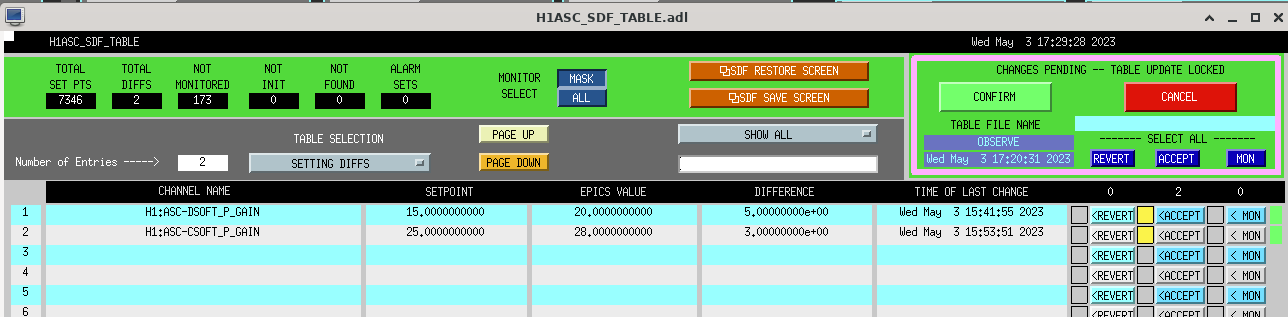
We just had a lockloss after 20.5 hours of lock that appears to be from the ASC, specifically CSOFT P. The oscillation was at about 0.45 Hz and the ring up occurred within the last two minutes of lock. The oscillation appears in other ASC signals, such as INP1, DHARD, and MICH.
I am suprised to see this kind of lockloss so long into the lock, so I am not exactly sure what action to take. I have increased the DSOFT P and CSOFT P gain to give more bandwidth to the loops. I also think we should try to get an OLG of CSOFT P at this higher power (the last OLG was taken at 60W, 67539). OLGs of all arm ASC loops at 430 kW of power would be ideal, but take time.

Accepted in DSOFT, CSOFT sdf, see attached.
Camilla noted another CSOFT P ringup last night. I decided to run another sensing matrix measurement at the REFL port to see if any optical gains or phases changed. I have attached the old sensing matrix measurement at 2W (on which our current sensing matrix is based), and the sensing matrix I took at 76W with the new SRCL offset. (Just a note, I forgot to open the POP beam diverter before taking this measurement, so I have no data of the sensing in POPX at 76W).
As a reminder, our current pitch input matrix is as follows:
| REFL A RF9 | REFL A RF45 | REFL B RF9 | REFL B RF45 | |
| CHARD P | 0.175 | 1.337 | 0.232 | 1.356 |
| INP1 P | 0 | 2.4 | 0 | -2.4 |
| PRC2 P | 0.056 | 0 | 0.034 | 0 |
It appears that the INP1 P signal has flipped sign in REFL WFS A RF45. Assuming that INP1 P and CSOFT P are cross coupled, that is likely the culprit. INP1 P also did ring up in the locklosses. Hopefully, the fix will be as simple as flipping the sign of the INP1 P sensing in A RF45. We will test this on the next lock.
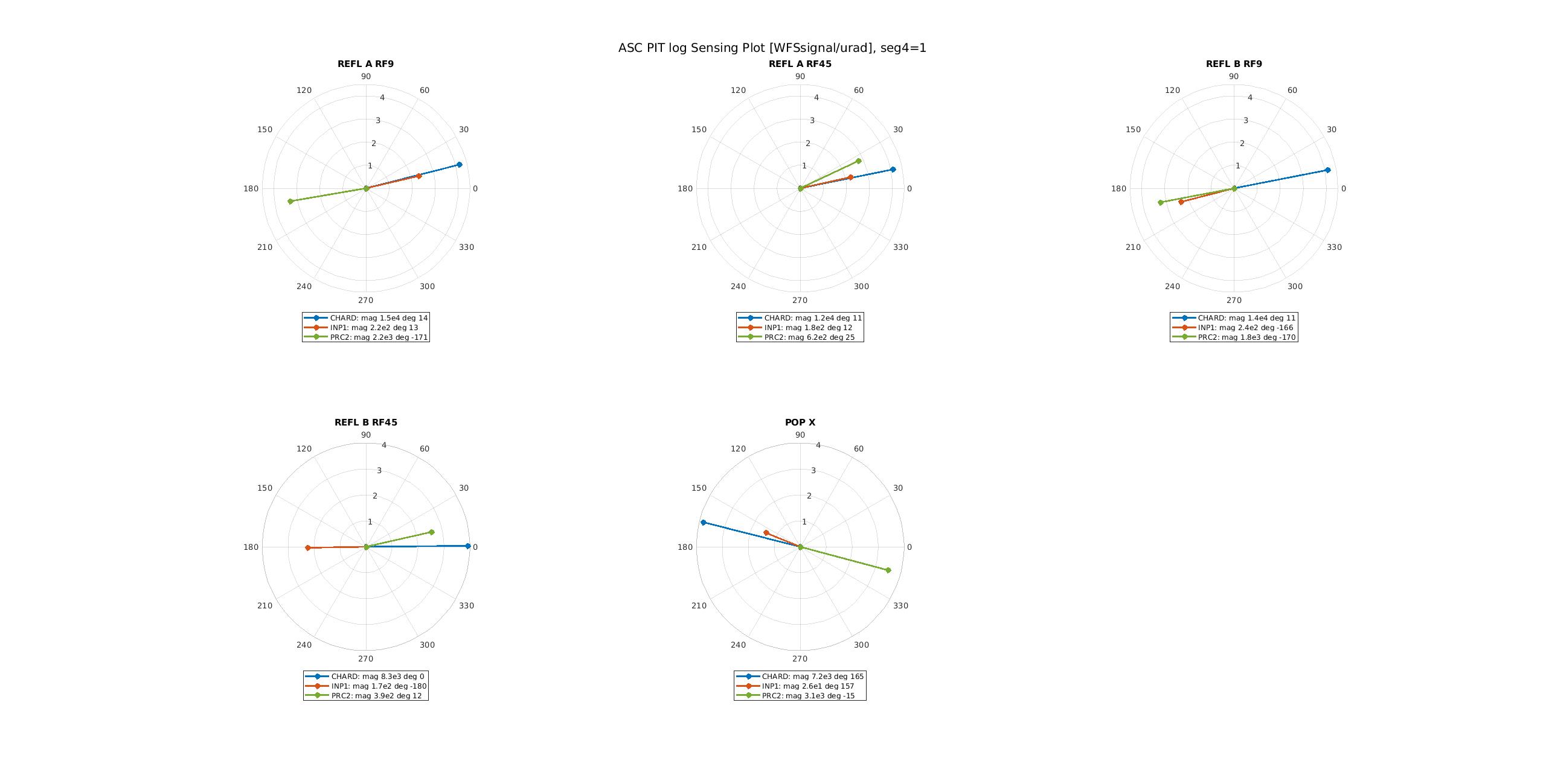


At 2W I changed the sensing matrix for INP1 P slighty to be 1.74 of REFL A 45 and -2.93 of REFL B 45. I obtained these values by inverting the sensing matrix I measured at 76W. This uses the recommended ratio of A and B 45 suggested by the matrix, rescaled to match the gain of the loop. I also checked that the phase of INP1 is correct. I injected CHARD and PRC2 lines and saw that there was minimal coupling of those two loops into the new INP1 signal. This is a relatively small change. If we still have problems in full lock, we probably need to update the CHARD and PRC2 sensing to ensure the subtraction of the INP1 signal is correct. I will update the guardian with the new INP1 values.