
evan.goetz@LIGO.ORG - posted 11:22, Friday 12 May 2023 (69536)
Updating calibration of the hardware injection paths
As O4 approaches, we will begin running the CW hardware injections soon, perhaps starting next Tuesday maintenance. A crucial part of the injections is calibrating the hardware injection excitation point (note that this calibration may drift, especially if the splitting ratio of the photon calibrator optical follower servo changes, so nominally one would compare the actual injection waveform on the RX or TX PD with the recovered one in strain). I am revisiting the measurements made in LHO aLOG 46848 to update the hardware injection actuation function for CW hardware injections.

As a reminder, the hardware injection path sees the following:
                                                            V              W     N                 1      m     h
[ 61 usec delay x 61 usec delay x AI(d) x 61 usec delay x ----- x AI(a) x --- x --- x sus.norm x ----- x --- x --- ]
                                                           cts             V     W                f^2     N     m

The terms AI(d), AI(a) are the known digital and analog anti-imaging transfer functions, respectively, that we can model in pyDARM; sus.norm, 1/f^2, and m/N are pieces from the SUS dynamical model for the L3 stage of the QUAD suspension; N/W is the watts-to-force transfer coefficient 2*cos(theta)/c where theta is the angle of incidence and c is the speed of light in a vacuum; V/cts is the DAC calibration for the Pcal system 20 V / 2^18 cts; and h/m is the strain per meters, essentially 2/(L_x + L_y). So the remaining term we need to know is the watts per volt of the photon calibrator.

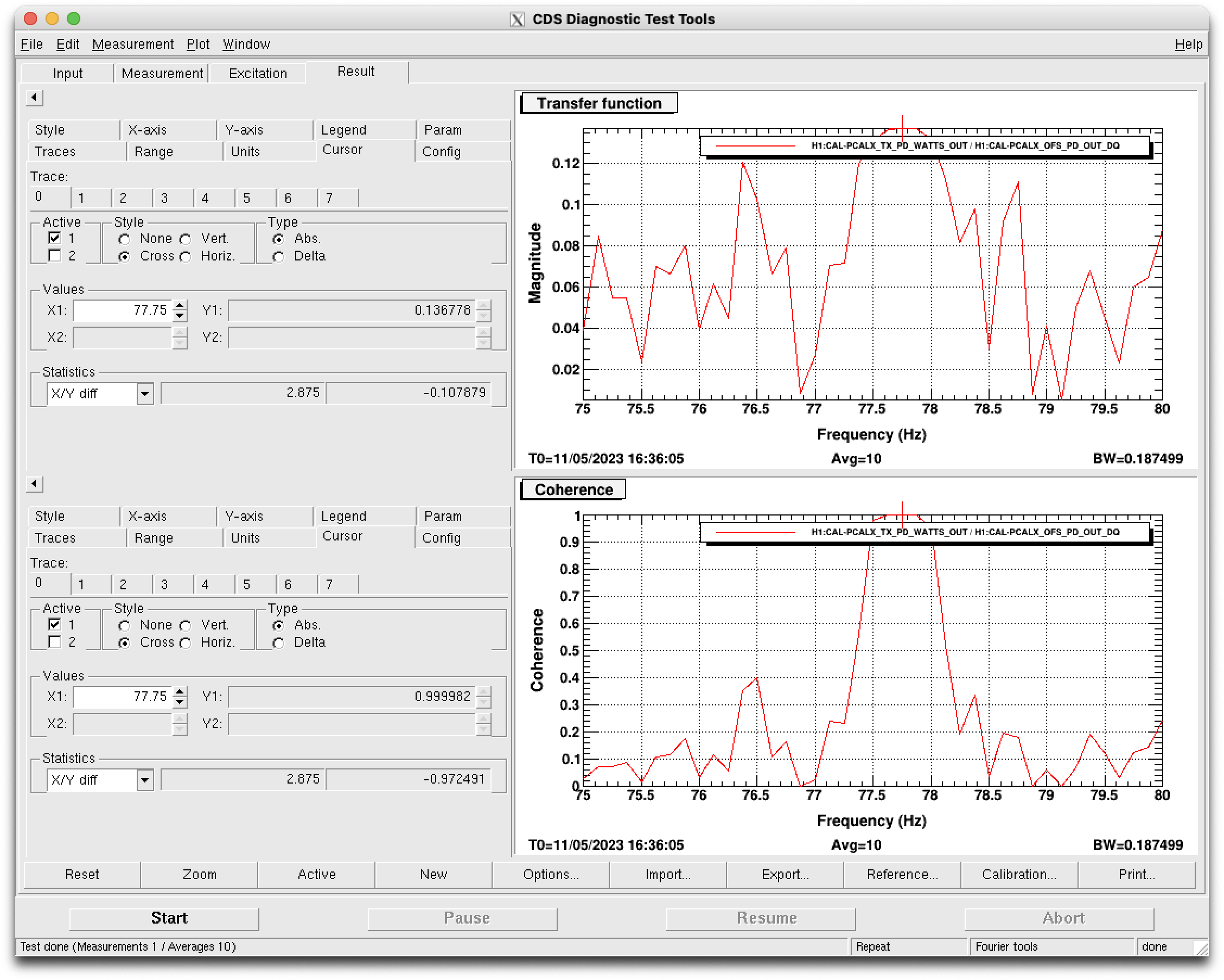
Historically, I calculated this value through a series of calculations and a single transfer function measurement (e.g., LHO aLOG 46846), but now this is a lot simpler due to some front end improvements. Now I can take a transfer function measurement and get the results directly from that measurement H1:CAL-PCALX_TX_PD_WATTS_OUT / H1:CAL-PCALX_OFS_PD_OUT_DQ, using 10 averages and BW setting of 0.1 Hz.

Attached is a screenshot of that transfer function, where I zoomed in on one of the systematic error calibration lines, 77.73 Hz. The coherence at the closest bin, 77.75 Hz is very high (>0.9999) and the resulting transfer function magnitude is 0.136778 W/V. Compared to the previous value of 0.13535, this is a change of just over 1%.

I then used an up-to-date pydarm_H1.ini file with this new value for pcal_etm_watts_per_ofs_volt = 0.136778 to generate an actuation function file attached to this aLOG. The main difference is the new calibration of the W/V value and to remove a DC scaling of the AI(a) of 0.99. These two effects combine to change the DC calibration of the excitation point by 2%.

The next step, not yet done, is to update the CAL INJ filter bank values with updated numbers in the filter banks FM6 antiAIaGain (change to 1.0) and FM7 cts/N (change to 1.4539e13). I am not sure the current value in the FM3 N/m value is correct, if I calculate the m/N value at 1 Hz for the x-arm TST stage, I get a value of 0.00156554 m/N ==> 638.75611903 N/m, which is significantly larger than the current value of 382.954.
Images attached to this report
Non-image files attached to this report
