
While LLO were not Observing, I took some SQZ data to help better understand our SQZ angle for future overnight tests. Our squeezing hasn't been great over the last few days, we expect as our NLG and power though the SHG have decreased, we will go onto SQZT0 tomorrow.
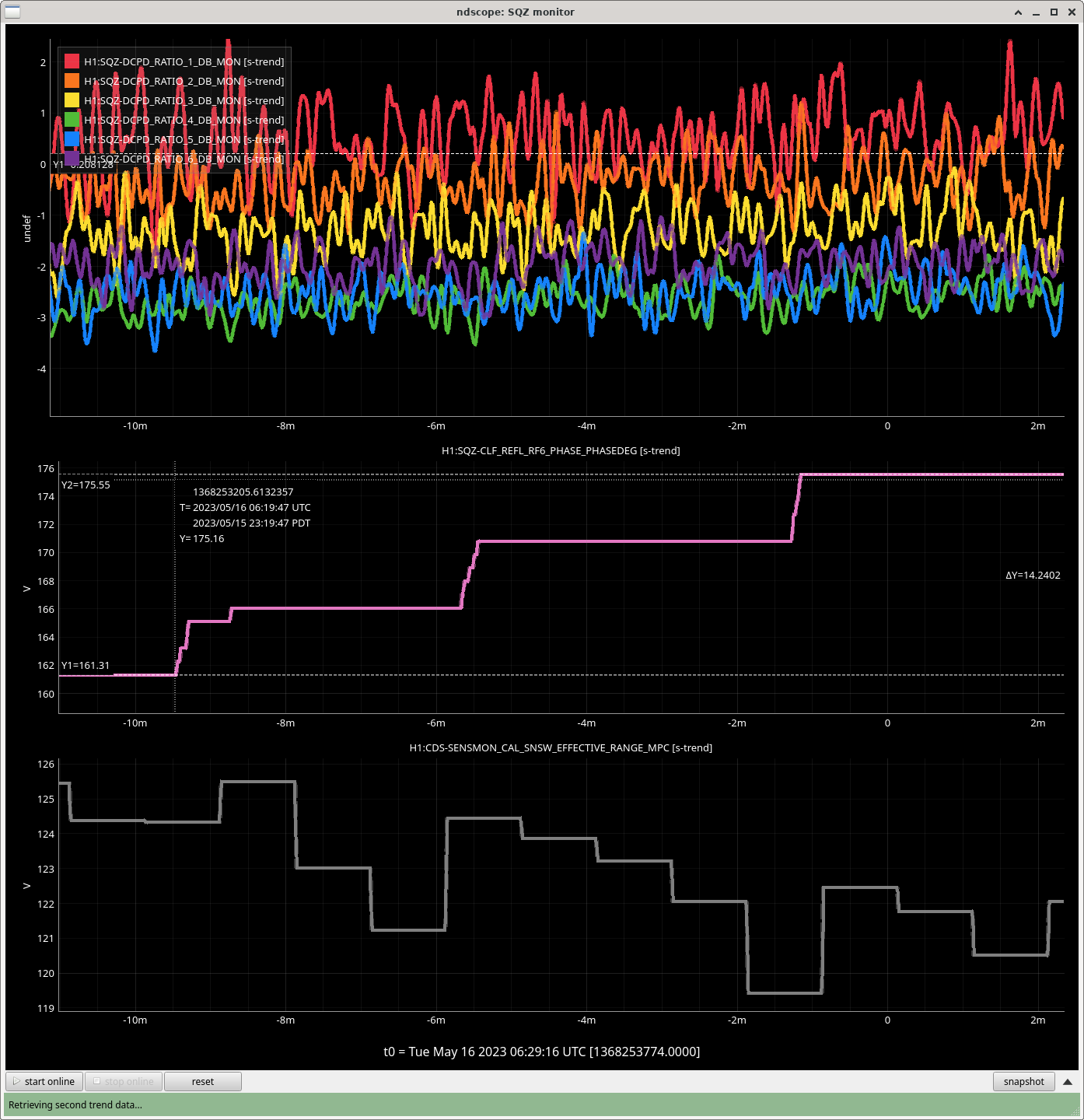
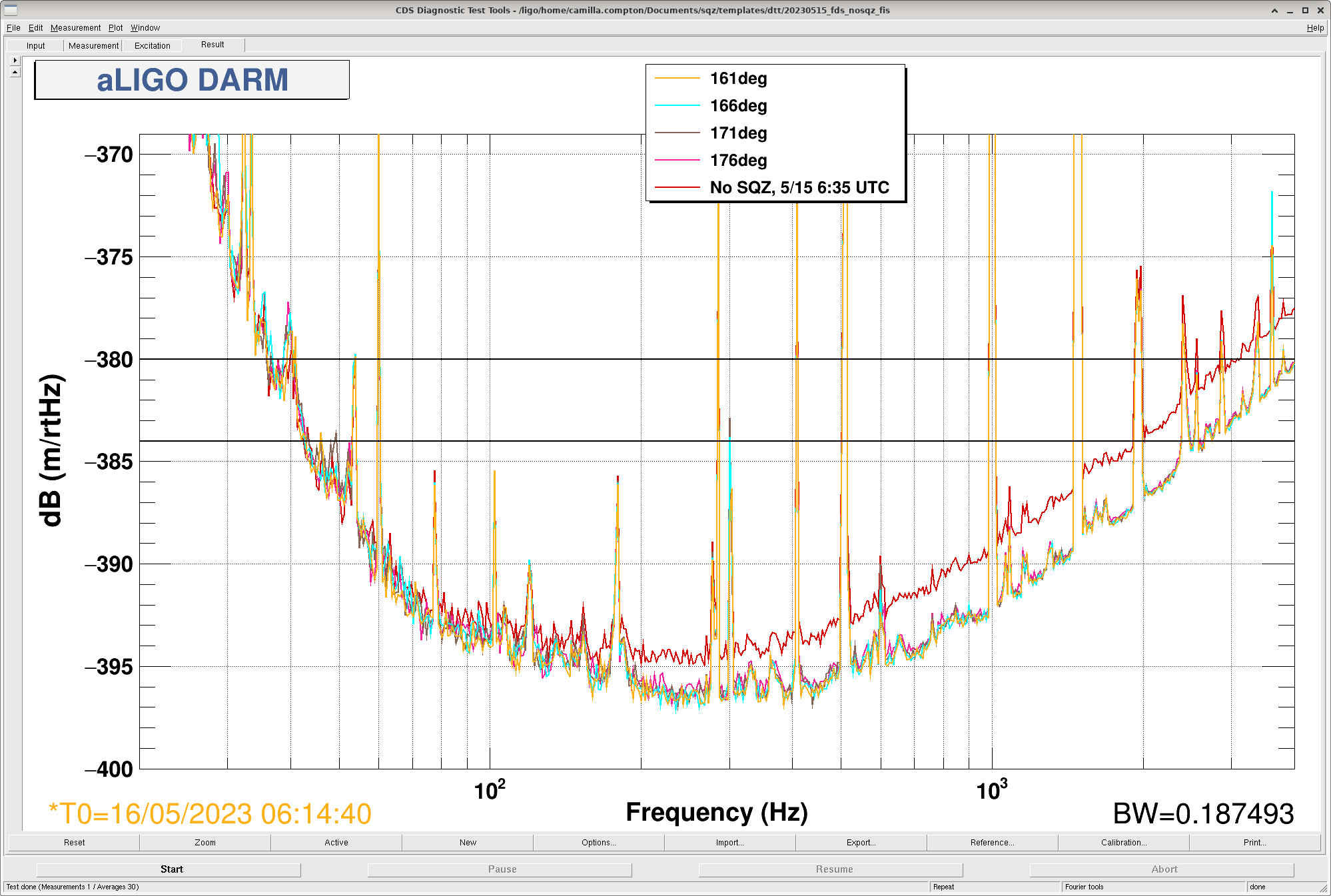
- 6:19 to 6:30 UTC, I made small SQZ angle adjustments during Observing tagging DetChar. See attached plot and dtt.
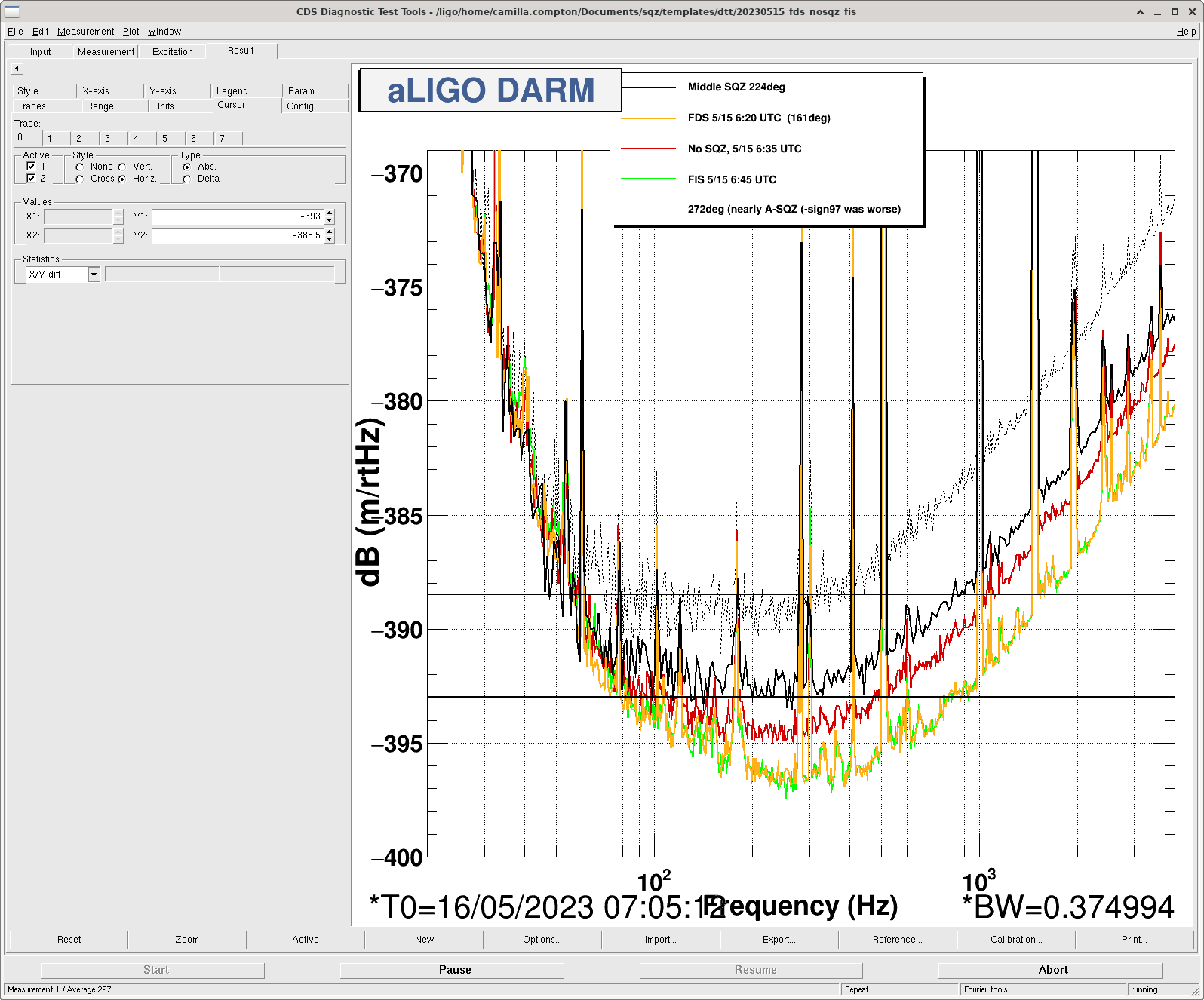
- 6:33 to 6:43 NoSQZ. DTT plot
- 6:45 to 6:52 FIS (SQZ_MANAGER went to FIS via FDS, I think this may be because I weighted the edges between SQZ_ASC and FIS, we should maybe remove this)
- 6:54 Back to FDS (Took two attempts of FC locking to go back to FDS.)
- 6:54 - 7:16 Finding SQZ (161deg), No-SQZ (positive CLF servo sign 97deg / normal sign 272 was nearly as much A-SQZ) and mid-SQZ (225deg) levels, attached plot. 9dB difference between SQZ and Anti-SQZ.

Naoki, Sheila, Vicky. It was great that Camilla did these meausurements last night!
OPO TRANS DC POWER = 39.6 uW. According to calibration on 2/3/23, which has been pretty trustworthy, this is about NLG = 3.92, so generated SQZ = 9.24dB.
- no sqz 1368254000 - 1368254627
- asqz 1368255661 - 1368255794 (~2min, +276.8 deg). About 6.3-7dB anti-sqz, call it about 6.6dB asqz.
- mid-sqz 1368256444 - 1368256532
- sqz 1368256735 - 1368258507 (+161deg). About ~2.6-2.9 dB sqz, call it -2.7dB sqz.
Based on the no-sqz data at this time, IFO losses are below 35%, and more like 20-30%. These sqz/asqz levels suggest either significant 50% squeezer losses (15-30% excess sqz losses from ifo losses), or that our NLG is mis-calibrated/mis-tuned due to wrong opo temperature at the time.
If we had only the known levels of squeezer injection losses (say common 20-30% losses with ifo + additional 7% sqz injection losses, total ~30% loss), I'd expect we'd have seen ~7.5-8 dB asqz, and over -3.7dB sqzed noise reduction, which was clearly not the case.
Assuming fixed/real NLG, adjusting losses to match observed sqz/asqz. With NLG = 3.92, this gives generated SQZ = 9.24dB. To only see Anti-SQZ = 6.5dB and sqz = -2.5dB, suggests the squeezer sees 45-50% total losses, so like 15-30% excess of ifo losses.
Given these SQZ/ASQZ levels, calculate NLG and losses. Best-case for losses, an NLG=3.3 and losses 42% would be sensible. This is still excess 10-20% sqz losses from ifo losses.
What was our NLG? Today Naoki measured NLG=3.75 after several DAQ restarts. This would need about 50% sqz total losses, 15-30% excess sqz loss from ifo losses.
Potentially the opo co-resonance temperature is mistuned for red/green co-resonance, given that I'm not sure we re-tuned the OPO temp optimally with this lower NLG and the recent LVEA temperature drifts. Maybe our AS42 offsets are also bad, we have not updated them in a while, and there have been many computer restarts last week. As well, we've had FC alignment/ASC changes; we've checked for clipping but maybe with recent computer restarts it is worth double-checking. We'll check everythign again after today's sqzt0 table work, and see if we can reconcile these numbers. We can try to more often quickly check asqz/mean-sqz to better understand our losses.

I checked the logic and removed the weighted the edge between SQZ_ASC and FREQ_INDEP_SQZ in SQZ_MANAGER so it should now go straight to FIS if it is requested. It can also go between FIS and FDS as icky and I previously added.
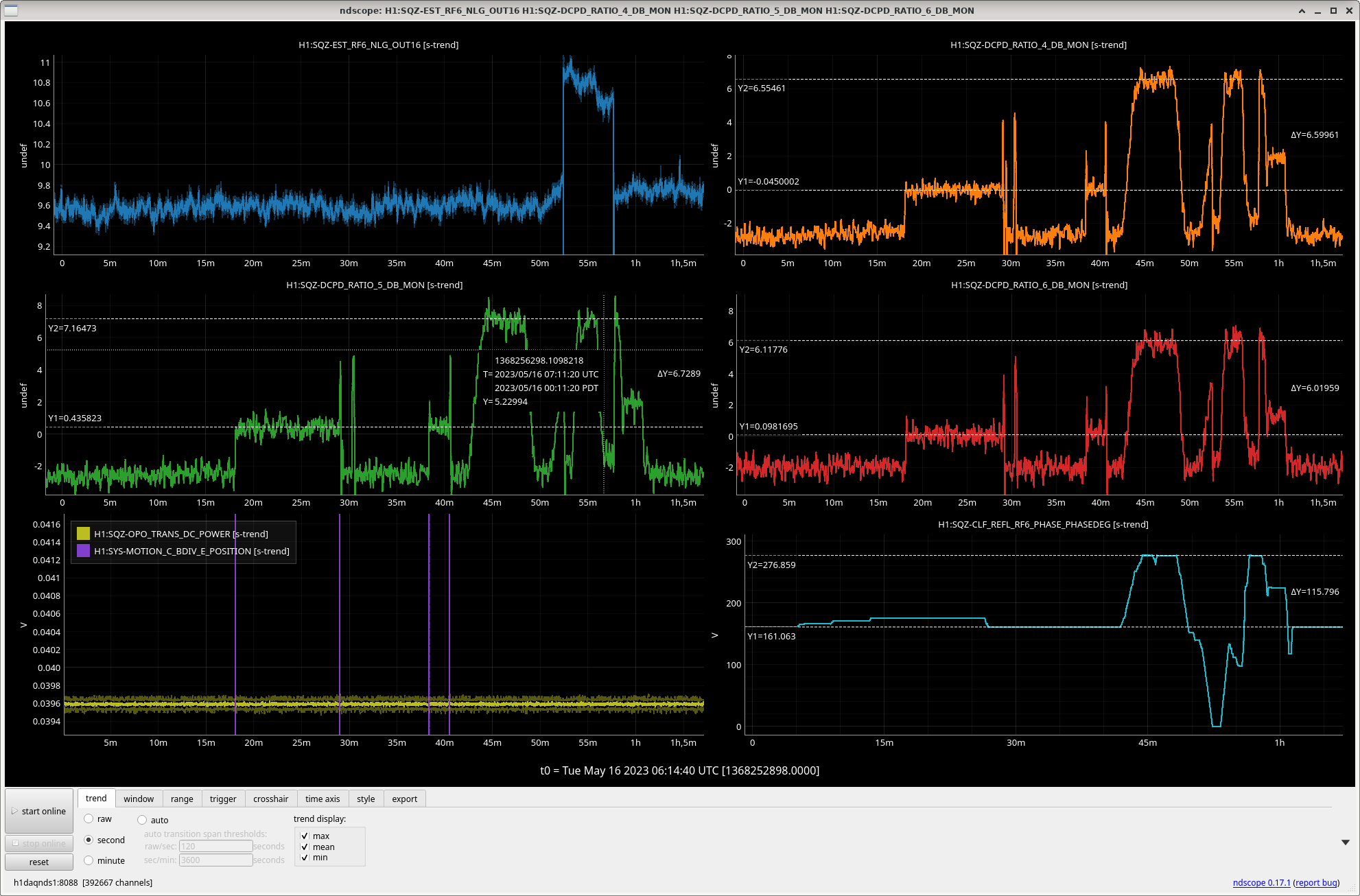
Looking into why SQZ_FC was slow (3 minutes) getting from FIS to FDS, see attached:

- 1st t-cursor - TTFSS unlocked. SQZ_LO_LR went DOWN and SQZ_MANAGER went to SQZ_READY_IFO and closed BDiv. Correct behavior, but why did TTFSS unlock?
- 2nd t-cursor - FC green lost lock, SQZ_FC took itself DOWN
- 3rd crosshair cursor - SQZ_MANAGER SQZ_READY_IFO requested SQZ_FC to GR_LOCKED, is our aim to have it relock here?
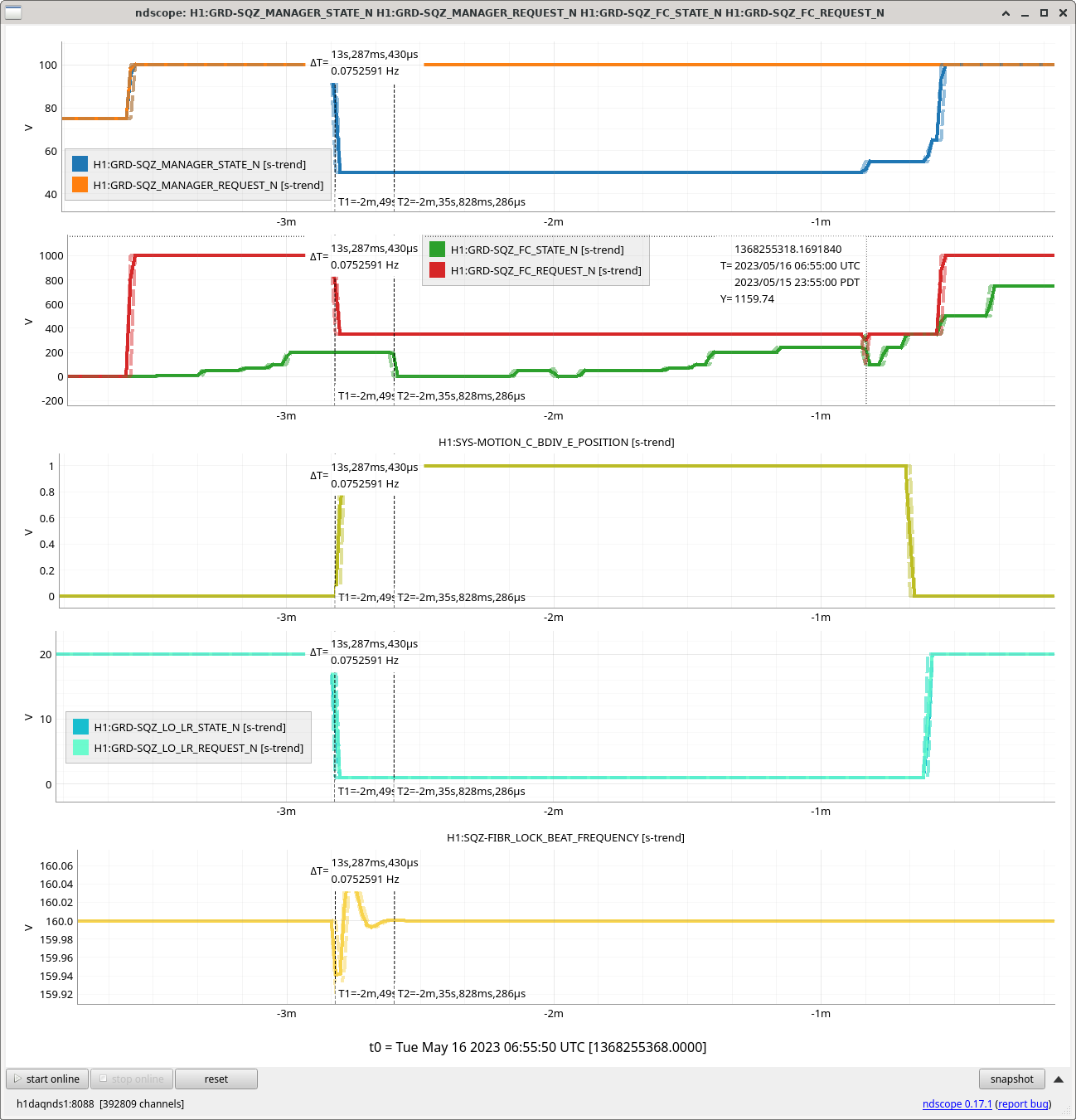
As the FC goes from FIS --> FDS, the FC guardian is bringing FC2 from MISALIGNED --> IR_LOCKED. But in the process of physically moving FC2 back, it is free-swinging, and I wonder if maybe the CLF glitches through FC resonance in this time. The CLF going through FC resonance kicks the LO loop, which kicks TTFSS, and in turns brings down the LO loop, causing SQZ_MANAGER to go back to SQZ_READY_IFO, since it looks like the LO loop failed. When we're locked next, we can check if the LO loop can stay locked while the CLF glitches through, and if it can, maybe the guardian brings down the LO loop pre-emptively even if it doesn't have to.
Maybe we don't care to switch faster between FIS --> FDS. But if we do, I wonder if we could just tune the FC out of band, as far as the RLF-CLF can go. Or, we can bring FC-IR back with bdiv closed, or open with the LO loop unlocked. If we need to do this for upcoming sqz scans, I think we can smoothen out this transition.
To comment about the losses quoted above -- I think the losses were weirdly high b/s squeezer was in a not optimal way, related to our SDF mess after computer restarts, maybe our low NLG and higher CLF powers we happened to be using for a week or so, and other semi-random technical problems that have popped up over the last 1-2 weeks. I think our previous measurements of 3.5-4dB SQZ exclude losses of order 50%, when the squeezer is operating nominally and things are "normal". But we will check asqz/sqz more regularly now, to help track losses.