
We've known for a while that when we inject laser frequency noise, we see significant downconversion in DARM, together with the expected linear coupling. In particular, when injecting band-limited laser frequency noise in the kHzs region, we see noise in the 100s Hz region getting worse.
Over the past few days I did a few noise and line injections to characterize this coupling. A more detailed analysis will follow, but here are some observations:
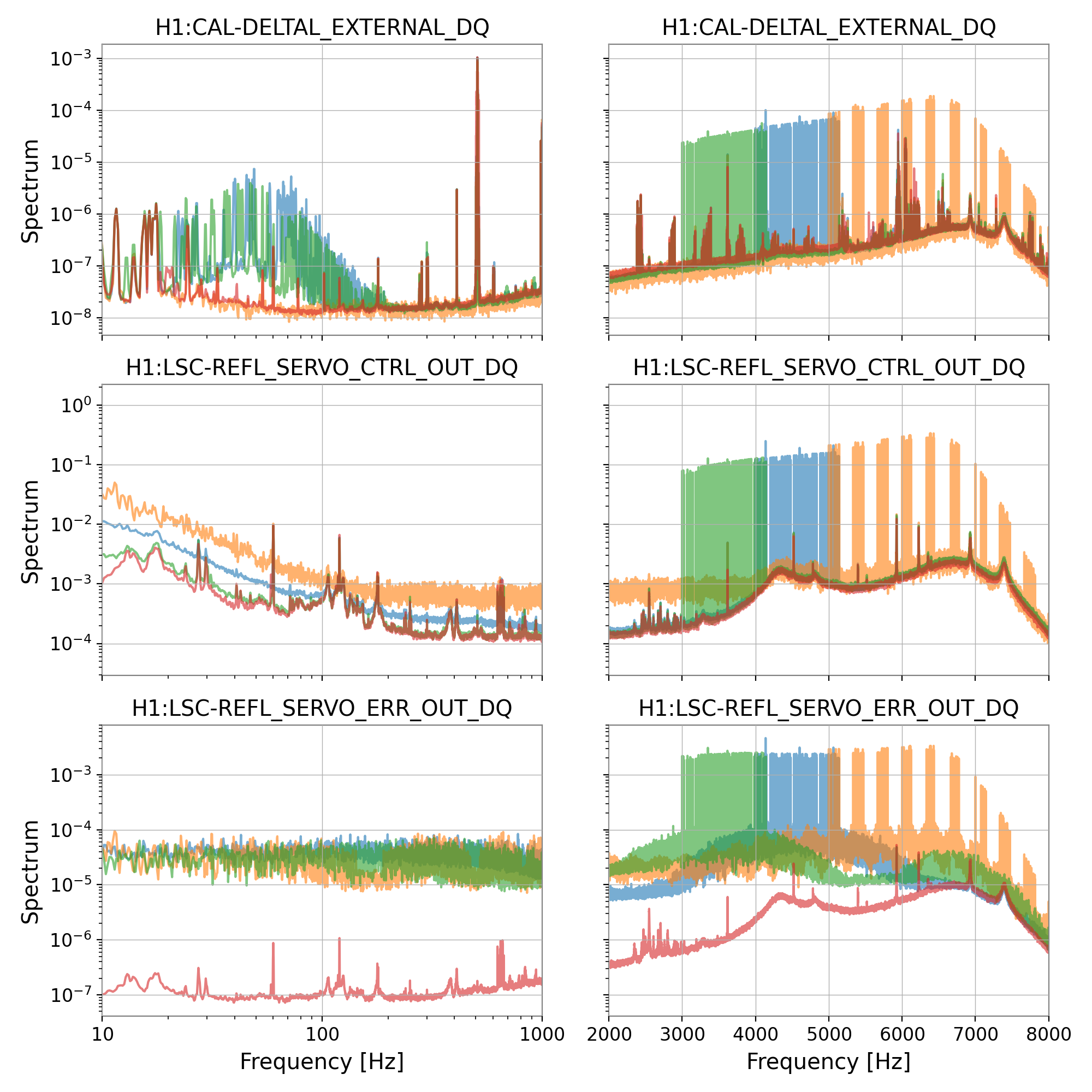
- only laser frequency noise between 4000 and 4500 Hz causes visible down-conversion in DARM
- injections out of this band don't show a measurable non-linear coupling into DARM
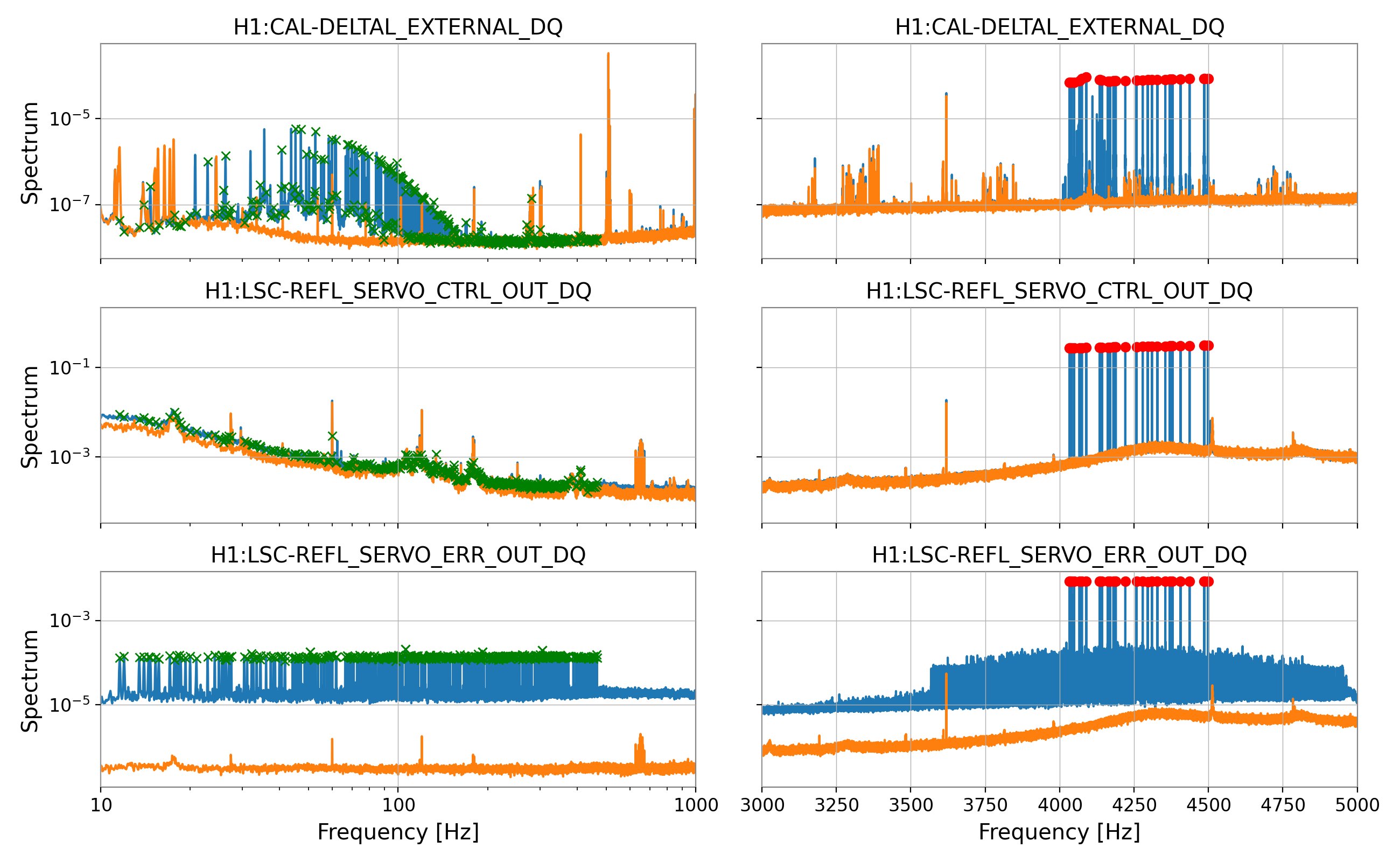
- there is also a non-linear effect visible in the REFL signal itself: when injecting high frequency lines, there are lines appearing in REFL SERVO ERR at lower frequencies
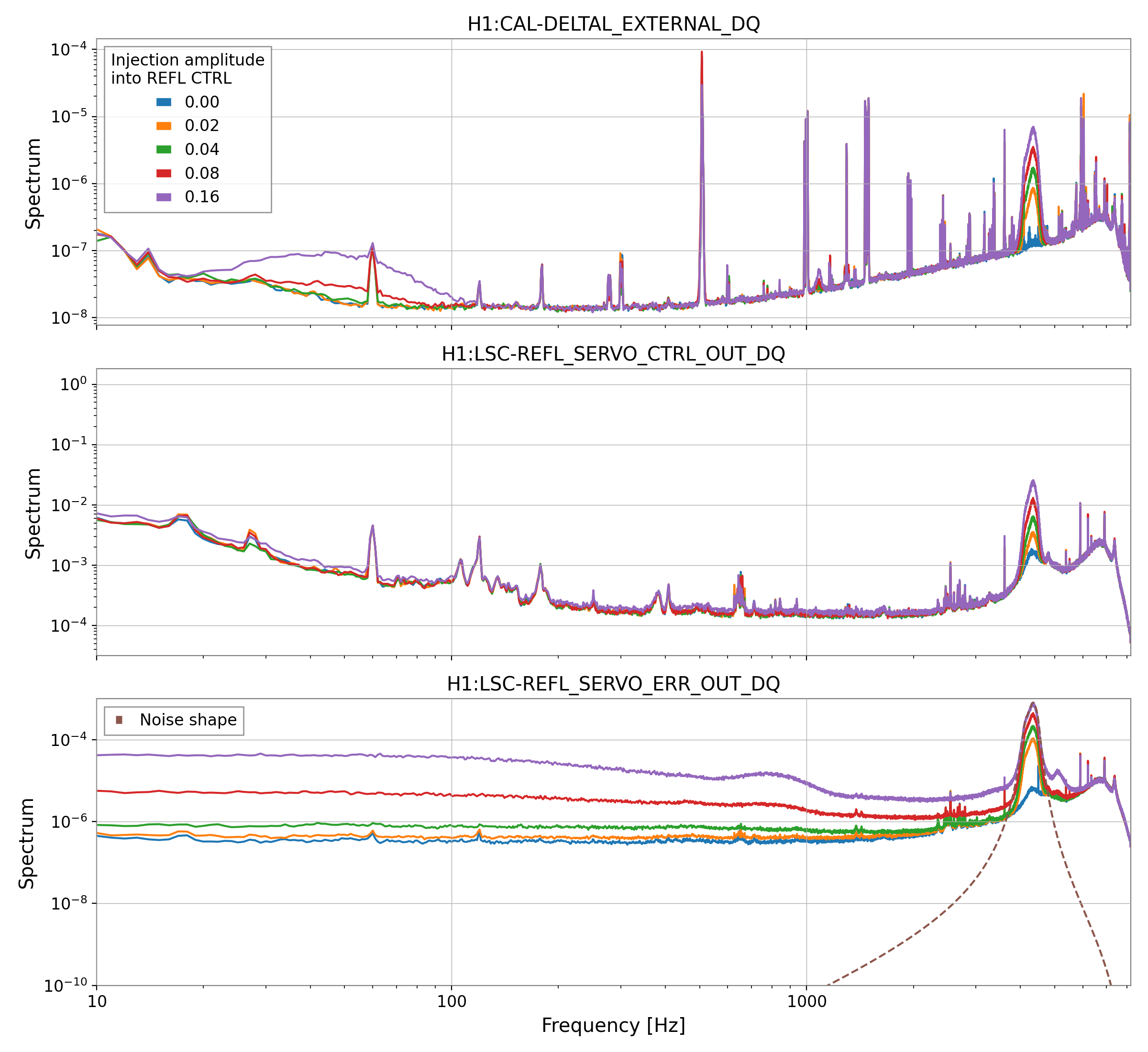
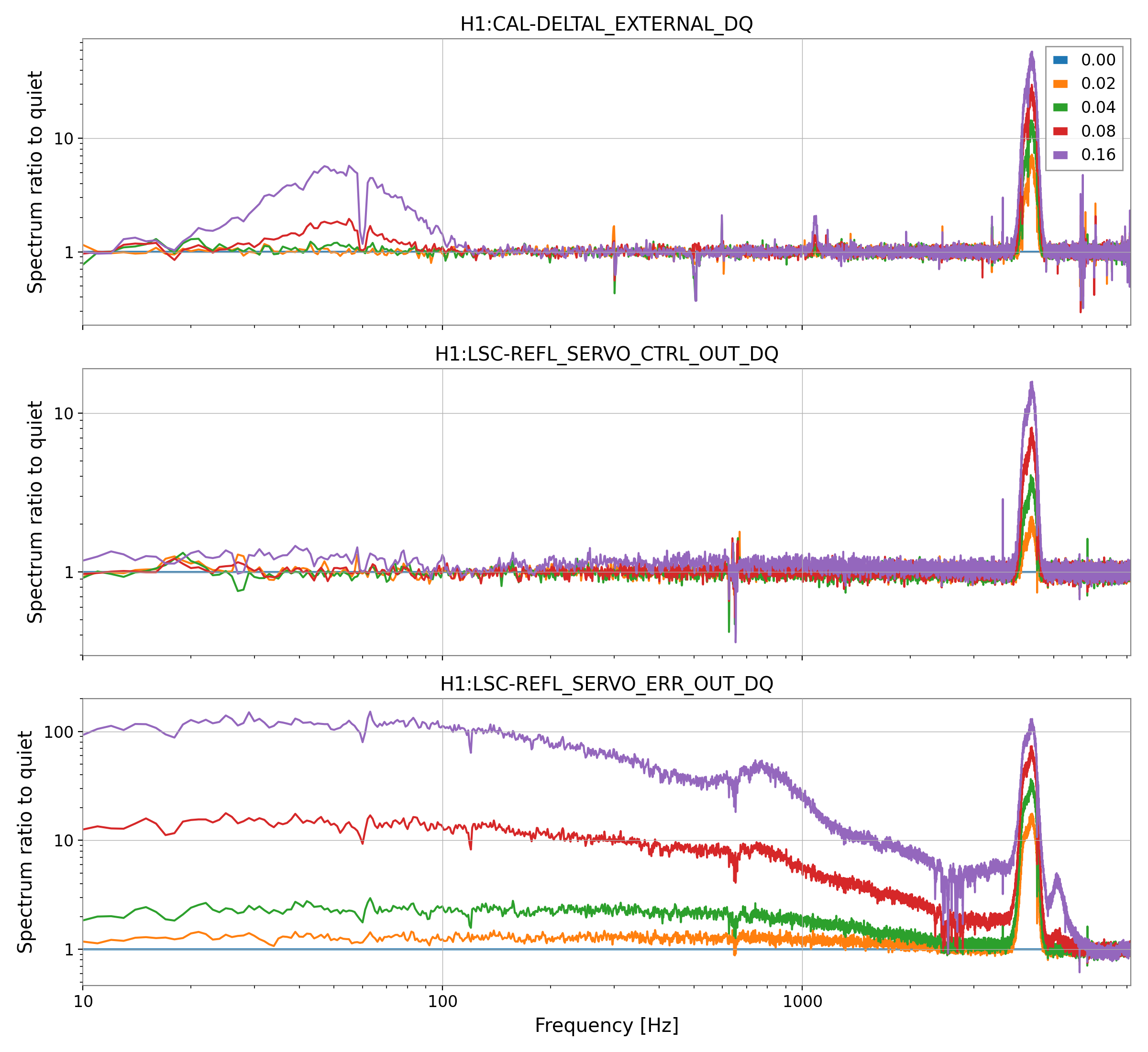
- the low frequency noise that appears in DARM scales quadratically with the amplitude of the high frequency noise injected in the laser
- when injecting lines in the laser frequencies, we see lines in DARM and REFL SERVO ERR at the difference of frequencies, meaning that this is a quadratic effect involving laser frequency nosie alone. This seems to indicate that the idea that the downconversion is due to the OMC dither line is not correct
The first two plots attached show the effect of injecting noise that mimicks the shape of the 4.3 kHz bump visible in CARM. The first one shows the spectra, the second plot shows the ratio to the quiet time. It's clear that the 100 Hz bump in DARM scales quadratically. It also seems that the downconversion effect is not large enough to be worrisome at this level.
The third plot shows what happens when I injected several lines at high frequency. The red dots shows the lines I injected, while the green Xs shows all the differences in the frequencies. All excess lines in DARM and REFL ERR are marked with a green X, so we see that the coupling is quadratic and does not involve any other line.
The last plot shows that line injections at frequencies outside the 4 - 4.5 kHz band don't produce significant downconversion in DARM.
In a follow up analysis, I plan to model the quadratic coupling from REFL to DARM, and build a noise projection.
4.1 kHz is the OMC dither line.
LHO alog 44874

Keita did some nice work in the past on the downconversion from frequency noise near the OMC dither.  At that time we determined it was not limiting DARM.  Is worth doing again.