
jeffrey.kissel@LIGO.ORG - posted 17:17, Wednesday 07 June 2023 - last comment - 07:27, Friday 09 June 2023(70258)
Debating Between 60W and 75/76W: Lack of Duty Cycle is NOT related to Input Power Choice
J. Kissel

There's an on-going debate whether we prefer 76 W (now 75W) PSL input power vs. 60 W PSL power, because we think that we had better noise performance at 60 W. It's a great debate, and I'm all for it. One thing I want to make super clear -- the lack of duty cycle during the engineering run and through the start of O4 has *NOT* been because of the increase in power from 60W to 76W. We've had one heck of a couple of months in terms of
    (1) An insidiously slow drift in yaw on all of our HAM ISIs due to an innocent oversight of a foton-induced copy-and-paste error in ISI RZ blend filters (now fixed)
    (2) Literally every Tuesday for the past 4 Tuesdays, we've had a 1 deg C (~1-2 deg F) rapid temperature excursion in the LVEA, and some not even on Teusdays
    (3) A particularly earthquake full couple of months
    (4) We've had 3 or 4 inadvertent, system-wide, inter-computer communication "dolphin" crashes, sometimes causing a day of confusion from settings lost
    (5) Several electronics chassis fail all inadvertently

Further, (1) and (2) caused all sorts of apparent trouble that we interpreted as PR3 alignment / ISCT1 alignment troubles, and thus there may be some residual noise knock-on effects as a result.

Indeed, though I don't yet have the quantitative evidence to prove it, I think our issues with (1) and (2) drove us to move PR3 into a different position -- which in turn pushed the arm cavity spots to a different position onto a different point absorber/ acoustic mode situation -- which in turn caused our problems with "a new PI" at the start of the run -- and drove the choice to decrease the ETMX Ring Heater power -- which then drove us to decrease the power from 76W to 75W.

All of these issues cropped up right around the increase in power, and have continued through the start of the run, so I think some -- including myself -- had gathered an incorrect impression that H1's low duty cycle at the start of the run has been because of the power increase. With the trends in this aLOG, I argue it has not.

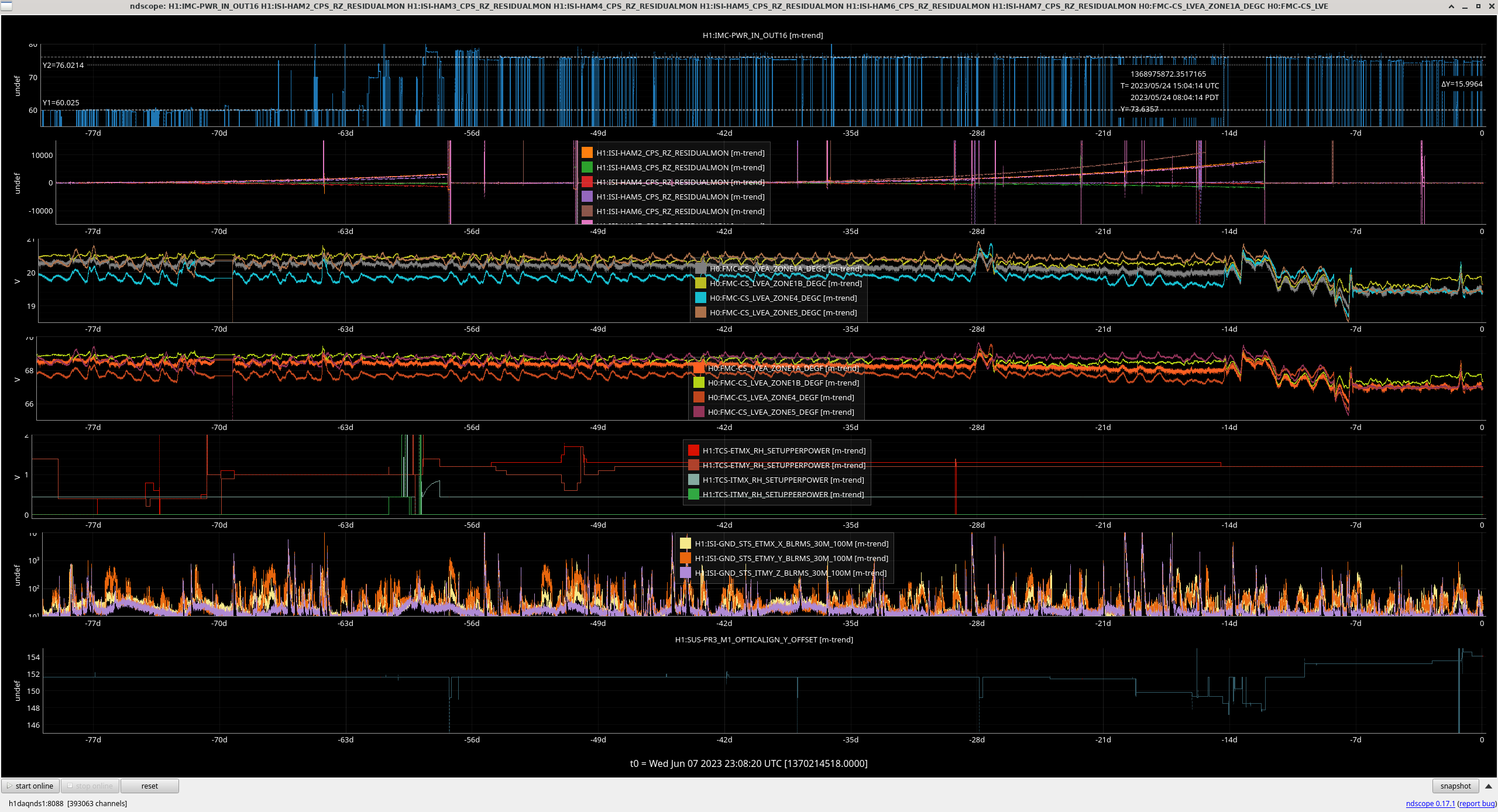
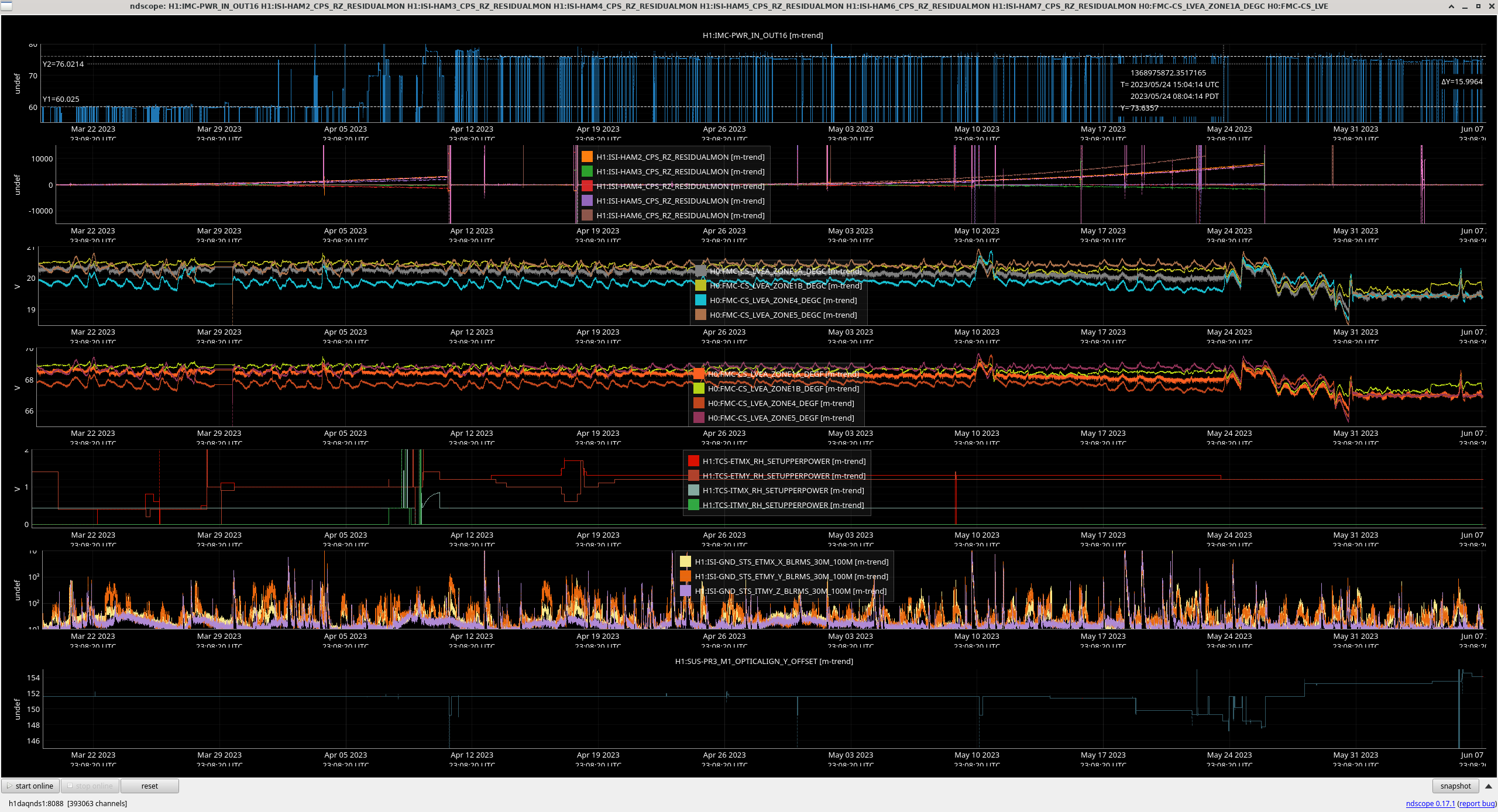
Check out the attached past 3 months worth of trends, in both relative time axis and absolute UTC time axis.

Remember, the observing run starts -15 days ago, or on May 24 2023 at 15:00 UTC.

1st panel: IMC input power, in Watts, showing the transition from 60W to 76W

2nd panel: residual HAM-ISI position in RZ, in nanoradians, showing the 10-20 urad drift of the tables due to (1)

3rd and 4th panel: temperature zones in the LVEA, in deg C and deg F, respectively, showing the last 4 Teusday's worth of temperature excursions

5th panel: all test mass ring heater power level settings, in Watts showing the early explorations of ring heater settings after power up, and the ETMX reduction during the HAM ISI alignment excursion (the upper half is shown, but both upper and lower halves are set equally each time)

6th panel: 0.03 - 0.1 Hz BLRMS of the ground motion at each of the three buildings, showing the "earthquake and wind" band, highlighting (3)

7th panel: PR3's yaw alignment slider, indicating that we've been steering PR3 around all over the place only in the past 4 weeks, likely a result of the ISI yaw drifts (1) and temperature excursions (2).
Images attached to this report
Comments related to this report
Adding another dimension to the problem...

I was thinking over night about this, and realized "well, maybe there's *one* part of the power increase that has impacted duty cycle; the 11 Hz ring ups from PRCL going unstable thru too much gain."

But, I've added the PRCL gain adjustments to the series of trends -- see new attachments in relative time and UTC time -- and I think the new-ish PRCL instabilities can also be explained by drifts and changes in alignment.
- We started using the THERMALIZATION guardian around Apr 24. This slow ramps the PRCL2 gain through the thermalization period

- We made a change, *reducing* the PRCL2 end-point setting on May 21 -- but this was reactive to the time when the ISI YAW drifts were at maximum.

- We then restored that end-point setting on May 26

- Then, on May 31, after having starting to have trouble with 11 Hz ring ups of PRCL gain, we adjusted the "base" PRCL1 gain from 1.0 to 1.5, -- but this was reactive is after several days of LVEA temperature drifting around between May 25 and May 31, and an especially bad Tuesday on May 29th.

- On Jun 4th, the LVEA temperature controls settle on a "new normal" and we "find" we need to increase the "base" PRCL set point again to 1.7 on June 6

- Then on Jun 7th, we reset the "base" PRCL1 gain to 1.0, but instead increase the thermalization set point higher.

My vote is the following: we take the hit in time that this will mean:
- Restore (or change to re-create) the LVEA temperature to values we had consistently for months up until May 10th. Since the LVEA is en-mass cooler than before, we can use the individual zone heater settings to bring each zome back *up* to is "prior to May 10th" value.
- Once that's settled, we re-align PR3 YAW to the slider values we had up until May 10th of 151.6 "urad," and run an initial alignment.
- Once that's settled, we go out to ISCT1 and re-reset the alignment of the table (though it's not reproducible, hopefully, doing so will get us back to the ISCT1 alignment we've had for many moons prior to all this mess).
- Once that's settled, restore ETMX ring heater to its value of 1.3 W.
- Once that's settled, we go back to the May10th era PRCL gains and THERMALIZATION guardian set points of PRCL1 = 1.0 and PRCL2 = 23.0.

If all that works, then we re-calibrate PR3's sliders, optical levers, and OSEMs.
Images attached to this comment
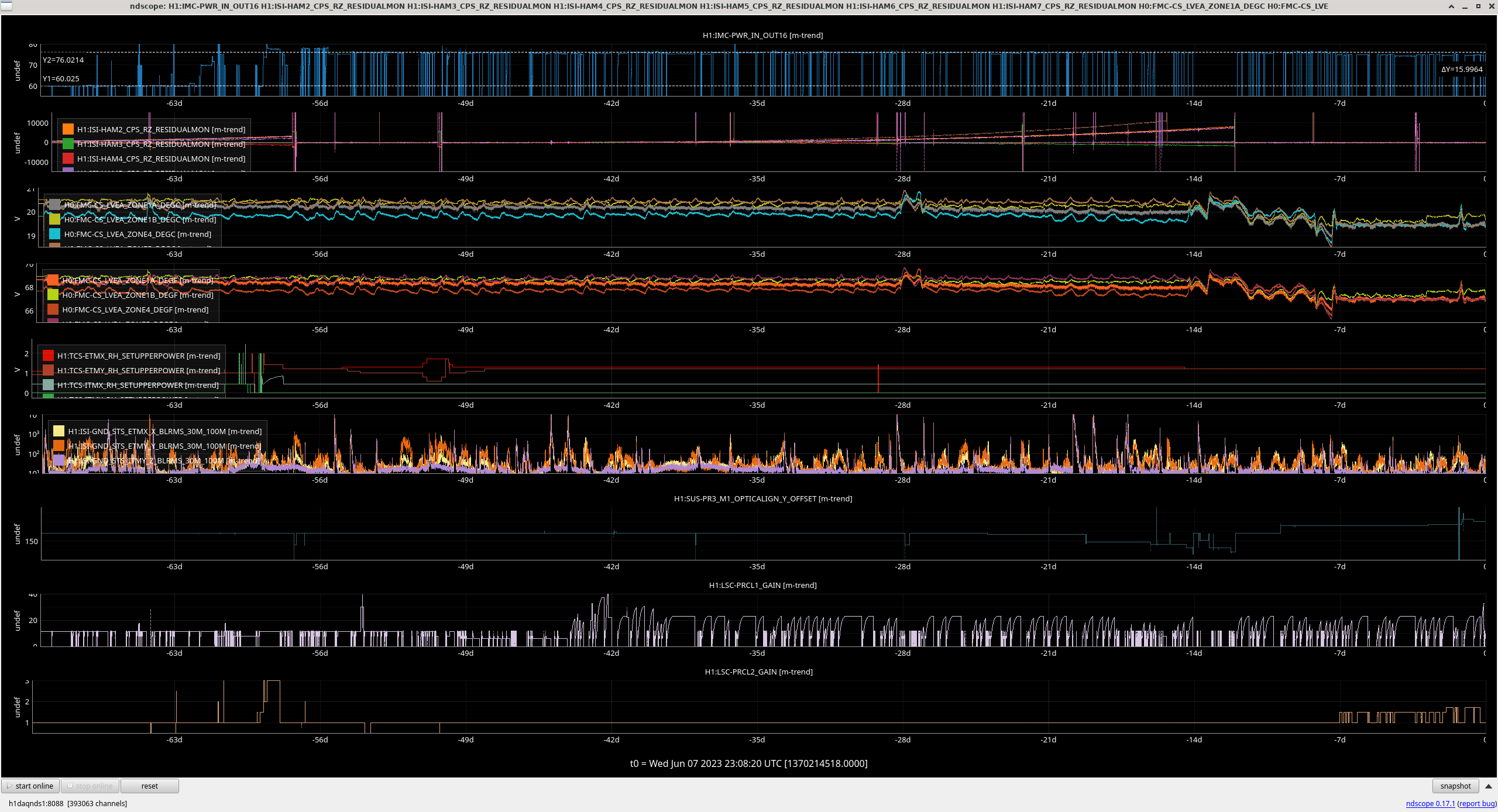

Since it's perhaps quite tough to see all these traces stacked vertically on top of each other (a regrettable "must" because the timing of all these changes is important to the story) I've capture this epic ndscope session as a .yaml template.

/ligo/home/jeffrey.kissel/2023-06-07/
    2023-06-07_3motrend_IMCPWR_ISIYAW_LVEATEMP_GNDBLRMS_PR3YAW_PRCGAINs.yaml

I can't attach a file with the ".yaml" or ".yml" extension to the aLOG, but it's linux, so I've just changed the file extension to .txt (because, in the end, it *is* just a text file). So if you'd like to download it from here and look around, download and then change the extension back to ".yaml".
Non-image files attached to this comment

With the temperatures more stable then they had been we are waiting to get the cooling coil strainers cleaned before attempting other changes. The major flucuations we were seeing we caused primarily by a cooling coil not getting to temperature creating an issue for mulitiple days. Once the strainers are clean temperature control can be changed to try and recreate previous zone temperatures. Though it was nice have all zones grouped together for once.