
Evan, Craig, Dan
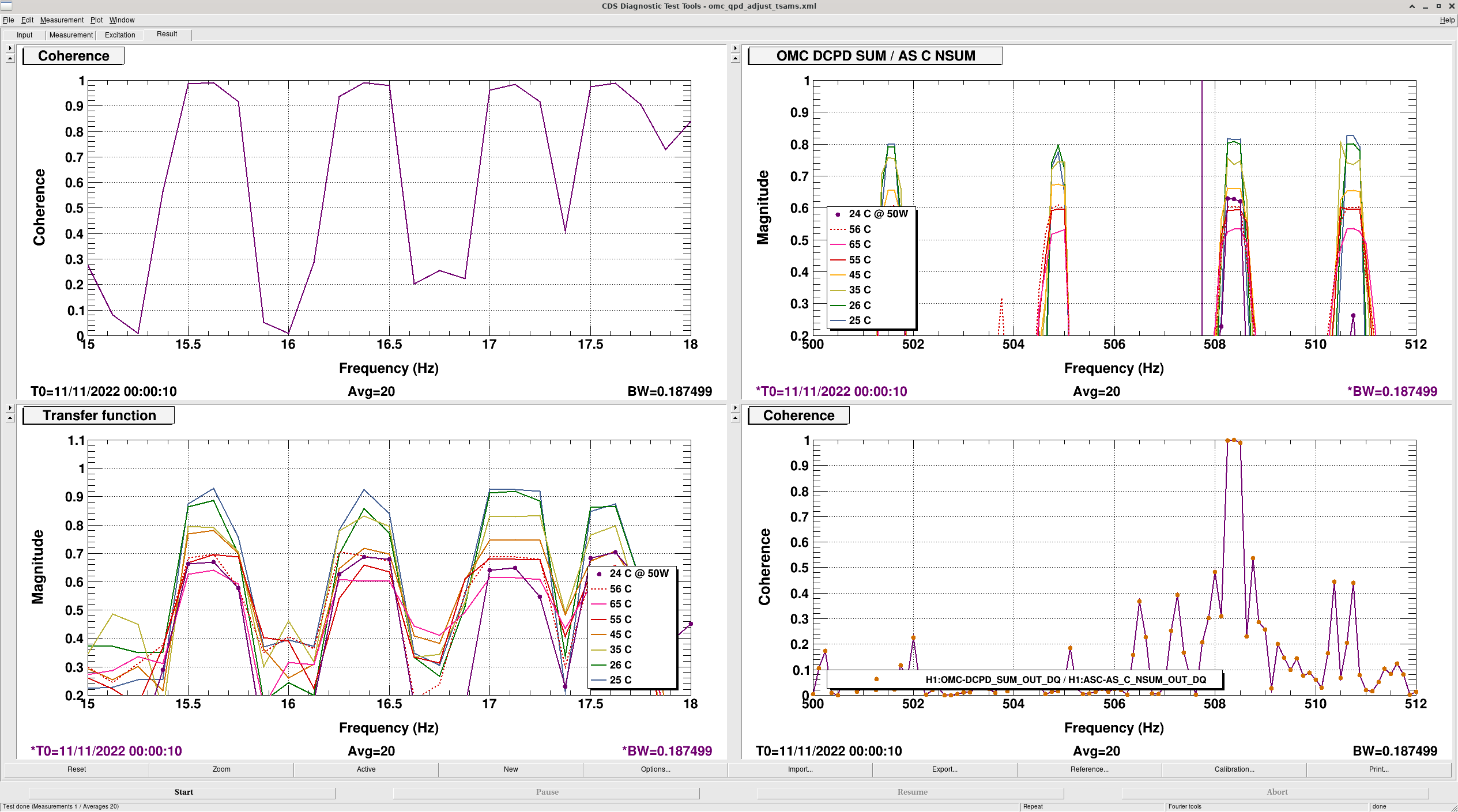
Yesterday during the 25W lock at DC readout we were looking into the transmission of violin and calibration lines through the OMC whilst changing the OM2 TSAM actuator. Assuming the calibration of AS_C and DCPD are good we can compare the ratio of both to try and infer how much the DARM mode couples through the OMC.
Shown in the attached plot is this ratio at the 17Hz cal line and the violin modes around 500Hz. Nominally OM2 should have about a 1.7m RoC which is when TSAMs is about 55C. At this temperature the throughput is about 70%. Increasing the TSAMs temperature) the throughput reduced. Seeing this we switched off TSAMs and let it cool down to 25C and then left it off. During this cool down the throughput seems to keep increasing peaking at better than 90% @ 25C.
The purple trace shown is the same measurement done when we reached 50W today with the TSAM @ 24C. The throughput appears to have significantly reduced again, down to 65%. We do not see as many violin modes now as most have been damped.
Overall these results seem confusing. They suggest quite extreme changes in the mode matching into the OMC of the DARM mode. I'm skeptical that going from 25->50W could really reduce the mode matching by this amount. Some more analysis of this will come tomorrow. We also need to look at how these ratios change in the new OMC REFL channel too.
We are suspicious that there might still bs some alignment issues too. We tried moving the OMC QPD offsets just now but we lost lock shortly after picking a new one.
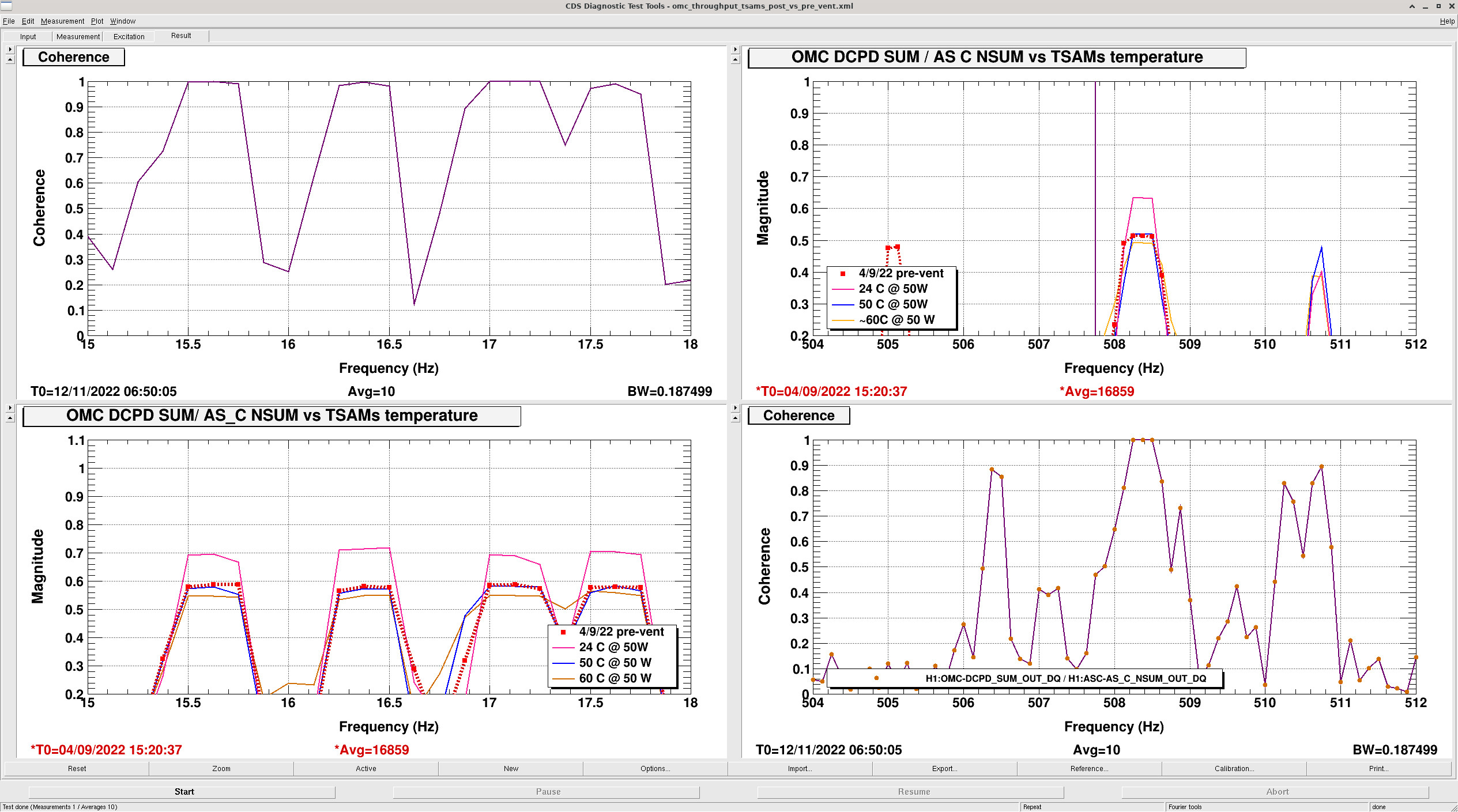
Looking at the DCPD/AS_C ratio again at 50W when changing the OM2 TSAMs last night. Also showing the ratio before the vent for the 17Hz and one of the 500Hz violin mode.
It looks like putting the OM2 back to it's nominal (RoC ~50C) returns the same OMC line throughput to back to what it was pre-vent (4/9/2022). Having the TSAMs at 24C improves this ratio, up to about 70%.
I looked again at the 25 W data and separately extracted the changes in AS C NSUM and DCPD sum, in addition to their ratio, at the PCAL drive frequency of 17.1 Hz. I used 0.86 A/W to convert the DCPD channel to milliwatts. The arm power and DARM offset during this lock is lower than the nominal high sensitivity, which is why the optical gain is only about 1 mW/pm.
GPS time Temp ASC/PCAL DCPD/PCAL DCPD/ASC
(s) (C) (mW/pm) (mW/pm) (mW/mW)
-----------------------------------------------
1352064408 65.0 1.75 1.08 0.62
1352064790 55.0 1.59 1.08 0.68
1352065329 45.0 1.42 1.08 0.76
1352066298 35.0 1.29 1.08 0.84
1352071194 25.0 1.16 1.07 0.93
The DCPD dc value remains servoed to 5.0 mA during this time (about 5.8 mW). I am not sure these data are consistent with the simple picture of a change in the OMC throughput η. We would expect to find that the ratio ASC/PCAL scales like 1/sqrt(η), while the ratio DCPD/PCAL scales like sqrt(η), thus making the overall ratio DCPD/ASC scale like η.
DTT template attached. The coherence with the OMC reflection photodiodes was iffy and I suggest this test should be repeated with more PCAL strength in order to get reliable values for the reflection measurement.
Addendum: I also looked at the subsequent 50 W lock (20 mA dc current) that Dan mentions in his comment. The result is qualitatively the same: there is no meaningful change in the optical gain DCPD/PCAL, and all the change occurs in ASC/PCAL.

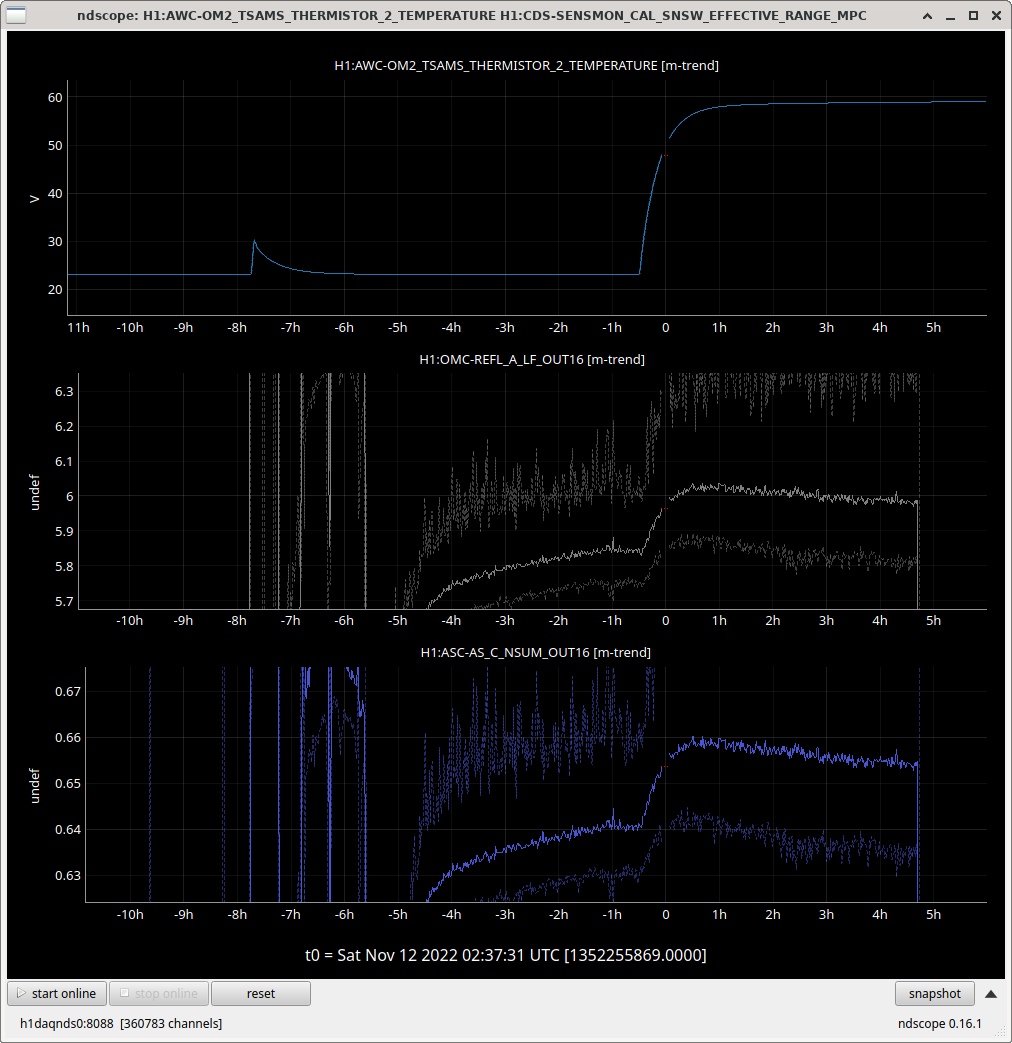
Attaching a plot of the heating and cooling of OM2. After a full throw of the heater, it will take about 2 hours to come within 2 °C of its steady-state temperature.

