
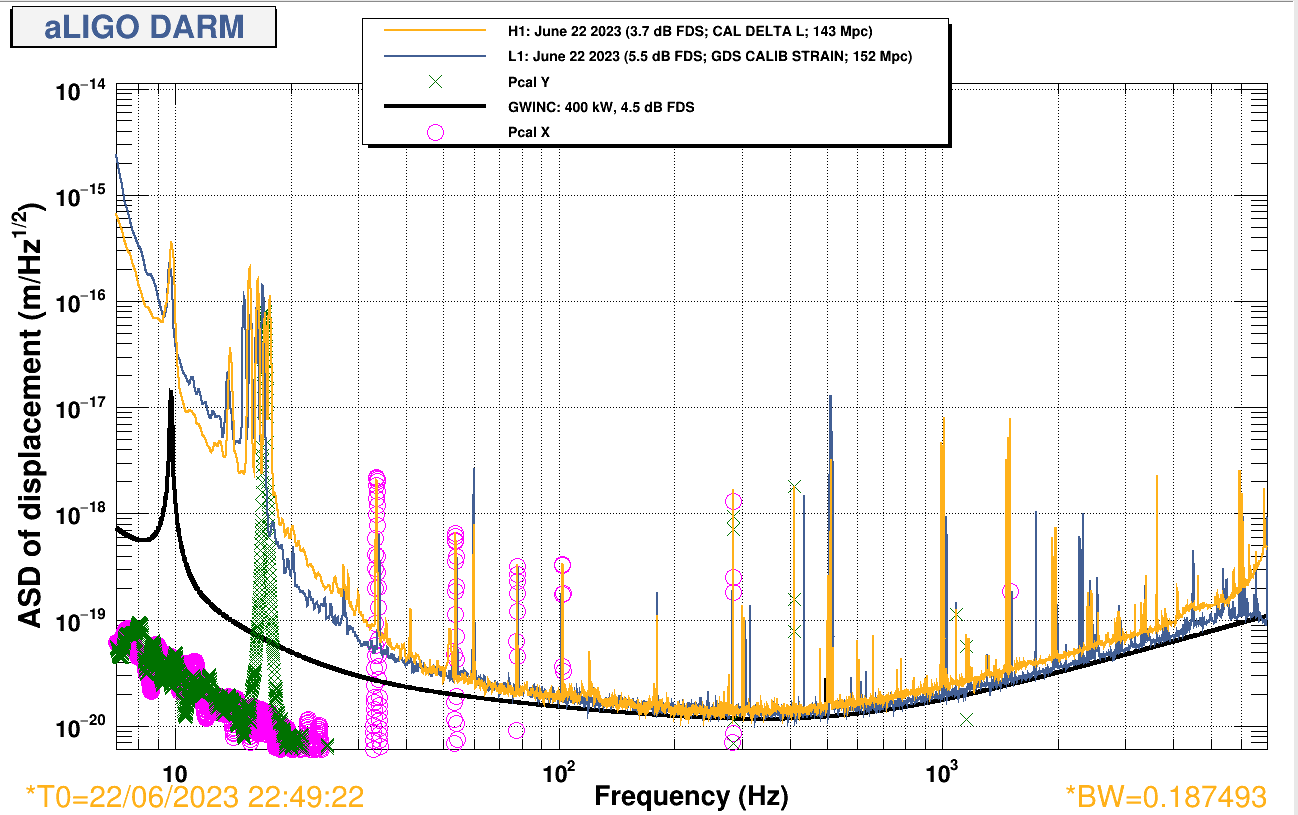
I have updated the LHO and LLO references in the H1_DARM_FOM.xml template (see userapps, isc/h1/scripts). LLO's new trace is using 100 avgs of observing GDS calib strain from today (multipled by 3995). LHO's new trace is 100 avgs of Cal Delta L right after we updated the MICH FF and improved the low frequency sensitivity. Gabriele, Vicky, and Masayuki and I determined that LHO currently has 3.7 dB of FDS and LLO has 5.5 dB of FDS, so the legend is updated correctly. We also determined LHO is at about 143 Mpc range and LLO is at about 152 Mpc range.
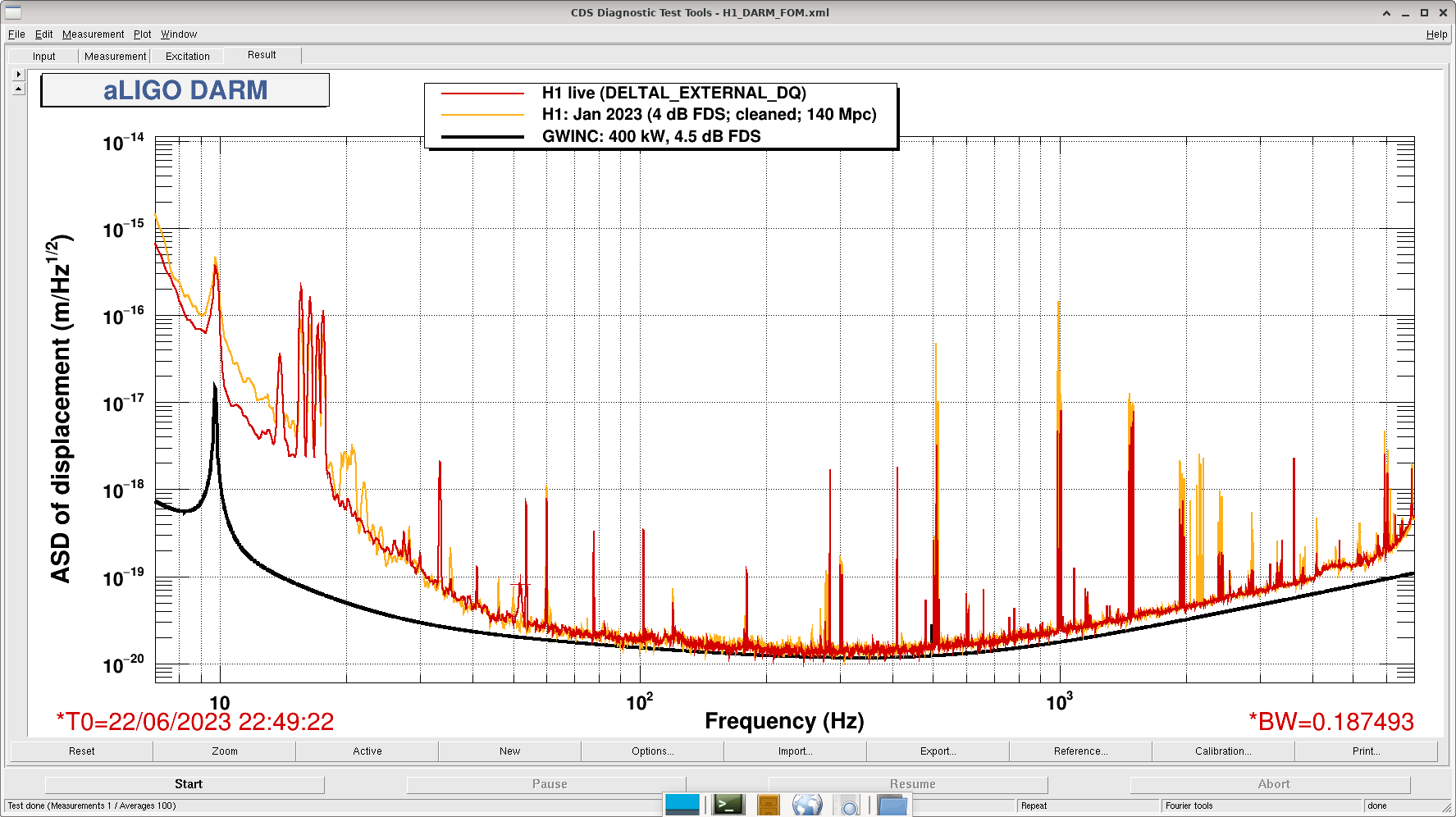
Our sensitvity is now improved below 30 Hz from our last reference trace taken in January after updates to things like the cleaning, LSC and ASC. The gains below 30 Hz have been mostly due to the improvements made to the ASC and LSC. Going back to 60W input has been very beneficial for our low frequency improvement!
The first attachment to this log compares the measurement I used as our new reference (in red, live trace), to the January 2023 reference in yellow. There is also the gwinc trace for 400 kW and 4.5 dB FDS in black.
The second attachment shows the new LHO reference in yellow and the new LLO reference in blue in the DARM FOM.
A variety of range metrics are attached comparing O4 performance to O3. (The times used for the sensitivity curves here are not the same as for the wall plot.)
Hanford's comoving volume sensitivity (proportional to its ideal detection rate) is now 1.8 times larger for systems below about 40 solar masses total. The volume increase for 1000 solar mass IMBH binaries is more than 4.
Also uploaded to the DCC: https://dcc.ligo.org/T2300239

