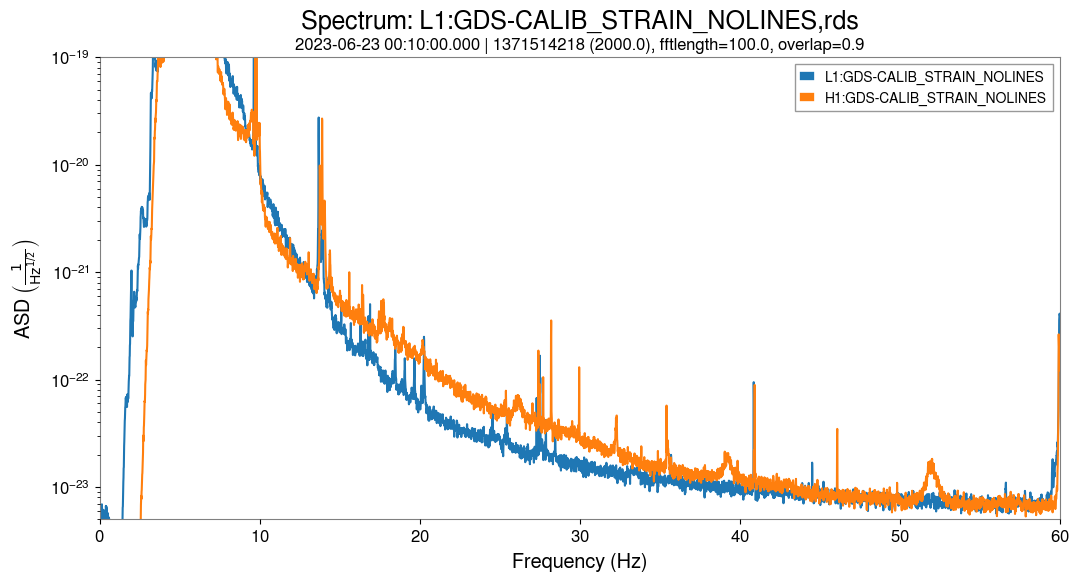
In 70768 Peter noted noise bumps separated by 13Hz (26, 39, 52Hz). Fig 1 is a reproduced version of Peter’s plot. Elenna followed up with plots of suspensions with modes around 13Hz. This is a follow up of both of those things, but with no cause identified.
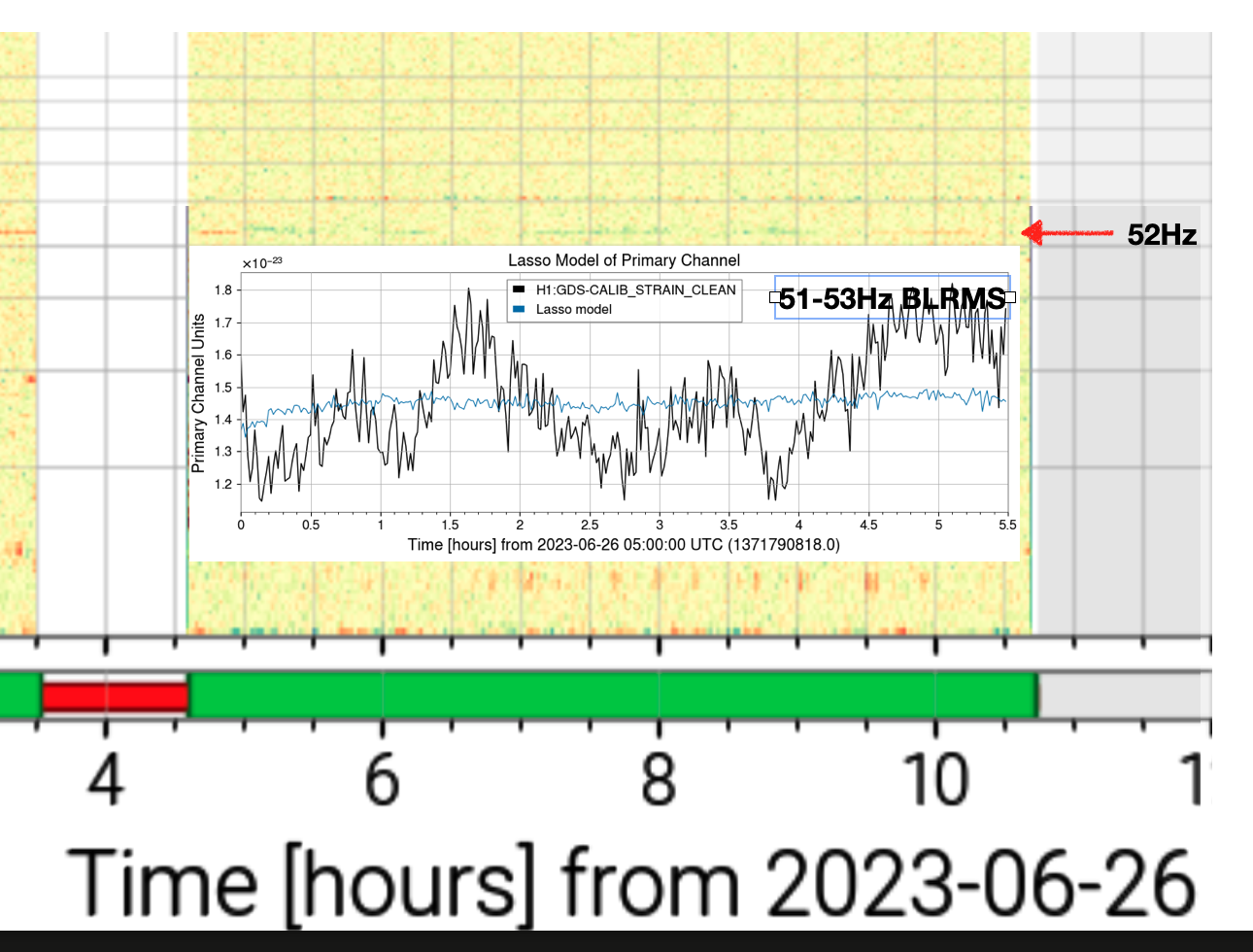
The 52 Hz bumps are visible in the 24-hour spectrograms on the summary pages. The one that stands out most clearly is the 52Hz bump (The 3rd harmonic, 52Hz/4=13Hz). Fig 2 shows a 51-53Hz BLRMS of STRAIN overlaid with one of the 24 spectrograms, just showing that the BLRMS and the spectrogram roughly agree (ignore the blue trace).
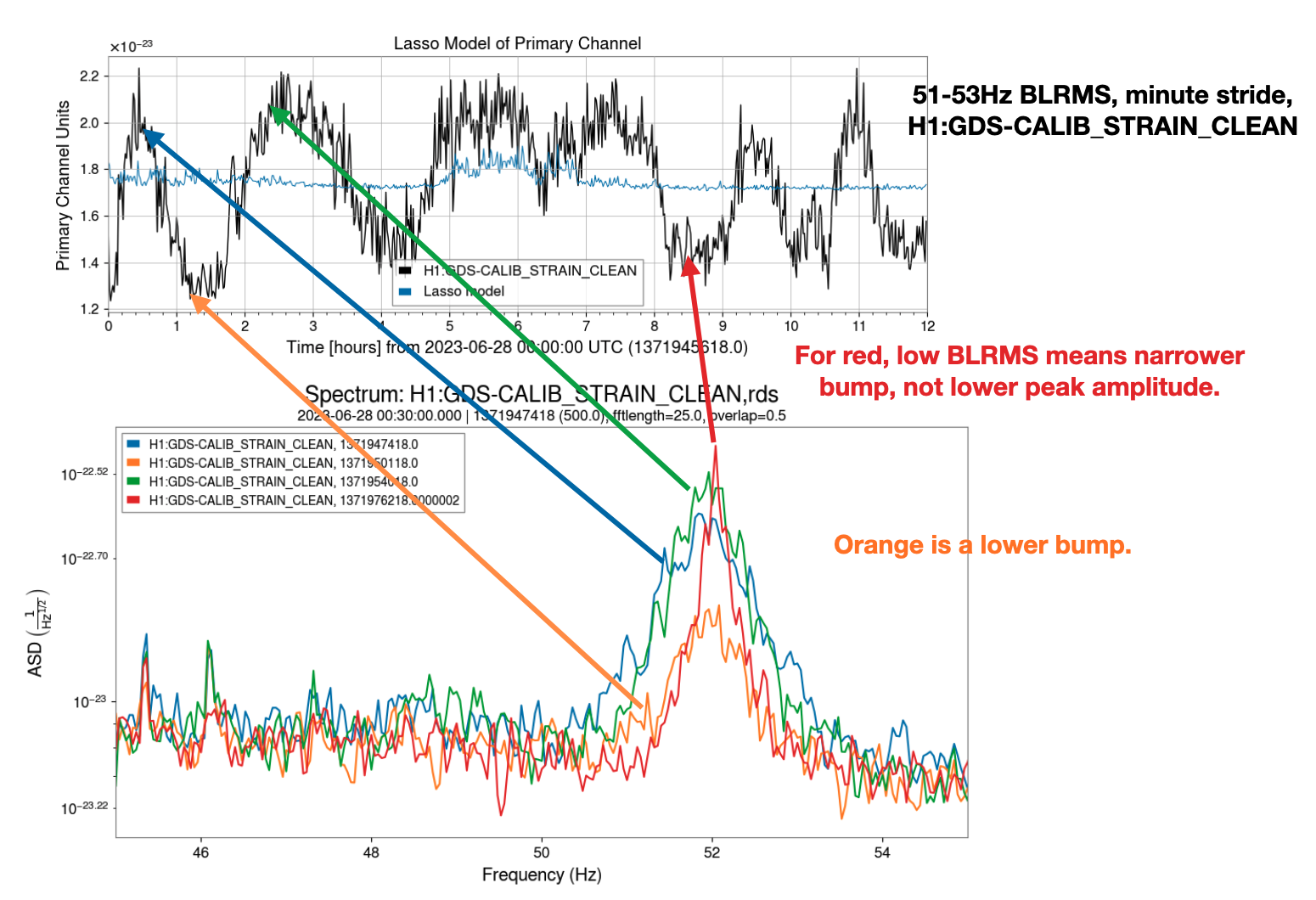
The 52Hz bump changes width over time, which complicates searching for correlation with BLRMS. Fig 3 shows that high BLRMS times are large and broad bump, but low BLRMS time can be low bump or tall skinny bump.
Using gwdetchar-lasso-correlation we can search all LHO channels for correlations with this 51-53Hz BLRMS. A summary of 52Hz bump lasso pages is below. ITMY/X/BS SUS/ISI channels seem somehow related as they show up multiple times (but not every time). On any given page there are other (random? such as VID CAM26 WY or Humidity) channels which look plausibly related but don’t show up on any other days. Maybe you will find clues that jump out but I only see some weak evidence. I think the correlation might be fooled by the bump height/width degeneracy in the BLRMS mentioned above.
- 2023-06-24-lasso-52Hz/ - The BLRMS slopes down over these 8 hours, so most channels are ones that also sloped during that time. Some ITMX/Y SUS/ISI channels look plausibly related.
- 2023-06-25-lasso-52Hz/ - This BLRMS had one drop at 18:15ish that lasso really focused on and aligned with 30-100Hz ETMX seismic. With only one drop hard to know if the correlation is real. SUS ITMX also shows up.
- 2023-06-26-lasso-52Hz-v2/ - Top correlation is (unknown to me) MX channel PEM 29. ITMY RZ looks decent.
- 2023-06-27-lasso-52Hz/ - This BLRMS starts with a “fast” modulation of the bump with 4 cycles in the first 1.5 hours, then transitions to a “slow” modulation with about 1 cycle per 1.5 hours. The BS RY 30M channel sees a similar frequency change but doesn’t exactly match up. The first channel, a CDS relative humidity sensor is actually not bad.
- 2023-06-28-lasso-52Hz/ - VID CAM26 WY looks good. Unfortunately, this channel does not match the 52Hz BLRMS on other days.
- 2023-06-29-lasso-52Hz/ - ITMX L1 FASTIMONs look good.
Figures 4-8 are some of the more convincing correlated channels on the various days.
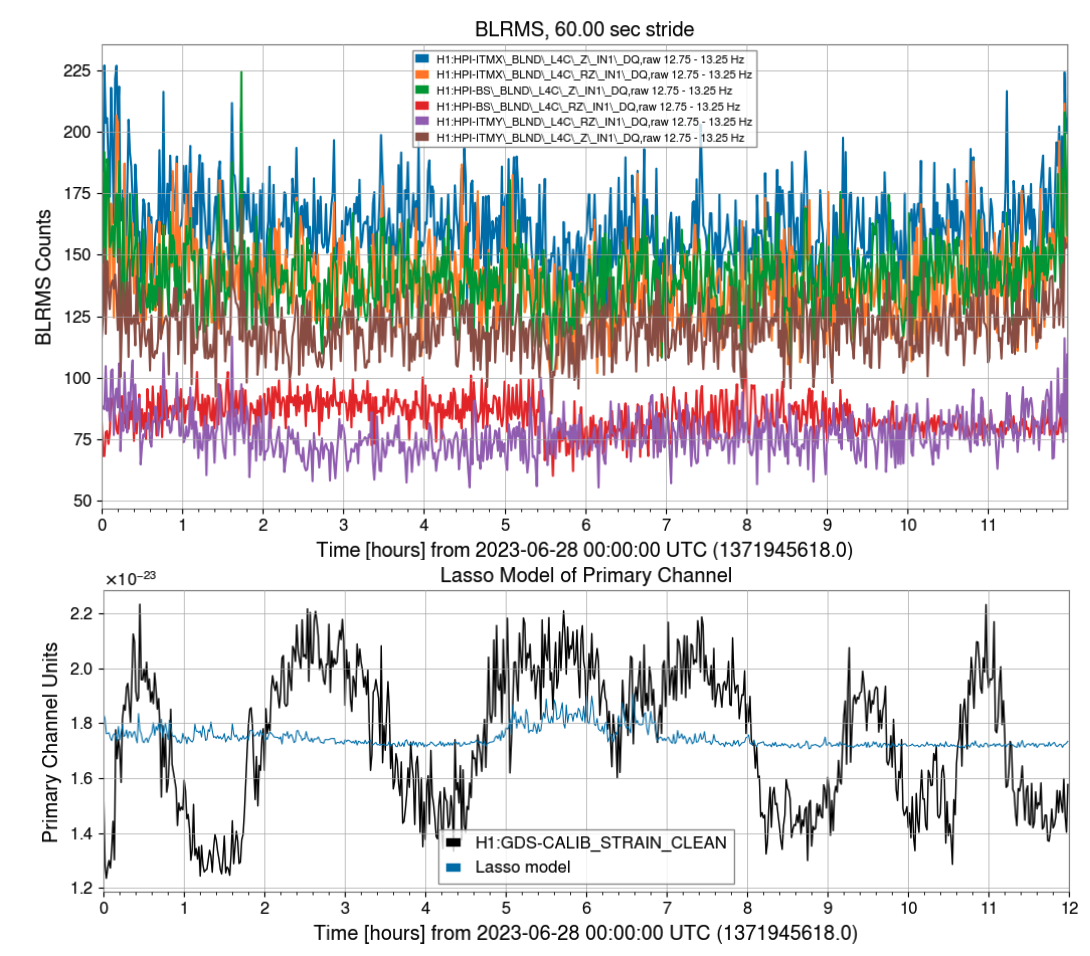
Finally, given the apparent 13Hz base frequency, I had a look at various suspensions (guided by some links from Arnaud). There is strong 13Hz in ITMX, ITMY, BS HPI (Arnaud mentioned the arm cavity baffles hang directly from HEPI). But the BLRMS of the 13Hz band seems pretty stable and doesn’t match the BLRMS of the 52Hz bump, Fig 9.
So likely the resonances are more or less stable and if they are the driver of the n*13Hz bumps, the coupling is modulated by something, such as alignment.