
louis.dartez@LIGO.ORG - posted 18:39, Wednesday 05 July 2023 - last comment - 18:45, Wednesday 05 July 2023(71074)
commissioning simulines calibration injections at LHO
V. Bossilkov, L. DartezSummary We gave the simulines calibration injection scheme another go at LHO during this week's commissioning window. In short, the commissioning endeavor was partially successful: we did not lose lock and we were able to gather useful data for the actuation stages and the DARM OLG. However, additional commissioning time is required before we can fully adopt simulines for the regular calibration measurements at LHO.
Objective
The goal of today's session included the following: 1.) Determine whether we can run simulines at LHO reliably without losing lock, 2.) assess the data quality of the recorded simulines hdf5 files and confirm that they can be read and post-processed 3.) evaluate the spacing of the common frequency vector that is used for all measurements 4.) tweak the injection amplitudes and integration length to get a good enough SNR while keeping the amplitudes and integration lengths as low as possibleCode Execution
We ran two trials with injections at different amplitudes: 0.5*A and 0.1*A, where A is the corresponding amplitude typically used for the same injections in DTT. Simulines uses a configuration file in.INIformat to inform the various injections of their frequency vectors, amplitudes, and other settings. The two files we used, both of which are located in/ligo/groups/cal/src/simulines/h1_test_settings, are named as follows: Half the DTT amplitude:settings_h1_0.5.iniOne tenth the DTT amplitude:settings_h1_0.1.iniThese files are contained within the simulines repo as of commit bf25b1b4. The simulines code was run using the following command from within the repo'ssimulinesdirectory:python simulines.py -i ../h1_test_settings/settings_h1_0.5.iniThe terminal output for both runs is attached here. All measurements were placed in/ligo/groups/cal/H1/measurementsas they would during a normalpydarm measureexecution. Once recorded, we ran a quick script that Vlad wrote to take a look at each measurement's uncertainty as it compares to those taken with DTT. The script used lives at/ligo/home/louis.dartez/projects/20230705/simulines_commissioning/simulinesUncert_H1.py. This script compares each simulines injection with a corresponding DTT injection. The exact DTT injections used for this initial test run are listed in the script source code (uploaded to this alog for redundancy).Results
We were able to successfully run simulines for all of the normal calibration measurement sweeps (we did not take any broadband measurements). The table below contains plots comparing the uncertainty from the simulines (SL) injections vs the same using diaggui (DTT). The top plot in each figure shows an overlay of the uncertainty from the SL injection and the DTT injection. The bottom plot contains the residual (SL_unc / DTT_unc). The left and right columns correspond to the 0.5*"DTT Amplitude" and 0.1*"DTT Amplitude", respectively. Each actuation stage is displayed on its own row.
| 0.5*Ampl | 0.1*Ampl | |
|---|---|---|
| ETMX L1 | 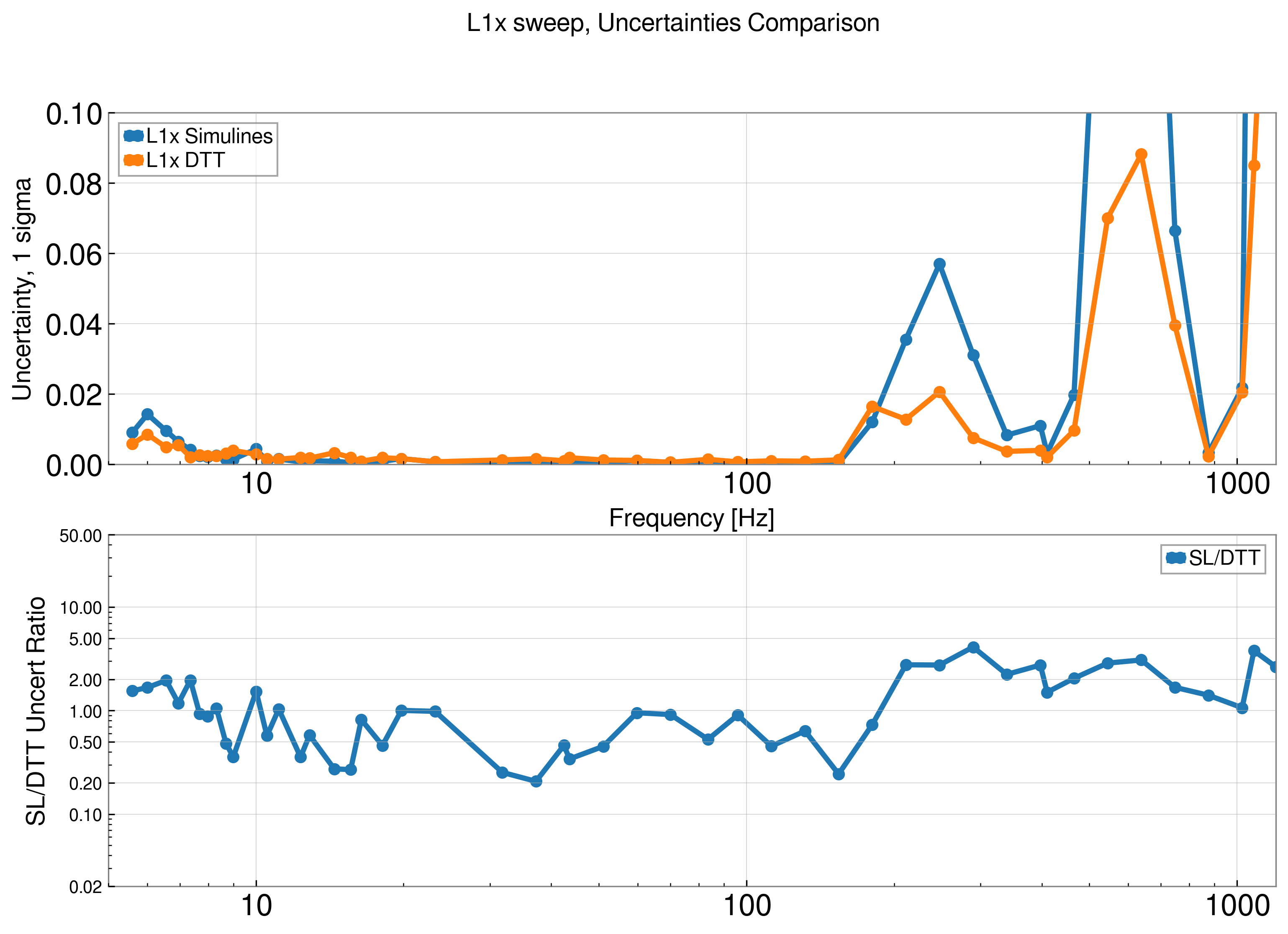 | 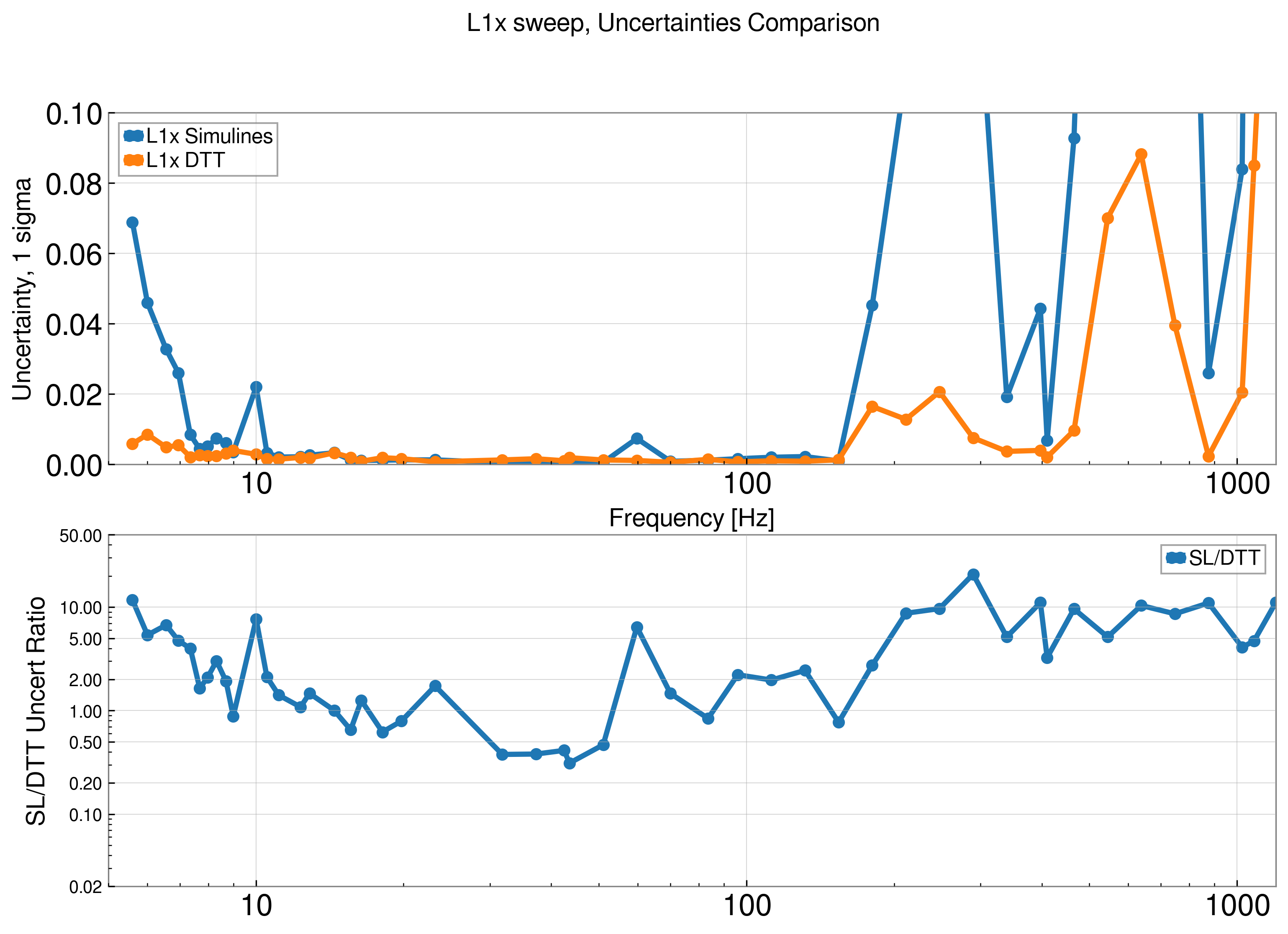 |
| ETMX L2 | 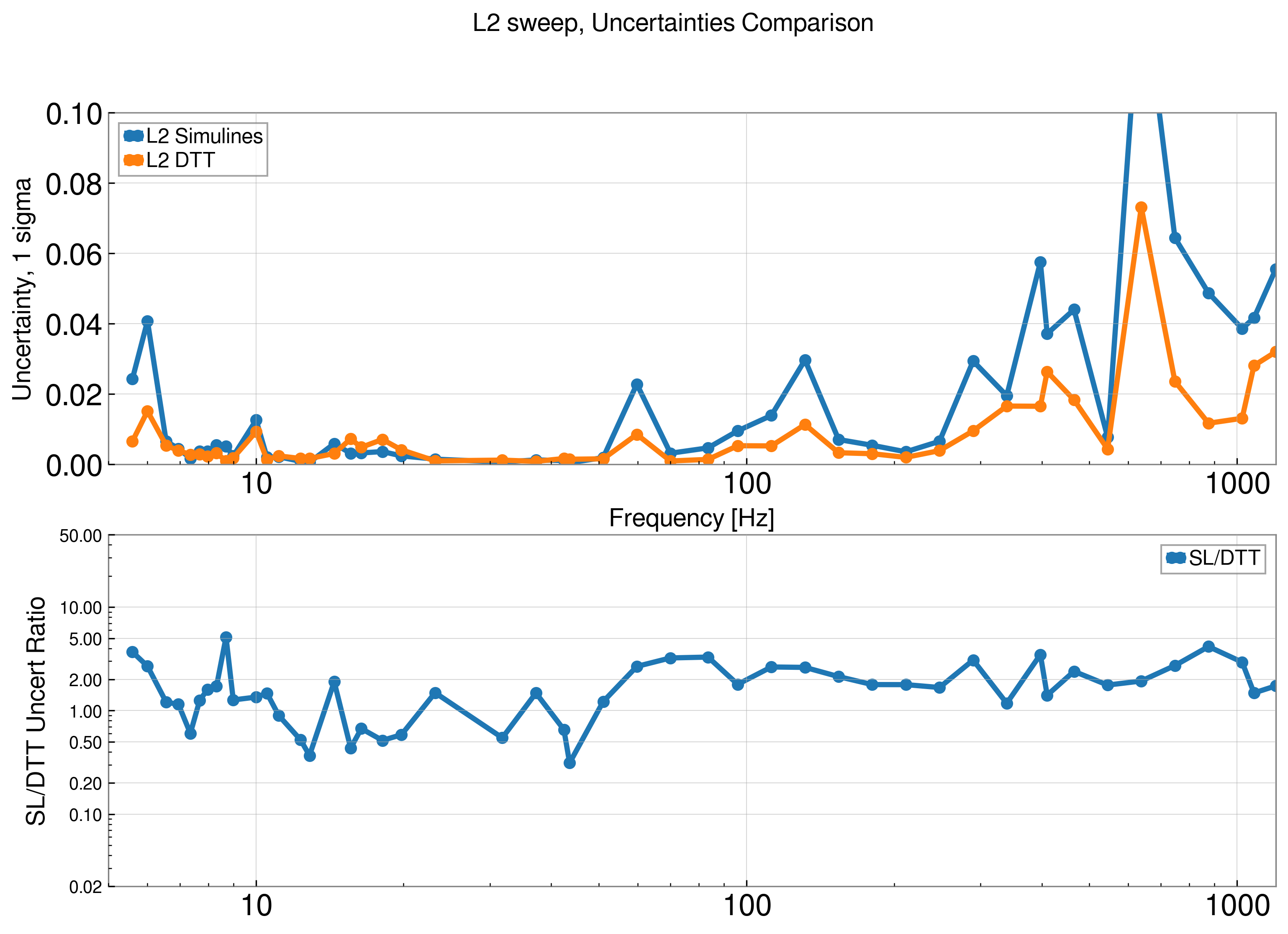 | 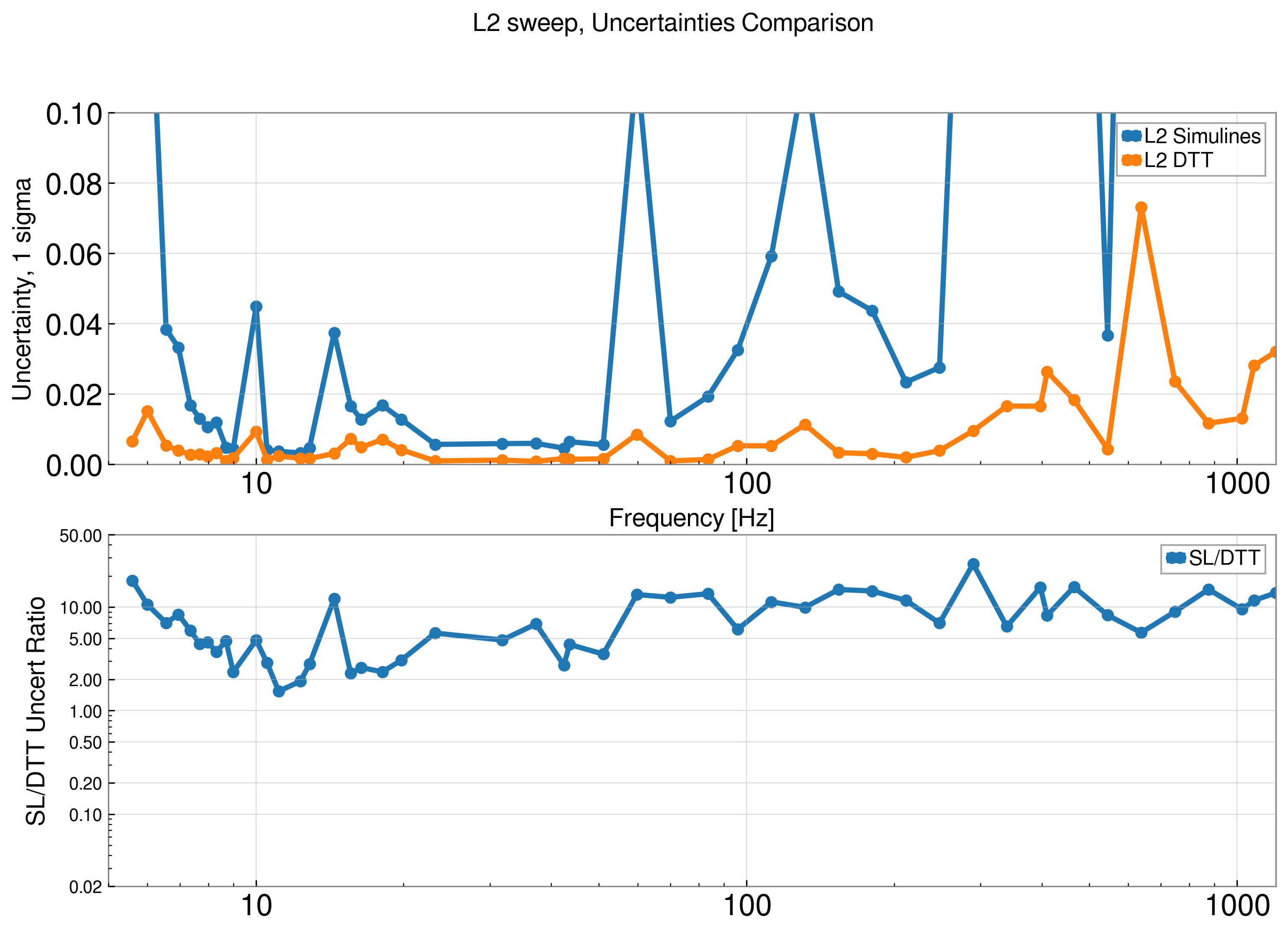 |
| ETMX L3 | 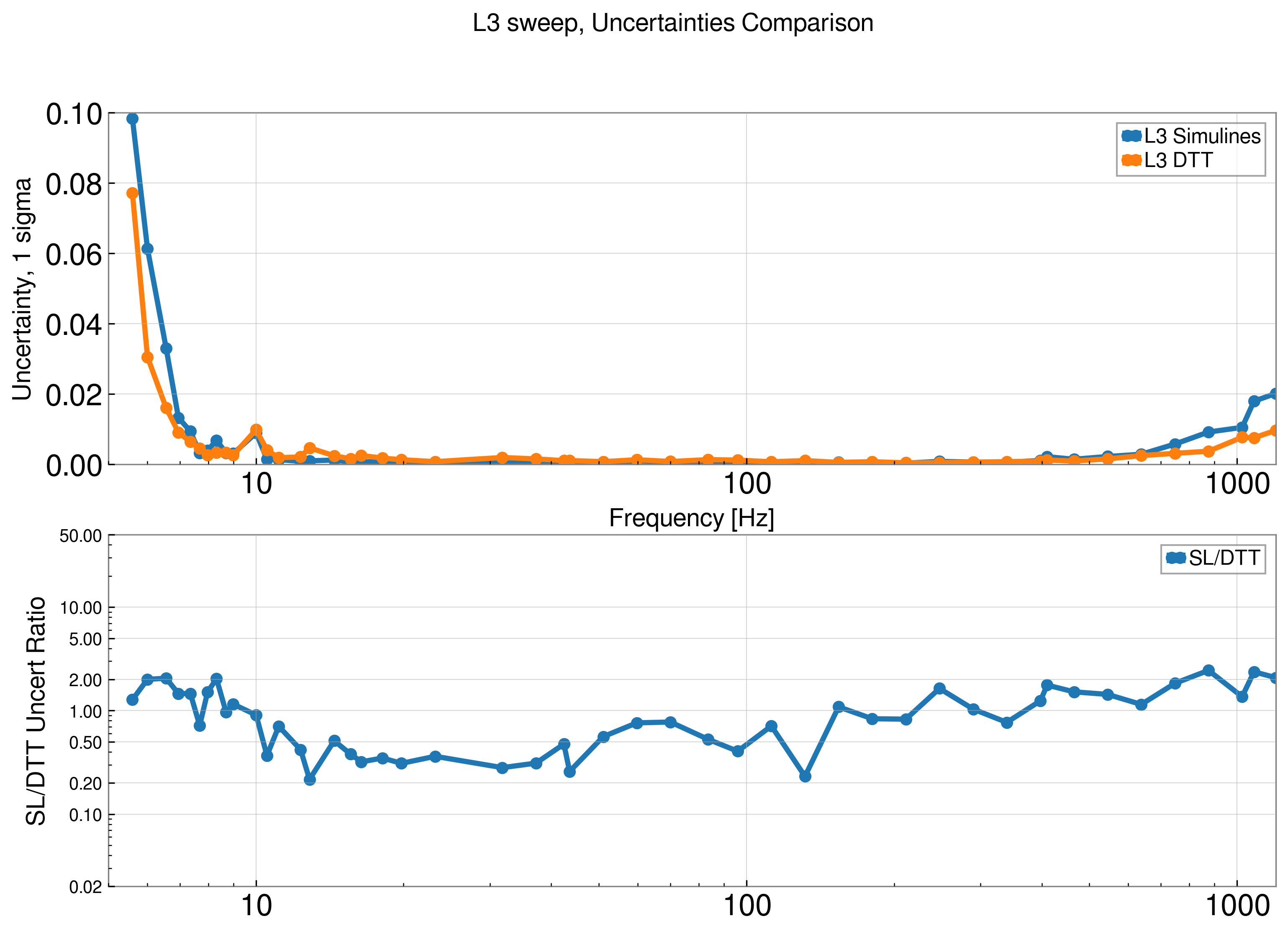 | 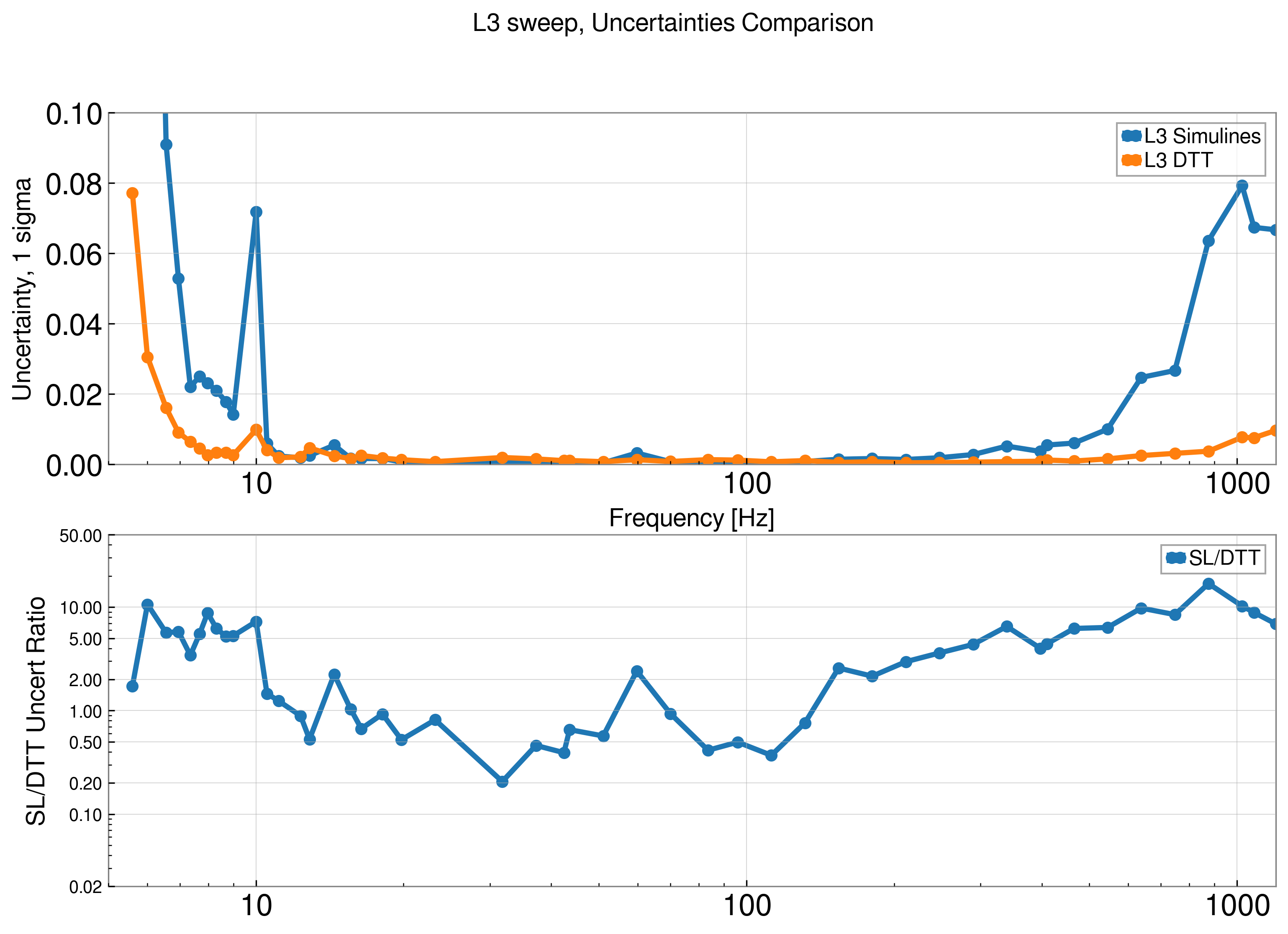 |
Images attached to this report
Non-image files attached to this report


Comments related to this report
The two simulines injections were at the following GPS times:

Trial 1 Start:
   2023-07-05 19:02:04.672 UTC
   GPS 1372618942.672165

Trial 2 Start:
   2023-07-05 19:25:27.781 UTC
   GPS 1372620345.781883

Each simulines suite ran for approximately 23 minutes.