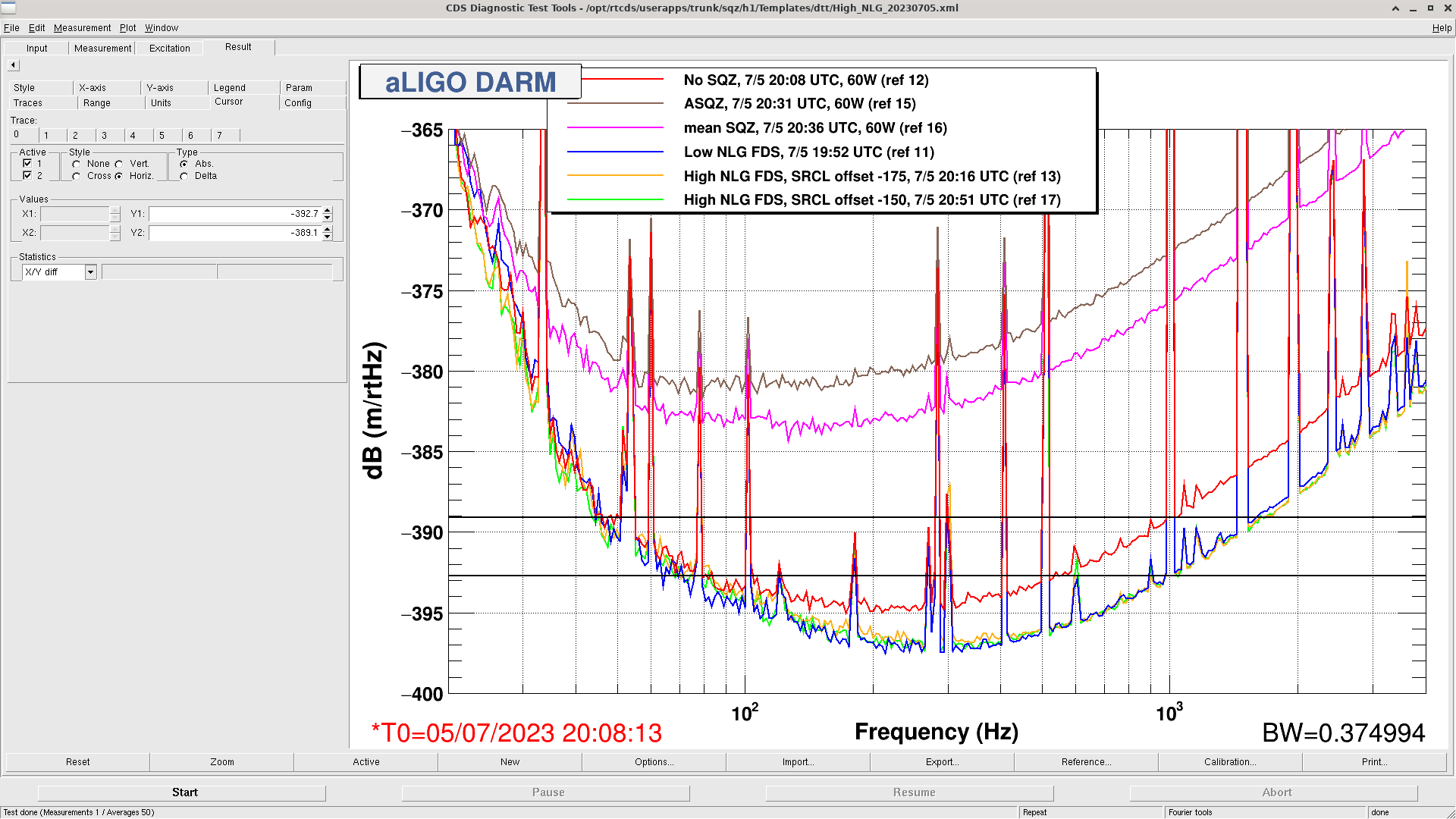
Compiling recent squeezing levels to look at squeeze losses with recent anti-squeezing, mean squeezing levels. Reminder the expected losses are minimum ~15-20% (see sqz budget). Recent measurements suggest ~35-40% ~32-40% total sqz losses, higher than compared to our best previous obervations of squeezing, where 4.5dB indicated ~30-35% total sqz losses.
edit2: As pointed out by Daniel, these loss estimates are extremely course, mostly useful for us to check if something is extremely wrong, but error analysis required to make real statements about loss based on this. In particular, to estimate loss from mean-sqz* (insensitive to sqz angle rotations + phase noise) -- the loss error bars depend on error in the generated sqz / NLG level, and errors in our measure of mean-sqz levels (w.r.t no-sqz). I don't have an estimate of NLG error bars right now, so this uncertainty is open. To give a sense of the varying loss estimates based on mean-sqz levels, I am adding in some totally eye-balled error estimates of mean-sqz levels, just looking at DARM screenshots in the alogs listed.
| alog | gen sqz (NLG) | anti-sqz (dB) | mean-sqz (dB) | sqz (dB) | est'd loss from asqz | est'd loss from mean sqz |
| 71088, 7/5 | 18.3 dB (22.7) | 16.7 | 13.5 - 14 |
~35% | 40% - 32% |
|
| 70932, 6/28 | 15.5 dB (12.6) | 13.3 | 10.4 - 10.9 |
-3.7 | ~43% | 43% - 36% |
| 70686, 6/21 | ~15.5 dB (12.6) | 13.6 | -- | -3.7 |
~40% |
-- |
Re: IFO output losses without squeezing -- this is best analyzed for no-sqz times from e.g. 70930 with hot OM2. Some no-sqz times early on at 60W (cold OM2, before LSC FF tuning, not sure calibration) in e.g. 70668 (~20min), 70686 (~5min). Analysis of output losses at 60W, with hot vs. cold OM2, forthcoming. edit: Recent info on AS port losses -- see Sheila's log 71087 regarding HAM6 losses w.r.t. OM2 heating (could change IFO-OMC mode-matching differently than SQZ-OMC matching), and OMC single bounce scans with hot OM2 70866, and cold OM2 70409 (can be useful w.r.t. OMC round-trip optical losses).
Re: technical noise limitation, here's a reminder of this log from Naoki 69767. Classical noise corresponds to an effective / apparent loss in the squeezing level, like the ratio (classical noise asd / no-sqz noise asd)^2. If this ratio is e.g. 0.3, this looks like an apparent loss of (0.3**2)~10% in the observed squeezing level. edit: Noted by Daniel, that Sheila's recent cross-correlation estimate of classical (non-quantum) noise 70891 suggests that at 1kHz, classical noise is ~40% of shot noise without squeezing, this is like an apparent sqz loss of (0.4**2)~16%. This technical noise is an extra loss, contributing to the difference between observed sqz vs. anti-sqz levels.
Given output losses & technical noise close to shot noise, anti- and mean- squeezing can provide additional constraints on squeezing losses without subtracting classical noise and ignoring sqz phase noise, which *should* be low. In particular, mean-sqz should provide a good loss estimate since it's also not sensitive to the squeeze angles / mis-rotations, while anti-squeezing could be misleading depending on how the rotation goes.
edit: Looking at recent DARM with high NLG, shot noise squeezing seems to improve with more sqz despite the alog text, so I don't think squeezing is limited by phase noise yet, even at really high NLG's like 20+.
edit2: * the phrase "mean squeezing" refers to an unlocked squeezer with the sqz beam diverter open. In this configuration, sqzing hasn't been phase-locked to the outgoing IFO light yet, so we see just the noise power from sqz added to DARM. In this way, the unlocked "mean sqz" configuration averages over all sqz angle phases (averaging out e.g. phase noise). This case is also unlike anti-squeezing, which adds noise in a controlled way that we have to rotate into (sometimes we don't have the demod-phase range to rotate into anti-squeezing fully; this would bias our measurements of it), and asqz may be subject to random sqz-misrotations from e.g. SRCL detuning/mode-mismatch. Averaging overall sqz angle phases allows mean-sqz to show approximately the average noise variance from anti-squeezing and squeezing, e.g. (V_asqz + V_sqz)/2, aka "mean-squeezing". Extracting loss from mean-sqz levels requires only measures of generated sqz level (=nonlinear gain) and the mean-sqz level, but these measurements need to be somewhat precise to extract meaningful loss data.