Several CHARD_Y tests today during the commissioning time. A more detailed analysis will follow.
Went go to NLN_CAL_MEAS
## Test new CHARD_Y ##
- load new filter OK
- engage with gain 60 OK
- gain increase to 100 looks OK: what is that big peak at 3.x Hz? It's not gain peaking of the CHARD_Y loop
## Check A2L ##
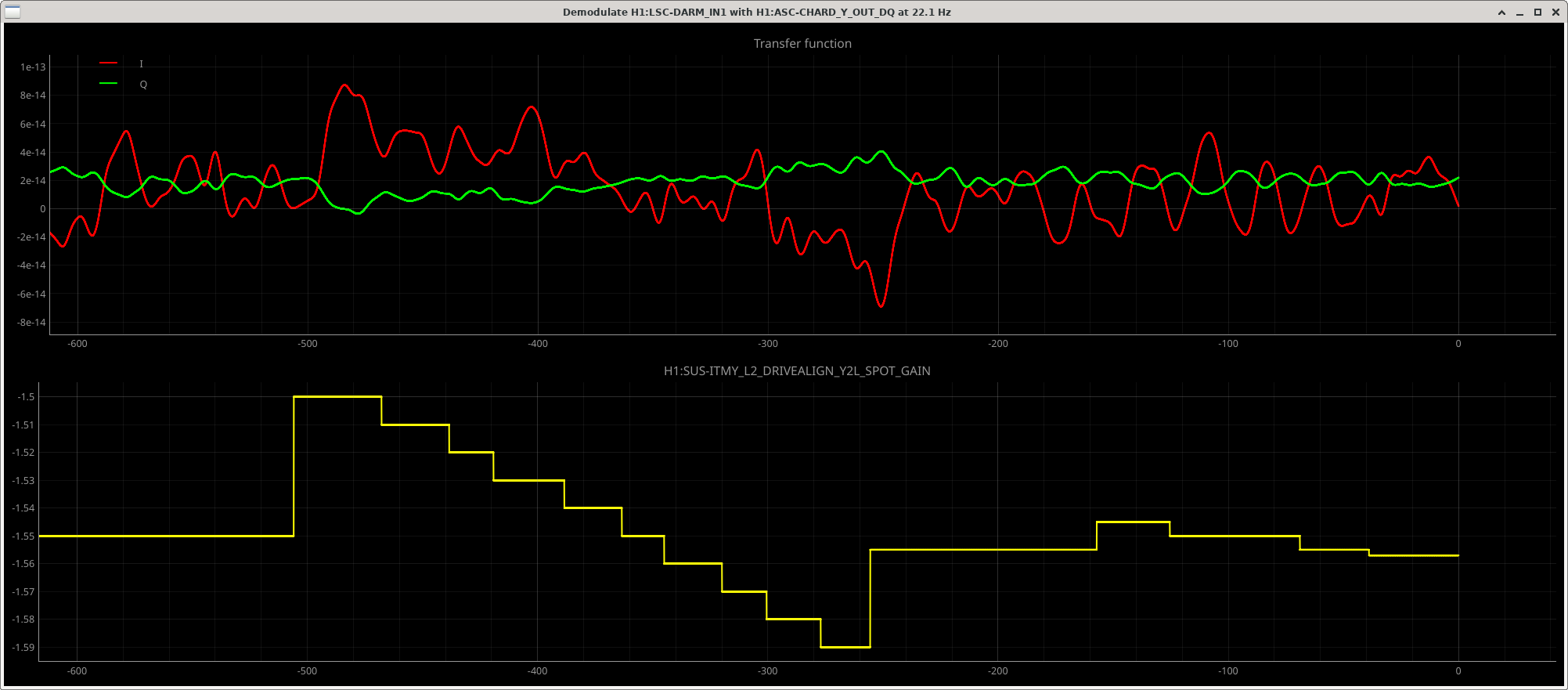
- inject line at 22.1 Hz and check demodulation of DARM. Large fluctaations, hard to tune
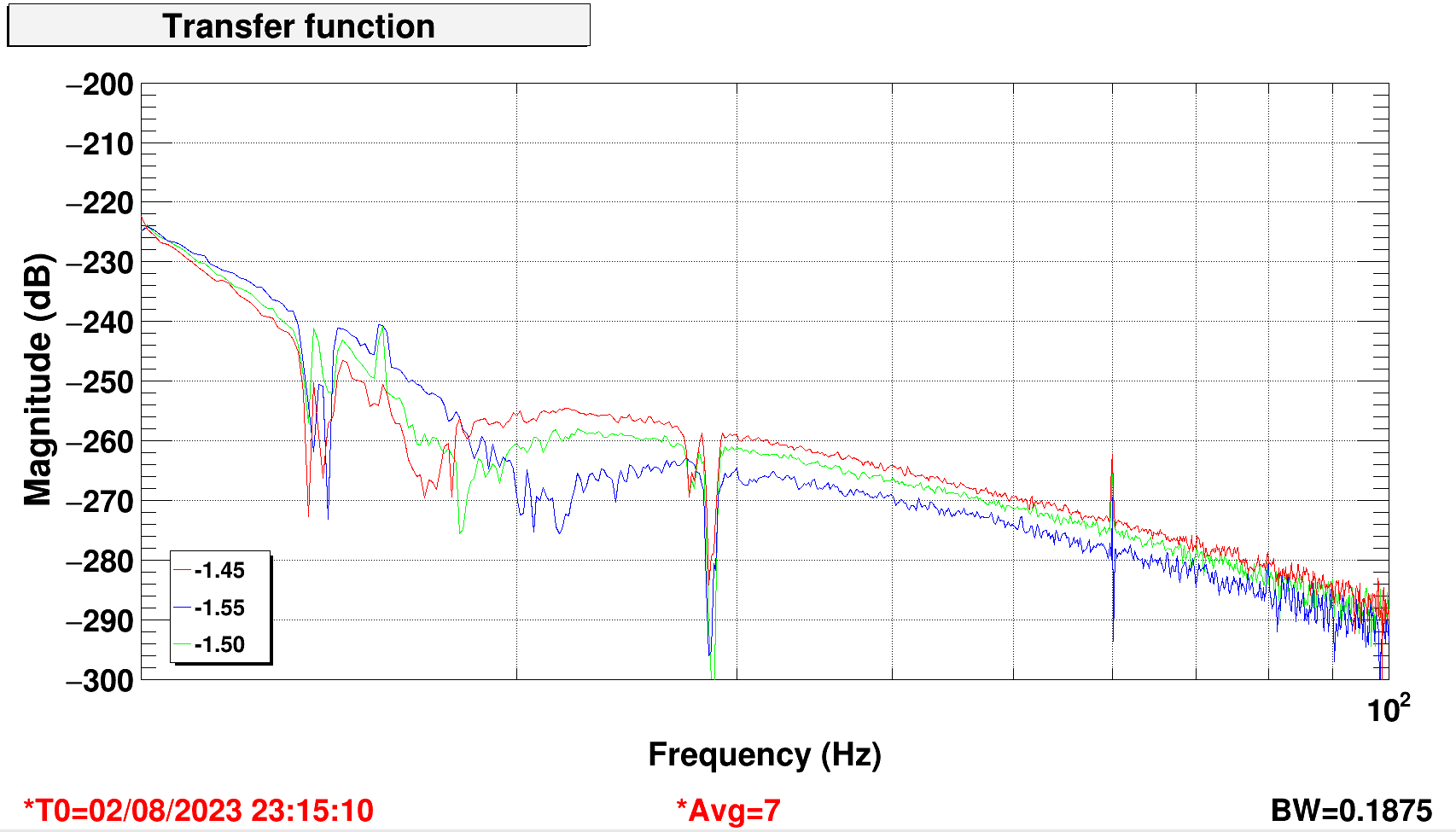
- inject noise [CHARD_Y noise ampl 20 butter("BandPass",6,10,100)]
coupling at low frequency changes differently than high frequency (-1.50 is a good compromise). Also, 22 Hz is right at the transition between the two noise coupling regions
## Test Mass damping ##
- reduce gain looking at TM signals and also CHARD_Y DHARD_Y
all test mass M0 Y gains to -0.5
from PDT: 2023-08-02 16:23:37.085598 PDT

     UTC: 2023-08-02 23:23:37.085598 UTC

     GPS: 1375053835.085598

to   PDT: 2023-08-02 16:32:40.068152 PDT

     UTC: 2023-08-02 23:32:40.068152 UTC

     GPS: 1375054378.068152
left gains at -0.5
## PR3 damping gain reduction ##
M1 Y damping gain to -0.5
from PDT: 2023-08-02 16:33:56.677335 PDT

     UTC: 2023-08-02 23:33:56.677335 UTC

     GPS: 1375054454.677335

to   PDT: 2023-08-02 16:44:18.190283 PDT

     UTC: 2023-08-02 23:44:18.190283 UTC

     GPS: 1375055076.190283
Lowering the damping gains might have changed a bit the plant? Measured another CHARD_Y plant [saved CHARD_Y_shaped_exc_2023_08_02.xml]
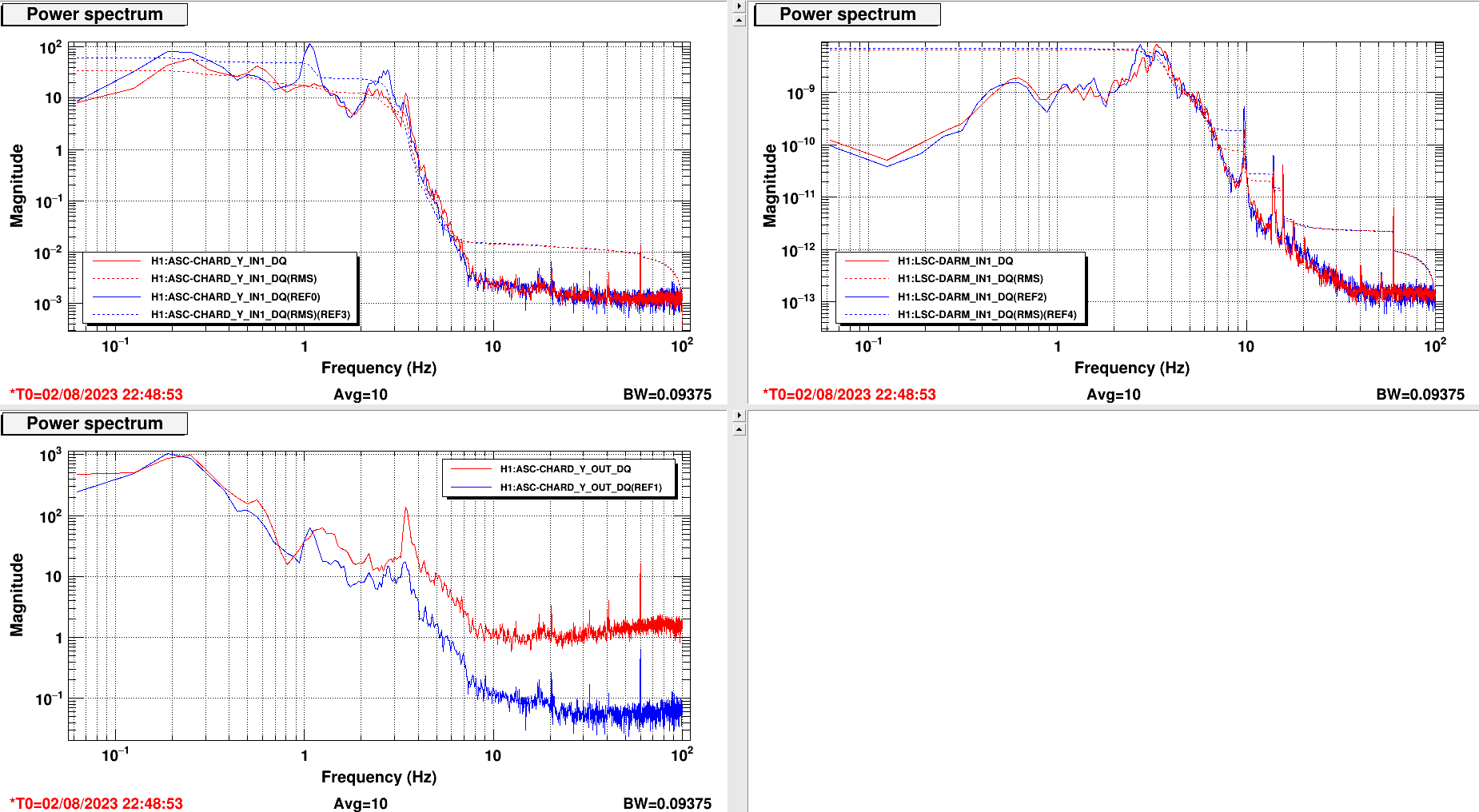
When we got back to NLN, I implemented the changes below to test overnight
- CHARD_Y engage FM9, increase gain to 100
- ITMY Y2L to -1.500
- test mass M0 Y damp reduced to -0.5
- PR3 M1 Y damp reduced to -0.5
In case of a lock loss, all those changes will be reverted
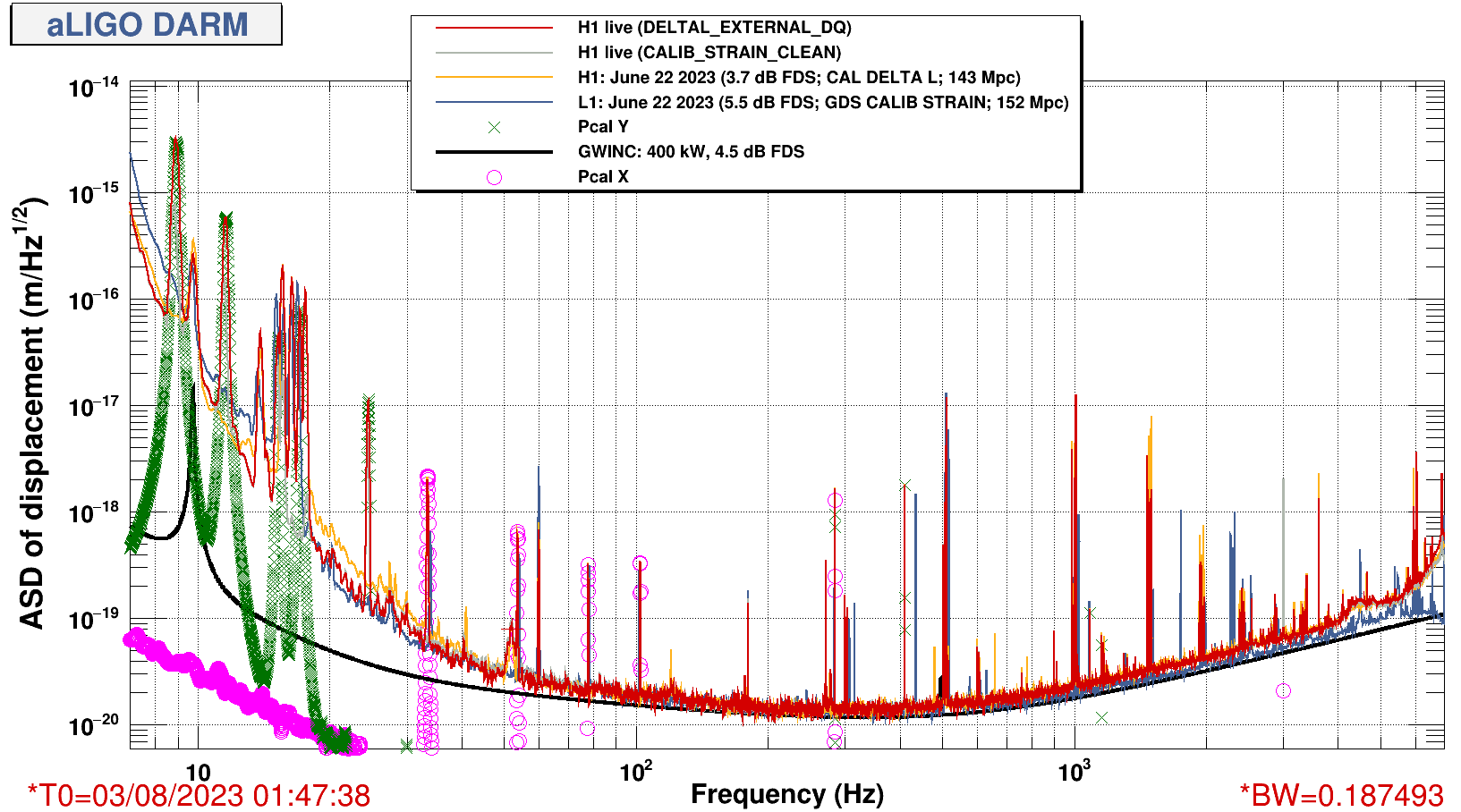
At a first glance there is some good improvement at low frequency.
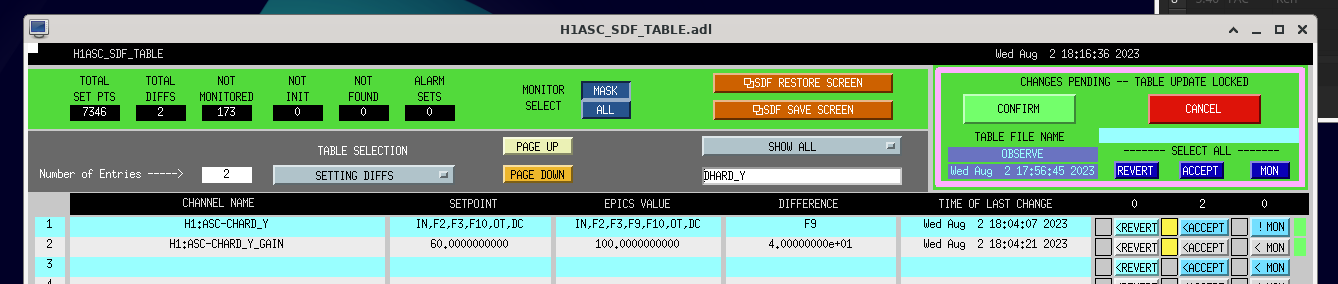
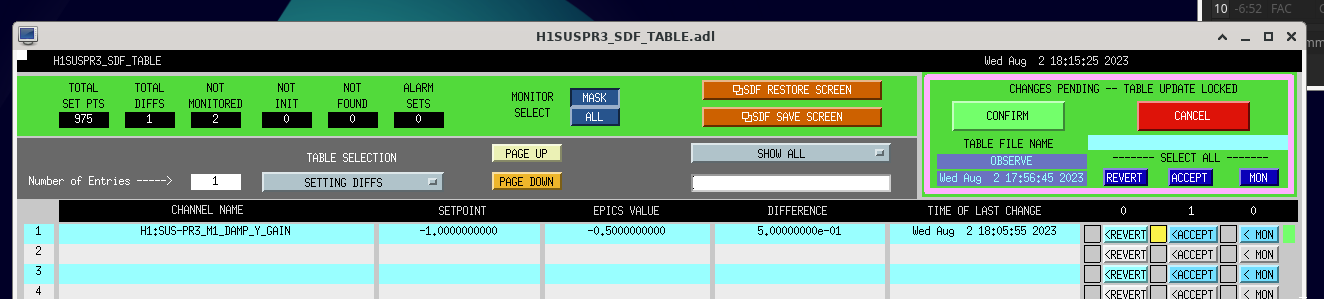
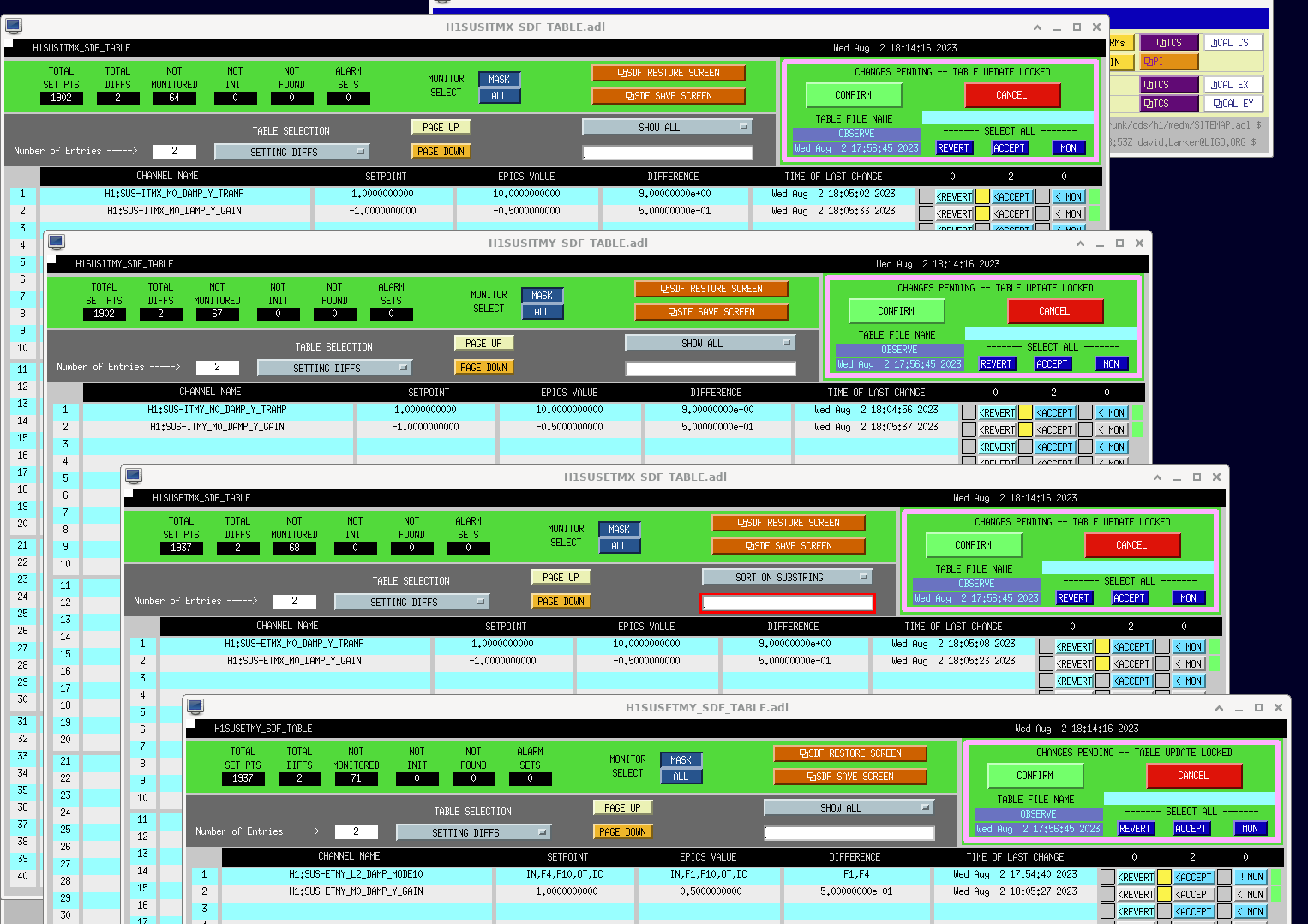
Here are the SDF Diffs which needed to be ACCEPTED for Gabriele's overnight test. These are for diffs for ASC, PR3 and all 4 Test Masses.
NOTE: For next lock, Guardian will take all these values to their "usual" values. So we'll have to ACCEPT all the diffs which come up to get us back to the "usual" state.