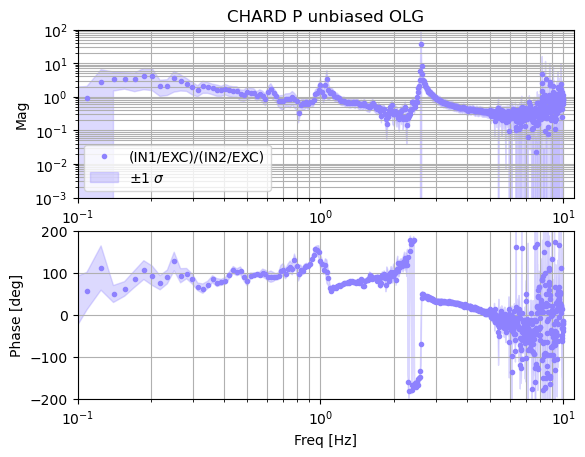
Today I took "unbiased" OLGs of DHARD P and CHARD P (see 67187 for discussion of unbiased measurements and methods). Craig previously measured these loops at 60W input power before I did some additional redesign of the loops (68698, 67488, 67518).
I have plotted the open loop gain with error shading in the attached plots. You can find the measurement templates, exported data, and processing code in '/ligo/home/elenna.capote/ARM_ASC/{DHARD,CHARD}'.
The templates for the these measurements are also saved in [userapps]/asc/h1/templates/{DHARD,CHARD} as '{DHARD,CHARD}_P_olg_broadband_shaped.xml'.
CHARD P has a UGF of 3 Hz with a phase margin of 33 deg. DHARD P has a UGF of 3.4 Hz with a phase margin of 27 deg.
DHARD has two other UGFs at 1.6 Hz and 2.4 Hz. CHARD has additional UGFs around 2.5 Hz, 1.2 Hz, 0.95 Hz and 0.65 Hz.

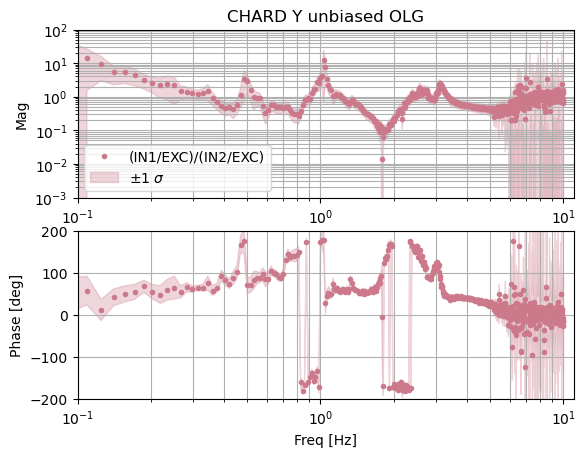
These are recent measurements by Gabriele of DHARD Y and CHARD Y, plotted with the error shading as well.
CHARD Y has a UGF of 3.3 Hz and 44 deg of phase margin. DHARD Y has a UGF of 5 Hz and a phase margin of 22 deg.
DHARD Y has additional UGFs at 2.1 and 1.5 Hz. CHARD Y has some interesting peak features that cross zero a few times between 2.3 and 3.3 Hz. There also appear to be additional UGFs around 1.2, 0.9, 0.5, 0.4 and 0.3 Hz.

Taking another look at these measurements, DHARD P has about 6 dB gain margin at the highest UGF. DHARD Y's gain margin about 3 or 4 dB. Tagging CAL because this comment might be useful for DARM loop investigations.