
Building off of 74289, I checked to see how the ALS-X beatnote strength was doing, and then tried to confirm that the issues were actually a result of the EX VEA temperature changes.
Currently, the beatnote strength is still oscillating, and last night it was back to dipping below -10dB when at its minimum (attachment1).
Here is what I noticed when looking to confirm the beatnote-temperature correlations:
ALS-X_FIBR_DEMOD_RFMON is very sensitive to changes in EX VEA temperatures
- Already pretty obvious based on how the temp changes from Friday affected ALS-X_FIBR_DEMOD_RFMON, but even small changes/normal daily fluctuations in EX VEA temperatures can change the beatnote strength by almost 2dB.
- Here are two stretches of time comparing the EX VEA average temperatures and how it affects ALS-X_FIBR_DEMOD_RFMON (attachment2, attachment3).
- Sometimes the temperature affects the beatnote strength more than other times.
ALS-Y_FIBR_DEMOD_RFMON is NOT very sensitive to changes in EY VEA temperatures
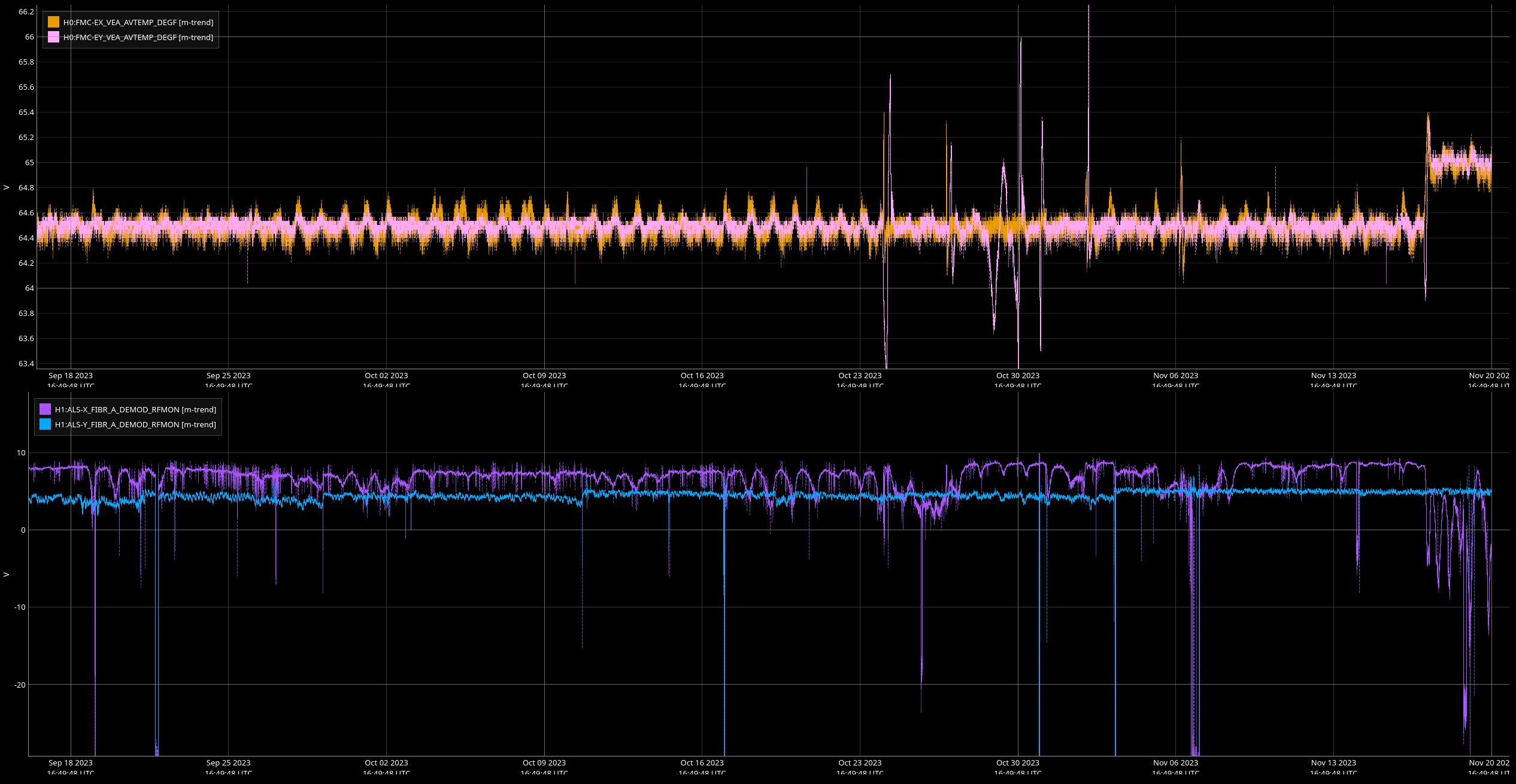
- Comparing ALS-Y_FIBR_A_DEMOD_RFMON and FMC-EY_VEA_AVTEMP_DEGF(attachment4), although VEA temp changes are definitely affecting the beatnote strength (especially during large temperature excursions), the beatnote strength is able to stay very consistant.
It is especially interesting seeing the difference between the amount of variation in ALS-X_FIBR_DEMOD_RFMON as compared to ALS-Y_FIBR_DEMOD_RFMON as temperature changes (attachment5). To be fair, the temperatures at EX do seem to fluctuate more (higher highs and lower lows) than at EY, but the way that the ALS-X beatnote strength reacts still seems to me to be much more exaggerated than it should be (like if ALS-Y was going through the EX temperature changes).


The demod readback goes thru channel 1 of the demodulator concentrator D1100691 before reaching the EtherCAT end station chassis 2 at the L5 terminal. The RF monitor is read using this calibration dB = 16.67 * V - 72.