Naoki, Karmeng, Andrei, Sheila
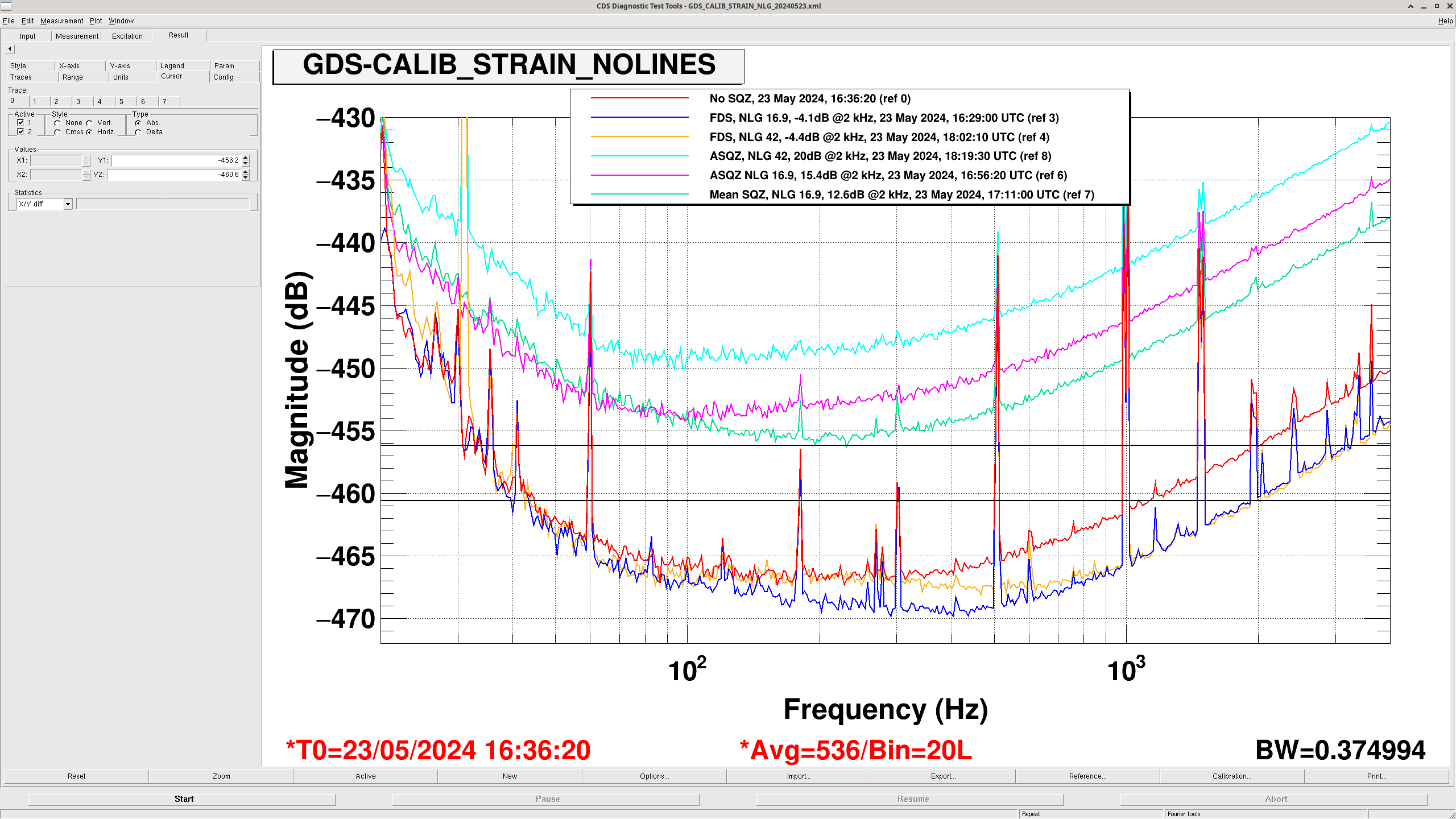
We did NLG sweep on DARM at NLG 16.9 (nominal) and 42. The IFO was locked for more than 20 hours and well thermalized. We also tried NLG of 65.9, but the squeezing level was not stable so we gave up this NLG. We will take the third NLG data tomorrow if IFO is thermalized.
Previous NLG sweep on DARM: 73747
How to measure NLG: 76542
How to change NLG: 73801
Note:
- Requesting SQZ_MANAGER guardian from FDS to FIS does not work. We need to request DOWN and then request FIS.
- With NLG 42, as soon as the seed was injected, the pump ISS failed. We reduced ISS gain from 31dB to 21dB to avoid it.
- With NLG 65.9, reducing ISS gain did not help, so we measured NLG without pump ISS. We requested OPO guardian to LOCKED_CLF_DUAL_NO_ISS and adjusted the OPO trans by changing the drivepoint of ISS.
| UTC | demod phase | DTT ref | NLG | SQZ at 2kHz (dB) | |
| FDS | 16:29:00-16:34:00 | 160.91 | 3 | 16.9 | -4.2 |
| No SQZ | 16:36:20-16:41:20 | 0 | |||
| ASQZ | 16:56:20-17:01:20 | -100.37 | 6 | 16.9 | 15.4 |
| mean SQZ | 17:11:00-17:16:00 | 7 | 16.9 | 12.6 | |
| FDS | 18:02:10-18:07:10 | 162.13 | 4 | 42 | -4.4 |
| ASQZ | 18:19:30-18:24:00 | -87.6 | 8 | 42 | 20 |
| mean SQZ | 18:29:00-18:34:00 | 9 | 42 | 17 |
| OPO trans (uW) | OPO temp | Seed amplified | Seed unamplified | NLG |
| 80 | 31.470 | 0.215 | 0.0127 | 16.9 |
| 100 | 31.454 | 0.534 | 0.0127 | 42 |
| 110 | 31.448 | 0.0725 | 0.0011 | 65.9 |
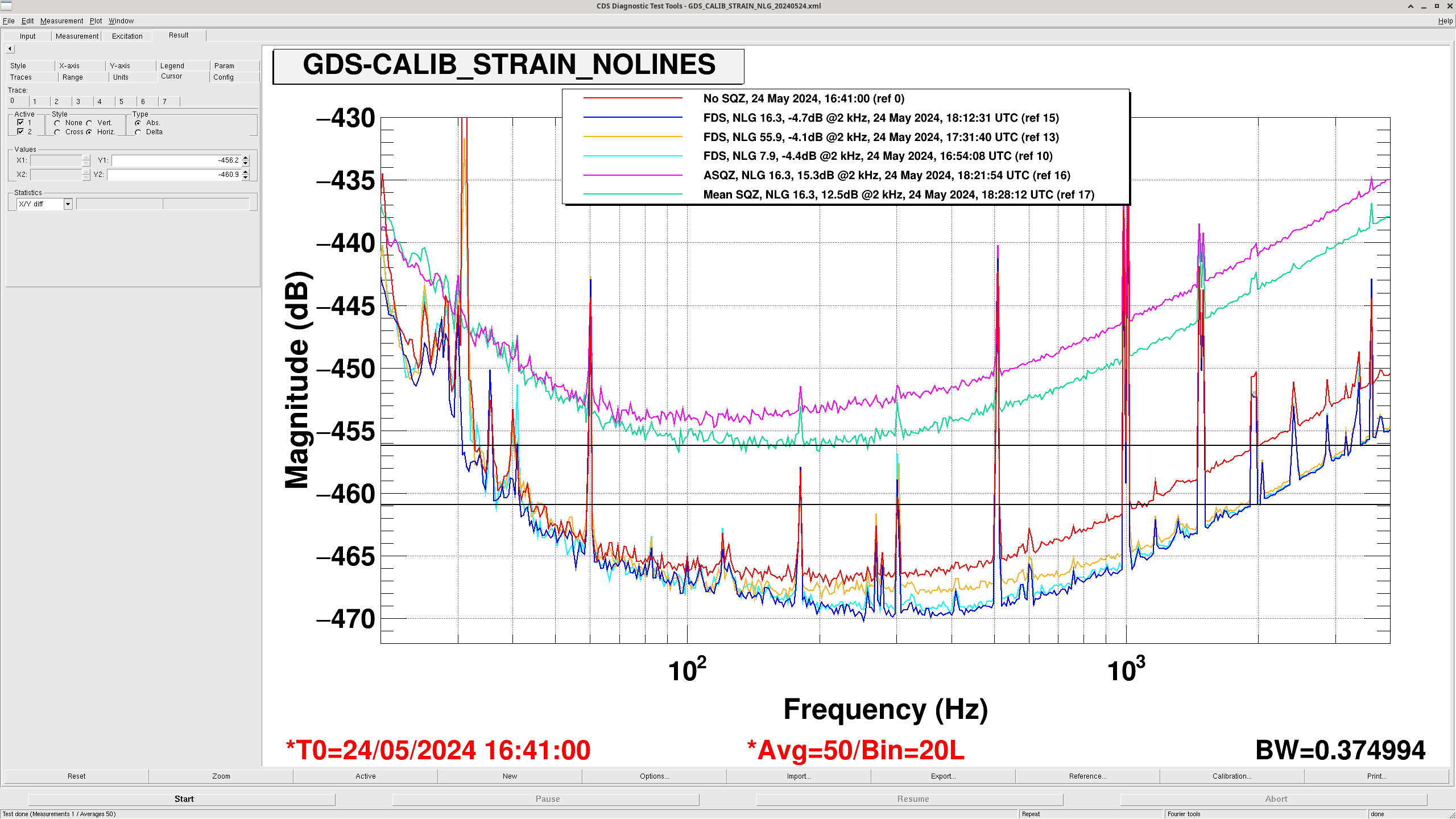
After PR2 spot move yesterday in 78012, we did NLG sweep again. This time we took three NLG at 7.9, 16.3 (nominal), 55.9.
| UTC | demod phase | DTT ref | NLG | SQZ at 2kHz (dB) | |
| No SQZ | 16:41:00-16:46:00 | 0 | |||
| FDS | 16:54:08-16:59:08 | 161.59 | 10 | 7.9 | -4.4 |
| ASQZ | 17:04:00-17:09:00 | -95.63 | 11 | 7.9 | 11.1 |
| mean SQZ | 17:10:52-17:15:52 | 12 | 7.9 | 9.1 | |
| FDS | 17:31:40-17:36:40 | 192.47 | 13 | 55.9 | -4.1 |
| ASQZ | 17:43:54-17:48:54 | -86.42 | 14 | 55.9 | 21.2 |
| mean SQZ | 17:50:53-17:55:53 | 55.9 | 18.5 | ||
| FDS | 18:12:31-18:17:00 | 190.31 | 15 | 16.3 | -4.7 |
| ASQZ | 18:21:54-18:26:54 | -97.79 | 16 | 16.3 | 15.3 |
| mean SQZ | 18:28:12-18:33:12 | 17 | 16.3 | 12.5 |
| OPO trans (uW) | OPO temp | Seed amplified | Seend unamplified | NLG |
| 60 | 31.484 | 0.0086 | 0.00109 | 7.9 |
| 80 | 31.468 | 0.0174 | 0.00107 | 16.3 |
| 105 | 31.446 | 0.0609 | 0.00109 | 55.9 |
Vicky, Karmeng
This NLG scan is compatible with ~30% SQZ losses, ~20 mrad phase noise.
Attachment 1, 2 - Calculated loss ~30% from mean sqz and generated sqz, then fit ASQZ/SQZ to estimate phase noise ~ 20 mrad and technical noise. If fitting SQZ+ASQZ together to estimate, then fit loss ~32-33%. This uses standard linear opo equations to estimate generated squeezing level based on NLG.
Attachment 3 - Calculated loss ~ 27% from mean sqz and generated sqz, then fit ASQZ/SQZ to estimate phase noise ~ 20 mrad and technical noise. This uses bowtie opo equations to estimate generated squeezing level based on NLG (few % lower generated sqz than the above estimate). See Eq. 13 of Dhruva's ADF paper, e.g. P2200041.
NLG calibration - Estimates OPO green pump trans threshold @ 142 uW. This seems close to previous threshold estimates ~149 uW made just after moving to this crystal spot (LHO:73562, Oct2023 crystal move).
A comparison of O4a (hd,ifo) and O4b NLG (ifo) scans, maybe most interesting is comparing homodyne vs. interferometer squeezing in O4a (~32% loss, LHO:78000). O4a/O4b IFO losses look similar, but I think it's largely an issue with this O4b measurement?
A note about this NLG scan - I think total optical losses should be < 30% based on seeing >5dB SQZ previously. For example, the -5.4 dB SQZ observed in LHO:76553 is too much squeezing, and incompatible with losses >30%. So I think this measurement has higher losses than "normal" in O4b, maybe related to the alignment / mode-matching / (something that drifts) not being optimal here. Would be interesting to get back to the -5dB spot (of course), and see how losses look then.
Code with instructions is here: https://git.ligo.org/victoriaa.xu/nlgscans

