Here's a look at some old data from september's OM2 heating test. I'm posting this incomplete alog, which has been sitting in my drafts for a long time, so that at least this information is available to people.
Background about the measurements:
Information about this dataset, bold numbers are used as assumptions in these models:
- I summarized measurements from Sept 4th in 86785, and estimated that kappa c was 1.1% lower with OM2 hot than cold, implying that the IFO to OMC mode mismatch is 2.2% worse with OM2 hot than cold. In the models I'm making I let the IFO to OMC mode matching be perfect for cold OM2, and 2.2% mismatch for hot, although they could both be worse than that.
- Matt measured the sqz to OMC mode matching with an OMC scan for OM2 hot to be 6.8% in 88060 (This is with ZM4 strain guage at 6.2V, in Sept when this measurement was made it was at 6V, but the mode match depends only weakly on ZM4 as shown in Leo's measurements, ZM5 has been at -0.4V for many months).
- For OM2 cold, the SQZ to OMC mode mismatch was 2.8% 88088
- Camilla took a dataset for comaprison with OM2 cold in 86777, nonlinear gain 22.9
- We took sqz data with OM2 hot in 86736, with nonlinear gain measured to be 24.0
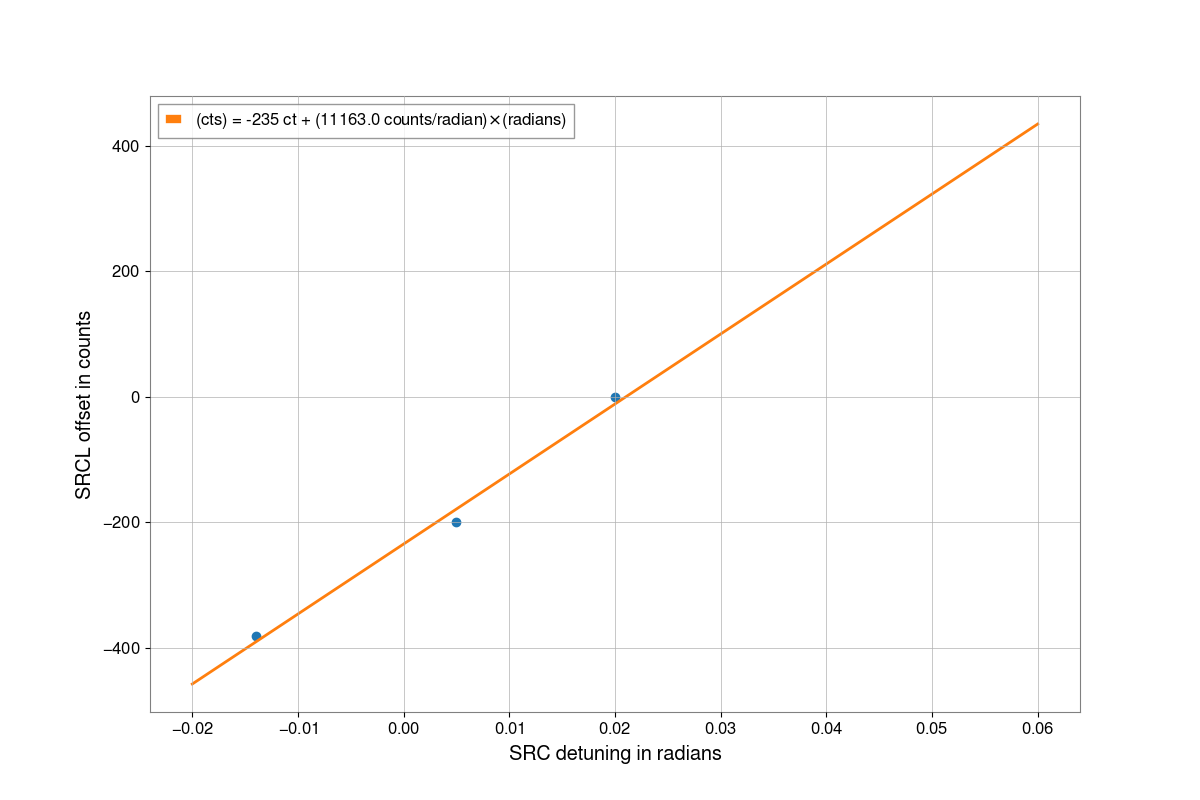
- While OM2 was hot, Camilla and Elenna did the "brontosaurus" measurement, where they used FIS to measure rotation and varied the SRCL offset, 86737. Elenna used the usual fitting code here, which assumes that the rotation is due to the SRCL offset. P2500132 section IV D discusses this, that the squeezing rotation caused by exteral mismatches (ie, sqz to OMC or IFO to OMC) are indistinguishable from the rotation caused by SRC detunings. Based on the linear fit, they changed the digital offset in the SRCL servo, we can use their fit for the slope to say this was change of 0.0134 radians in the SRCL offset, although probably not actually bringing the SRCL detuning to zero. I don't believe that we did a sensing function measurement which could distinguish between the squeezer mode mismatch and actual SRCL detuning.
- Retook OM2 hot data set with the new SRCL offset, still NLG of 24.0 86739
- We have known squeezer injection losses of 7.3% and known IFO readout losses of 10%: loss tracking gsheet
Here is a plot with all of this data, we took mean sqz data for all three data sets with the LO unlocked, we only took anti-squeezing data for the first OM2 hot data set without adjusting the SRCL offset. The low frequency non quantum noise is worse for the OM2 hot data because we didn't retune the feedforwards after heating up.
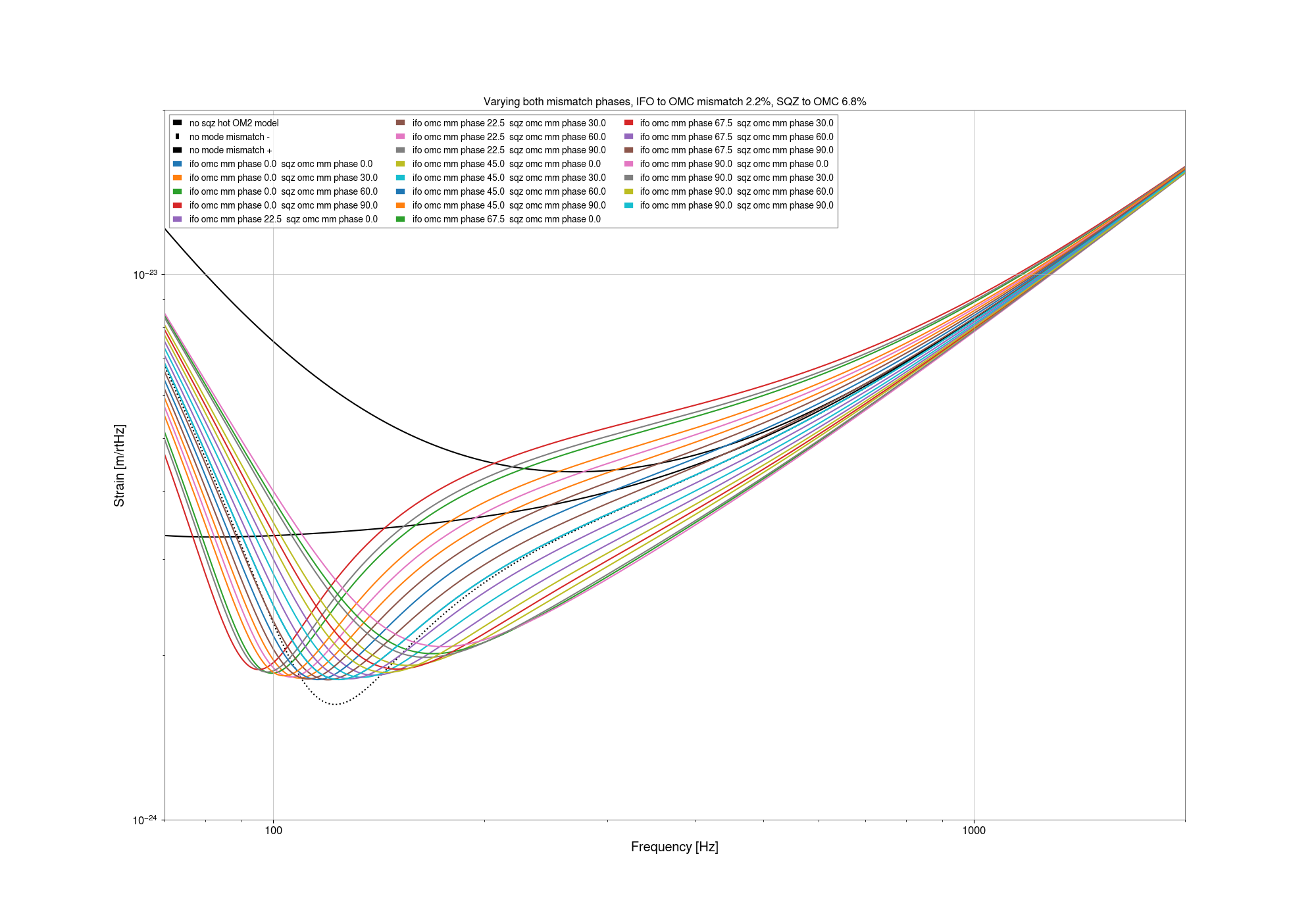
Some gwinc plots to help me understand the impact of mismatch phase:
In gwinc the mismatch is parameterized as IFO to OMC, and SQZ to OMC, since we have not adjusted the psams while we heated up OM2 we will need to increase both of these mismatches for the hot OM2 state, and both of them have a mistmatch phase which changes the frequency dependent rotation significantly. This rotation is most obvious for the mid- squeezing traces, where we adjusted the squeezing angle so that the high frequency noise matches what it is when there is no squeezing. To help myself understand, I made some plots that show a series of models with our measured mismatch magnitudes listed above and the squeezing angle fit for high frequency, varying ifo to omc mismatch phases, or sqz to OMC mismatch phases. Here is another plot showing only one type of mid sqz with both phases varying, which may also be helpful to look at to see the envelope of what varying the mismatch phase can do. Kevin has said that the only thing that matters is the relative mismatch phase, this plot illustrates that where most of the traces can't be seen because they are hidden by others with the same relative mismatch phase. The traces where two mismatch phases are identical are closest to the trace with no mismatch.
Looking at losses:
Looking at the plot with all the data, you can see that the mean squeezing is mostly the same for the three cases, above 200 Hz, suggesting that the losses are about the same for all three cases. Below 200 Hz, there is as usual some kind of extra noise that makes the mean sqz trace not useful for estimating loss. We only measured anti-squeezing for the hot OM2 case before we added the SRCL offset. This plot of a model of anti-squeezing shows that we don't expect much difference in anti-squeezing for the level of mode mismatch and SRCL offset that we have, except around 20Hz where technical noise would cover the quantum noise.
There are two ways to use these data to estimate unknown losses. I've used 2-2.3kHz since the technical noise is further from the shot noise than in other parts of the spectrum. Assuming an arm power of 330kW we can use no sqz data to estimate readout losses, doing that we need to add just a small amount of extra losses to explain our shot noise: 1.5% for cold OM2, 2.4% for hot OM2 no change in SRCL offset, 0.9% for hot OM2 with SRCL offset changed. This is encouraging since it means that we can account for most of our readout losses, however it doesn't agree with the estimate based on kappa C for the change in losses as OM2 was heated. We can also use the nonlinear gain and unlocked squeezing level to estimate unknown loss: cold OM2: 15.1%, hot OM2: 15.7%, hot OM2 SRCL offset: 19.8%.