J. Freed,
Continuing From 88293, I took phase noise measurements of waveform generators relevant to SPI pathfinder with two different methods. This first method is the standard method that LIGO uses which follows the BluePhase 1000 manual. I used this method to highlight the issues this method has in the context of SPI. The second method is a slight modification to the standard method which shows a lower noise floor in the area of interest for SPI.
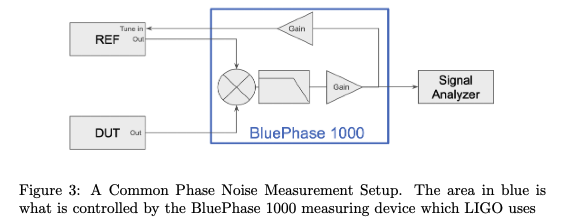
First Method: BluePhase1000_Setup.png (from LIGO-T2400324) Shows a simplified Phase noise measurements set up of what the BluePhase 1000 manual provides. A simple way to take phase noise measurements is to mix the signal from the Device under Test (DUT) with a reference device (REF) outputting the same frequency but at quadrature. Ideally, this mix outputs only the differential noise between the two devices. If the reference device has much better performance, then the mix ideally outputs only the DUT noise. In this method, a feedback loop is used to keep the REF at quadrature with the DUT. For the REF device, I used the 80MHz OCXO housed in LIGO-D1100663.
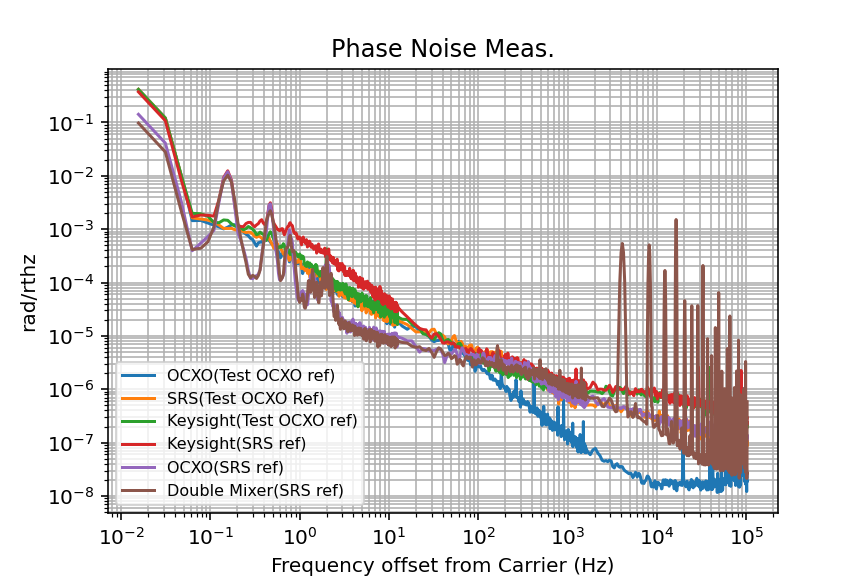
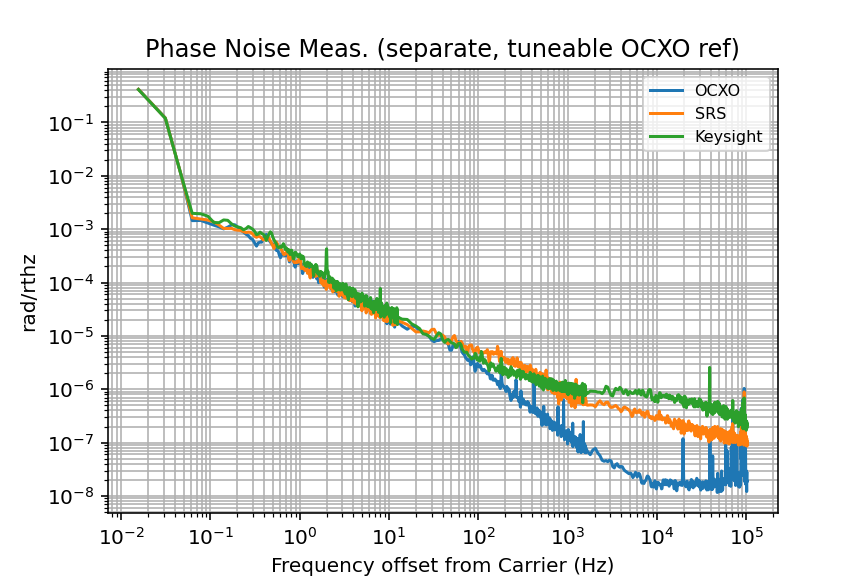
OCXOComparisonTOCXO.png Shows the results from the first method, I used 3 different devices as the DUT; a 80MHz OCXO here at LIGO LIGO-S1000565, a SRS SG382, and a Keysight 33600A. The main thing of note is that OCXO is expected to have a much lower noise floor than any other device; however, below ~60Hz the noise is not limited by the different DUTs. Since the REF is another OCXO, I believe the feedback loop that keeps the REF device in quadrature is limiting measurements below 60Hz. Since SPI is interested in phase measurements well below 60 Hz this first method will not work for taking phase noise measurements for SPI. Especially since SPI has both an 80Mhz and an 80MHz -4096Hz signal and LIGO does not have a 80MHz -4096Hz OCXO to use as a ref.
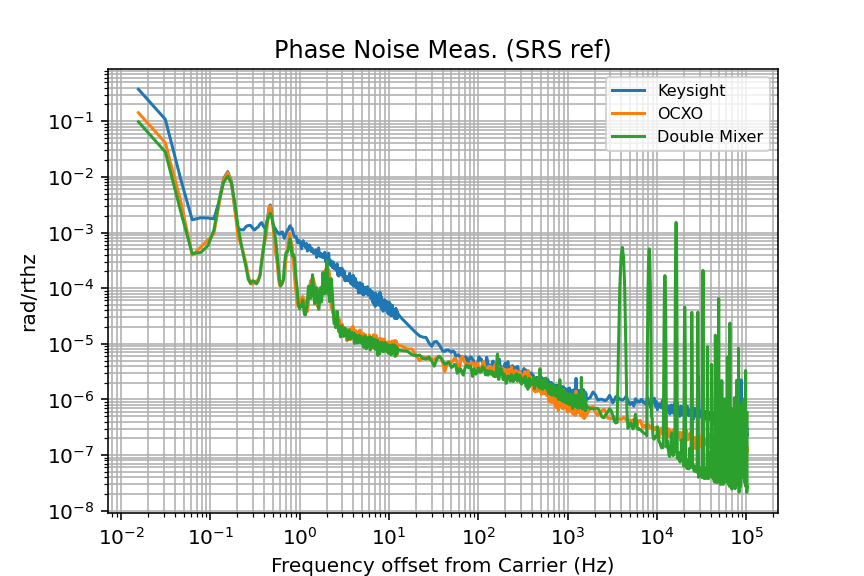
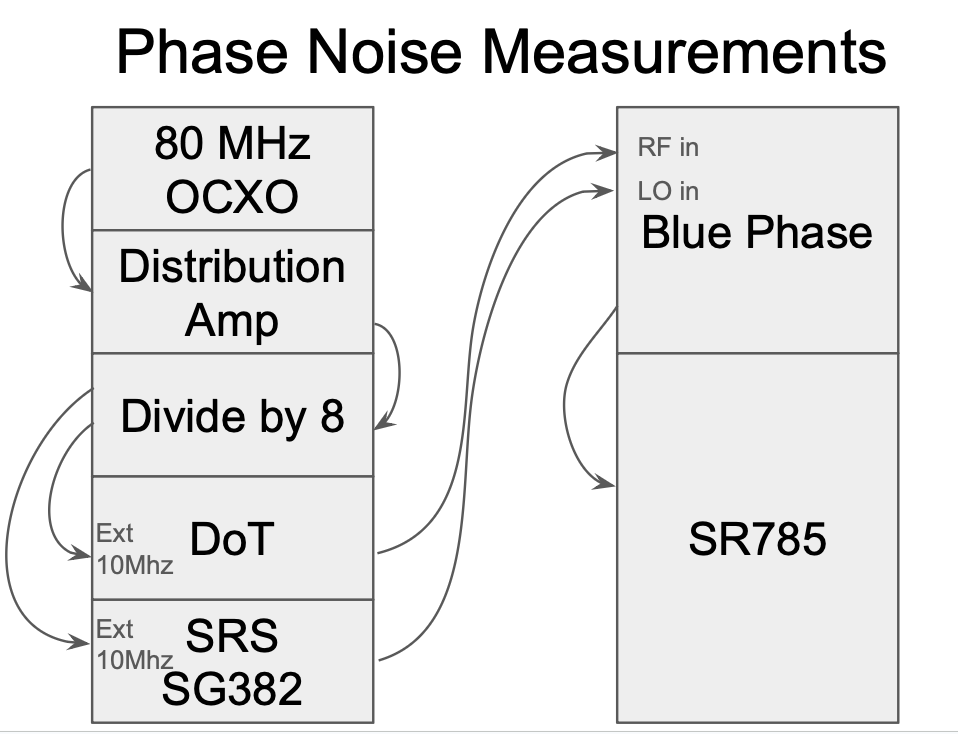
Second Method: PhaseNoiseSetUp.png shows the modified set up; where the REF device is the SRS SG382. This method puts the REF device at quadrature by setting it manually and holding it there through the 10MHz timing port created by dividing by 8 the 80MHz OCXO signal. Since both the REF and DUT are referenced to the same OCXO (or the DUT is the OCXO itself), ideally both devices will be held at quadrature bypassing the need for a feedback loop. In practice, I did notice a small amount of drift from quadrature over time.
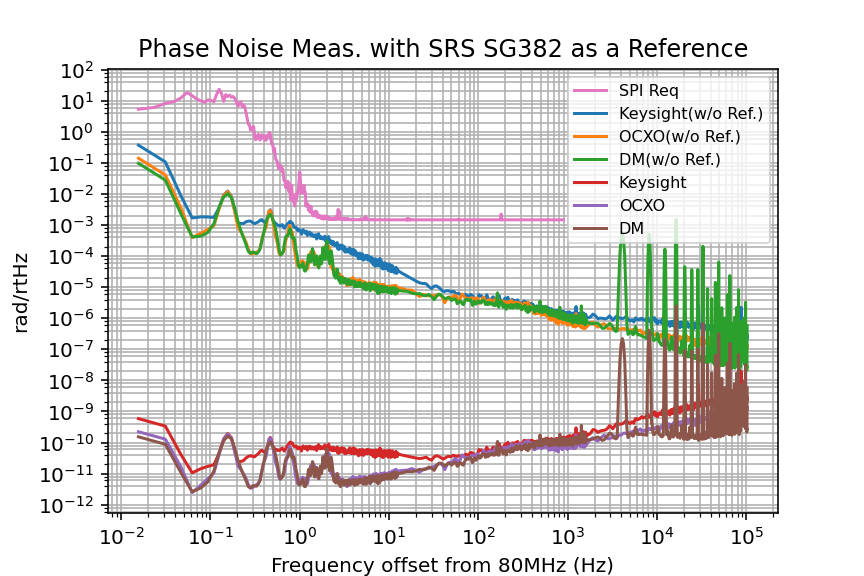
OCXOComparisonSRS.png Shows the results from this method. This graph shows both the OCXO and the Double Mixer have phase noise performances well below the noise performance of a typical waveform generator (Keysight) below 100Hz. Though combined with the last alog, still very much better than SPI requirments.
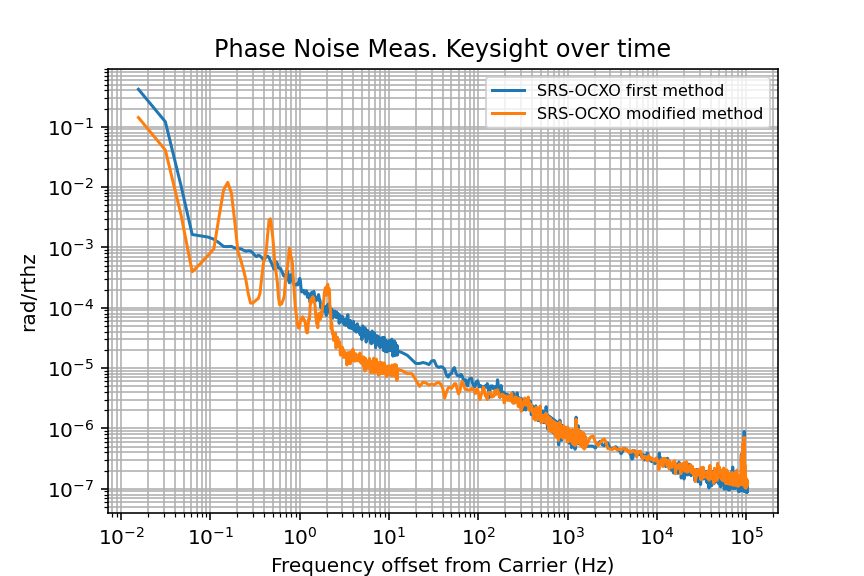
Difference: OCXOComparisonSRSOC.png (ignore the title on this plot) shows the mix of an 80MHz OCXO and the SRS using the two different methods to hold one at quadrature with the other. With the modified method, we are not limited as much below 60Hz, except those peaks at ~0.16Hz, ~0.45Hz, etc.. which I believe are caused by the divide-by-8, not the SRS; as the SRS measurement using the first method did not have these peaks.
Extra:
OCXOComparisonFull.png Shows all measurements on one graph.
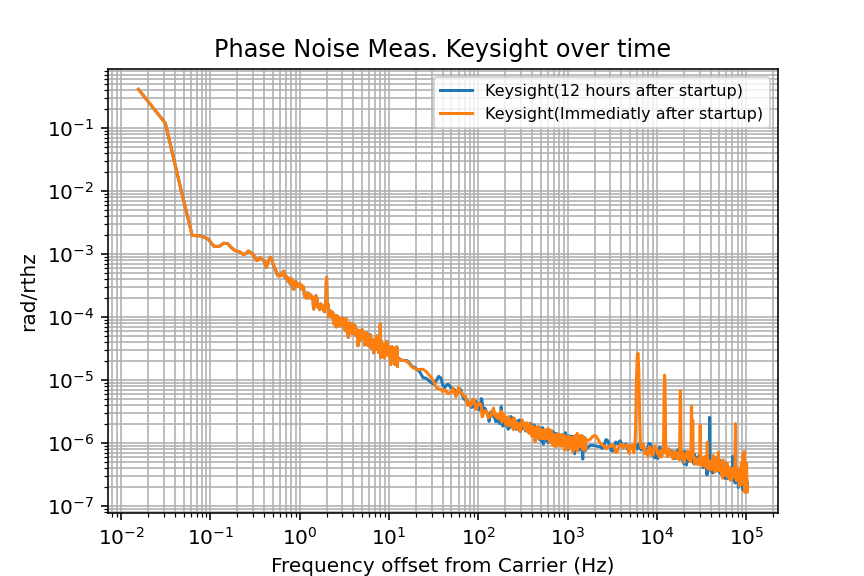
OCXOComparisonKey.png Shows that Keysight had strange harmonics at multiples of 5kHz but disappeared 12 hours later.
Applying the equation found in 88293 to the data in the modified method, we get a new plot Keyrad3.png that shows the SPI noise budget for phase noise of oscillators used in the build/install of SPI. We can come to the same conclusion as last time, that since SPI has a reference interferometer the noise drops significantly at low frequency (the area where SPI operates). The noise from SPI's selected oscillators for the build/install is expected to have a negligible effect on our noise budget.