jeffrey.kissel@LIGO.ORG - posted 10:55, Wednesday 25 February 2026 (89263)
SPI Single-element Photodiode Short Check :: No Shorts Pin-to-Pin -- Everything Good-to-GO
J. Freed, J. Kissel

We worried for the production, already class-A clean, SPI's single-element PD (SPD) assembly (D2600001) that the unused GAP5000 pins of the dual-purpose D1700116 ceramic circuit board may have shorts from FFD-200 SPD case to its anode and cathode if the case of the PD was not insulated from those GAP5000 pins -- as was found possible in the dirty test setup (see list item 2. in LHO:89247).

This morning, we opened up the cleaned assemblies (still serialized under the drawing for the cable, D2400341),
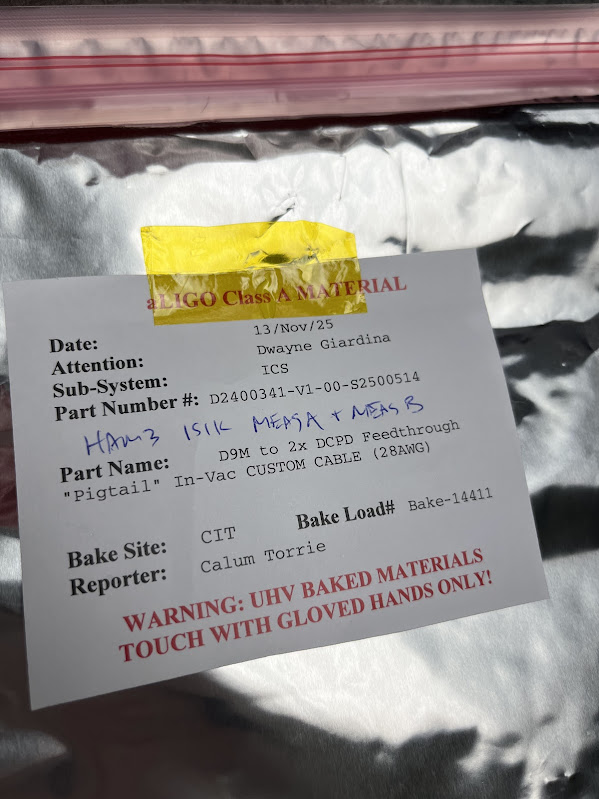
    - S2500514 :: HAM3 ISIK MEAS A and MEAS B
         --Pins 5-9 -> PD Box S2400197 -> DCPD 001
         --Pins 4-8 -> PD Box S2400198 -> DCPD 002
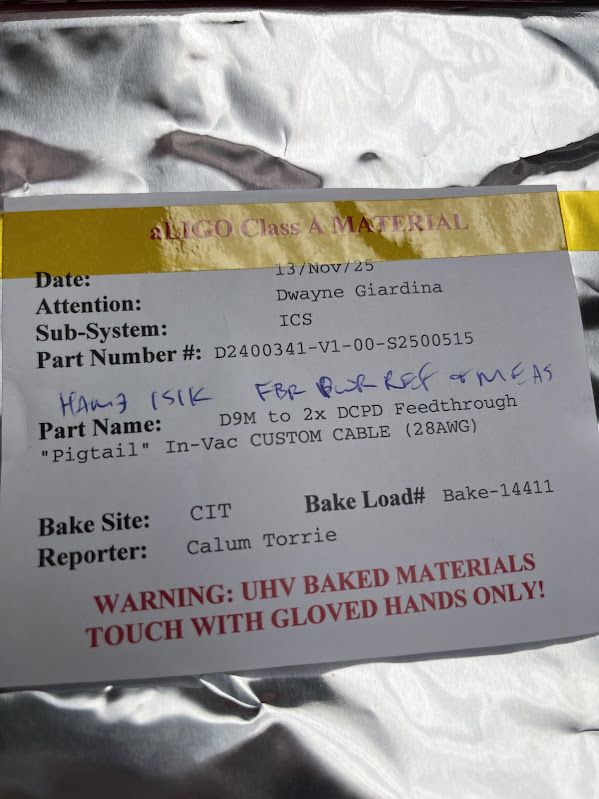
    - S2500515 :: HAM3 ISIK FBR PWR REF and FBR PWR MEAS
         --Pins 5-9 -> PD Box S2401094 -> DCPD 004
         --Pins 4-8 -> PD Box S2401093 -> DCPD 003
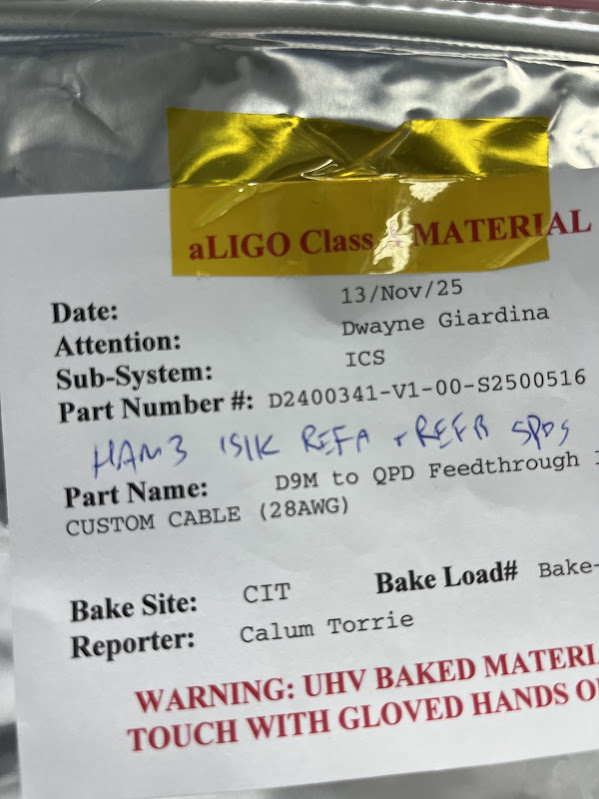
    - S2500516 :: HAM3 ISIK REF A and REF B
         --Pins 5-9 -> PD Box S2401096 -> DCPD 005
         --Pins 4-8 -> PD Box S2401095 -> DCPD 006

And found that for every assembly,
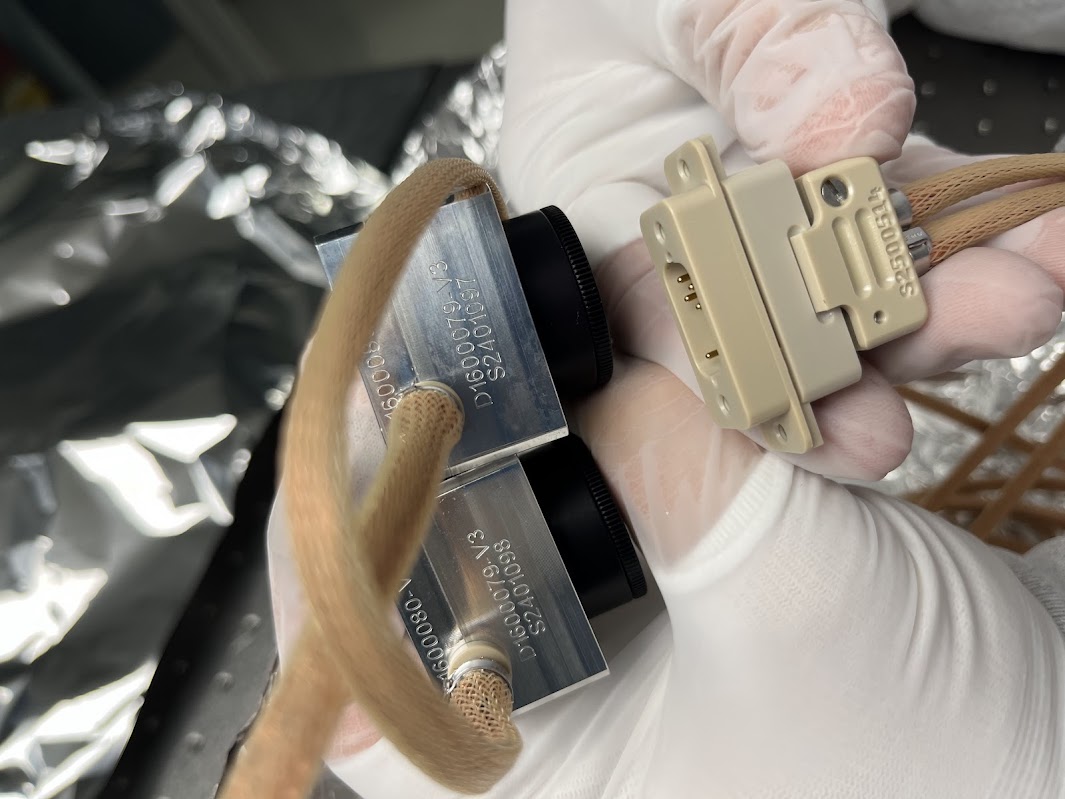
    - Per D2400341, only pins 1,4,5,8, and 9 exist. See example picture of S2500514
    - All the anode (5 or 4) or cathode (9 or 8) pins are isolated from the case pin (Pin 1)
    - The anode pins for the two diodes (5 and 4) are isolated from each other
    - The cathode pins for the two diodes (9 and 8) are isolated from each other
    - Each diode's cathode to anode resistance (5 to 9 and 4 to 8) is in the ~2e6+/-1 [Ohm] = ~few [MOhm] as expected for the reverse bias operation we'll use the system.

The production PD assembly will function as designed without any shorts :: the negative reverse bias topology of the transimpedance amplifier and cable readout system will work!

I also attach pictures of the bags that aide assignment of serial numbers to assemblies.
Images attached to this report