
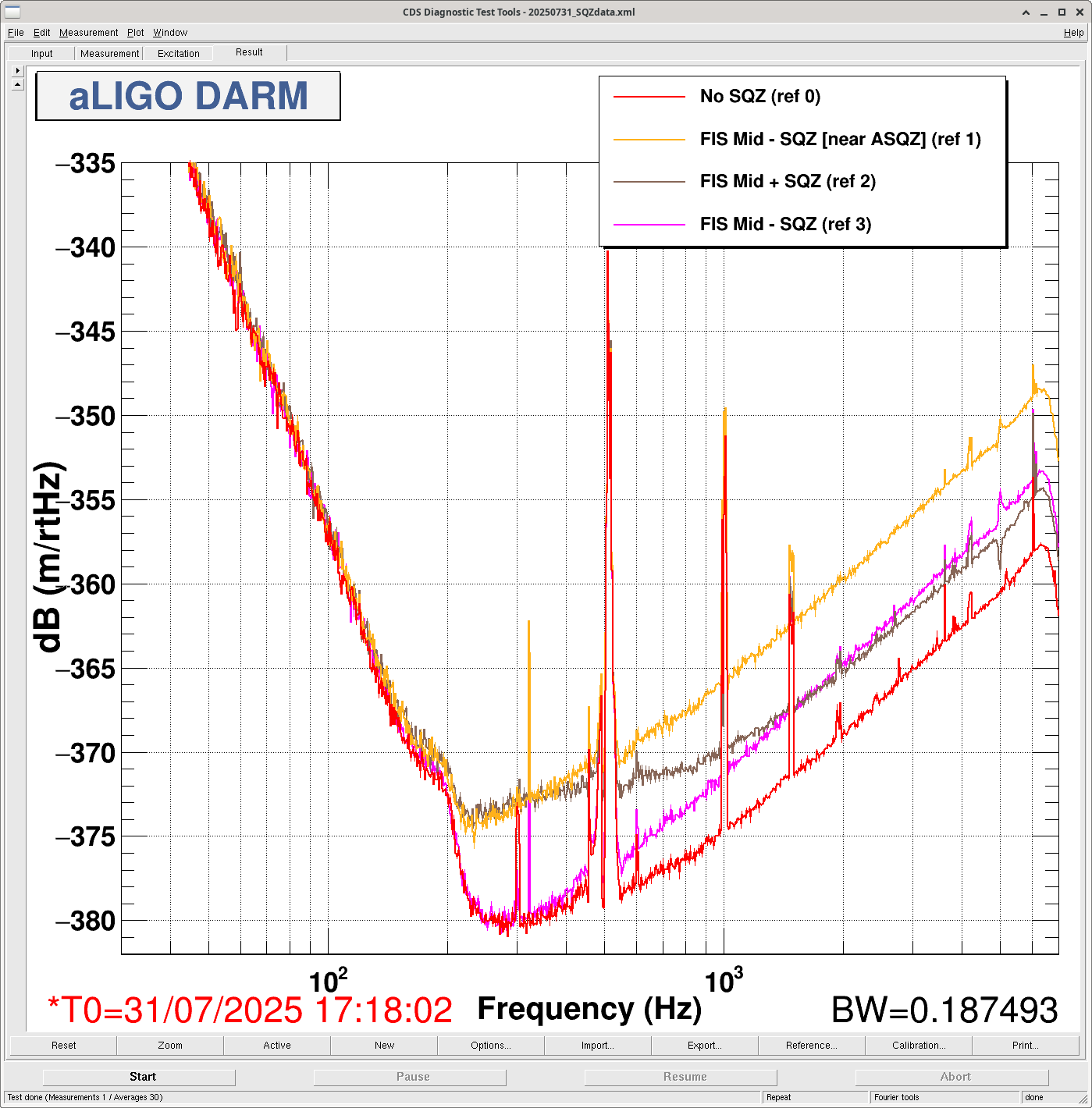
/ligo/home/camilla.compton/Documents/sqz/templates/dtt/20250731_SQZdata.xml screenshot attached and /ligo/home/sheila.dwyer/Noise_Budget_repos/quantumnoisebudgeting/data_files/higher_order_modes_sqzdataset2W.xml screenshot attached.| Type | Time (UTC) | Angle | DTT Ref in SQZ | DTT ref in HOM | Notes |
| No SQZ | 15:20:00 -15:25:00 | N/A | ref 0 | ref 0,1 | |
| FDS Mid - SQZ | 15:31:00 - 15:34:00 | (-)120 | ref 1 | ref 2,3 | Was close to ASQZ so retook below |
| FDS Mid + SQZ | 15:36:00 - 15:39:00 | (-) 30 | ref 2 | ref 4,5 | |
| FDS Mid - SQZ | 15:40:00 - 15:43:00 | (-)150 | ref 3 | ref 6,7 |
| OPO Setpoint | Amplified Max | Amplified Min | UnAmp | Dark | NLG | Note |
| 80 | 0.0533596 | 0.00250 | 0.007039 | -1.93e-5 | 7.6 | Temp already optimized |
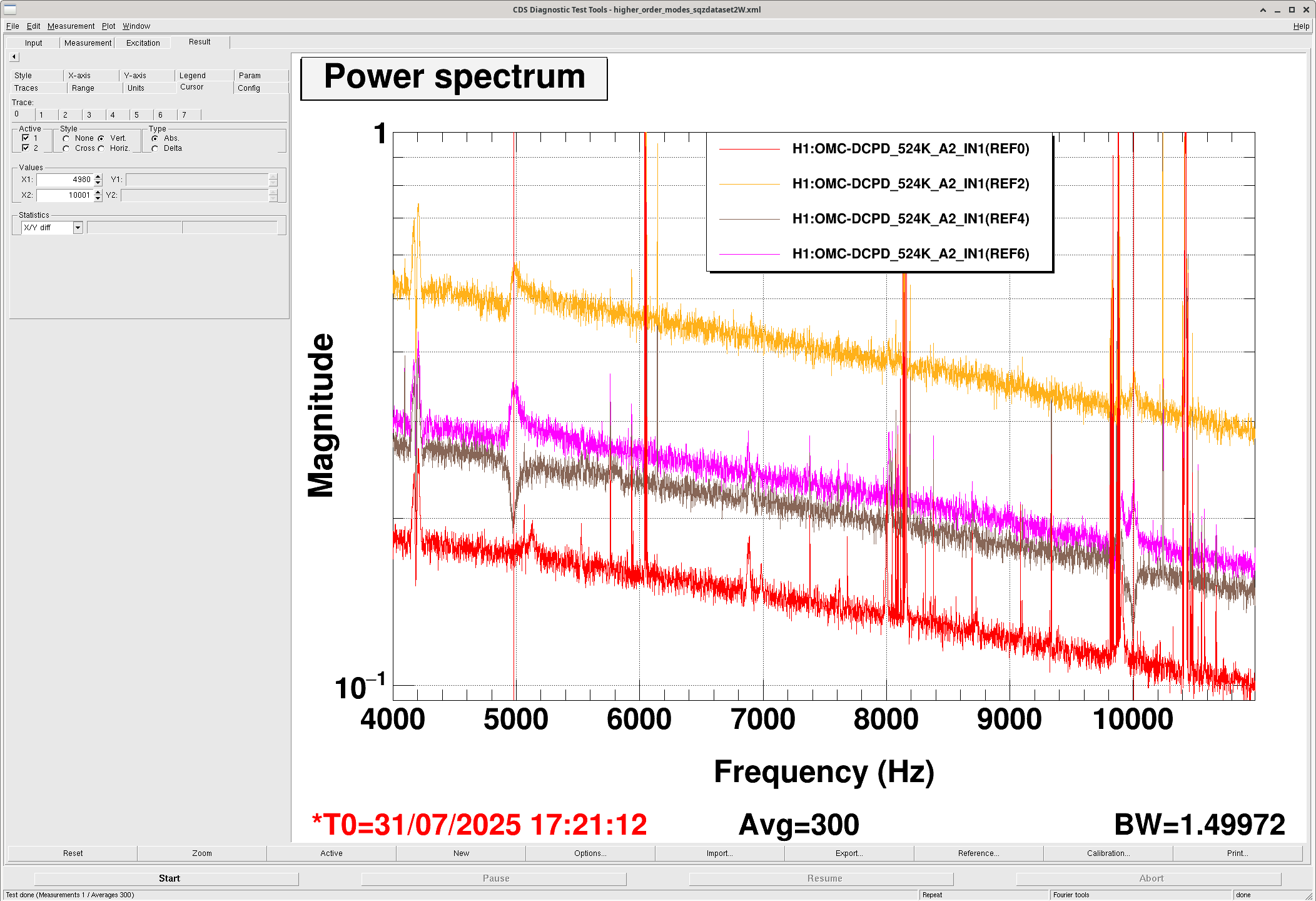
In this data I only see evidence of one mode at 5kHz, and one mode at 10kHz. If the astigmatism that caused the X arm second order modes to separate into two in 86107 is due to the point absorbers or some other laser heating, it could make sense that we don't see astigmatism at 2W. However, the ring heater settings for the two arms are different, so I would have expected the X and Y arm HOMs to be separated even at 2W. This data was taken with 0.44W on ITMX RH (per segment), 1W per segment on ETMX RH, 0W on ITMY RH, and 1.5W per segment on ETMY RH.
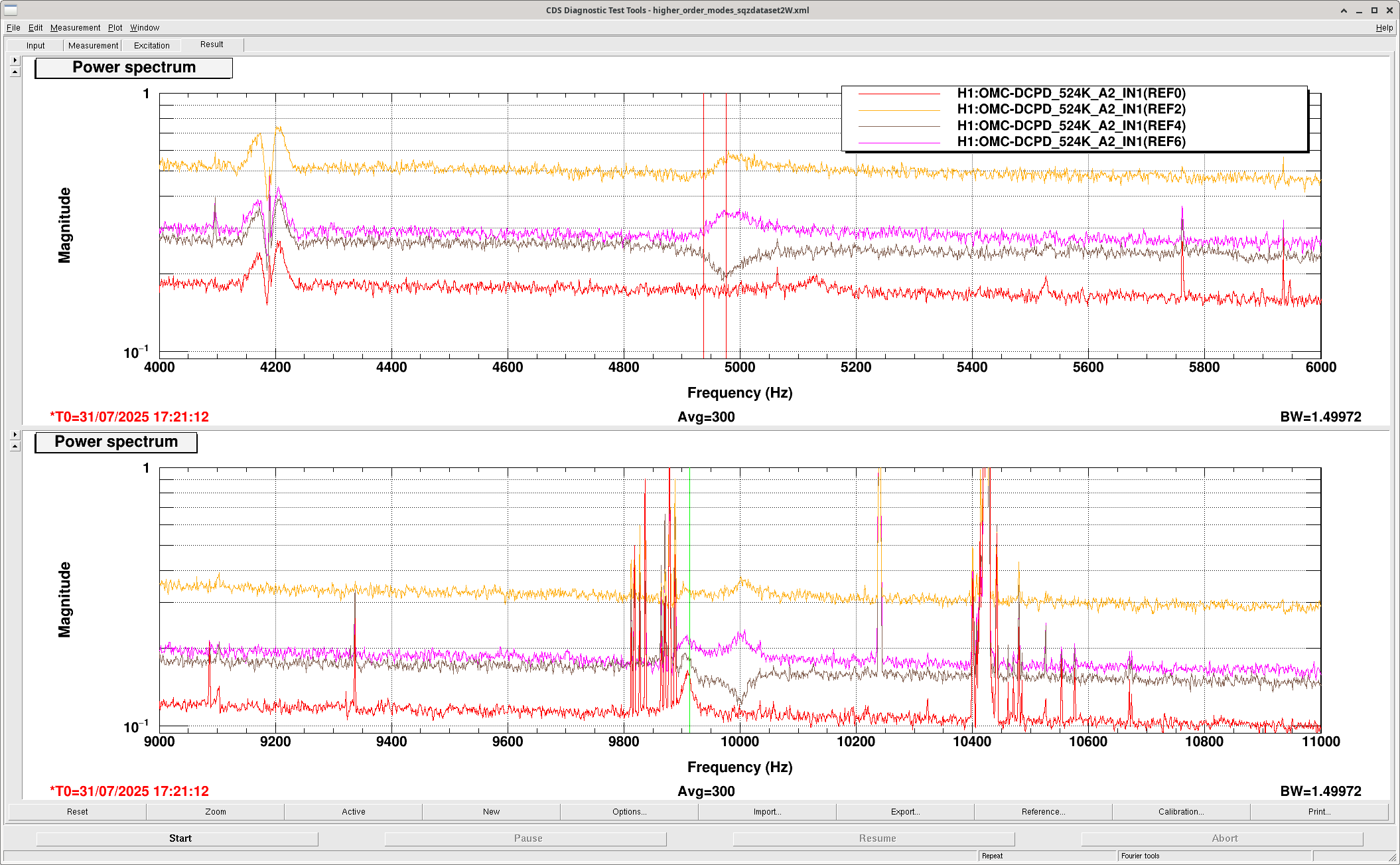
Using a cursor to find the edges of the rotation from the three mid sqz traces that Camilla tok, the 5kHz mode frequency is 4956.5+/- 20 Hz, and the 10kHz mode is at 9981.5 +/- 19.5 Hz. This suggests that the second order mode is at 99% of 2* first order mode frequency, similar to the ratio that we saw at full power. 86107. In the attached screenshot, the top panel shows where I put the cursor to measure the location of the 5kHz mode, the lime veritcal line in the bottom plots shows twice that frequency, 9913 Hz, which is clearly below the sqz rotation caused by the HOMs.
The hour times in my data table are all incorrect, should be starting at 17:20UTC.
When we started the data taking with NO_SQZ at 15:20UTC, the IFO had been down and the CO2 lasers off for 2hours 5mins.
At Matt's request I revisited this data.
We didn't plan on doing subtraction on this data at the time we took it, so we didn't save the high rate individual PD time series to do the cross correlation. Instead, I made a rough shot noise model (a line in a semilog plot), subtracted that in quadrature from the no squeezing data to estimate the non quantum noise and subtract that from the squeezing measurements.
Above I wrote that there is only one mode at 5kHz, and one at 10kHz, but after doing the rudimentary subtraction this data does seem to suggest that there are two modes at 10kHz, which we would expect since the ring heater settings are different for the two arms. The rotation that is partially hidden by quantum noise and is around 9875-9900 Hz, and seems to rotate in the opposite direction from the more visible one at 10kHz. (This is different from what was seen at full power in 86107 and in the similar ADF measurements in Kevin's comment).
The code used to make these plots is based on 86107 and is available here.
Note: The pink trace in this plot is labeled anti-squeeze, but it is not, it is actually a mid squeezing angle that is somewhat close to anti-squeezing.
