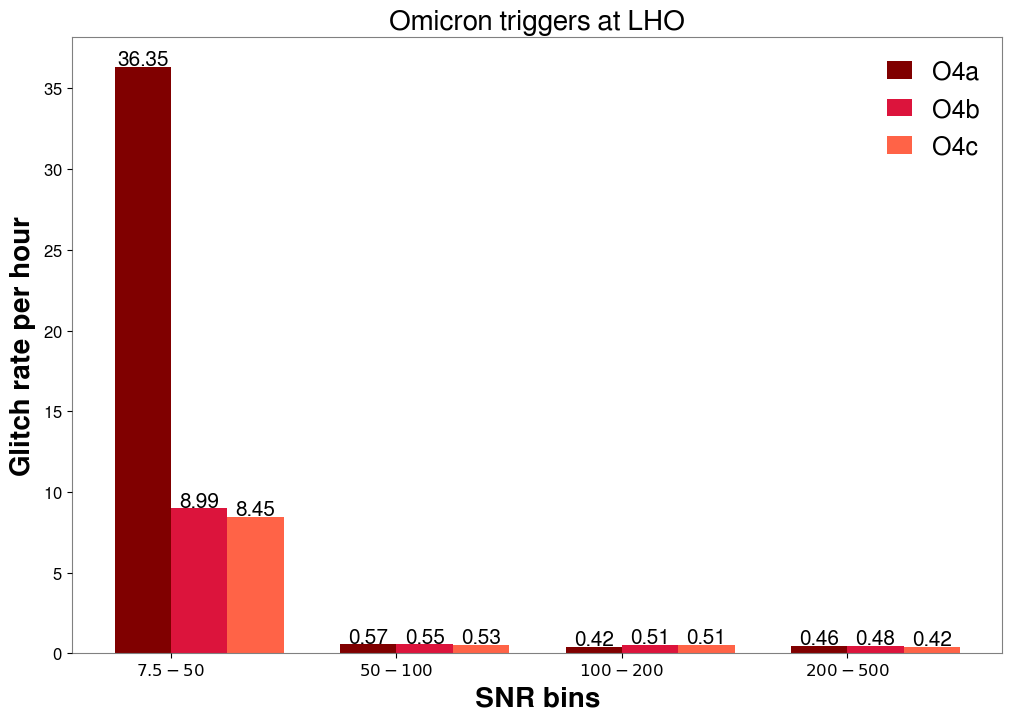
Attached to this alog are the Omicron glitch rate compariosns between O4a, O4b, and O4c. I am posting just for the record, but this was also presented at the LVK in Pisa (see here). For the comparisons, I used roughly about ~3240 hours of observing time (denoted by the H1:DMT-ANALYSIS_READY:1 flag). The exact GPS times used for the analysis were:
O4a: 1372611618 - 1389484818
O4b: 1397692818 - 1422118818
O4c: 1422118818 - 1447502418
The first attached plot shows the glitch rate across each observing period, which includes glitches with an SNR > 7.5, and frequency between 10 Hz - 1024 Hz. The rate was the highest in O4a, at around ~38 glitches per hour. The subsequent glitch rates for O4b/c were lower and similar levels, coming in at around ~11 glitcher per hour and ~10 glitches per hour. In O4a, the glitch rate was high due to increased non-stationary noise from ~10 Hz - 50 Hz (see alogs 71005 & 71092). The following two plots show the glitch rates as a function of SNR and frequency. Most glitches had an SNR below 50, and frequency below 50 Hz.