jeffrey.kissel@LIGO.ORG - posted 16:06, Friday 24 April 2026 - last comment - 16:39, Friday 24 April 2026(90006)
SPI MEDM Screen Initial Release
J. Kissel

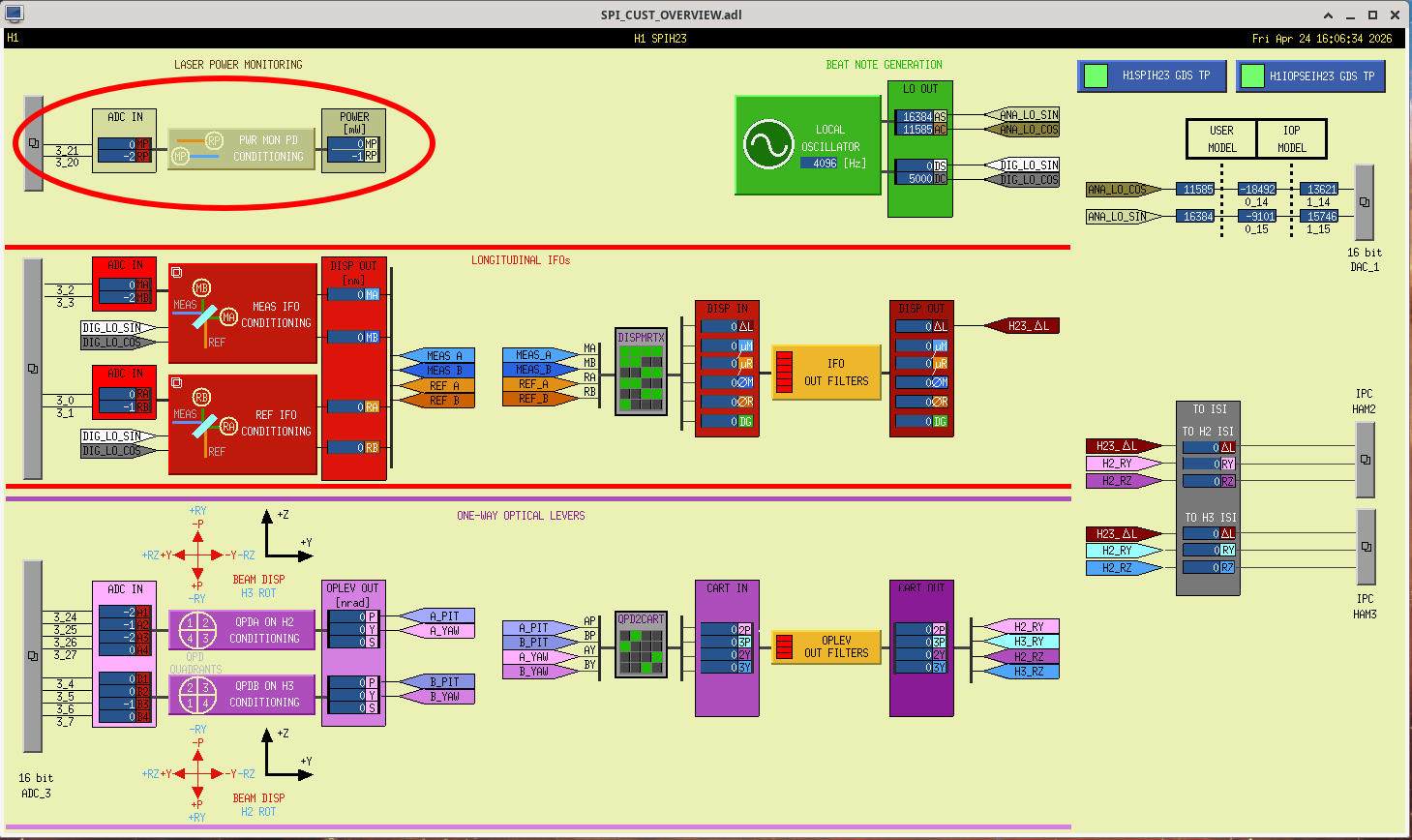
After the install of front-end software (LHO:89777 and LHO:89919) the next step for SPI is MEDM screens -- the UI/UX for the SPI L interferometers and PY one-way optical levers.

Here, I post screenshots and corresponding userapps svn file and location.
Sub-screens and their future purpose will come in the comments, but make sure to also check out G2402138.

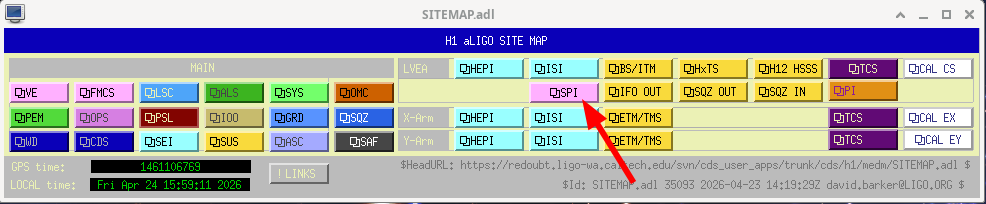
In the main entry, I show off the new place that SPI lives on the LHO sitemap and the overview screen.
The overview screen, and all subordinate screens use a marco file, which I also attach.

All of these files are, of course, properly version controlled in the userapps SVN, here:
OVERVIEW SCREEN
    ${USERAPPS}/spi/common/medm/
        SPI_CUST_OVERVIEW.adl        rev 35102

MACRO FILE
    ${USERAPPS}/spi/h1/medm/
        h1spih23_overview_macro.txt  rev 35106
Images attached to this report

Non-image files attached to this report

Comments related to this report
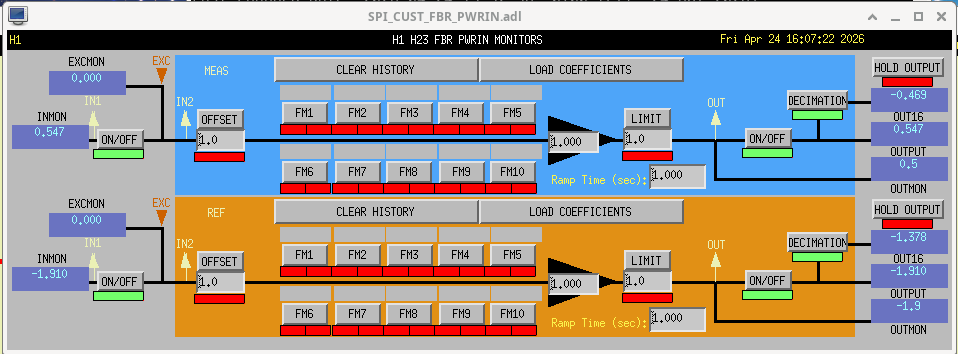
POWER MONITORING

These cover the on-board power monitor SPDs. Eventually, we'll use these filter banks to calibrate the PDs into [mW] as it lands on the ISIK breadboard.

${USERAPPS}/spi/common/medm/SPI_CUST_FBR_PWRIN.adl     rev 35102
Images attached to this comment
LOCAL OSCILLATOR

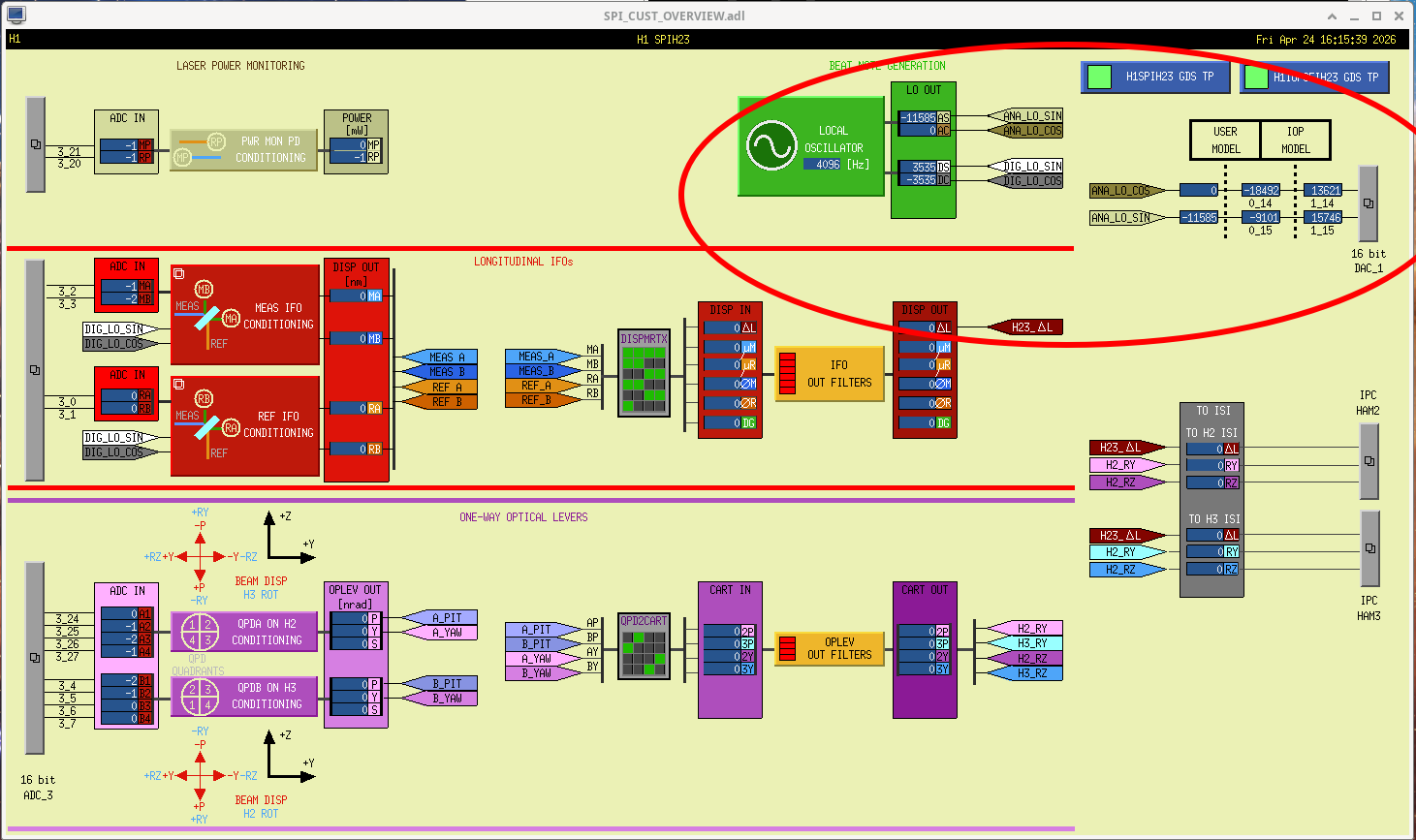
The SPI's longitudinal IFO that measures the differential displacement in the main IFO's X direction release on heterodyne interferometry, with the interference between two beams modulated at 80 MHz and (80 MHz- 4096 Hz) = 79995904 Hz, which creates a beat note at 4096 [Hz]. 80 MHz comes from the site's RF distribution system of 80 MHz. The 4096 Hz is initially digitally generated via CDS, and a copy of that is sent out via DAC to be subtracted from 80 MHz with our homegrown single-sideband mixer, a.k.a "double mixer" (D2400315). This is the screen that controls the parameters of the cds oscillator, as well as some phase rotators and filterbanks to condition the digital LO into an analog signal for the DAC.

Nominally, the cds oscillator clock emits a 1 [count] amplitude wave, and the CLKGAIN, SINGAIN and COSGAIN parameters are set arbitrarily high, since its use as the LO for digital demodulation is usually entire internal to CDS. However, because this LO goes somewhere into real electronics, I've set the calibration of the signal condition filters such that the CLK, SIN, and COS gain are in units of [mV/ct] -- and I've set the LO amplitude at 5000 [mV] = 5 [V], mid-range of the DAC.

Since we don't yet know the right phasing, all the phase rotators are current set to 0 [deg].

${USERAPPS}spi/common/medm/SPI_CUST_LO.adl    rev 35103
Images attached to this comment


INTERFEROMETERS

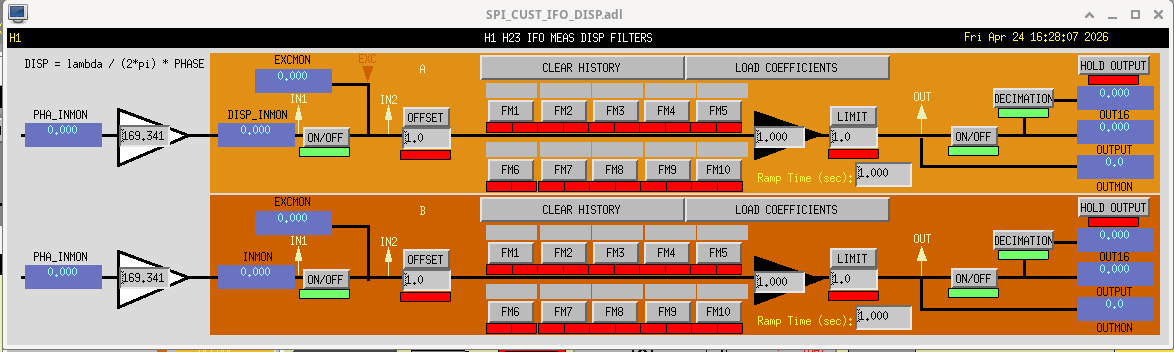
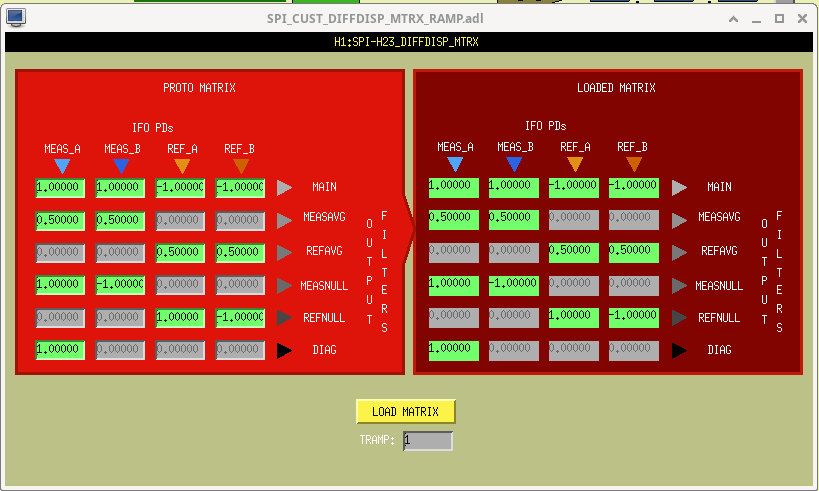
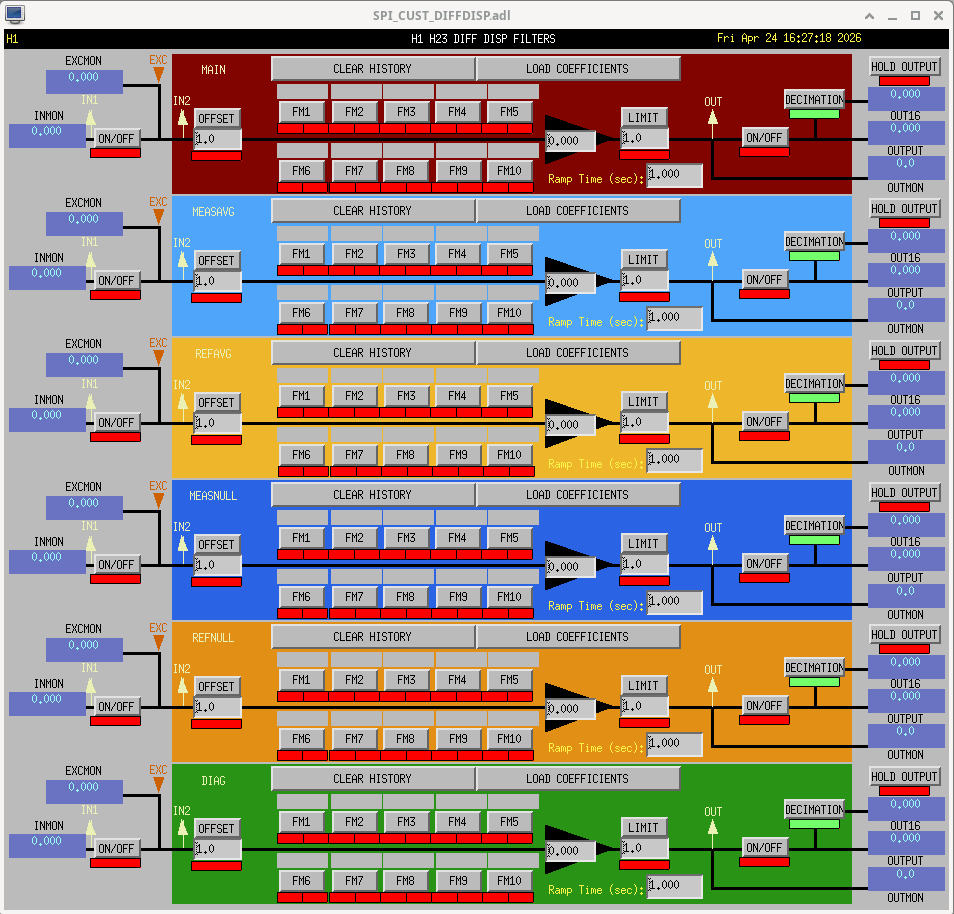
Here're the screens (less commissioned) that cover the digital demodulation and conversion to differential displacement.

${USERAPPS}spi/common/medm
    SPI_CUST_IFO.adl
        SPI_CUST_IFO_DEMOD.adl
        SPI_CUST_IFO_DISP.adl
    SPI_CUST_DIFFDISP_MTRX_RAMP.adl
    SPI_CUST_DIFFDISP.adl

all commited to rev 35102
Images attached to this comment


ONE-WAY OPTICAL LEVERS

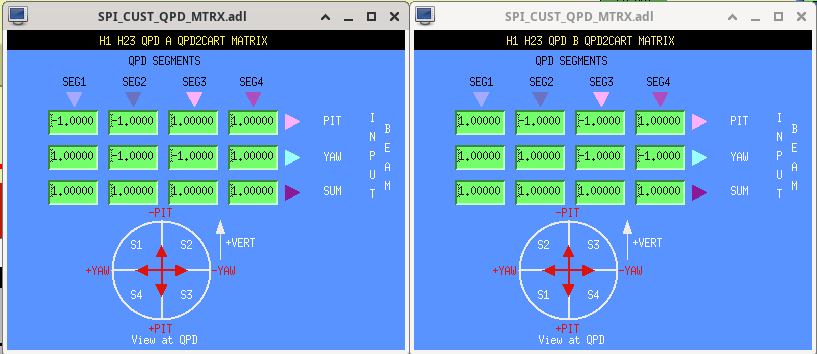
Here's the signal chain for the one-way optical levers. There's a good bit of confusing basis changing happening given
- the orientation of the QPD segments w.r.t. to vertical being different on HAM2's ISIJ QPDA and HAM3's ISIK QPDB,
- The usual conversion from QPD segments to pitch and yaw, as the beam flies, then
- Converting from beam pitch and yaw to ISI rotation, given that the HAM2 QPDA measuring HAM3 rotation is on the "front" +X side of HAM2, and the HAM3 QPDB measuring the HAM2 rotation is on the "back" -X side of HAM3.
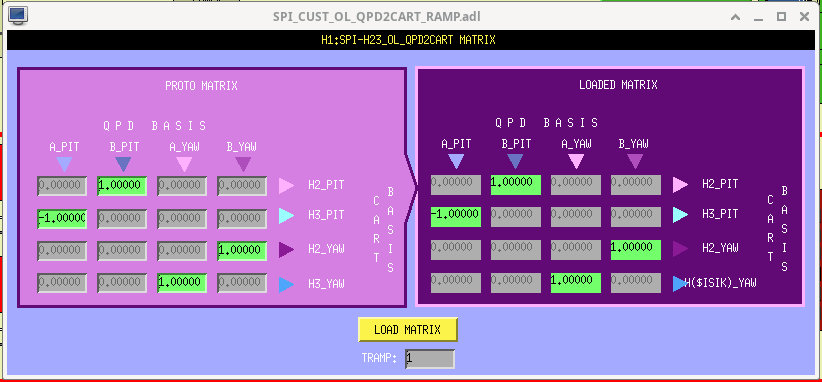
So I had to make custom SPI screens (rather than use the standard ASC QPD screen) that hopefully clears all this up. Also, the QPD2CART matrix is a ramping matrix, and I've never liked the auto-generated MEDM screen for this, so I pioneered a new one that I think has a better user interface.

${USERAPPS}/spi/common/medm/
    SPI_CUST_QPD.adl
        SPI_CUST_QPD_MTRX.adl
    SPI_CUST_OL_QPD2CART_RAMP.adl
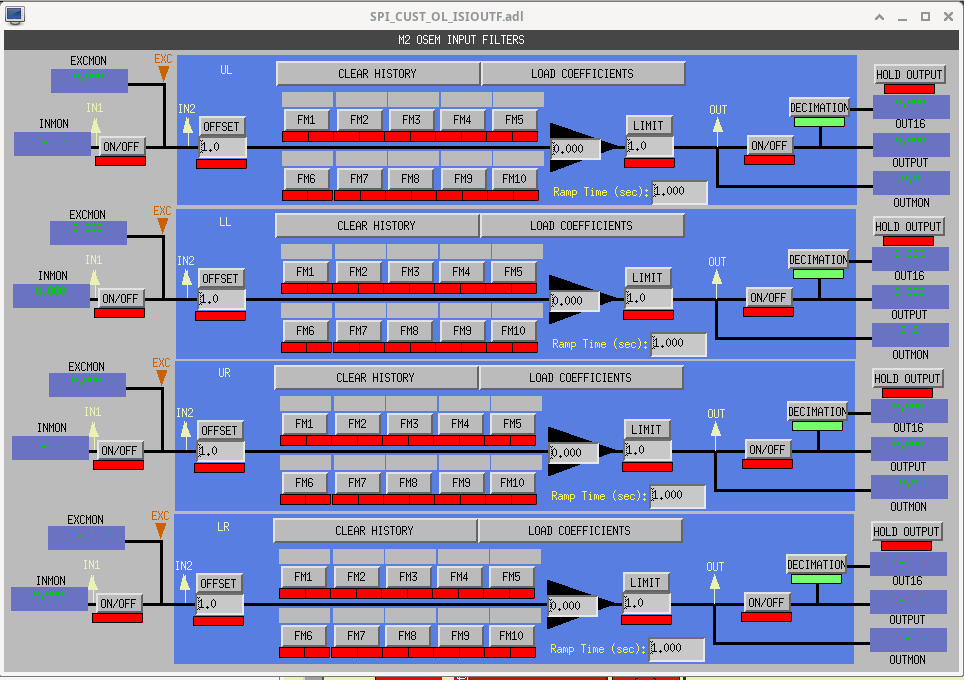
    SPI_CUST_OL_ISIOUTF.adl

all at rev 35103.
Images attached to this comment