Summary: Since I had trouble seeing a noticeable improvement in jitter by looking at the IMC WFS in this alog #89988 where the PSL output power was 2W, I looked at times when we were at 10W PSL output power to see if we were limited by shot noise. The measurements at 10W show that we might have decreased jitter but I checked the QPD sum values for the measurements after JAC was installed vs. before and we are near the edge of the QPDs.
I took reference times, when our input power was 10W to see if this gave a better measurement of jitter
Time 1: 2025/11/17 16:13:17 UTC during initial alignment. Without JAC.
Time 2:2026/03/19 15:31:23 UTC during commissioning when HAM1 was at vacuum.
Image one shows the yaw measurement, there is again a difference in the value at DC of the QPD ASDs. It looks like the peaks seen between 40 and 1000 Hz are slightly better with JAC than without JAC but it is only obvious on WFS A and B QPDs (top left plot comparing green and purple lines for WFS A and red and yellow lines for WFS B).
Image two shows the pitch measurement, there is again a difference in the value at DC of the QPD ASDs. It looks like the peaks between 40 and 1000 Hz are slightly better with JAC than without JAC but it is only obvious on WFS A QPD (top left plot comparing green and purple lines).
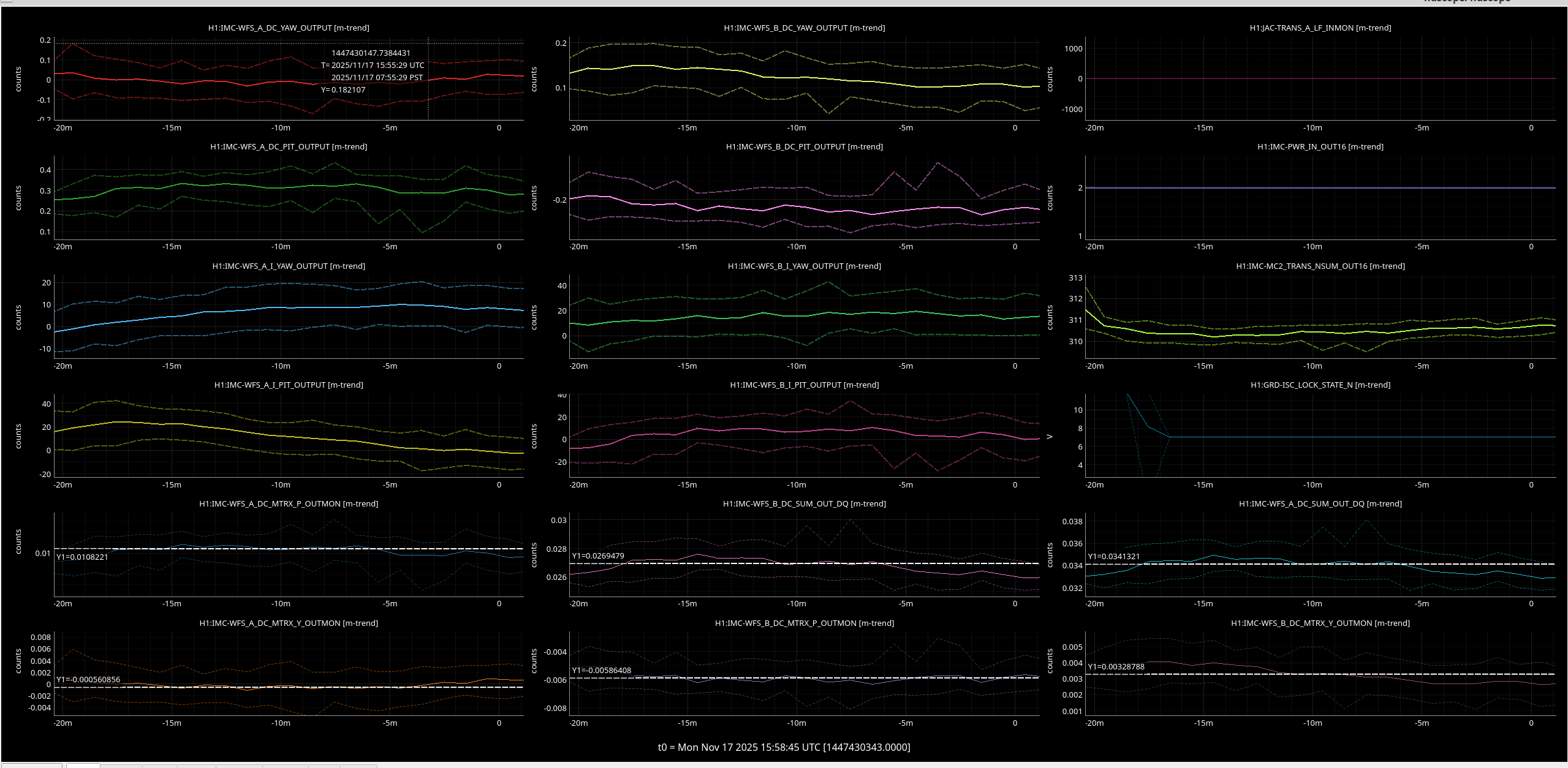
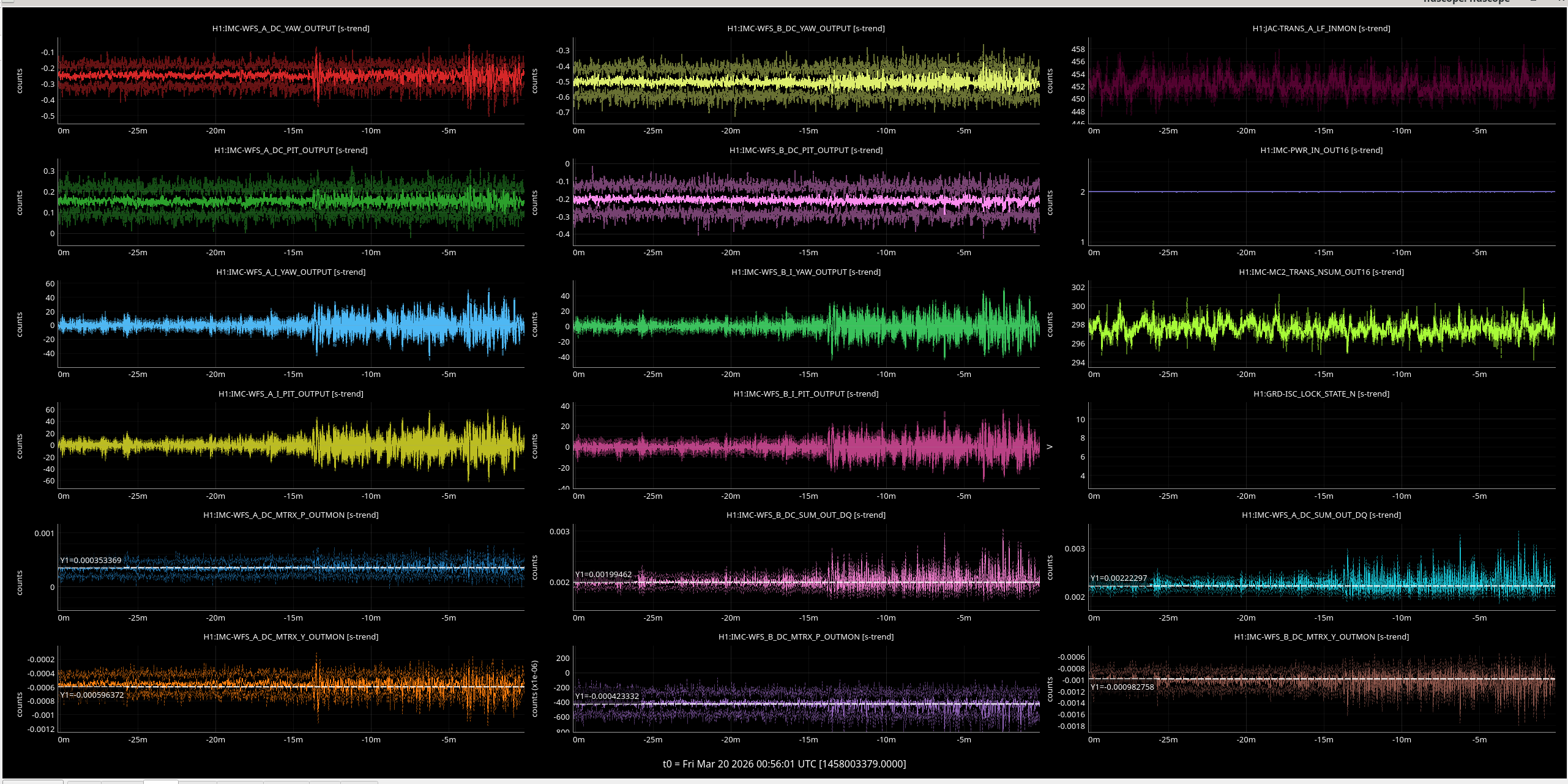
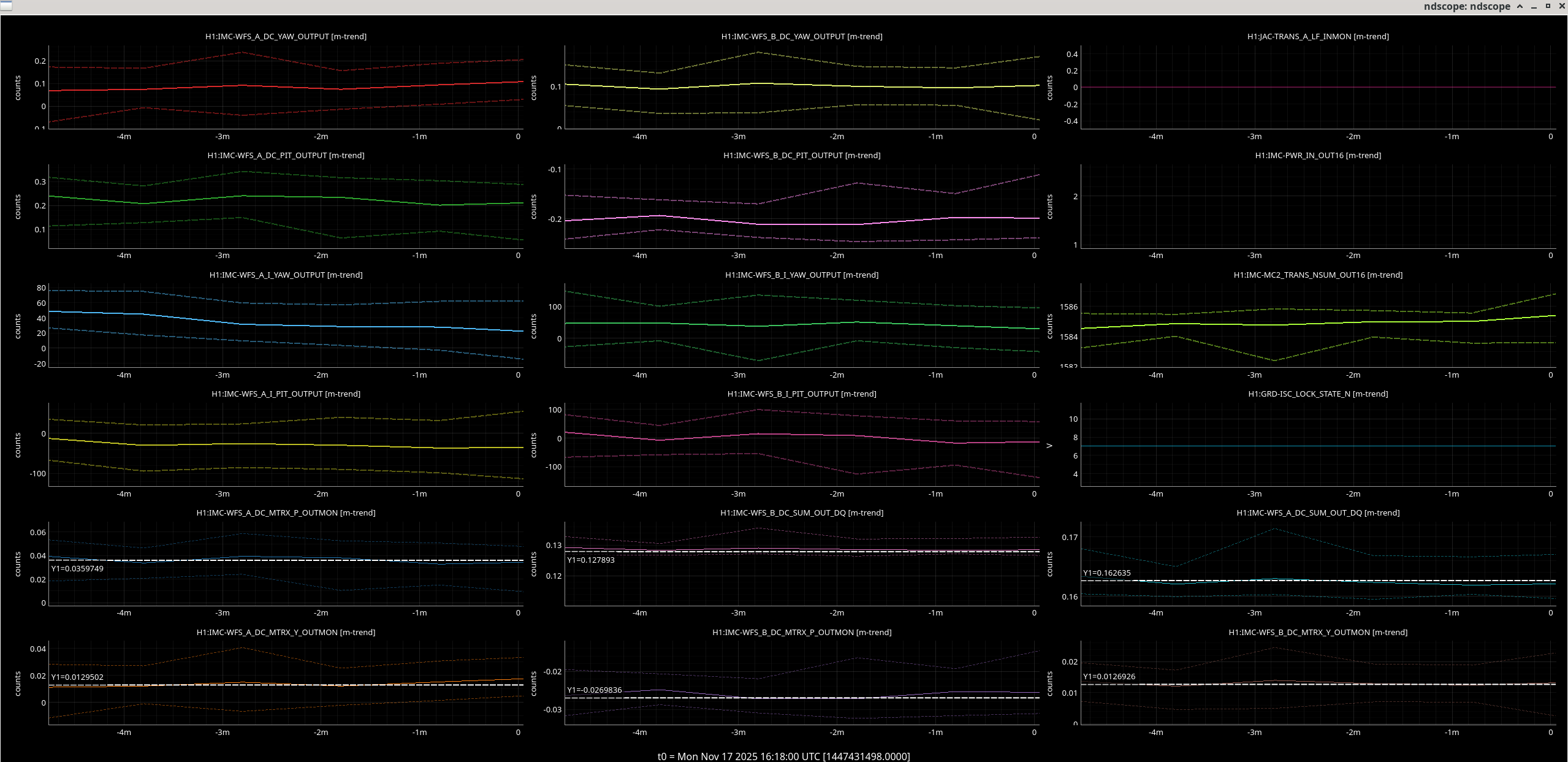
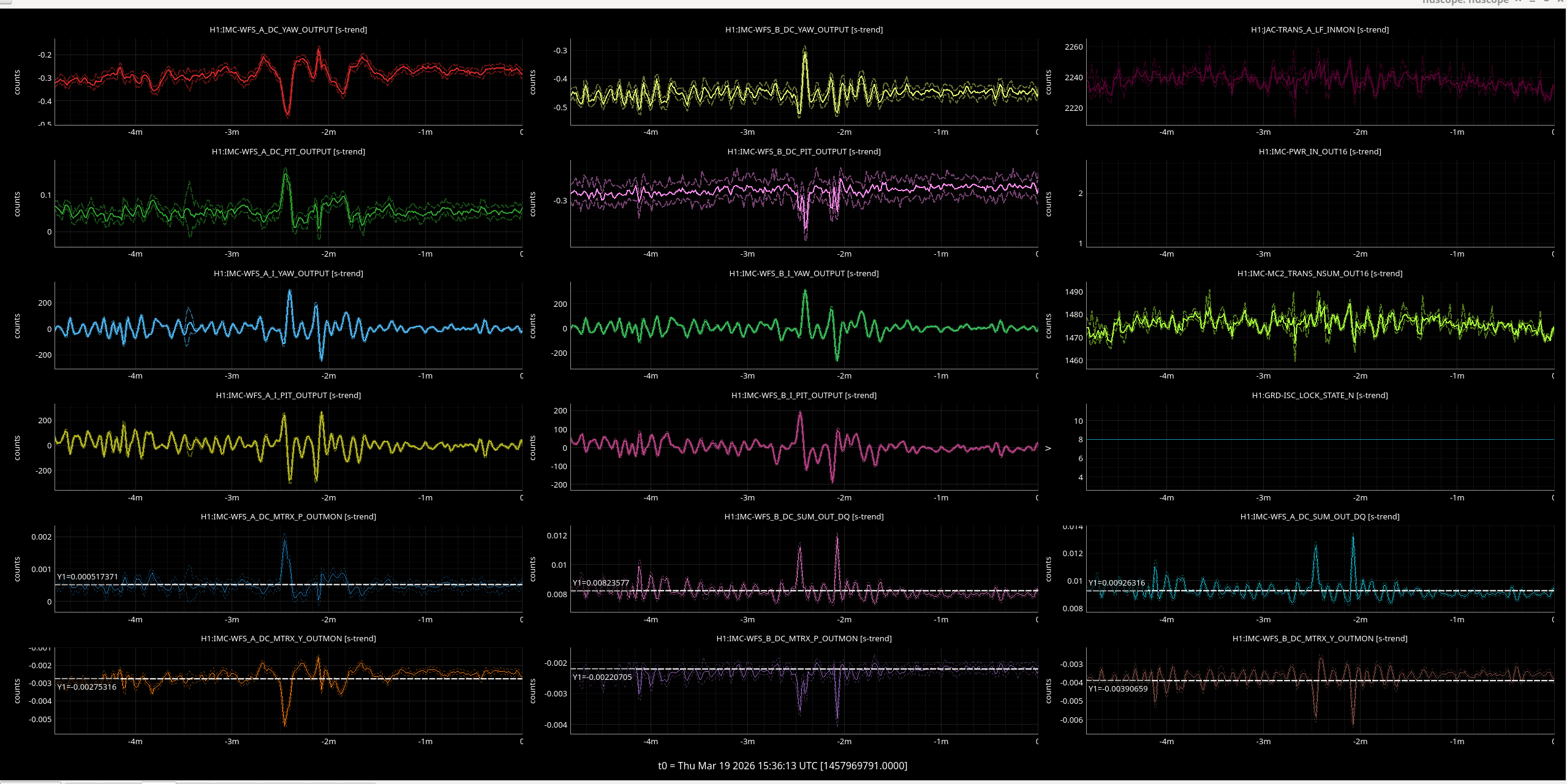
I also checked that the QPD sum values changed between my reference times during O4 and after JAC installation. See these four images.
1. 2W reference time during run. A and B QPD SUMs were arpund 0.03 counts.
2. 2W reference time after JAC installation. A and B QPD SUMs were arpund 0.002 counts. Maybe we are now nearer the edge of the diode?
3. 10W reference time during run. A and B QPD SUMs were around 0.16 and 0.13 respectively.
4. 10W reference time after JAC installation. A and B QPD SUMs were around 0.009 and 0.008 respectively. Maybe we are now nearer the edge of the diode?


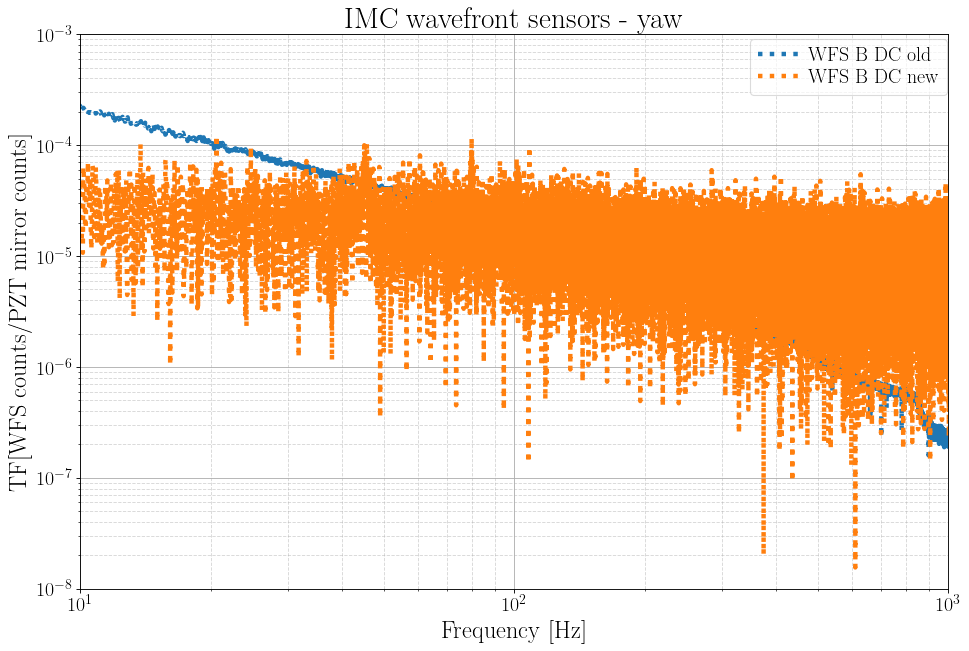
Just adding a note with the comparison I used for my GWADW talk on May 19th so its in the alog.
I did an injection into the yaw DOF of the PZT mirror in the PSL and measured the response on the IMC REFL QPD DC when locked, since this was used to do jitter injections to produce noise plots during O4 I could compare to a time when we did this measurement during NLN without JAC, and locked at 10W with JAC.
The power difference shouldn't matter since I am doing a transfer function, but unfortunately the injection I did was not high enough to see coherence in the IMC REFL WFS QPDs and I ran out of time to repeat the measurement in March due to corner re-alignment efforts.
The two times I chose were:
60W lock without JAC: 07-08-2025 21:47:59 UTC - approx 16 minutes.
2W lock with JAC: 18-03-2026 22:28:12 UTC - approx. 16 minutes.
The graph which compares WFS B QPD with old measurement in blue and new in orange can be used to put a lower limit on the suppression of JAC. It gives a minimum jitter reduction of 0.15 at 10Hz.
I would like to redo this once we pump down the corner sufficiently to do some measurements with the main laser.
The txml measurement files that contain the data I used for this are in /ligo.home/jennfioer.wright/git/2026/JAC/JAC_PZT_Y_inj.xml for the new measurement and the same folder but the file 20250807_IMC_WFS_PZT_Y.xml for the older measurement.