I had a look at some of the data from Leo Schrader's SURF project, in particular the measured overlaps of the sqz beam with the OMC posted 86485 and the measured q parameters on SQZT7 posted in 86365.
I first took the measured q parameters, and using finesse propagated them to the OMC and calculated overlaps, which are plotted as sqrt(vertical overlap * horizontal overlap). The attached scatter plot shows the predicted overlaps compared to the measured overlaps as the ZM4 + ZM5 strain guage voltages vary. You can see that for the nominal O4 settings of -0.4V ZM5, 6.2V ZM4, the measured q agrees pretty well with the measured overlap. Moving away from the nominal values, some of the measured qs do not seem very compatible with nearby measured overlaps. (note, these measurements cover the whole PZT range of 0-200V for both psams, the strain gauges just have different ranges.)

I then tried to use the overlap data to take a gues at what this means for the actuation range of ZM4 + ZM5 psams. I used the following information from Camille to estimate the ROC of ZM4 and ZM5.
- ZM4 is SN1, characterization data in E2100289 indicates that before the preloading was changed in chamber, with 0V on the PZT the optical power was -106mD. In 75677 the pre-load was increased by 29 in lbs, T2300426 says the preload should increase the optical power by 2.4 mD/ in lb of preloading, so after preloading the optical power with 0 V on the PZT should have been -36mD, or an ROC of -55.5 meters. 0V on the PZT now corresponds to 2V on the strain guage.
- ZM5 is SN4, E2100291 says with 0V on the PZT the optical power was 667mD with 20 in lbs of preload. 75709 says the preload was increased to 47 in lbs, so 27 in lbs of preload was added. I assumed that the optical power change with pre-load is the same for ZM4 as ZM5, and estimate that the optical power after the pre-load change the optical power with 0V on the PZT should be 729 mD, or an ROC of 2.737 meters. 0V on the PZT now corresponds to -5.2V.
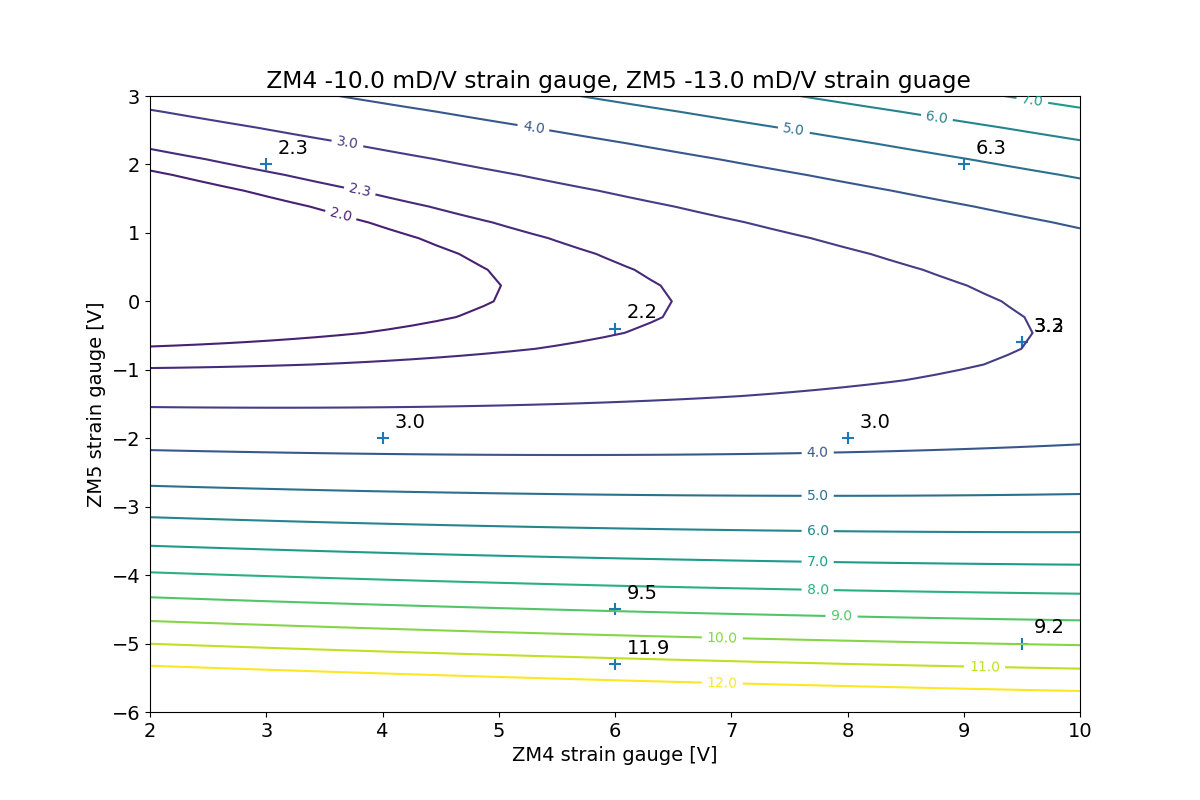
I used these estimates for optical power with 0V on the PZT and varied a linear slope of optical power per strain guage voltage. Assuming a slope of mD/V for each psams, I estimated the ROCs of each mirror. For any set of psams slopes, I estimated the q before ZM4 by using the measured q for the nominal strain guage values of 6.2 and -0.4V. I flipped the sign of the real part and propagated it back to before reflection off ZM4 using the estimated ROCs for that slope, then flipped the sign of the real part again to reverse propagation direction. (Thanks Keita and Disha for help understanding how to flip the qs). I then propagated that estimated q back through the ZMs allowing the strain gauge voltage to vary and calculated overlap with the OMC. This approach garantees that the nominal strain gage of 6.2V -0.4V the contour will match the 2.3% mismatch estimated from the measured q there. It would be nice to do an actual fit, and also allow the ROCs at 0V on the PZTs to vary, to see if we can get a better match to the dataset that way.
In the example contour plot I've put ZM4 at -10mD/V strain gage, which means -0.36mD/V PZT, and the O4 nominal ROC would be -25.6meters. ZM5 is at -13mD/V strain gage, which means -.47 mD/V pzt and nominal ROC of 2.99 during O4.
Lastly, I made a plot of propagation of the measured qs to the output of the AR side of SRM, that we can compare to Evan Hall's much nicer plots of SEC and arm cavity modes at SRM.
The script used to make these plots can be found in the commissoning-modeling-repo here.


Evan and Camille both pointed out that I made an error with the signs in estimating the ROC of the psams after the pre-load change.
ZM4 has a negative ROC, adding pre-load to ZM4 should make it more curved, having a more negative optical power or a smaller negative ROC. For ZM4 with 0V on PZT, -106 - 2.4*29 = -175.6 mD, or ROC of -11.4 meters. DpV on the strain gage should be a negative number.
ZM5 has a positive ROC, adding more preload should make it less curved, so smaller positive optical power, larger positive ROC. ZM5 before preload change was 667mD, after preload change it should be 667 -2.4*27 = 602mD, or ROC 3.32 meters. DpV on the strain gage should still be a negative number.
Correcting this in the script changes the plot of the overlaps slightly, new version is attached.
ZM4 nominal O4 ROC -9.2m, actuation -0.36mD/Vpzt
ZM5 nominal O4 ROC 3.7m, actuation -0.47 mD/Vpzt