
We started with yesterday's alignment. I checked flashes in ISS array PDs and didn't like that the balances between them were very much different from how they were when IMC was locked back in March.
Then we started changing IM2 and IM3 to see if we can get back, but I was appalled that the flashes became stronger and stronger on array PDs as we aligned, which probably means that the beam was almost falling off of the PDs when we started.
That shouldn't have stopped us because we don't know where the beam was on the array PDs when MC was locked (people gave up optimizing that path because things didn't make sense), it could have been falling off of the diode (because each diode is 2mm, QPD is 3mm, the beam size is ~250um or so, and the beam was almost in one quadrant of the QPD). But I started thinking about many what-ifs and wasted time.
After all, since IM4 TRANS and ISS array QPD are both reasonably close to March 2026 position, we know that the beam position as well as angle of the beam injected into ISS path from IM4 are already close to those when IMC was good in vacuum.
What we should do is this:
- Revert back to Monday IM2/IM3 alignment. Confirm that the IM4 trans position as well as ISS array QPD position are OK.
- Check flashes in 2nd loop inloop and out-of-loop sum. Recheck if at least one of them is comparable to when IMC was locked back in March, taking into account the power difference, even though Sheila checked it yesterday. At this point, we'll have established again that the position and the angle of the beam coming into the ISS path are reasonable.
- Check that the beam in ISS path is nowhere near being clipped by baffles and ISS array cover and the elevator aperture of the ISS array. Don't fix clipping right away, do it after swapping the array because we'll have to move pico mirrors anyway.
- Swap the array. There's no assurance that the beam will be on the QPD right away but that's OK. We can move the unit on the spacer if that helps. Go as close as you can, then start using the two pico steering mirrors. Use the array input aperture to aid the process.
- Once you see the beam on the QPD, continue to center the QPD, fix clipping, not necessarily in this order.
- Check the flash height of array PDs as well as QPD, see if things makes sense.
Other things to note:
This is not required for the alignment but it's helpful to know how much we can move the beam on QPD. In an unlikely event where we somehow lose the beam in vacuum on the array QPD after IMC is locked, we might be able to scan IM3/IM2 to regain the beam on QPD, and slowly move IM3/IM2 back to the nominal position while pico-ing so the beam isn't lost on the QPD. If the beam is not clipped, the beam displacement on the QPD is ~3mm per 1mrad of IM3 rotation using parameters collected from various documents, see attached script.
The same script shows you that the Gouy phase separation between two pico mirrors is 10 degrees (if we use the beam parameter in Matt Heintze's alog 12537, which was probably obtained by the measurement of the bypassed beam) or about 20 degrees (if we use IMC eigenmode parameter propagated to the ISS path using D1200693).
Another thing is, if we believe the design eigenmode number rather than the measured bypassed beam in Matt's alog, the beam waist will be smaller and at about 20cm upstream of the PDs. The beam size on the PDs is about twice as large as it should be (470um rather than 250um). I cannot measure the beamsize of the flashes so we won't do anything, but that's something to remember. If IM3 has enough actuation range, we can later lock the IMC, scan the beam across the PD until the beam falls off, see how sharp the fall-off is, and use the diameter of the PD (3mm) to determine the size of the beam. Maybe a good project for a fellow.

One of the things that bothered me (that isn't directly related to ISS alignment) is the fact that we had to rotate JM3 by a huge amount, i.e. negative 200um in PIT to "center" the MC2 trans QPD. This is the equivalent of the negative YAW rotation of the beam in IMC's coordinates (clockwise seen from the top). Since the distance between MC2 and JM3 is ~19m according to E2400218, this means that the MC2 beam position was moved by about ~7.6mm in -Y direction on MC2. This seems to roughly corroborate with the pictures in alog 90203 ("before" picture and "after", hard to tell how much it actually moved due to parallax but there's no doubt that the motion was large).
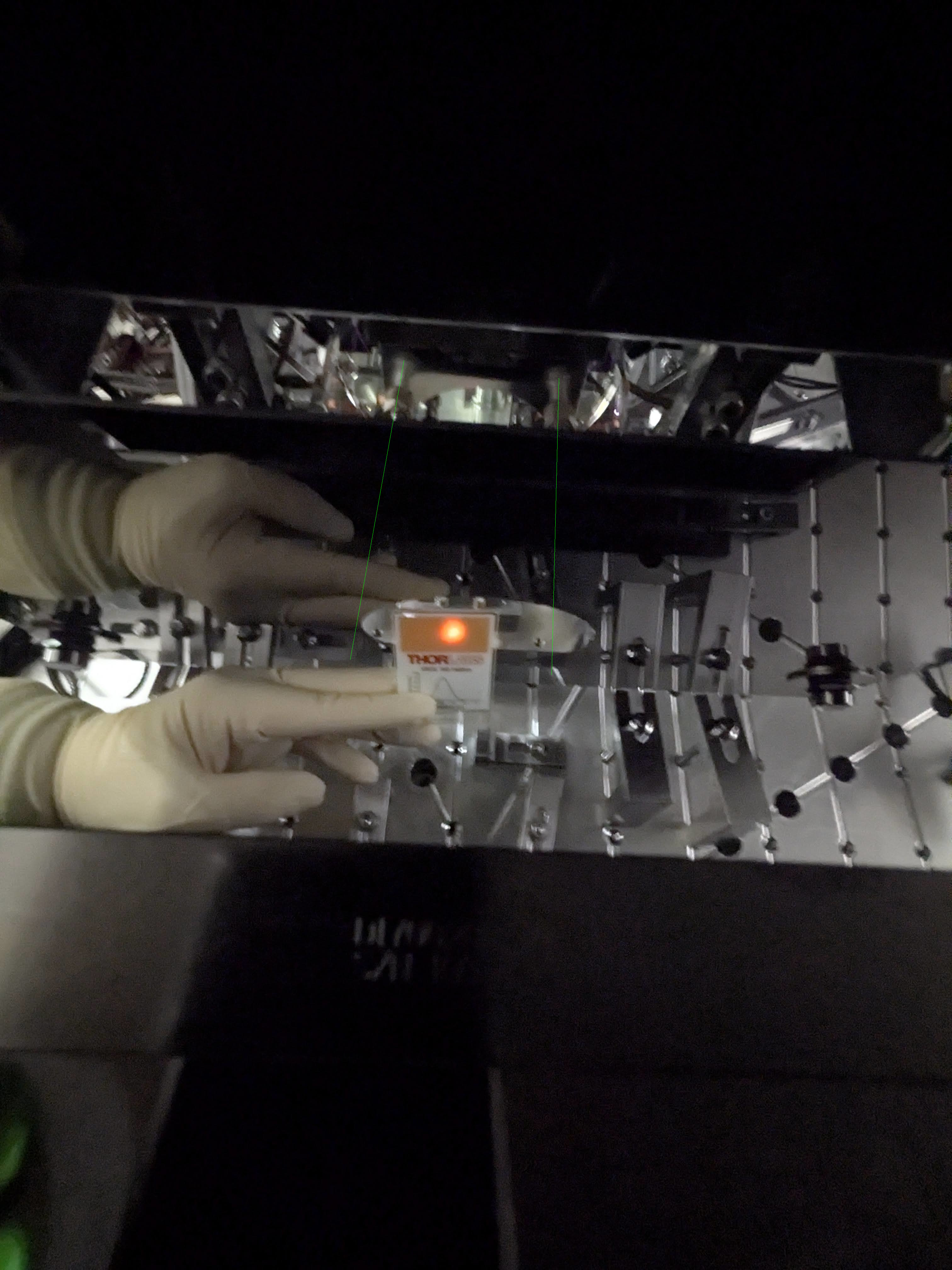

What if this is because something is wrong with the MC2 trans path? Like the pico mirror in front of the QPD was bumped (by a huge amount, however unlikely it is). My conclusion is that we can lock IMC in vacuum, use WFS with MC2 centering, measure the centering on MC2 using dither, and figure it out. If QPD center is grossly off from the MC2 center, we can pico.
Sorry the script in the above alog didn't work because it was missing one line.
Attached is a working version. You need a la mode matlab package https://github.com/nicolassmith/alm.