
jeffrey.kissel@LIGO.ORG - posted 16:21, Monday 18 May 2026 - last comment - 10:50, Tuesday 19 May 2026(90270)
2026-05-18 SPI Pathfinder Status Update
J. Kissel

Picking up from last Friday (2026-05-15, LHO:90253), today I:
    - Secured D_R_P1 and D_M_P1 and confirmed that TFP REFL beams went into the dumps
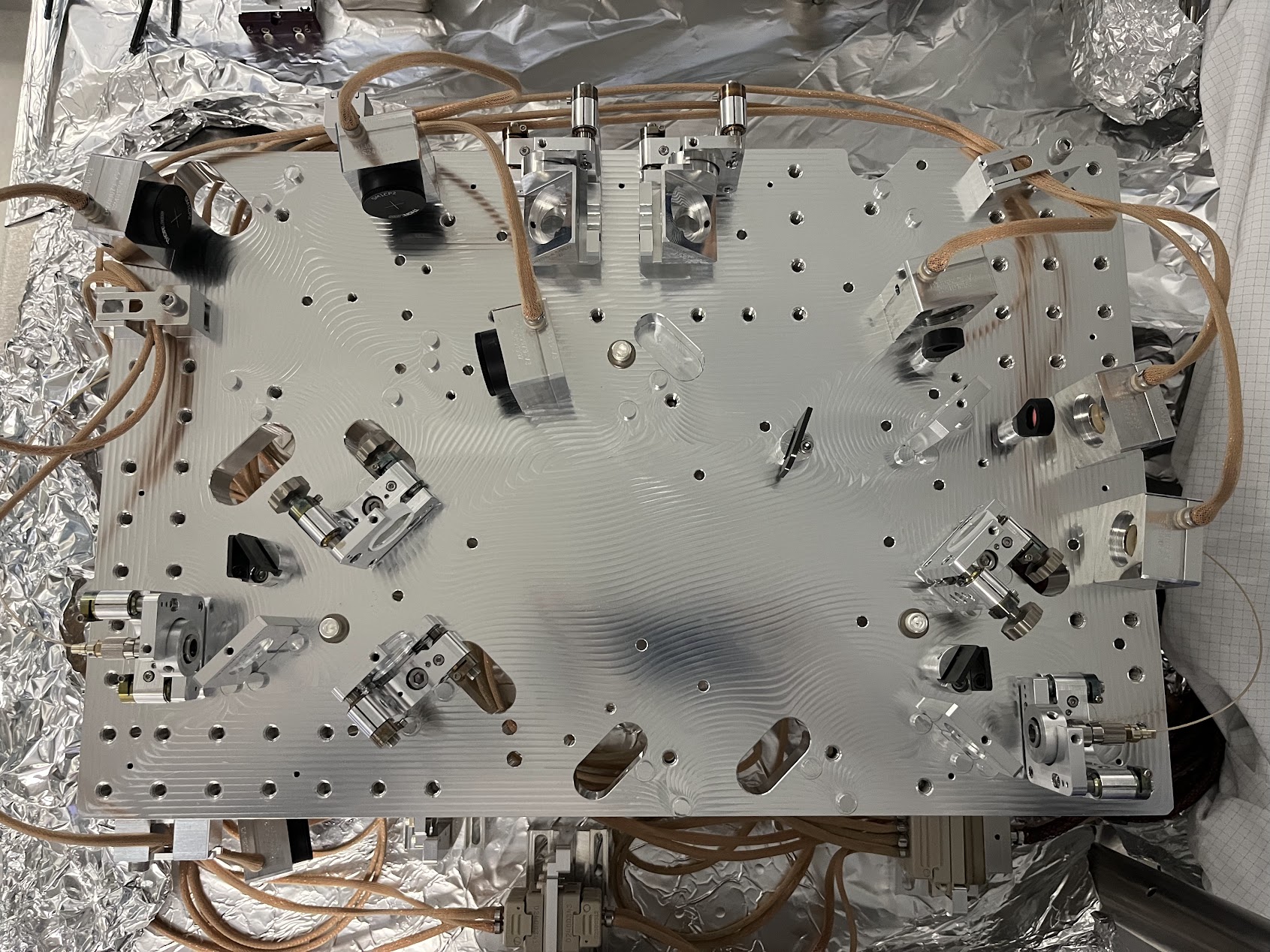
    - Started aligning REF path and migrating optics over from the D2400107-v4 breadbord's CVM100 mounts into / onto D2400107-v5 IXM100 mounts:
        . R_M1 migrated.
        . Re-set up the power meter gantry assembly (since its only me, and I need the power meter stable for maximizing throughput thru irises)
        . Placed irises in holes 83 and 84, adjusted R_F1 and R_M1 to walk and align the beam thru irises, confirming with IR camera view of iris holes and power meter thru-put.
        . Secured R_F1 and R_M1 IXM mount 8-100 alignment screw shaft set screws, since these optics shall not move again.
        . R_B1 migrated.
        . Aligned beam through holes 86 and 95, repeating process above, but only adjusting R_B1.
        . Uncapped IFO_REF A and B PDs, PWRIN_REF PD and hooked them up to the o-scope (discovering a minor re-cabling issue; see LHO:90268)
            UNSOLVED SIDEQUEST (1) :: PWRIN_REF PD has a ~120 Hz oscillation on it.
        . R_B2 migrated.
        . Aligned beam through holes 98 and 99, repeating process above.
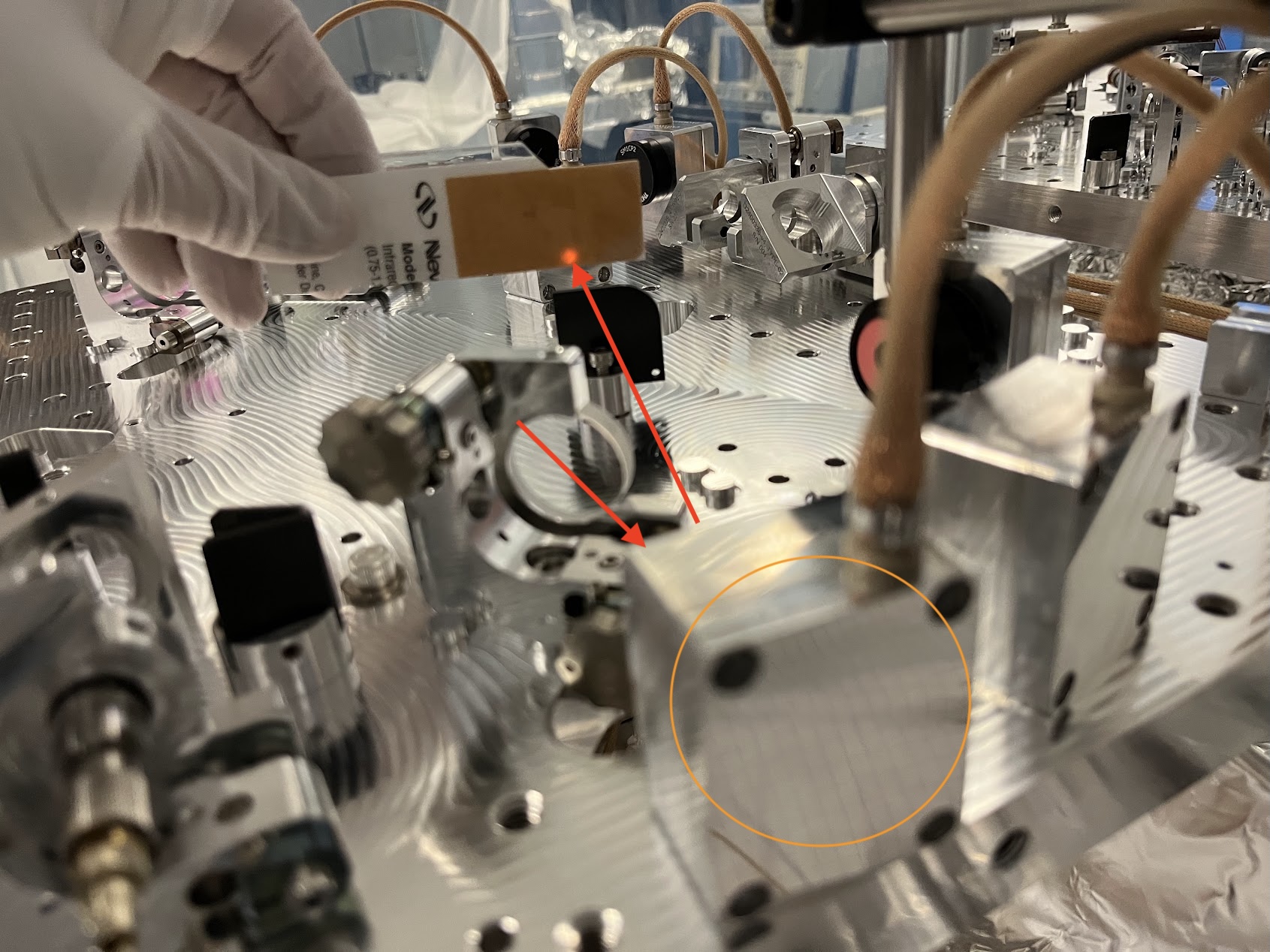
            UNSOLVED SIDEQUEST (2) :: Now, with D_FBR_PWRIN_REF so far away, the known issue with its PD seating within the generic enclosure means the PD reflected beam is ~2 inches above the board. Tried a huge 2"x3" dump but that was too big.
        . R_B3 migrated.
        . With nothing to align, just checked that beam went through irises in holes 100 and 97, and that beam looked well centered on PD. They did.
        . Migrated D_IFO_REF_B and D_IFO_REF_A, confirmed PD reflection landed on there and it did.

Done for the day! The MEAS PATH alignment tomorrow!
Images attached to this report
Comments related to this report
Regarding UNSOLVED SIDEQUEST (2) :: Now, with D_FBR_PWRIN_REF further away [...] the PD reflected beam is ~2 inches above the board.

Here're some picture to aide the discussion.

I say "this is a known issue," because we'd encountered this particular PD's pitch of the diode when assembling the CVM100 version of the ISIK transceiver, D2400107-v4, but in that layout, the PD was angled away from the incoming beam in the opposite direction and the the dump was closer. We didn't have room behind R_B2 to have the same dump location with the upgrade to IXM100 mounts.

None of the other PDs have this issue, the beam reflects back at the same 1 [inch] beam height that's the beam height for the board.

We were in too much of a rush and had too little experience/expertise with these to consider cracking open the Generic PD enclosure (D1600083) to try to fix it.
We suspect, in this Type 3 assembly for the FFD200 PDs, that either
    - the PD (line item 12 T1000573) is not seated well in its retaining ring (line item 4 D1600082),
    - there's a defect or something stuck between the retaining and its seat in the enclosure housing (line item 1 D1600079)
    - the retaining ring is not *exactly* the same size as the Q3000 for which it was designed and there's some slop in the assembly, or
    - the PD's pins were soldered into the PCB at an angle (line item 11 D1700116)
But we're just guessing.

This is S2401094, whose assembly technique is discussed in CIT:837 and record of completion is mentioned in CIT:898.

Starting up the conversation with CIT.
Images attached to this comment


Regarding UNSOLVED SIDEQUEST (1) :: PWRIN_REF PD has a ~120 Hz oscillation on it.

See attached o-scope picture -- channel 3 (purple). 2V peak-to-peak wobbly 120 Hz oscillation on a 4.5 [V] mean.

We've not tested this PD since we updated its transimpedance circuitry (see LHO:90105, and TIA Variant 3 D1002481 instantiation S2500713), so there may be a grounding issue there. Hard to believe it's the TIA op-amp itself, given that the RC feedback impedance we installed yields a 13.497 [kHz] pole.

I've only tested the IFO MEAS and IFO REF channels of the Variant 2 chassis with light so far, but they don't show any issue.

Laser power level on this PD during yesterday's test is the expected ~0.8 [mW].

I checked (but didn't re- or triple-check) that the electrical ground situation is well-managed. As in March 2026, the electrical ground of power supply feeding the TIAs banana'd-to-BNC'd-to-clip-doodled to the shield the o-scope's clip-doodle dongle whose signal is reading out PD ADC output voltage from a breakout board. Nowhere along this adpater/doodle/breakout/cable chain is metal touching metal.

I'll look through the chain again, try reading it out differentially, and consult with local experts. It isn't a high priority right now, but we need to understand this before the transceiver leaves the optics lab.
Images attached to this comment
