jeffrey.kissel@LIGO.ORG - posted 22:37, Tuesday 02 June 2026 (90455)
2026-06-02 SPI Pathfinder Update: VICTORY -- It was the NPRO Crystal Temperature / Frequency Drift -- GO FOR INSTALL
J. Kissel, S. Koehlenbeck, J. Wright, P. Opperman

After the most of the day Monday (2026-06-01) ruling out of the prime suspect (the picomotors causing alignment drift; see LHO:90438), I left discouraged that we had ruled our everything that could be spatially wrong with the MEAS beam going into the MEAS IFO (power, alignment, mode-shape, and polarization). However, Sina and special-guest consultant Patrick spent time reviewing everything that we ruled out and/or what it could be -- and Sina left the lab nudging the NPRO seed laser's crystal temperature from 24.6 [deg C] to 25.2 [deg C].

%%%%%%%%%%%%%%%
Executive Summary: Nudging the NPRO seed laser by 0.6 [deg C] (we believe) changed the resonant mode in the laser, stabilizing its output frequency. (We believe) the laser was in-some-way frequency drifting and/or mode hoping (a thing that would also be driven by the clean room environment in the ways we suspected were impacting the transceiver), and the path length differences between the REF and MEAS IFOs were discrepant enough (per the design layout) that the efficiency impact was much larger on the MEAS IFO. Having adjusted the laser crystal temperature, both IFOs are stable for hours and if/when small drift is seen its common to both IFOs as the gods intended. We can't claim we 100% understand it, or believe our own story, but it worked!

Finally happy with both the MEAS and REF IFOs, we mounted the transceiver vertically and confirmed its function in that orientation.

We're a go for install, and have started to dissect the production equipment from the optics lab.
%%%%%%%%%%%%%%%

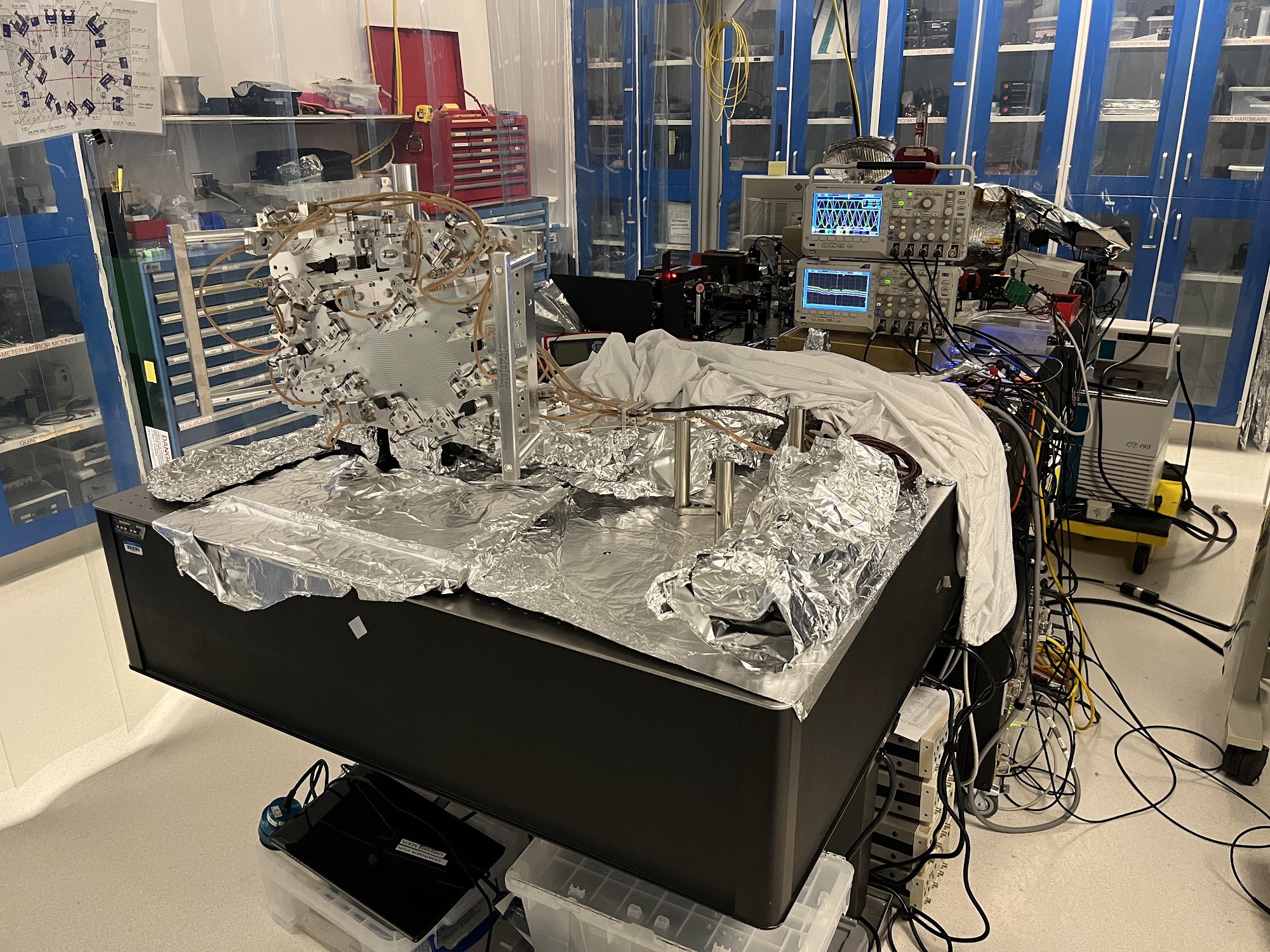
Some victory photos attached.

Other things that happened:
    - Prior to laser temp adjustment -- with MEAS IFO path on fully manually driven mounts -- we foiled (as protection) then C3 covered (as isolation) the transceiver. We still saw drift. That put the nail in the coffin that it wasn't transceiver itself that was sensitive to the environment.
    - We re-installed all picomotor-driven IXM100 mounts to support M_M1, M_B4, and M_M2.
    - Prior to install, we were able to (rather barbarically) back off stopper nuts of the pitch picomotors for the M_B4 and M_M2, so there is no longer any question whether the stopper nut is driving moving plate. All pitch and yaw actuators push the moving plate kinematically via the intended ball-bearing-to-carbide-plate design.
    - Re-installed M_M4 M_M5 periscope mirror mounts, including their adapters and D1800200 Type 07 beam-dumps. The dumps were parked in a position that still allowed transmission of the MEAS beam (as confirmed with no change in the -- now stable! -- MEAS IFO efficiency).
    - Nudged IFO MEAS A and IFO REF A PDs because the beam spot on the diodes was a bit OFF.
    - Reviewed and confirmed all PD reflected beams were on their respective dump, except for the known issue with the FBR_PWRIN_REF PD that reflects 0.2 [mW] of power up above the breadboard.
    - Built up a temporary vertical mounting system with 1 [inch] posts and small cylindrical laser holding mounts with mini bread-board feet.
    - Re-installed the handles on ISIK.
    - Unbolted, and was easily able to single-person lift the entire assembly and mount it.
    - Both IFO efficiencies were actually not-that-bad after installing. Wow!
    - A quick alignment tune-up from Sina recovered all the IFO efficiency we had while mounted horizontally.
    - Both IFOs were stable and happy for the entire series of victory photos we took; about 1 hr.
Images attached to this report