Below is the analysis for data taken on the FC path: between ZM1 and ZM2 and between ZM2 and ZM3, with Nanoscan, see Camilla's log 90573. As a reminder, ZM1 are flat optics, ZM2 is a PSAM with variable curvature, FC1 HR side is flat, AR side is curved with RoC ~1m.
The data suggest that the OPO mode is slightly different from O4 OPO, and also strongly suggest a new optimal ZM2 PSAM voltage can be found within the range.
We measured the beam profile at 5 different points after ZM1 with A:L2 lens at its nominal 0 position (sled that the lens lives on is flush to its translation stage on both front and back edges). At the last point with A:L2 at 0, we realized it would be pertinent to measure beam profiles for the two extremities of the A:L2 translation stage: -13 mm, which is closer to ZM1 by 13 mm and +17 mm, which is 17 mm further from ZM1. We then proceeded to take 5 measurements (again downstream from ZM1) for each of these lens positions. The nanoscan screenshots for each measurement are attached in the .zip folder.
The attached gif shows the beam waist position estimation extracted from the beam profile scans downstream ZM1, for all three A:L2 positions. The "target" and "O4 x/y" come from Keita's log 59515. The overlap plot attached shows the field overlap in percentage for all three A:L2 positions, with target and O4 beam parameters. With A:L2@0, the overlaps are above 99%, which bodes well for the FC mode matching prospects. There could potentially be a better mode matching solution to the "target" or "O4" for A:L2 between 0 pos and -13mm pos. However, the following measurements betwen ZM2 and ZM3 suggest fine-tuning of A:L2 position will not be necessary.
We also measured beam profile between ZM2 and ZM3 for three different points, setting ZM2 PSAM voltage to 4 different values at each point. The "nominal" O4 strain gauge (S.G.) for ZM2 has been 3.15 V, which corresponds to ~ 60 or 90 V pzt supply voltage depending on which direction one scans from. The edges of the psam range are 0 V and 196 V, which corresponds to ~1.2-1.3 V and ~6.04 V S.G. respectively. In the interest of more uniform sampling of the available psam curvatures, we also chose to sample 4.5 V S.G. (~120 V or 150 V).
This table shows experimental data mapped to radii of curvature of the ZM2 mirror, using Camille's E2100298. The exact PZT strain gauge/ PZT supply voltage that gives a certain RoC is affected by the hysteresis curve i.e. sweep direction.
| Strain Gauge (V) | PZT Supply Voltage (V) | RoC (m) with increasing scan | RoC (m) with decreasing scan |
| 1.3 V | 0 | 0.8211 | 0.82202 |
| 6.0x V | 196 | 0.8911 | 0.89114 |
| 3.1x V | 60 (d) or 90 (i) V | 0.8523 | 0.85025 |
| 4.4x V | 120 or 150 V | 0.87534 | 0.87242 |
Attached gif for propagation between FC1 and ZM2 show esimated beam parameters for all four SG cases: 1.3, 3.1x, 4.4x and 6.0x V. The exact values for the strain gauge varied from one beam profile position to the next, however it should be good enough to tell if we have enough range on ZM2 or not.
The gif switches between different SG values once every 2 second, the lefthand plot is useful in looking at the beam divergence near FC1 while the righthand plot is a zoom-in around the beam waist. Looking at the estimated beam waist position for 1.3 V and 3.1x V cases switching across the "FC x/y waist", "VOPO target waist", ''O4 x/y waist", we can guess there could be a better mode matching solution between these two SG values. "FC x/y waist" comes from the Finesse eigenmode solution for the FC path (thanks Kevin Kuns!), target and O4 values are the same from the above-mentioned Keita log, assuming ZM2 curvature to be 0.85025 m (3.15V SG), and the following distances between the optics: A:M3 --> ZM1: 158.2 mm, ZM1--> ZM2: 1498.625 mm, ZM2 --> ZM3: 1821.497 mm, ZM3--> FC1: 1000.261 mm. Camilla extracted these distance values from D1900365-v1.
Knowing the applied PZT voltage and the corresponding RoC, we can use the measurements at 3.1x V and 1.3 V to estimate the mode matching we would obtain if we swept the RoC between that of these strain gauge values. The attached FC mode matching projection plot is computed by taking beam parameter estimated from the beam size measurements for 3.1x V, propagates the beam back to ZM2, unapplies the estimated RoC (decreasing RoC value was used informed by data, indicated in bold in the above table), then reapplies the RoC between these two values, after the overlap with the FC eigenmode is calculated. This projection suggests that mode-matching points with >99% overlap for both x and y axes are accessible. Clearly, there is varying astigmatism with strain gauge setting, see beam profile plots where 3.1x and 6.0x V shows beams with smaller astig. than the other two points. Since the PSAM characterization data gives only a single RoC number rather than separate x/y effective curvatures, the projection should be interpreted as approximate. In practice, the final optimization should be done empirically.
The effect of the astigmatism is also apparent in this defocus vs beam size at FC1 plot that shows mode matching contours. The calculation is made at the FC1.p2.o plane in Finesse.


The beam width data kindly tabulated by Camilla, the R(V) data from Camille's dcc E2100298, and the analysis code .py are attached, in the .zip. Fair warning, the analysis code also makes a bunch of plots I find useful to look at but another user may find irritating :)
Code for the data points upstream of ZM2 attached. The measured beam widths and their corresponding position are listed in the script. The real raw data with the screenshots from the beam profiler UI is attached to the main log.

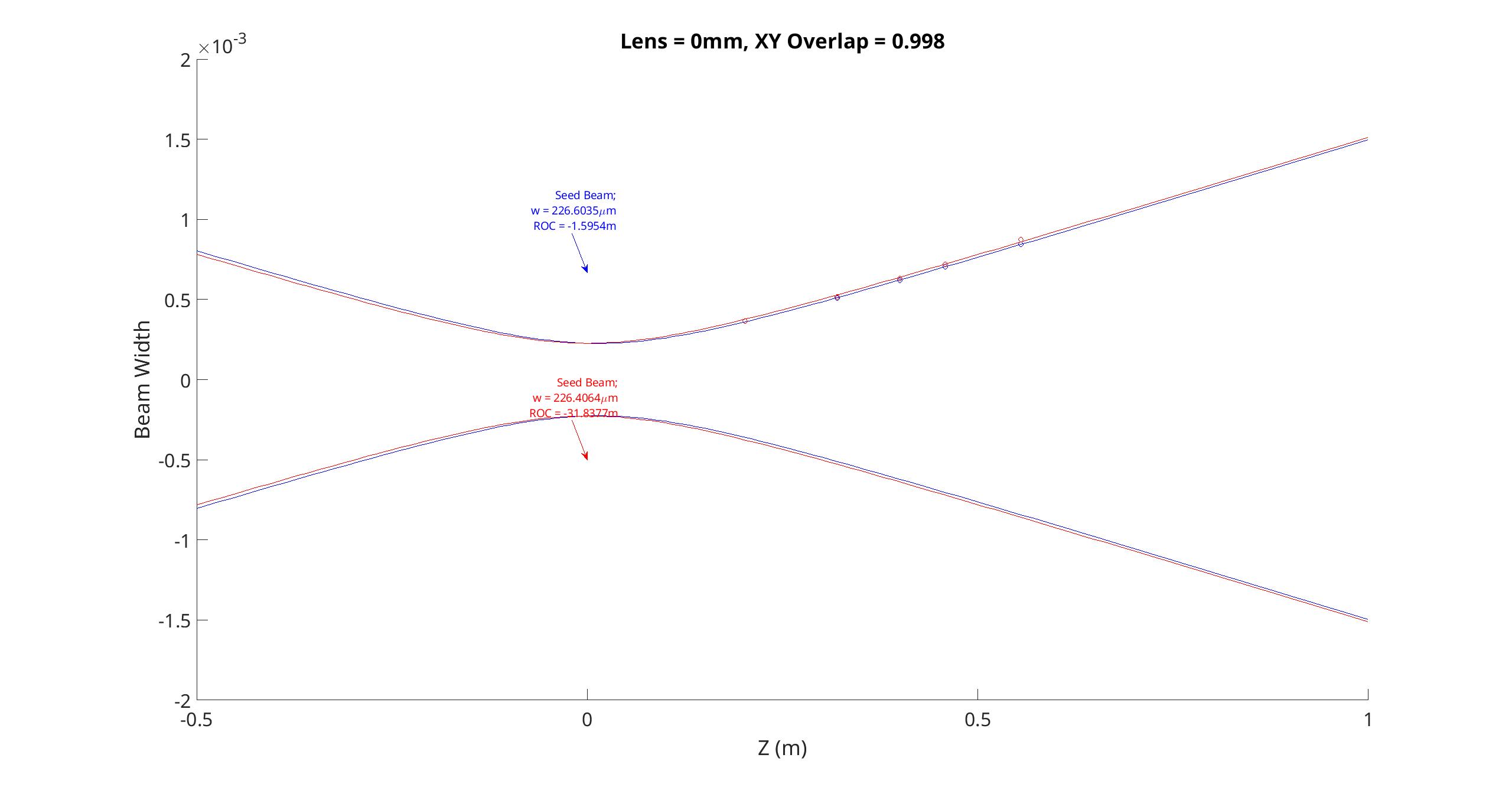
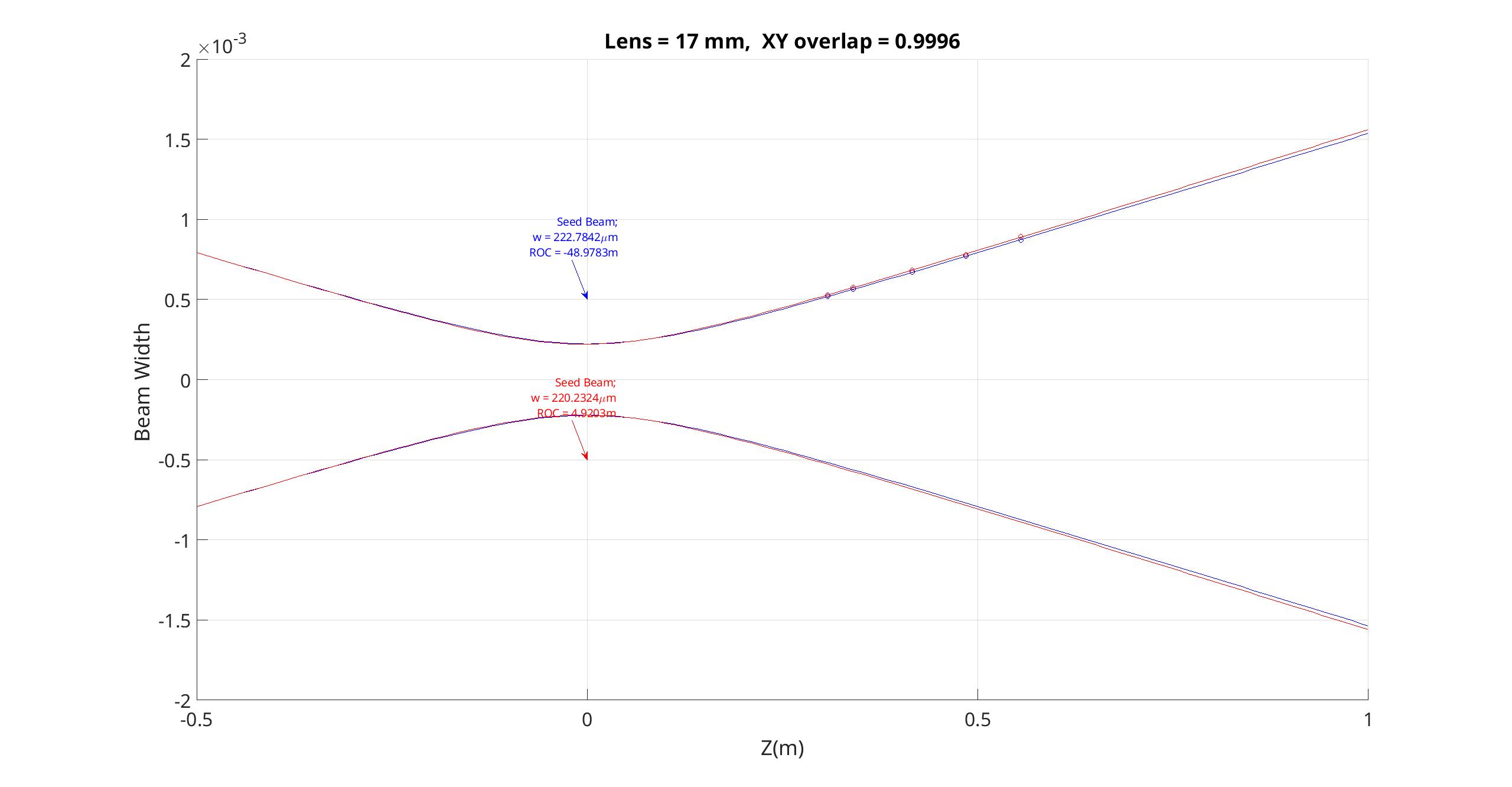
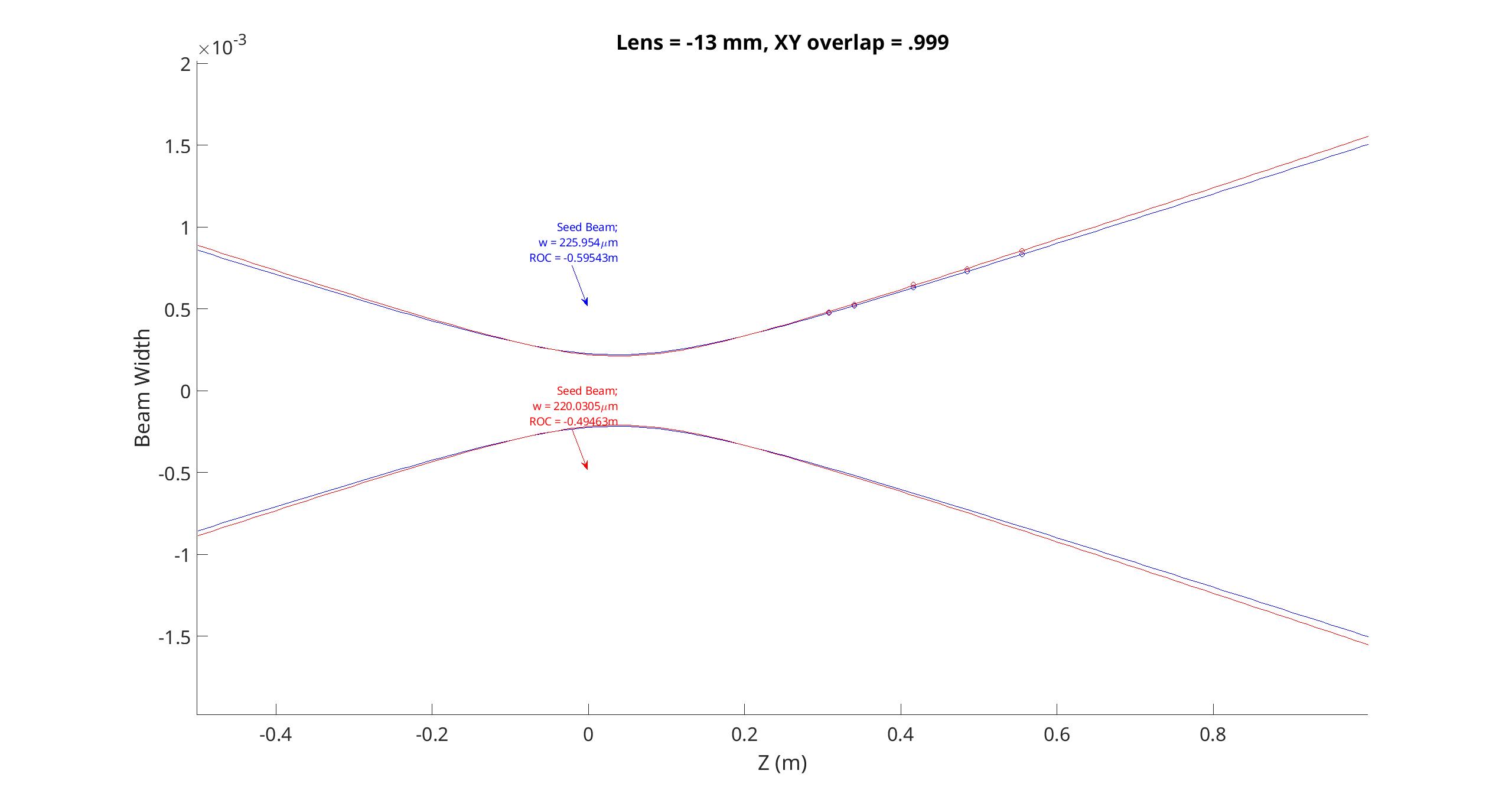
I wanted to try to get an idea of what sort of astigmatism we're seeing on the FC path. I was able to get good fits of Begum's data right after ZM1. This indicates that the astigmatism coming right off of the VIP looks quite good ( 99.9 +/- 0.1% overlap between X and Y). Plots of the fits are attached for each lens position.
I wasn't able to get particularly convincing fits of the data after ZM2. The points are several Rayliegh ranges away from the waist and I found that the fits were quite sensitive. I could get answers anywhere between 98%-100% mode overlap between X and Y depending on what parameters I used in a la mode for the seed waist. Someone might be able to do a more sophistocated fit of the data, but I think one would want to measure closer to the waist to better constrain the fit and get a more precise estimate of the astigmatism added by ZM2.

I've been reading through the design document about the FC path and ZM2. One thing imay be important to note when making projections about the correct strain gauge setting for ZM2: According to the design document the mode matching is quite sensitive to the exact value of the FC1 AR surface ROC. One might find that, if we change our assumption about the ROC for S2 of FC1, our target strain gauge setting for ZM2 changes significantly. In fact, the discussion makes it sound like most of the point of having ZM2 be adjustable was to compensate for our uncertainty in the ROC of S2 for FC1.
See LIGO-T1900649 and the discussion on Page 18 as well as Figure 10.
A note on the FC1 ROC sensitivity question: a scalar FC1 ROC sweep alone would be only partially informative, because the projection also depends on the FC-path distances and the voltage-dependent x/y astigmatism of ZM2 (see plots for the mode space and projected overlap with eigenmode from the original log). This is why the original log interpreted the projection as approximate and stated that the final optimization should be done empirically.
The more meaningful check right now is therefore a return-beam measurement between ZM1 and ZM2 while stepping the ZM2 strain-gauge setting. This can be done by placing a beam splitter between ZM1 and ZM2 and matching the return beam to the input beam by varying ZM2 curvature.
The modeling exercise could be a nice little real life vs model analysis later on.
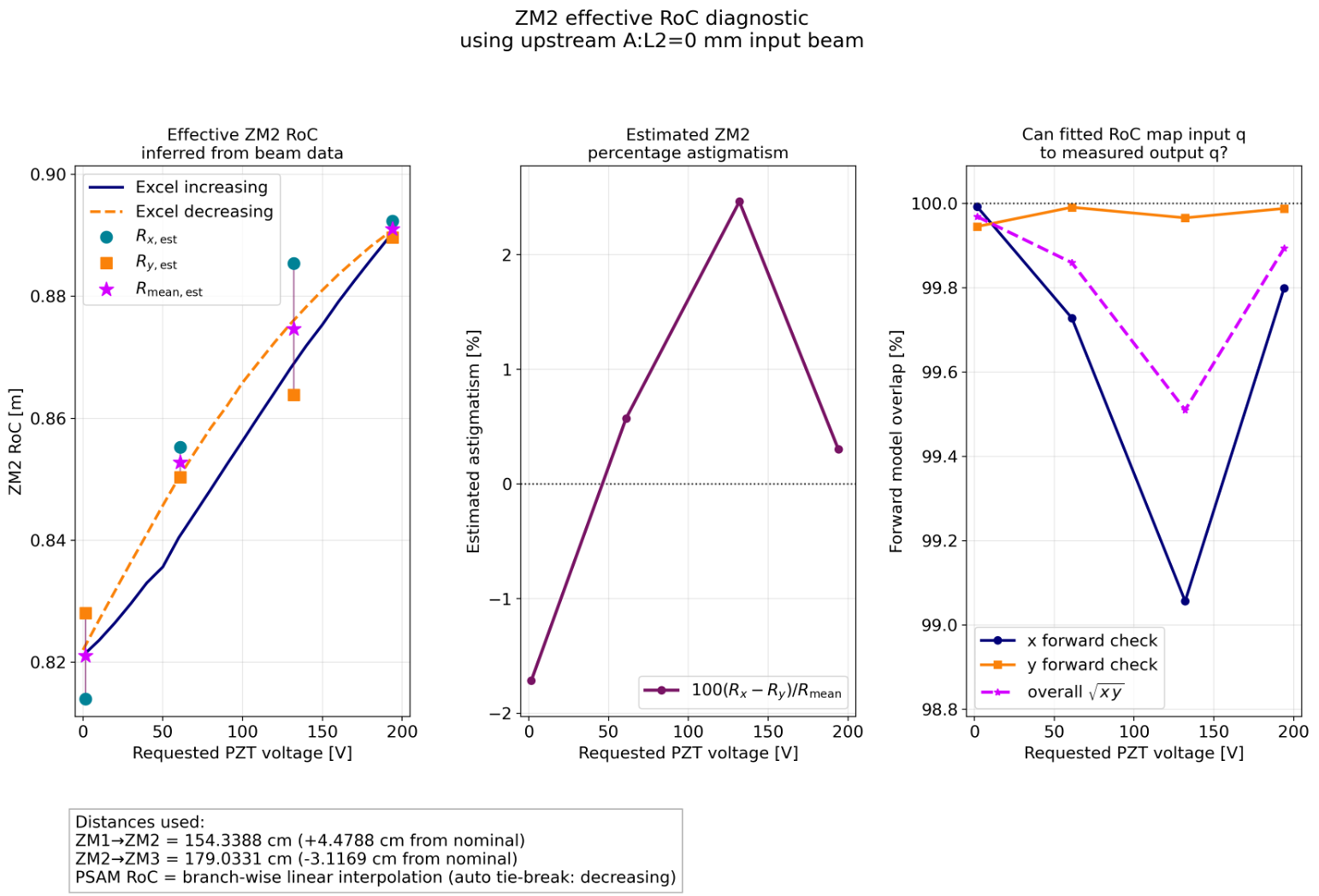
Attached figure left panel shows RoC in x (green circle) and y (orange square) calculated from the beam profiles taken downstream of ZM2, with 4 different strain gauge values.
These S.G.s were selected as 0 V (S.G. 6.x V), 200V (S.G. 1.x V), 60 V (3.1x V, nominal for O4), 132V (4.x V).
The pink stars are composite RoC obtained from the geometric mean of the beam profile data in x and y.
The measurements are overlaid with Camille's characterization of the ZM2 PSAMS (SN2), orange dashed line and dark blue solid line. The measurements and Camille's calibration are consistent for the composite RoC.
The middle panel shows the percentage astigmatism for each of these S.G. values, ranging within +-2.5% for these four measurements. Note that the astigmatism is not a monotonous function of supply voltage. This means we cannot interpolate the astigmatism for the operation point we end up in reliably, at least with such few measurements.
The righthand plot is probably the least interesting. It shows how well the beam profile measurements downstream of ZM2 overlap with beam parameter estimation using measurement upstream of ZM2 and the CIT calibration. It means we need RoC x and RoC y rather than a composite RoC if we want to use CIT measurements in modelling, in the absence of in-chamber measurements. Notice the higher the astigmatism the worse the overlap, as expected.
Since we care about a few percent loss at this point, these astigmatism levels are disturbing.