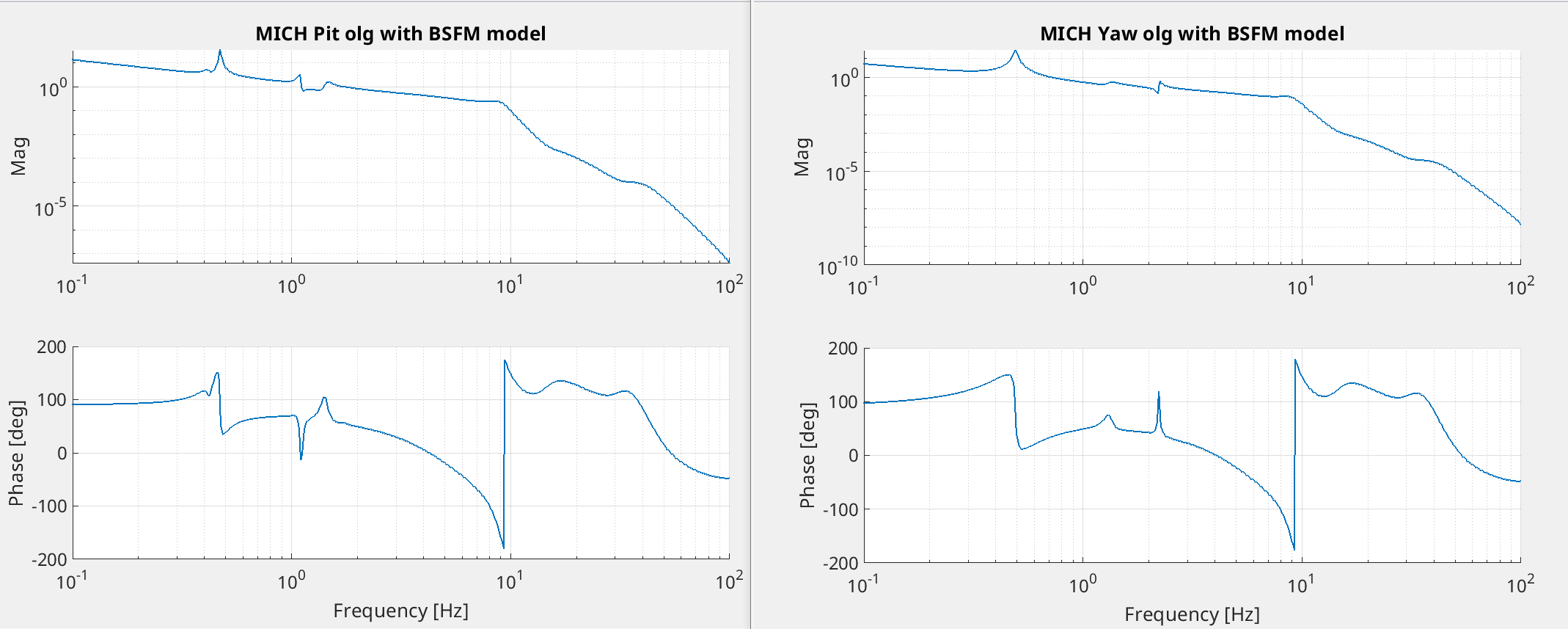
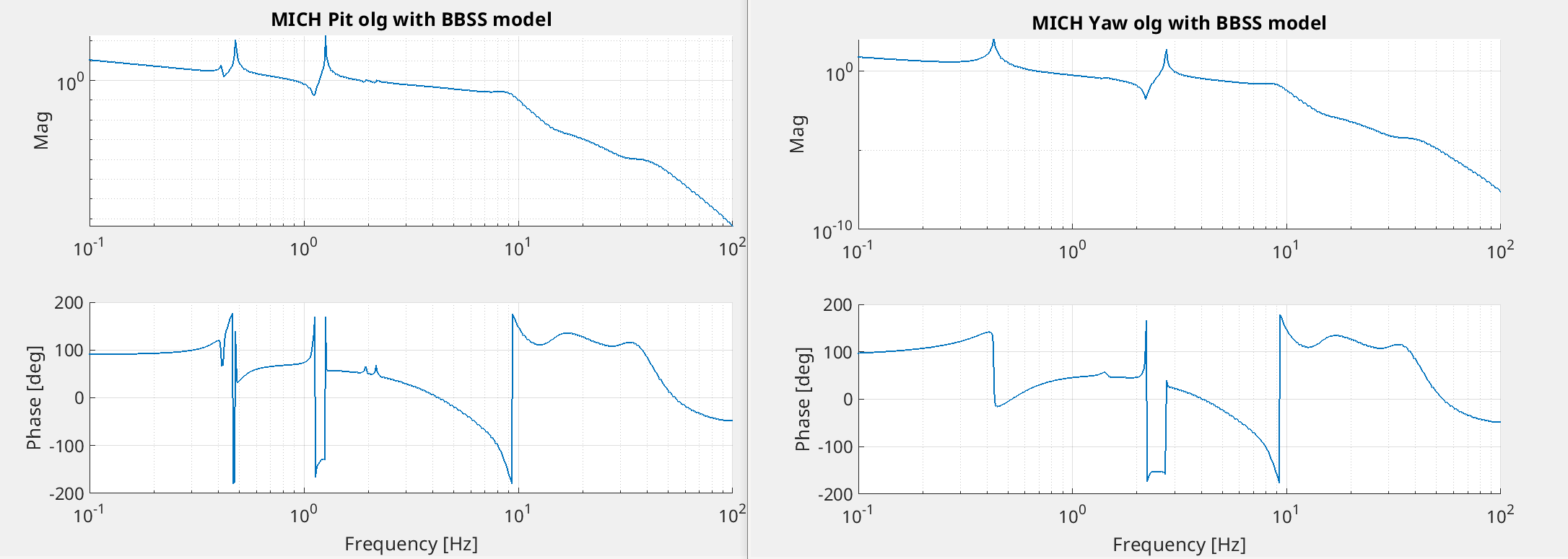
Following a similar process for the length control as in 91028, I used both the BSFM and BBSS model to construct a model of the MICH ASC and check the crossover frequencies.
The most recent ASC OLG measurements of MICH P and Y are in userapps asc/h1/templates/MICH. MICH P UGF is roughly 2 Hz, MICH Y is roughly 0.7 Hz. Using the BSFM model and this information, I once again assumed the optical gain of the MICH ASC would be the same and calculated a rad/ct calibration factor to use with the BBSS model. Note that these UGFs are from full power lock, so I'm not certain what the MICH ASC OLGs look like in DRMI lock.
The BSFM model also says that both P and Y have a 22 mHz crossover between M1 and M2.
Using these calibration factors show that we might have some trouble running with the exact same MICH ASC design with BBSS. I think this is because the MICH ASC design contains a pretty extreme BSFM plant inversion. We could replace it with a BBSS inversion, or use this opportunity to move to a slightly different design principle that doesn't require precise plant inversion.
The model also suggests that the yaw crossover from M1 to M2 will be about 22 mHz as before, but shows the pitch crossover would now be 8.5 mHz. I need to confirm I am using the correct lever arms for the calibration to make sure I haven't made a mistake there. Either way, we can confirm the crossover with an injection.
Just as with length, we would need to slightly adjust the locking filter design if we want to move to M1 and M3 actuation, but in principle I don't see any issue with driving from M3 instead of M2 for ASC as well. This would be in line with how we drive all other triple sus for ASC.
First attachment shows the MICH ASC in the BSFM model, second in the BBSS model.