Masayuki Nakano, Khanh Vu
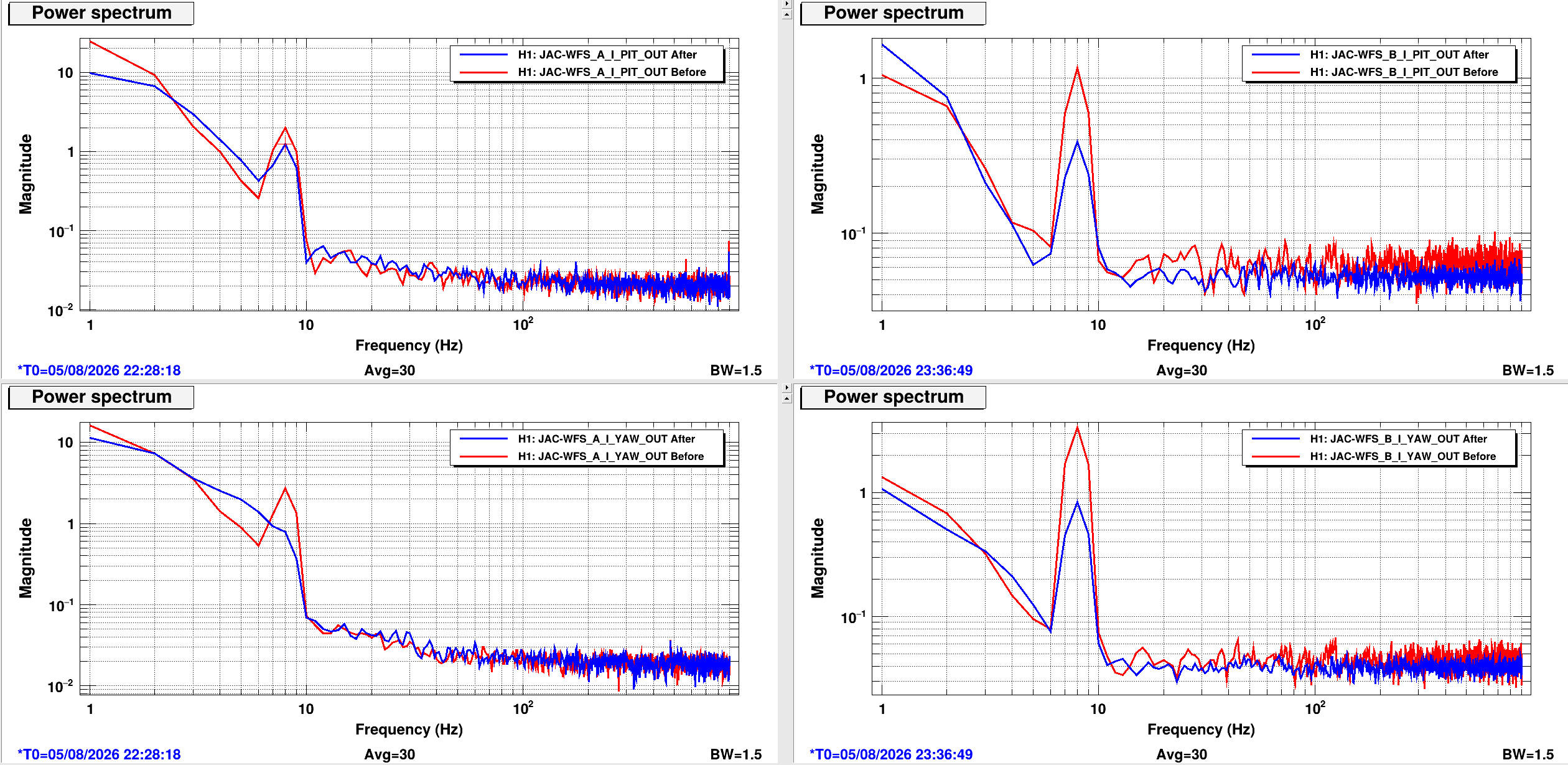
This afternoon we worked on balancing the wavefront sensors for JAC. As shown in the plots below, the coupling of the length signal into the pitch and yaw channels of both WFS A and WFS B is significantly reduced after the adjustment, indicating that the balancing was successful.
To measure the length coupling, we injected a 0.1 excitation into the JAC length loop error point at 8 Hz. The 8 Hz peak appeared in both the pitch and yaw channels of WFS A and WFS B, indicating an imbalance among the four quadrants of the wavefront sensors. To reduce this coupling, we modified the WFS input matrices, which convert the four sensor segment signals into pitch and yaw signals. Instead of using equal weights of 1 for every segment, we adjusted each weight based on the measured imbalance.
We first monitored the signals from all four segments of each wavefront sensor and calculated new matrix values. For each sensor, we summed the four segment signals and divided by four to obtain the average signal that each segment should ideally receive. We then calculated the fractional deviation of each segment from this average and used it to determine a correction factor. The new matrix entry for each segment is given by:
New weight = 1 − (Average − Segment)/Average
For example, the measured signals for channel I of WFS A were:
| A_I1 | A_I2 | A_I3 | A_I4 |
| 10.32 | 8.39 | 10.9 | 11.35 |
The sum of the four segments is 40.96, giving an average of 10.24. Segment A_I1 is 0.08 above the average, corresponding to a fractional deviation of approximately 0.008 (0.8%). Its new matrix weight therefore becomes approximately 0.992. Since this segment receives slightly more signal than the average, its weight is reduced accordingly. The same calculation was applied to all four segments of both WFS A and WFS B, and the updated matrices were loaded into the system.
The comparison of the pitch and yaw signals for channel I of WFS A and WFS B is shown below. The 8 Hz length coupling is reduced in all cases compared to the original matrices, demonstrating that the new balancing improves the wavefront sensor performance.