Summary
We performed a high-power test of JAC. The input power was ramped from 2 W to 62 W using the Guardian power up/down states, and JAC stayed locked through the entire ramp without any problem.
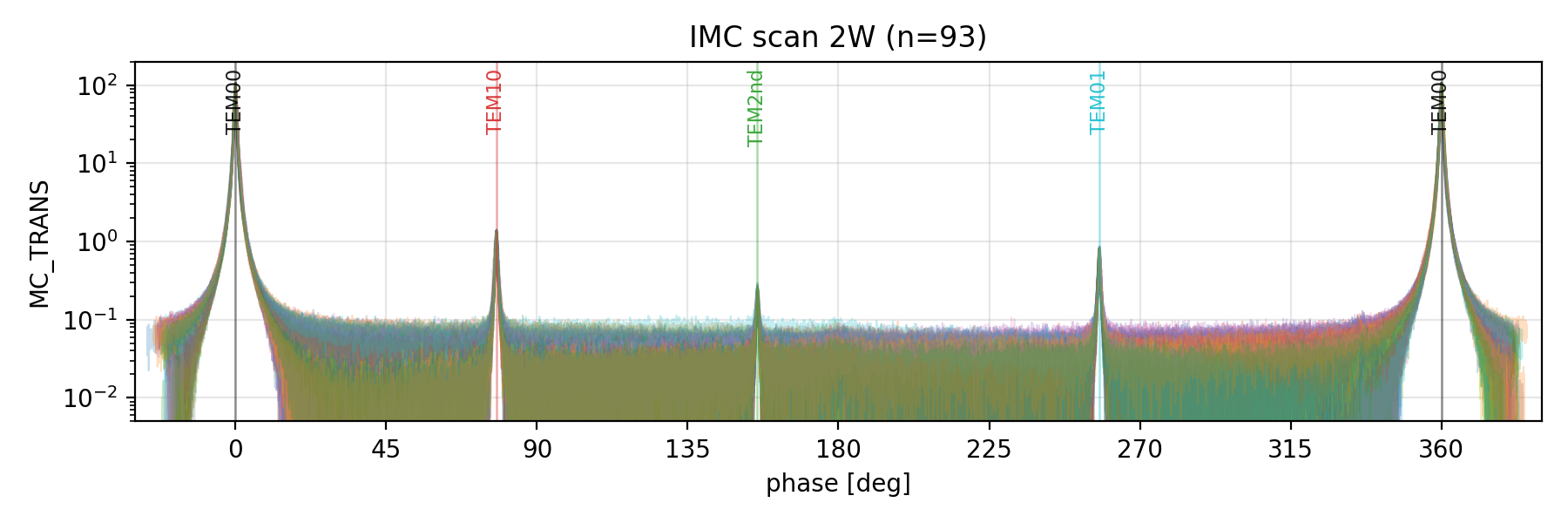
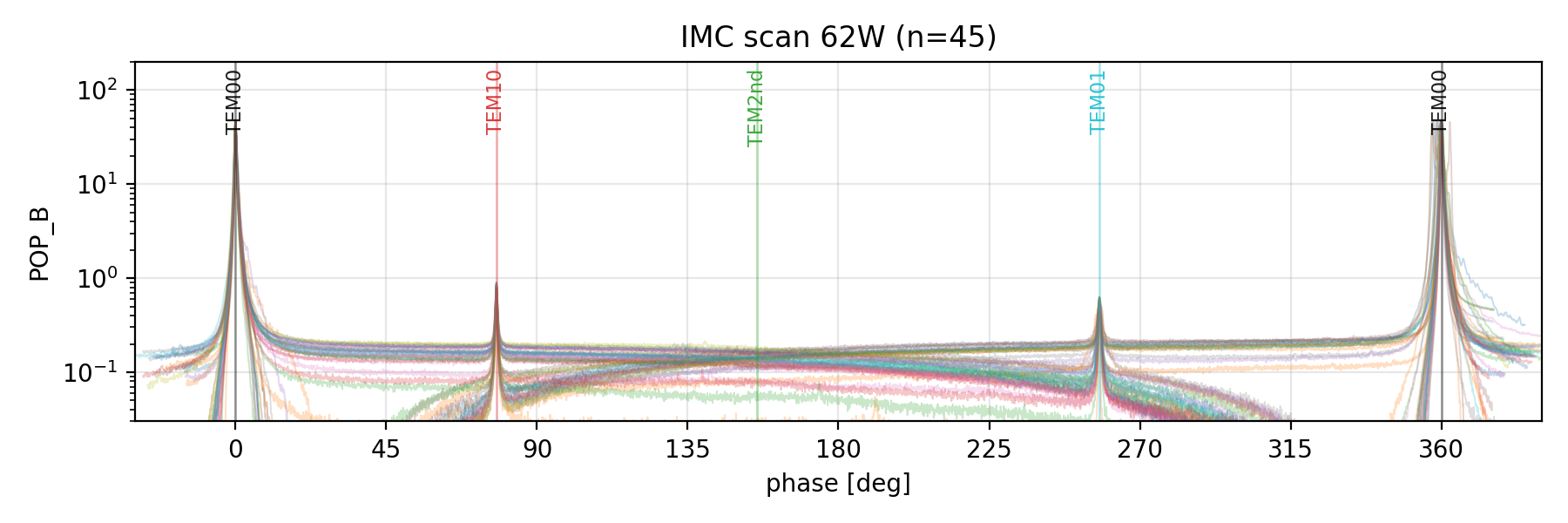
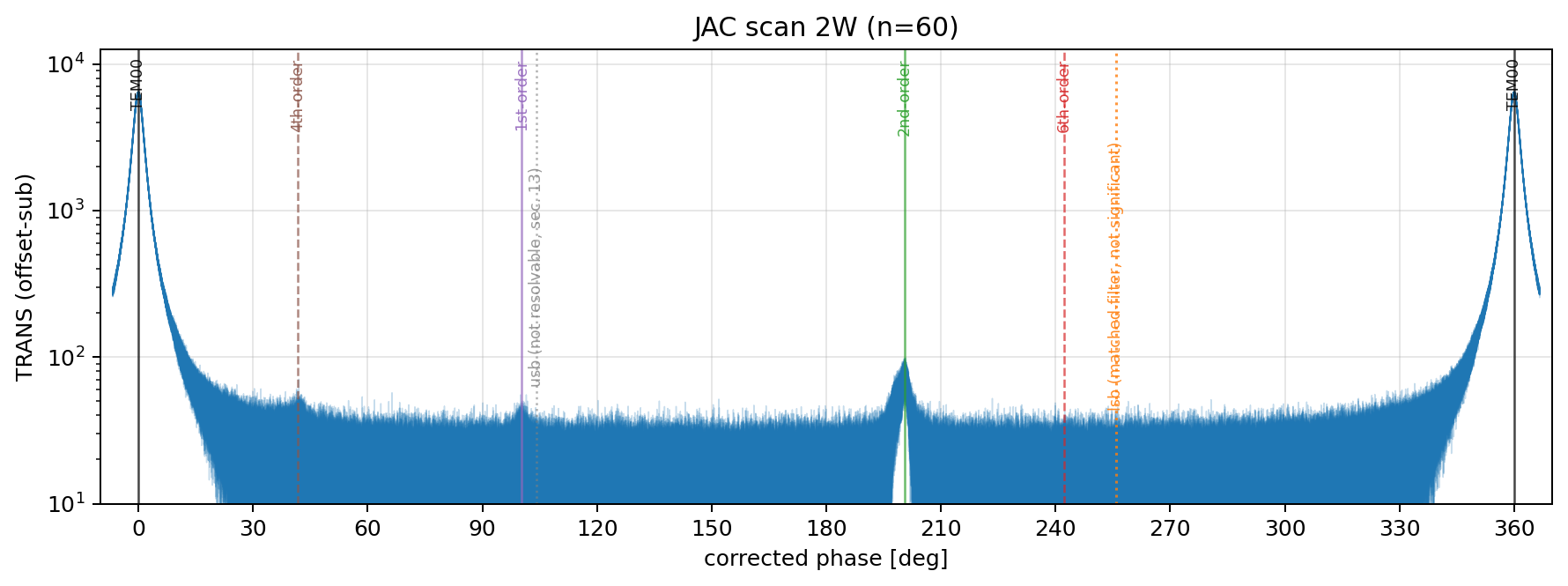
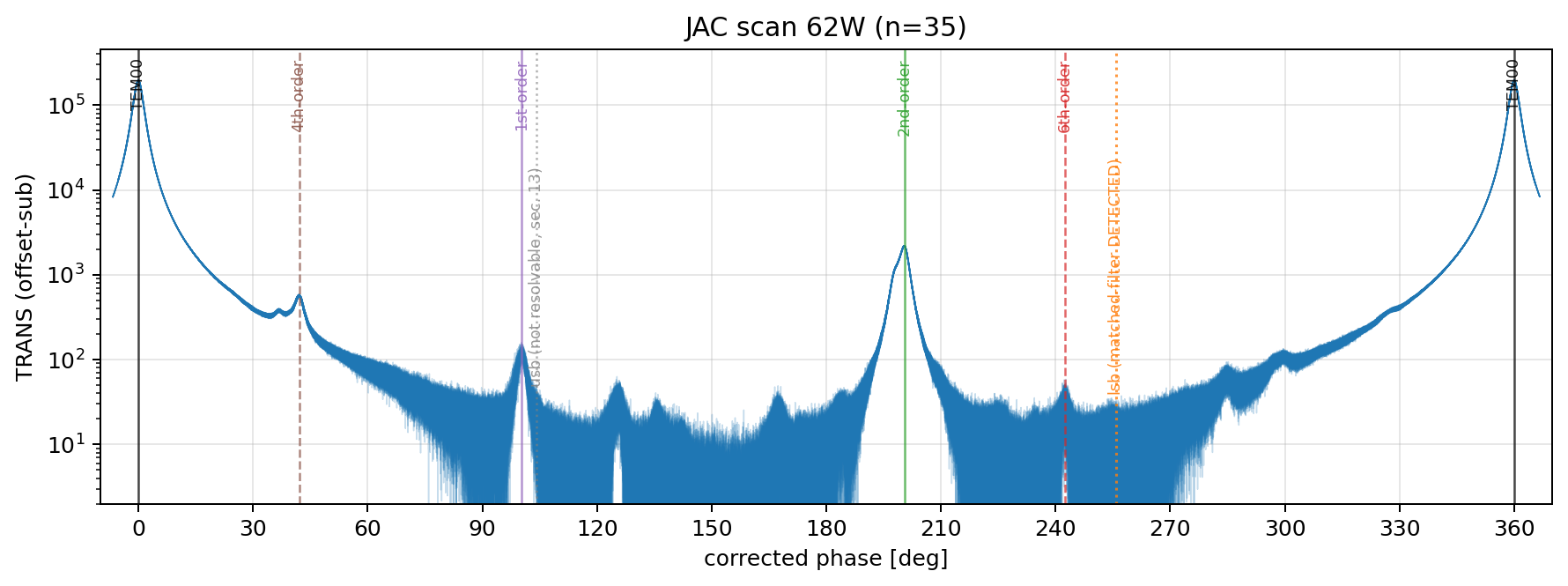
To quantify thermal effects on the mode matching, cavity scans of both the IMC and JAC were taken at 2 W and at 62 W. The main conclusion is that the thermally induced mode-matching change is negligible for both the IMC and JAC.
Other checks
JAC stayed locked through the entire ramp from 2W to 62W. The OLG was measured at 2W and 62W, the difference was about 3dB, and this increase is caused by the discrepancy of the power normalization value and actual power to the JAC REFL PD.
During the following test JAC lost lock a few times (deliberately and otherwise); in every case the trigger PD responded correctly and the shutter closed as designed. The ASC loops were also closed during the power increase and worked without issue.
IMC scan
The analysis follows the method already posted in alog 88984. For the 62 W scan the readout was switched to POP_B : MC2_TRANS starts to saturate at high power, and a saturation-induced tail dragging is visible in its response, which would contaminate the analysis. (Actually, POP_B has also the contamination, but I concluded that we can ignore that effect, since we can't see any 2nd order peak in the scan as discussed below.)
The IMC mode matching is at a very good level to begin with, and the thermal lensing improve the mode matching: the second-order mode content are 0.22% for 2W and <0.3% (62 W). As the attached scan plots show, there is no observable second-order peak in 62W plot, so the upper limit of 0.3% was estimated by the noise floor. Note taht the first-order modes are caused by intentional misalignment.
JAC scan
To estimate the thermal change for JAC, we also scan the JAC PZT. Scan parameters: PZT driver swept 51–311 V (triangle, 10 s period), 300 s at 2 W and 60 s at 62 W, reading channels JAC-PZT_DRIVER_VOLTS / JAC-TRANS_A_LF.
The mode mismatch is 1.1% for 2W and 1.0% for 62W. Again, no significant thermal change. Since the mismatch is visible at the >1% level, moving the PSL mode-matching lens could probably improve it somewhat; whether we do this is left for later.
As a byproduct, the 43 MHz modulation index was extracted from the scan with a matched filter on the lower sideband (62 W, 12.7–13.5σ): m ≈ 0.009, consistent with the expected 0.01.