[Jim W., Shoshana A., Michael R., Huyen P.]
0. Since HAM3 ISI has been updated with new CPS sensors (with fine vertical CPS), Jim updated new symetrization filters for the actuators using the ISI commissioning scripts.
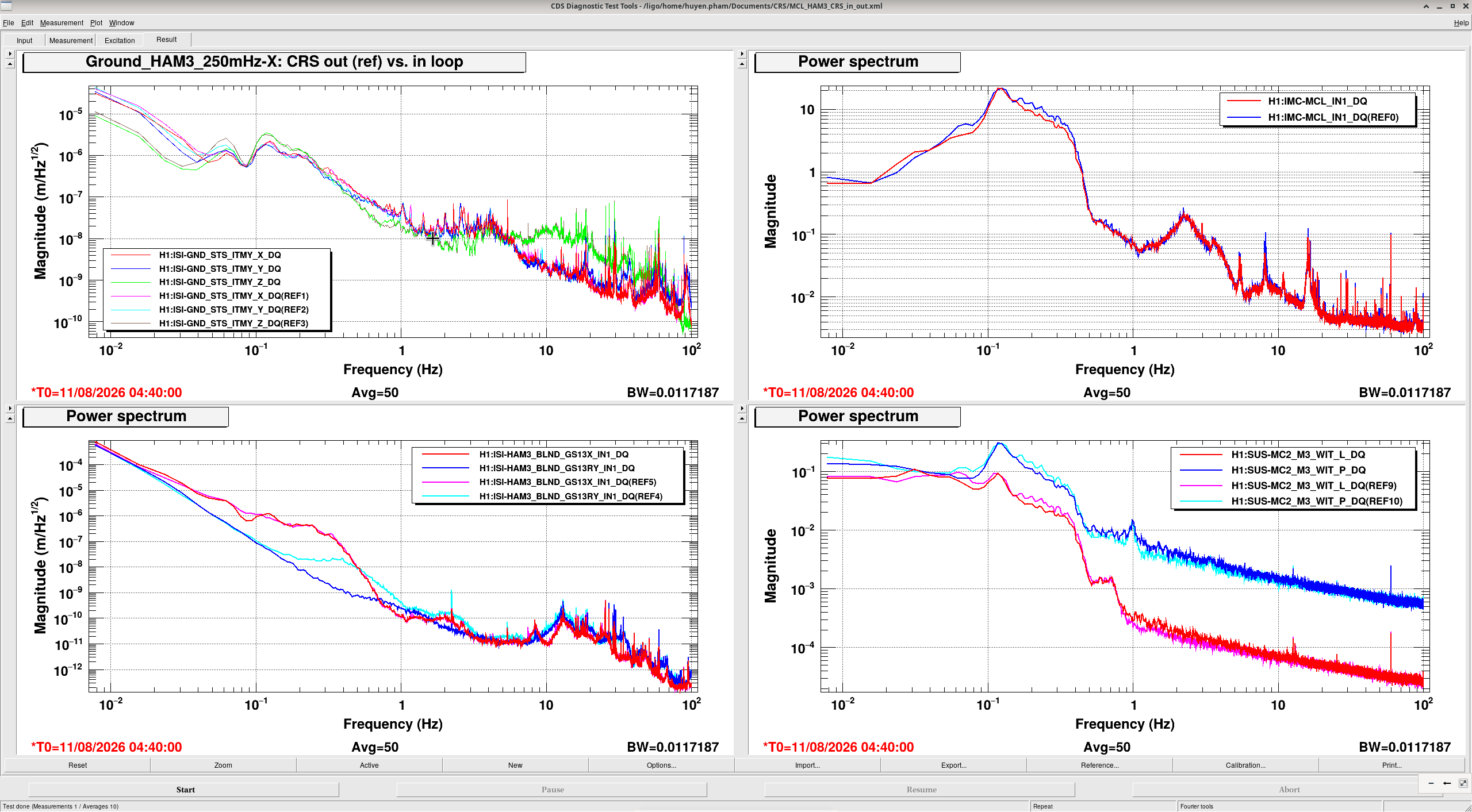
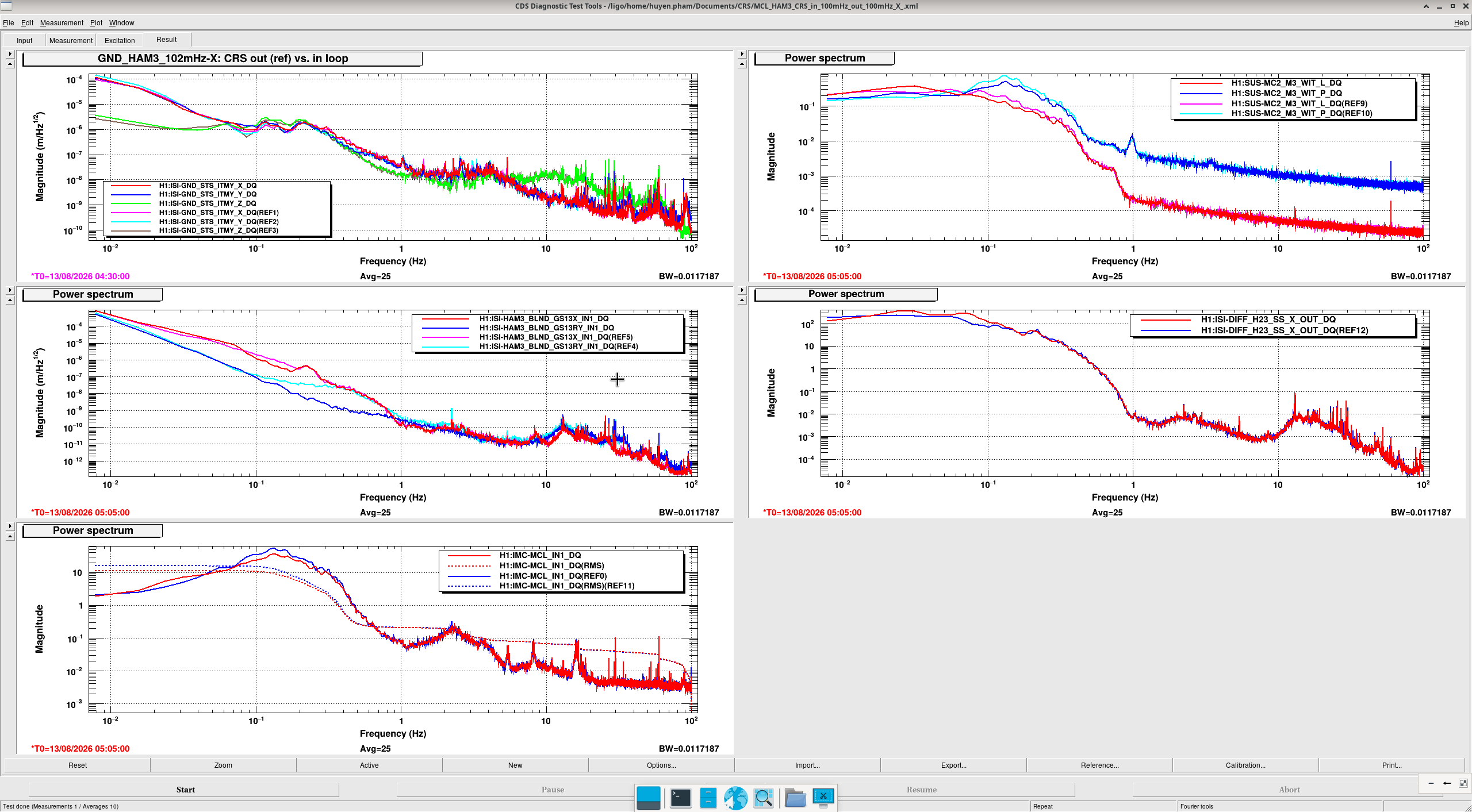
1. We have been testing CRS in/out of loop looking at IMC length (mostly during night time with IMC locked at 2W). The wind condition has been relatively quite so far for these tests. We can repeat in higher wind (ground tilt) condition.
| Time | HAM2 blend X | HAM3 blend X | HAM3 blend RY | CPS diff config | Results |
|
08/10 |
250mHz |
250mHz |
'many notches' - CRS out of loop 30mHz - CRS in loop |
following BSC2 |
CRS in-loop improved ISI RY down to GS13 noise Not much improvement in ISI X MCL see minimal improvement below 0.4Hz |
|
08/11 |
250mHz |
250mHz 102mHz |
'many notches' - CRS out of loop 30mHz - CRS in loop |
following BSC2 |
CRS in loop + 102mHz blend X - see improvement in X Know that this is mainly from blend push, not CRS MCL see x3 improvement below 0.4Hz |
|
08/12 |
250mHz | 102mHz |
many notches' - CRS out of loop 30mHz - CRS in loop |
following BSC2 |
Testing CRS effect on cavity length motion. Confirm that the improvement in ISI X and MCL saw in thelast test mainly coming from blend push. |
|
08/13 |
102mHz | 102mHz | 30mHz - CRS in loop |
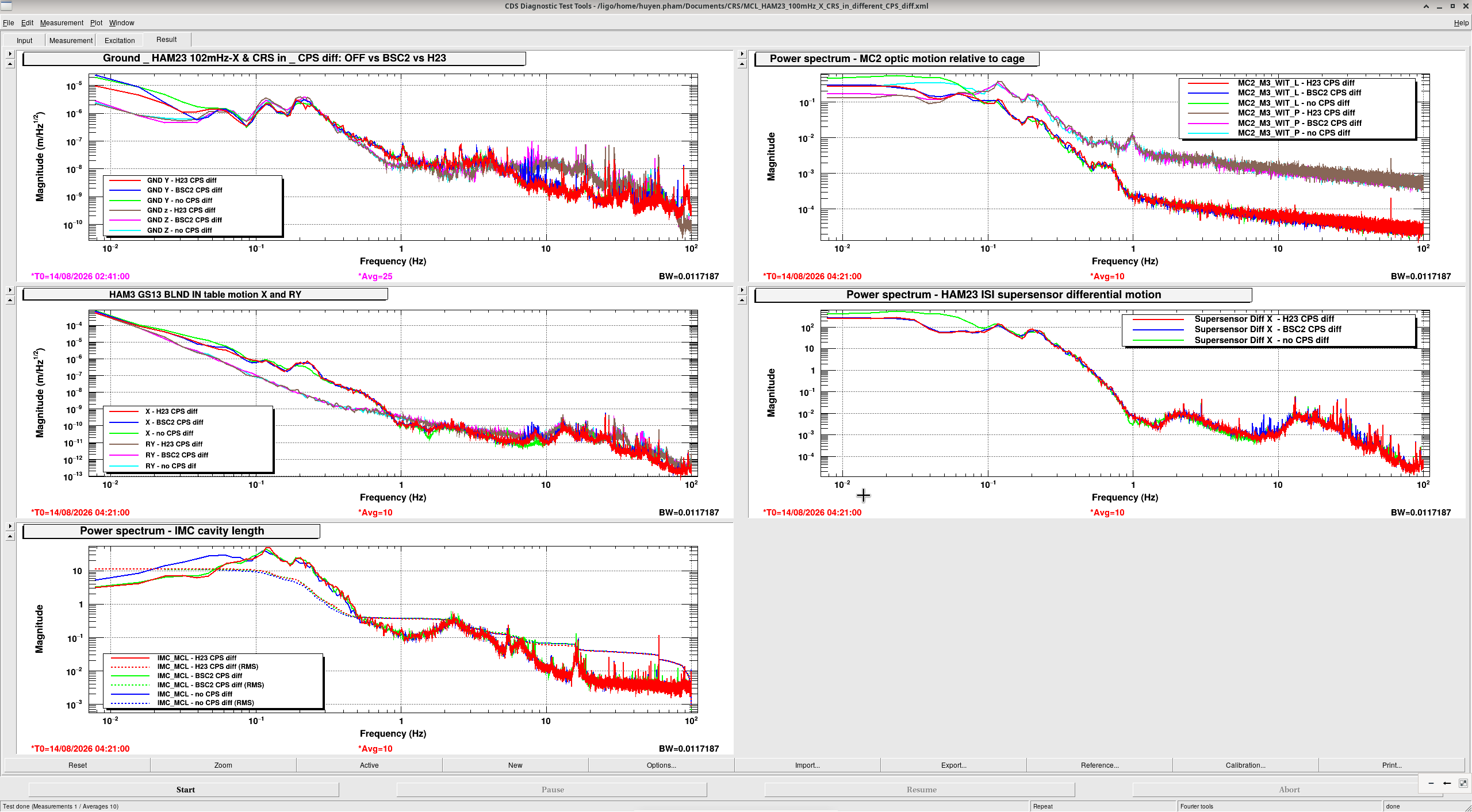
no CPS diff Following BSC2 HAM23 CPS diff |
HAM23 CPS diff or BSC2 BSC diff improve upto x4 below 0.1Hz |
We will try lower blend, e.g. 45mHz.
2. With CRS out of loop, we compared tilt spectra for CPS, GS13, and CRS. Without the proper capacitive damping, the OFFLINE/DAMPED stage rings up the CRS, making low frequency signal worse. Under ISOLATED state, the CRS can be damped, and CRS matches GS13 between 0.2Hz - 1 Hz. This test has been done at MIT, see alog 12136.
3. I also did make a different set of GS13 vertical symmetrization filters using global Z comb drive scripts from Brian, see last figure. The filter file is living under /ligo/svncommon/SeiSVN/seismic/Common/Documents/T2300404_HAM_symmetrization/ham3_fine_cps_and_crs/. We will test this later.