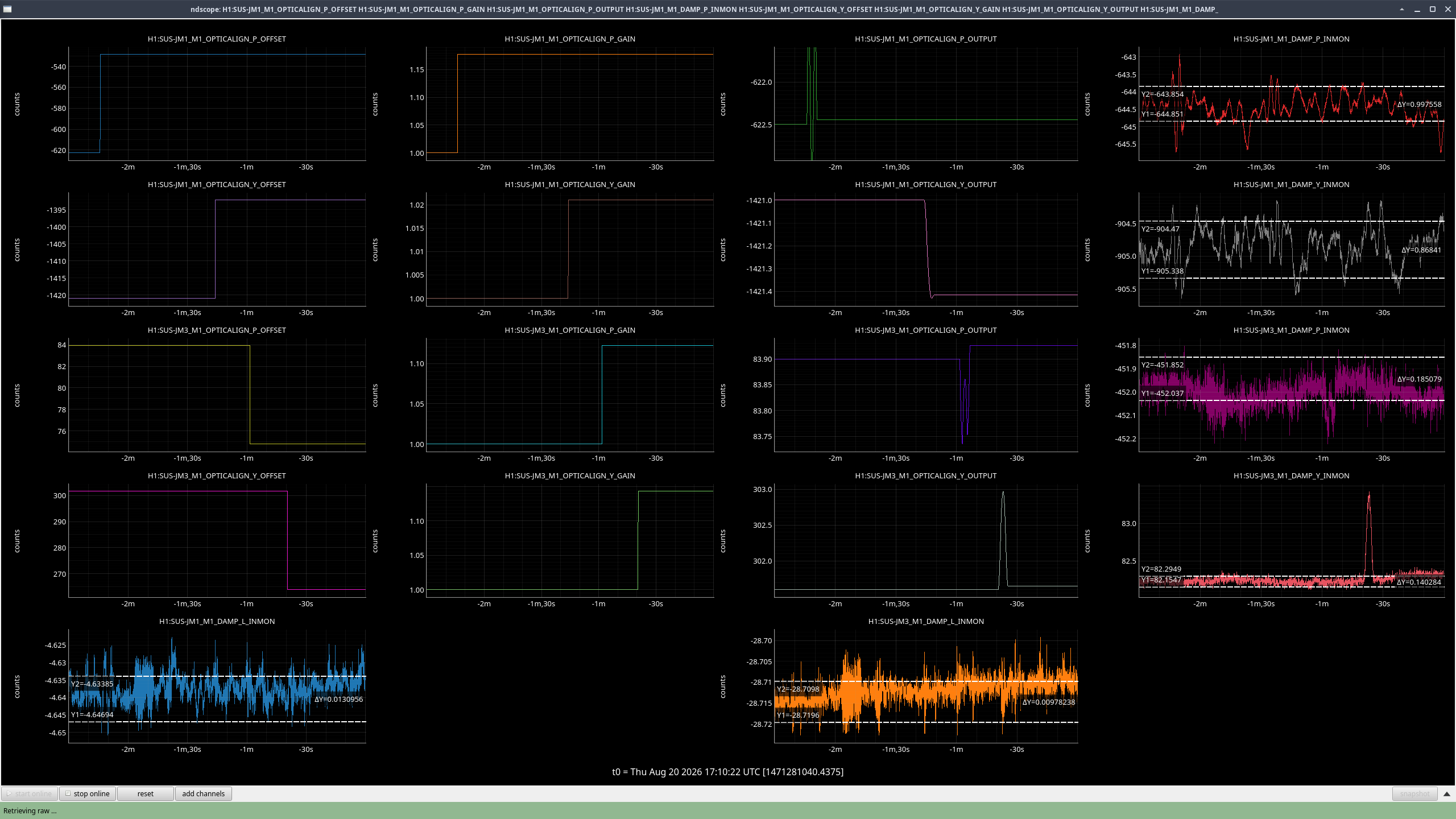
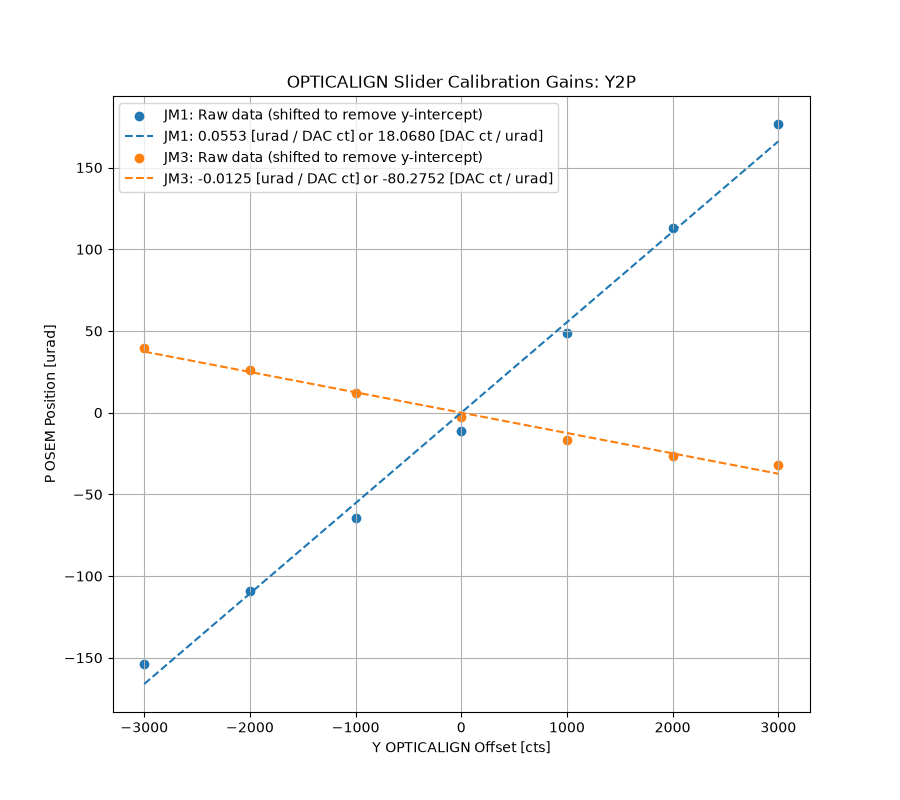
Calibration into urad has been done for JM1 and JM3's OPTICALIGN slider gains. The JM1 P and Y gain values match well with the values Masayuki found using a different method (91487), which is a nice double check.
The values to be put in {JM1,JM3}_OPTICALIGN_{P,Y}_GAIN and the necessary changes to the OFFSET values to keep the (current) OPTICALIGN OUTPUT the same are below, and were installed as of 2026/08/20 17:08-17:10UTC. Checking H1:SUS-{JM1,JM3}_M1_DAMP_{P,Y}_IN1 shows that pointing stayed the same before vs after this transition.
NOTE: This means that comparing slider values before vs after this calibration time will not make sense. Instead, you can look at the OPTICALIGN OUT16 values or the pointing using DAMP_IN1 channels since those will stay consistant.
| JM1 | JM3 | |||||
| Calibration Gain [cts/urad] |
OUTPUT (2026/08/19) |
New OFFSET | Calibration Gain [cts/urad] |
OUTPUT (2026/08/19) |
New OFFSET | |
| P | 1.1771 | -622.5 | -528.8420695 | 1.1217 | 83.9 | 74.79718285 |
| Y | 1.0207 | -1421 | -1392.181836 | 1.1428 | 301.6 | 263.9131957 |
Finding Calibration Gains
I used the method Jeff used in 77211 to get the counts -> urad calibration. So now when you move the OPTICALIGN slider by 1 in {Pitch,Yaw}, you actually get 1 urad in movement in {Pitch,Yaw}.
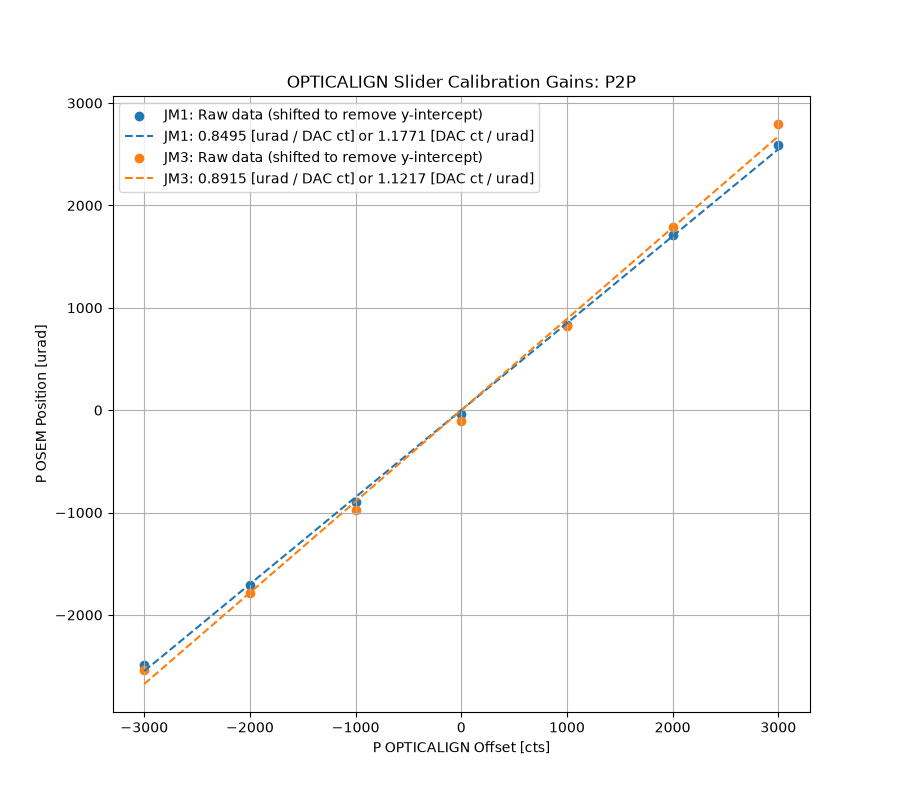
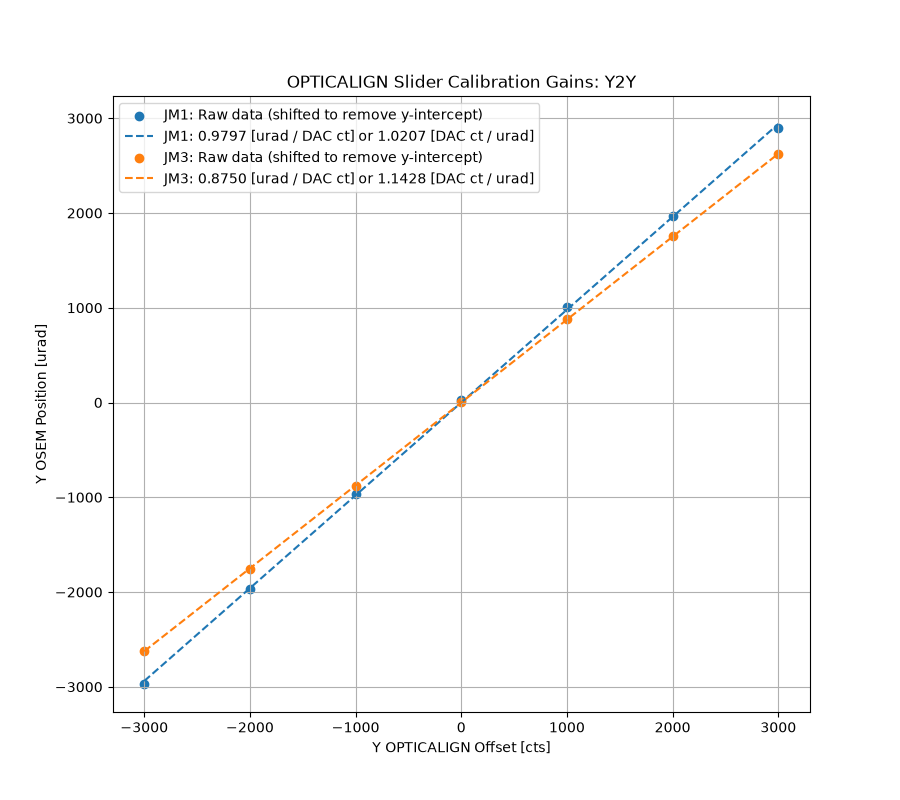
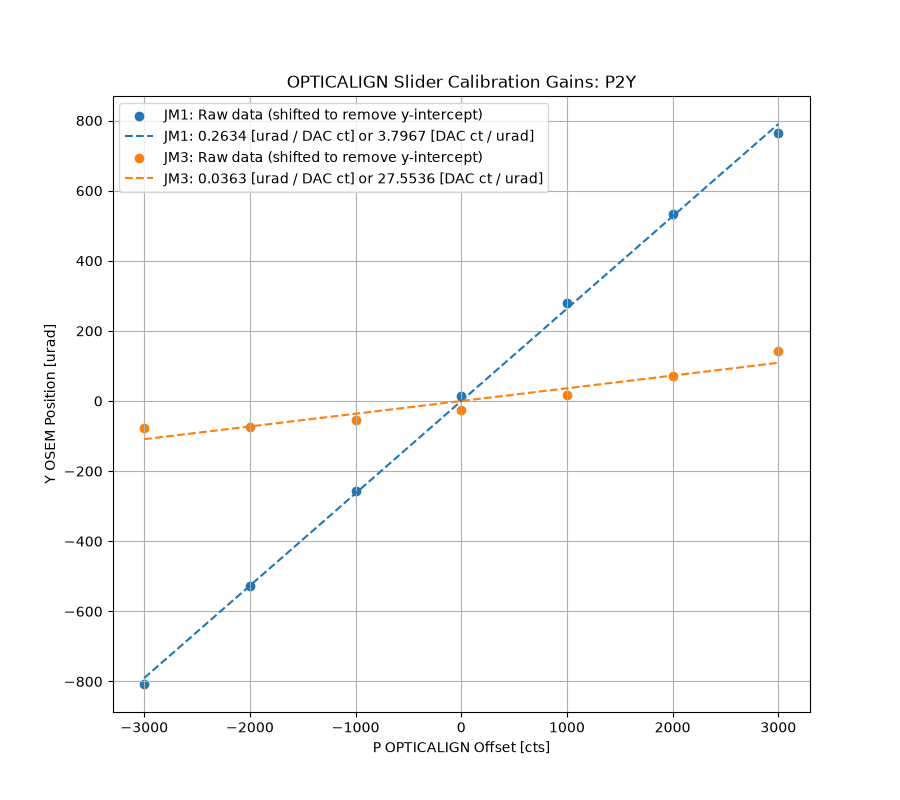
For each suspension, I put a series of OPTICALIGN offsets into Pitch and then into Yaw (only doing one dof at a time). At each offset, I wrote down the resulting values for DAMP_P_IN1 and DAMP_Y_IN1. Using these values I was able to fit a line for P2P, Y2Y, P2Y, and Y2P. I then inverted the slopes to get the calibration values in counts/urad.
On each plot I show the data points with the offsets removed (removed the 'b' from y=mx+b) for ease of slope comparison, and then also plotted the best fit line.
Both suspensions seem to have similar P2P and Y2Y as each other, but the cross-coupling is different. JM1 is a lot more cross-coupled with both P2Y and Y2P than JM3.
Finding New OFFSETs
OFFSET x GAIN = OUTPUT, and we want the OUTPUT to be the same as before, so we can just plug in our new GAINs and the OUTPUT that we want (aka the previous OUTPUT) and solve for OFFSET = OUTPUT / GAIN.