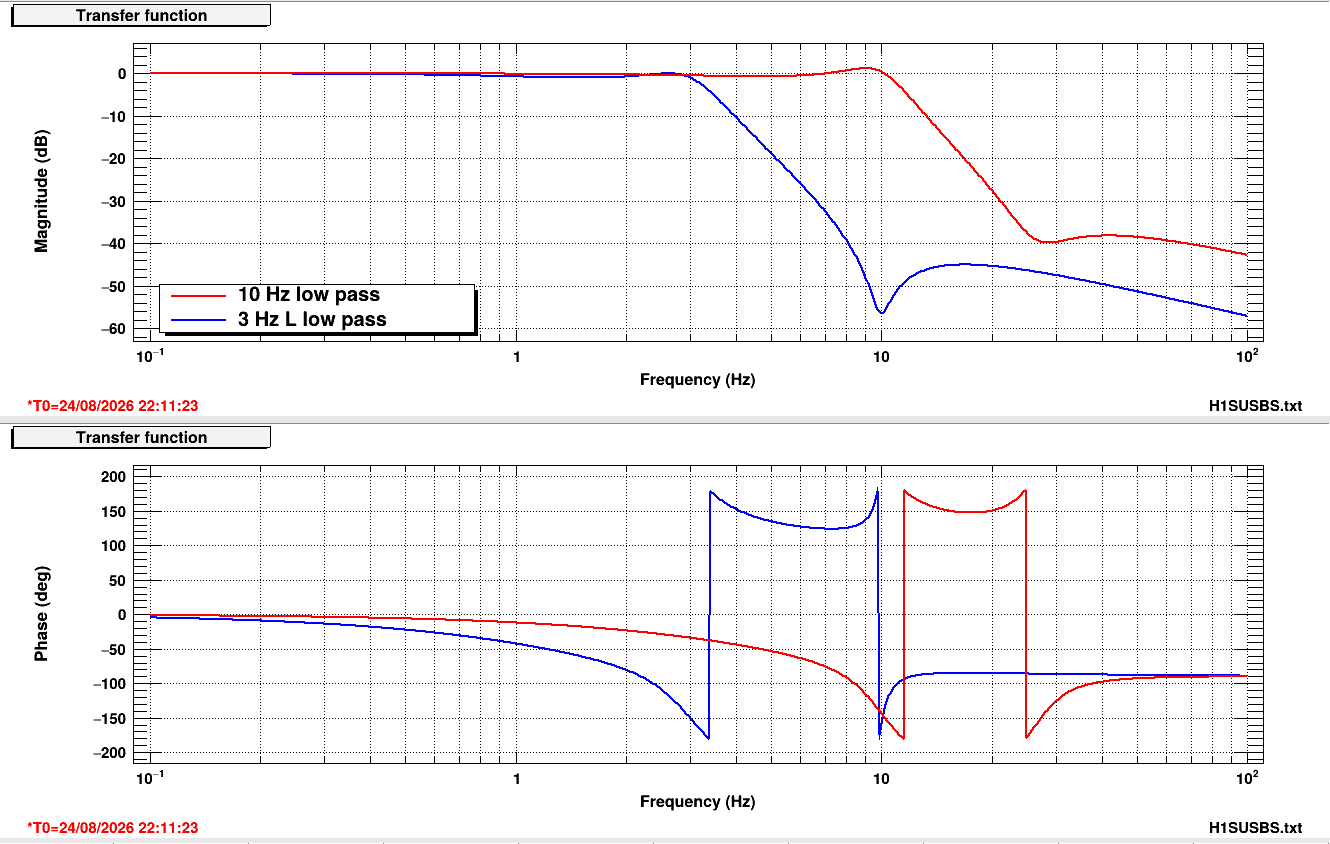
Just for the purposes of commissioning in the short term, I am doing some resdesign of the BBSS damping loop lowpass. Currently, the low passes are customized to each dof, but are roughly 3 Hz low passes with a low-Q elliptical design that gives something like 30-50 dB of attenuation. The rollof is extreme enough that we can't raise the gain. I have created a similar low-Q elliptical at 10 Hz with about 40 dB of attenuation that can be used for every dof. This design should give us plenty of phase to raise the beamsplitter damping gain significantly. I propose we use this design for now while we work on alignment. We can then try disengaging all oplev damping. Oli is working on determining the QOSEM performance, so once we understand it better, we can determine what kind of damping loop we need to meet noise requirements. To be clear, it's not my intention for us to use this design while in observing, just so that we can keep the beamsplitter still while we work on getting DRMI back. Here is a comparison of the current and new low pass
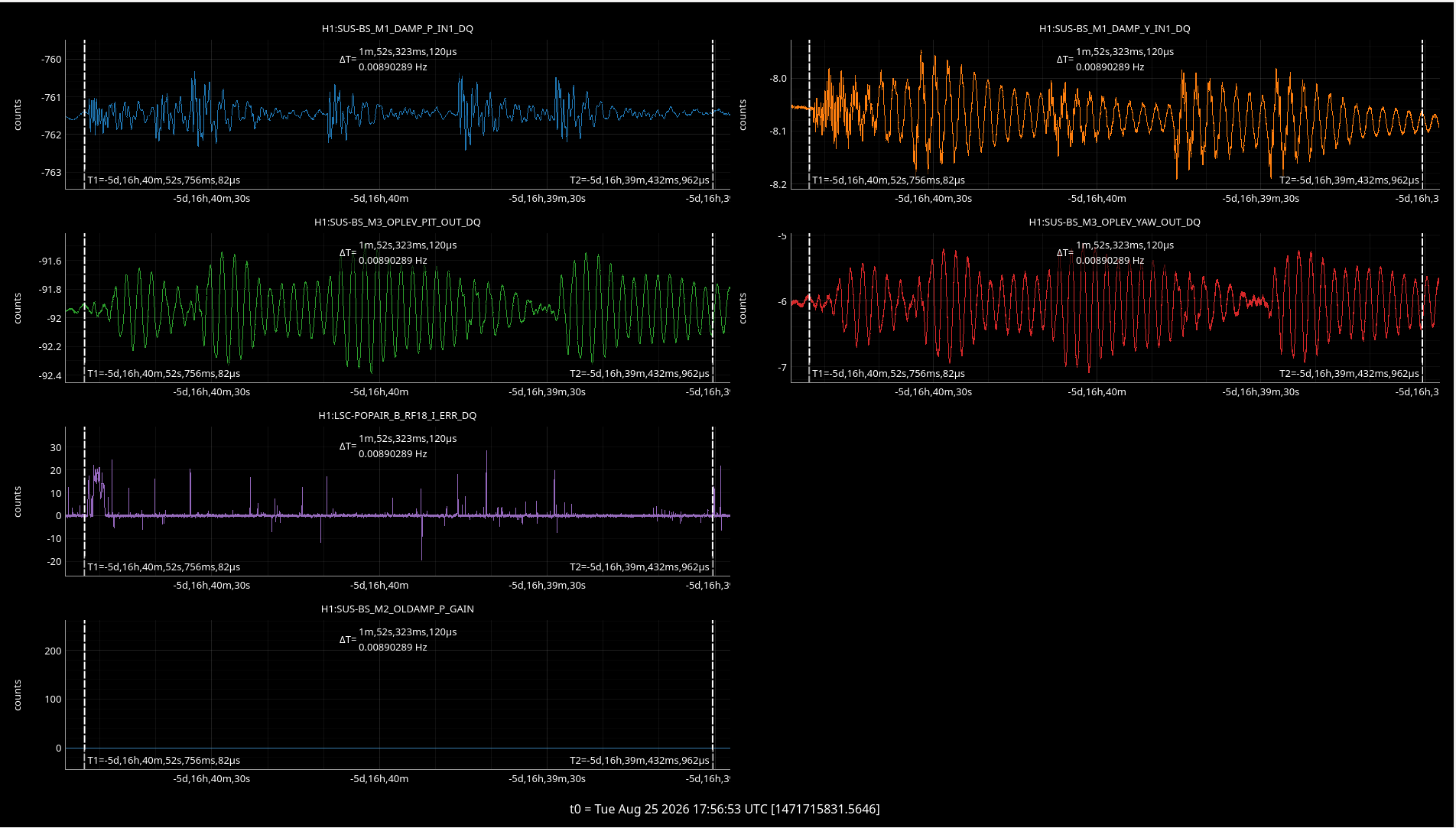
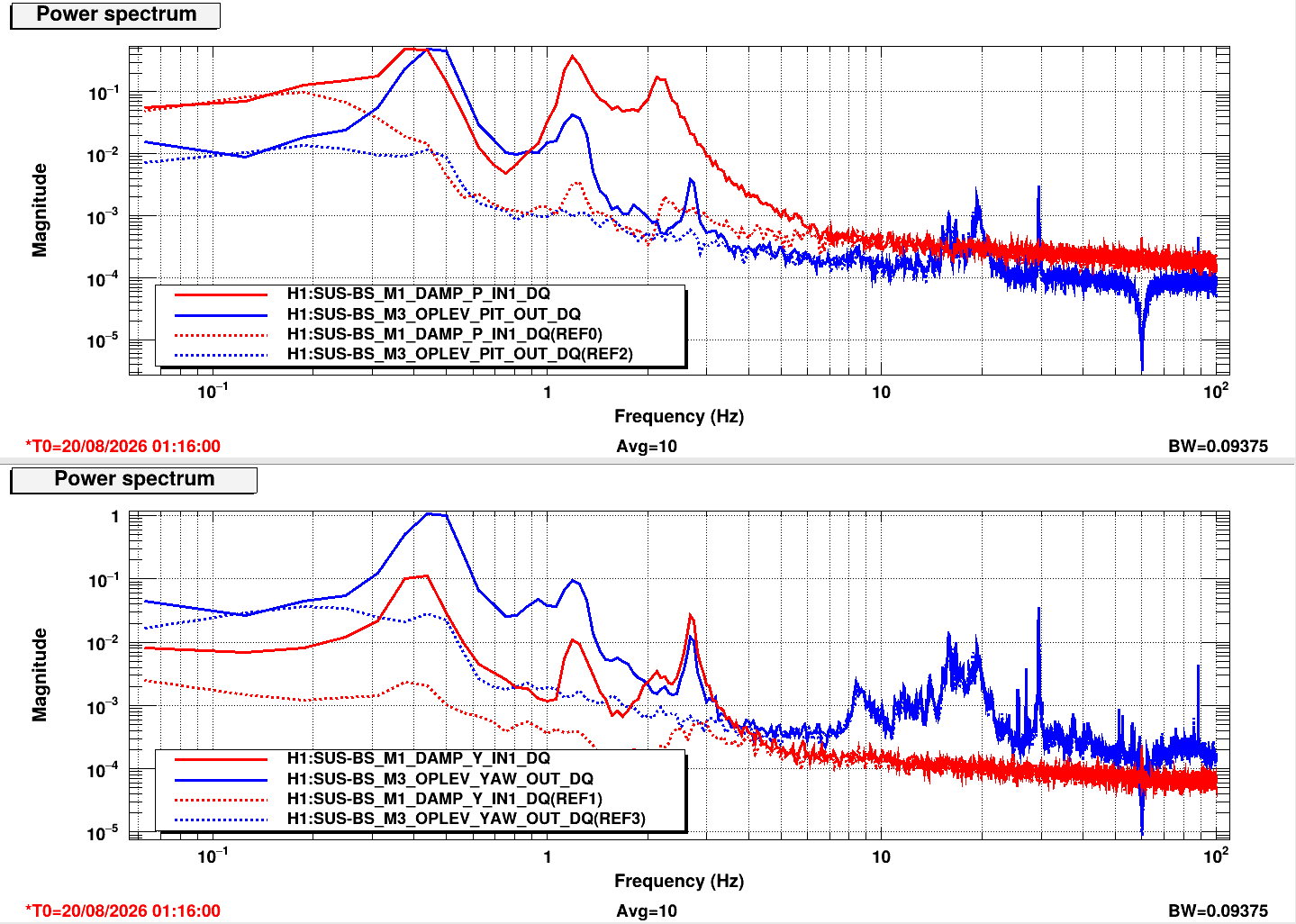
I have confirmed that a larger top mass damping gain is likely to help us lock without the oplev. This is a screenshot of a timeseries during a PRMI locking attempt showing both the BBSS top mass damping error signals and the oplev signals when the oplev damping was off. Both sets of error signals see the motion related to the PRMI locking kicks. I also plotted a spectrum of each signal compared to a quiet time just 5 minutes before (live traces are during locking, refs are quiet time). Both the oplev and osems signals can see the motion well above the noise during this locking time.
I have not yet tried turning up the gain in the damping loops- BS is currently in safe for tuesday work. Will try later today.
***
Edits to add:
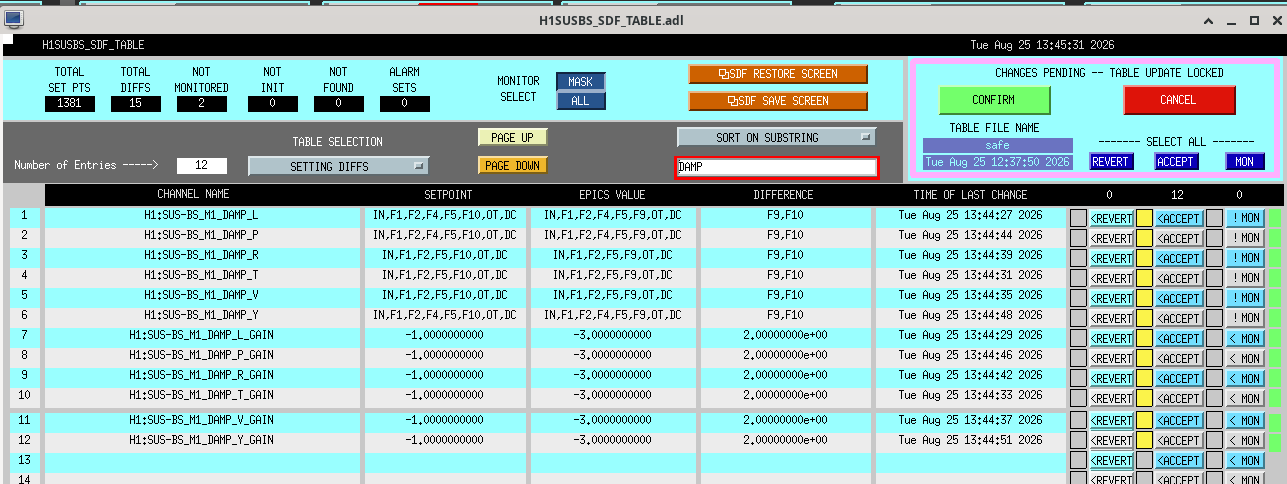
Louis and I engaged the new low pass with a gain of -3 instead of -1. We tried step testing with offsets on the top mass, and could see that indeed the ring down from these steps was about a factor of three shorter. We then tried a test offset in length on M3 since that replicates the kick that occurs during PRMI or DRMI locking. The oplev shows that with the higher gain damping, the motion from that kick damps down to the ambient level in about half the time (these are very rough numbers).
SDF of new settings