[Keita, Louis, Elenna, with input from others]
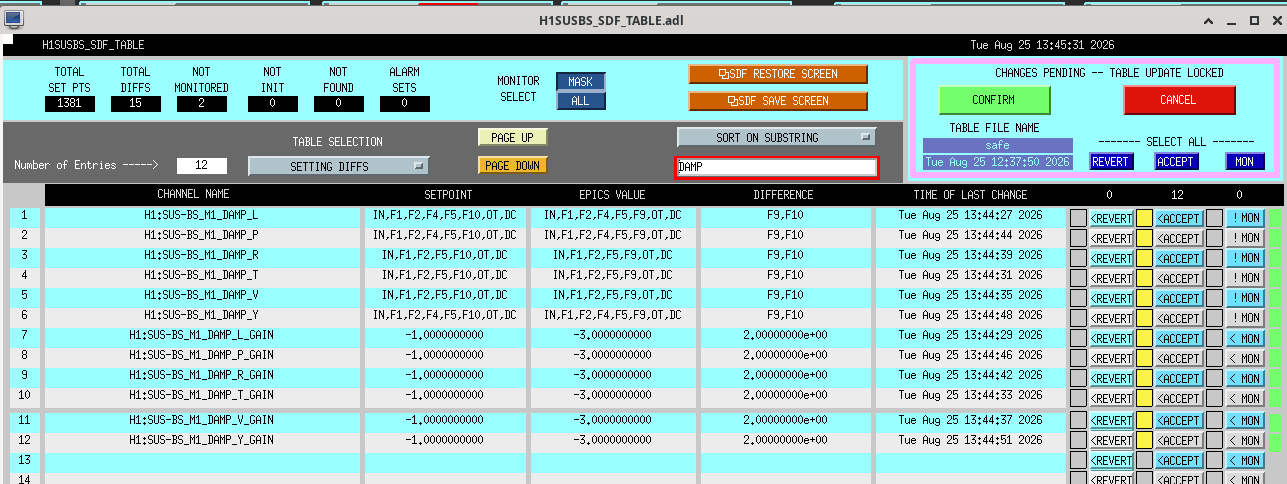
We locked PRMI again with the stronger BS top mass damping and no oplev damping. I also raised the damping gains of PRM, PR2, SR2 to -1. They have been set to -0.5 for a while now. I have SDFed these gains to -1 to help with locking.
> Since the PRMI buildups are so ratty, I am concerned about what is moving too much. Clearly the BS is the main culprit, but given the issues with PR2 where the damping was essentially doing nothing at low gain, I think we should raise the damping gain on all HSTSs to the original setting of -1. We can evaluate the noise effects in full lock, and perhaps have a gain setting for lock acquisition versus NLN.
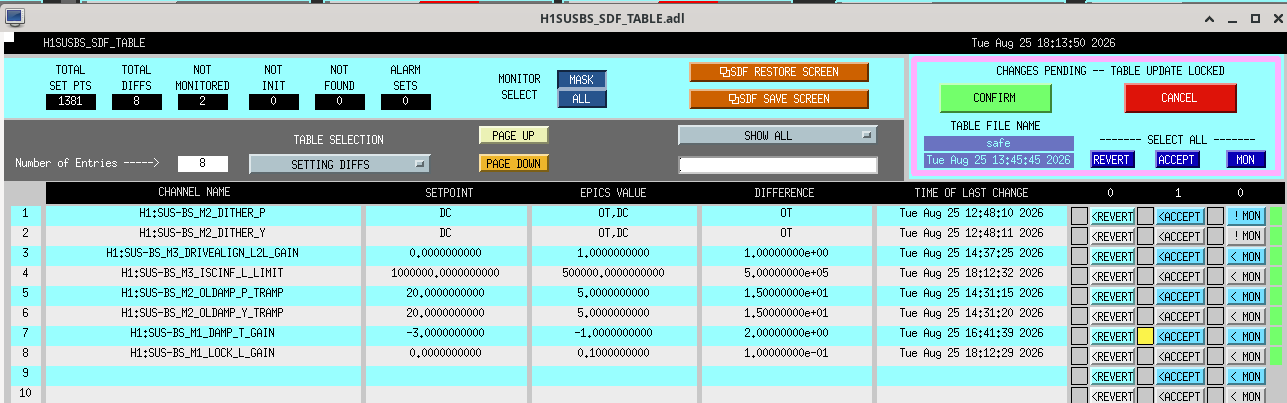
I had some initial trouble locking MICH, and realized that the M3 drivealign gain was incorrectly set. Once I fixed that, it was much better. We need to check the guardian to make sure this gets set correctly.
> Haven't looked into this yet, will do so today.
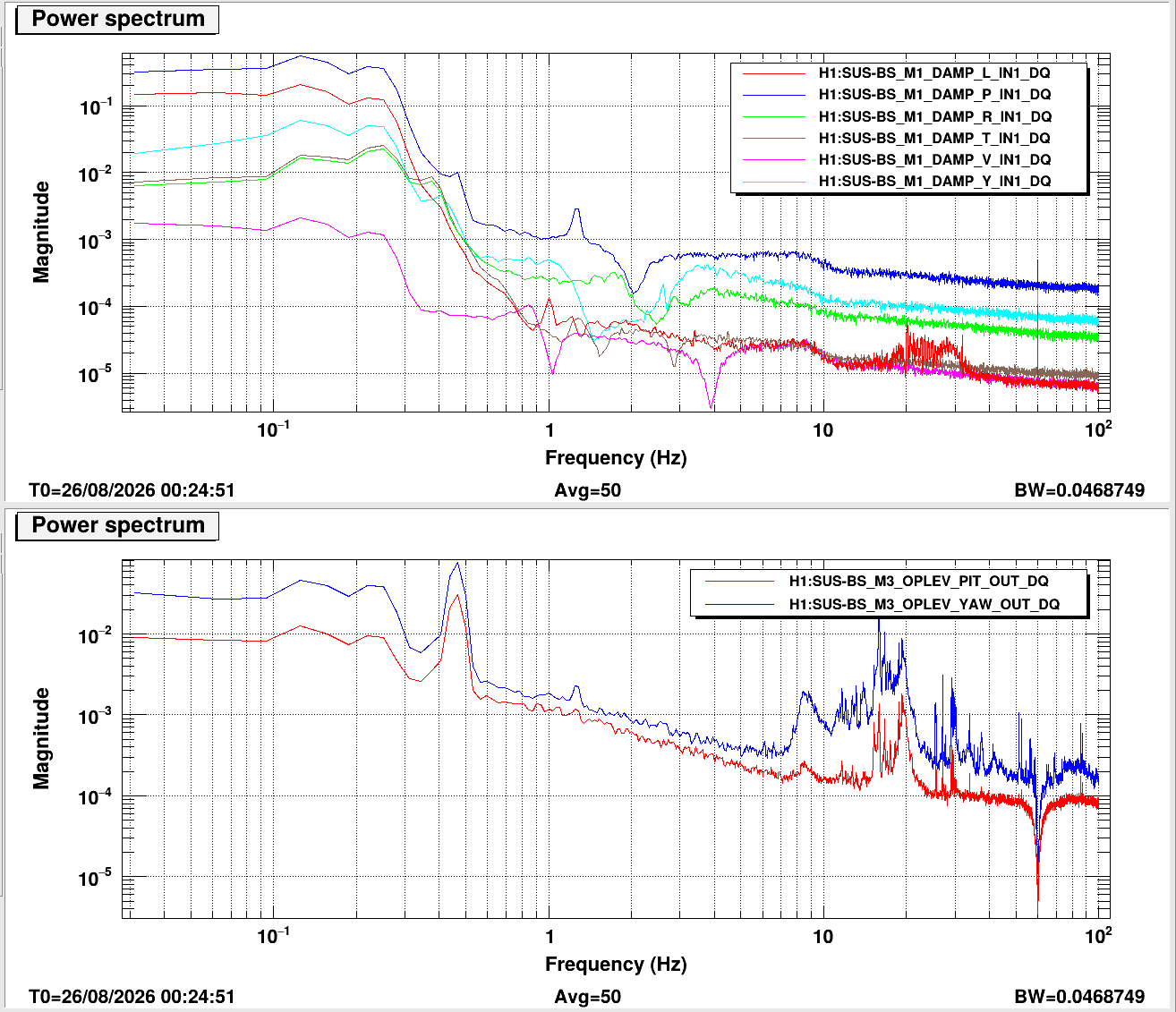
Using a beamsplitter damping gain of -3 for most DOFs works well. We had some excess 1 Hz motion which I tracked down to having too high gain on BS T, so I've left that dof at -1 gain. SDF 1 2
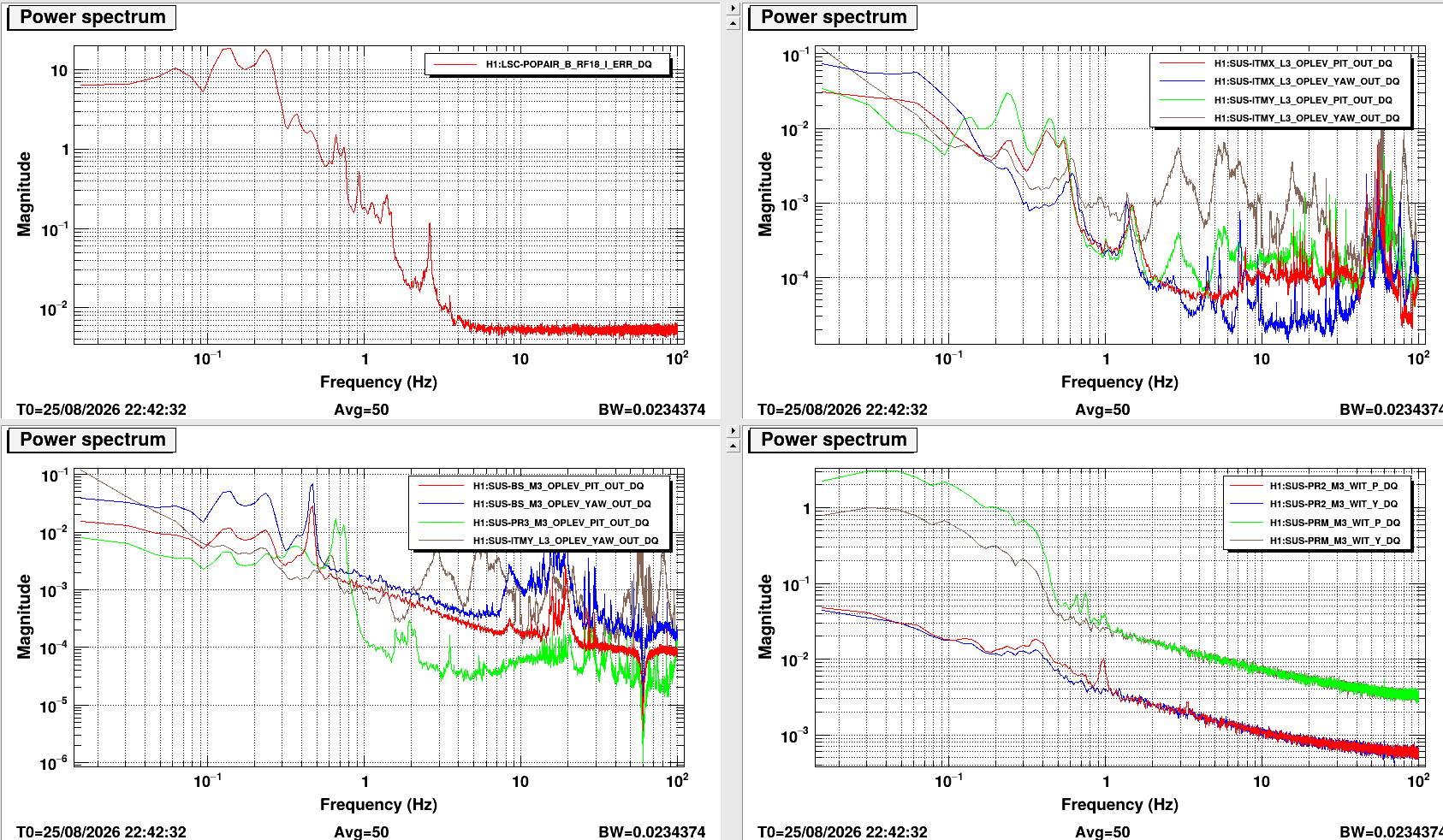
PRMI locks quickly, and it appears by camera that the BS moves a lot less in this state during locking. However, the buildups were very shaky as we sat in PRMI locked for more than 30 minutes. I looked at the signals and it appears that the largest motion in POPAIR RF18 was around 0.2 and 0.3 Hz. Jim put the beamsplitter ISI in the fully isolated state, and this help reduce the motion.
> There is still excess motion in the corner at 0.1-0.3 Hz, mainly on the BS ISI. Jim is looking into this issue. This shows up strongly in the BS oplevs, but you can also see some of it in the PR3 oplev. This explains some of the wiggly-ness in the PRMI buildup.
The rest of the movement occurring while we sit in PRMI seems to be that the BS moves a lot at 0.45 Hz. However this signal is not visible in the top mass osems, so it would probably be better if we could engage MICH ASC.
> Sheila has pointed out that we should look into length-to-angle decoupling, going to work on this today.
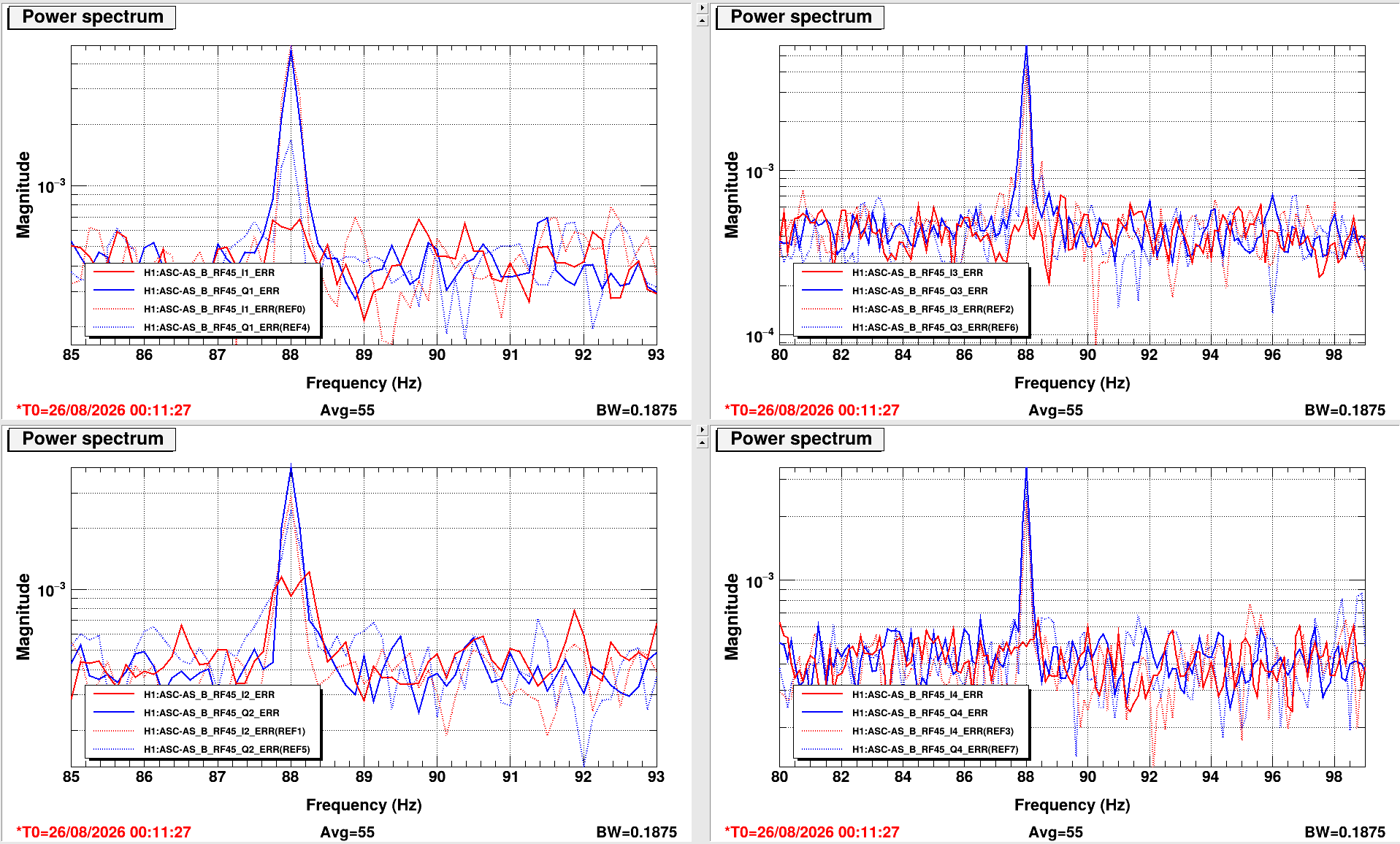
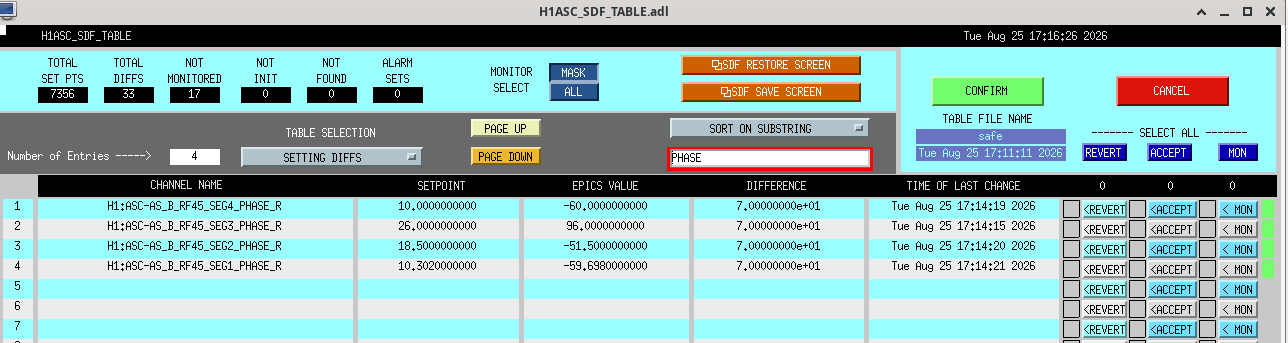
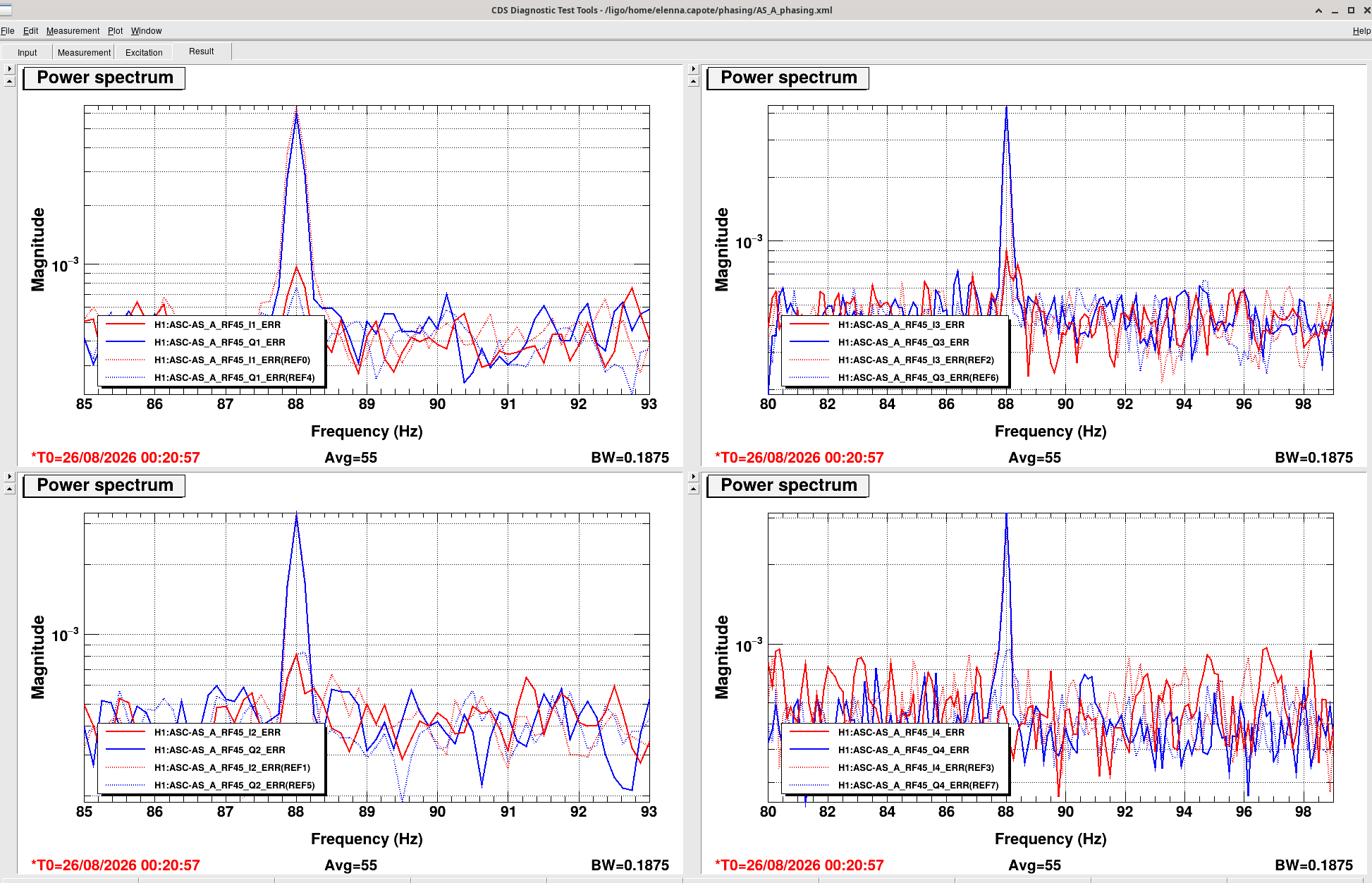
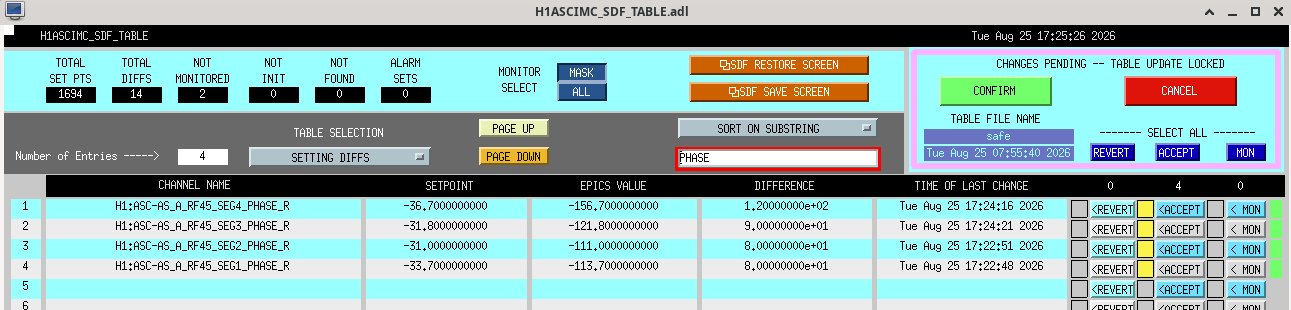
I had some trouble engaging the BS ASC, which should drive to M2 and M1. I checked the error signals (AS RF45 B Q), and realized it didn't make sense (> as in the signals did not cross zero when buildups maximized, etc). So I then checked the phasing by driving a MICH length line at 88 Hz. The phasing was very bad, mostly in I not Q, and I fixed it by adjusting the phase by 70 degrees for all four segments. One segment moved the opposite direction of the other three segments (as in three segments reduced phase by 70 deg, one increased phase by 70 deg), which Keita found was because the relative phase of Q3 compared to Q1, 2, and 4 was off by 180. By flipping the demod phase on Q3, all of the relative phases between the segments was zero. I SDFed these phases. (screenshots attached of measurements and SDFs).
For good measure I rephased AS A RF45, although I would want to recheck the AS RF45 phasing when we have a DARM signal. (screenshots attached of measurements and SDFs).
> We need to rephase all ASC diodes I suspect.
With the rephasing, the MICH ASC error signals looked much more reasonable. I can engage the loops, but the pitch loop runs off after a minute or two, so I might have the gain sign wrong. The guardian is still set to engage MICH ASC FALSE, so it has to be done by hand.
Conclusions from today:
- we can keep locking PRMI/DRMI with no oplev damping
- we can keep locking with high BS top mass damping
- we can have the BS ISI ST2 boost ON when locking PRMI/DRMI
> before I get too confident, let's monitor over the next few weeks as Jeff suggests in his comment. However, we relocked multiple times to PRMI yesterday without any big kicks, all locklosses were due to me messing around with the alignment, or the JAC losing lock.\
> as a final note, the oplev damping still works, so if something happens that kicks the BS too much, ramping on the oplev gain for a few seconds can quickly damp the motion down (I suspect it's very overdamped)
***
Right after posting this alog I tried again with MICH ASC.
I feel confident that MICH yaw works with a gain of 0.5. This is flipped sign and slightly larger than the gain setting in the guardian for this state.
I think MICH P works ok with -0.5 gain. I was testing it and all was well until the JAC unlocked itself for a separate reason. It can take MICH P a few minutes to fall over though, so I won't change the guardian setting yet.
However, if you run the MICH ASC, the buildups are much quieter in PRMI.
***
> Logging in this morning to add some clarifying statements to the above, since I wrote this a bit hastily last night.
Commenting with Primary Task as ISC and Tagging ISC just in case Elenna doesn't get the chance to change the main entry.

Also tagging SEI, GRD, and SYS -- to make sure they "hear" the statement "we can have the BS ISI ST2 boost ON when locking PRMI/DRMI," -- very encouraging improvement to the beam splitter's interactions with the ISI BS during lock-acquisition as a result of a larger beam splitter and lower-stage actuation. Now the ISI BS should no longer need to have to use a special state that's different that the other BSC ISIs that we've had to use for all observing runs to-date.

Let's a get a few more weeks of locking under our belt, but then *consider* simplifying the SEI guardian if the cost / benefit ratio is low.