jeffrey.kissel@LIGO.ORG - posted 10:18, Thursday 27 August 2026 (91704)
Front-end Model Prep for Piping ISC QPDs to Recycling Cavity HSTS to use as Optical Levers for Actuation Characterization
J. Kissel, E. Capote
ECR:E1800188 / IIET:10921
WP:13555

Pushing forward with a long-standing "to-do" signal exchange between ASC and SUS, here's the front-end software model prep for piping ISC "QPDs" (the audio-frequency channel outputs of the wave-front sensors of the same name),
    - REFL_A_DC (measuring the reflection off of PRM and the return beam from the IFO),
    - POP_A_DC (measuring the transmission through PR2, and the forward beam into the PRC)
    - POP_X_DC (also transmitted through PR2, but measuring the return beam from the IFO)
    - AS_C (measuring the output from SRM, the output of the IFO) [this is the only one that's actually "just" a QPD]
into the recycling cavity HSTSs, i.e. PRM, PR2, SR2, and SRM's already-present lock-in infrastructure as possible signals for demodulation. As motivated fully in the ECR, the primary reason is that unlike QUADs, the BS, and HLTSs, the HSTS's don't have optical levers. As such, length-to-angle characterization of the suspensions has been limited to the M3-stage OSEMs, which are not accurate to the level needed for, e.g. coil actuator balancing (methods described in LHO aLOGs 11392 and 9453). Using the IFO beam, and some linear combination of the four signals should give us excellent lever arms for angular sensing of each HSTS's motion, but better than the M3 OSEMs. Again, there're more reasons to do this than just coil balancing; see ECR.

Here're the changes:

h1asc model (committed to r35935)
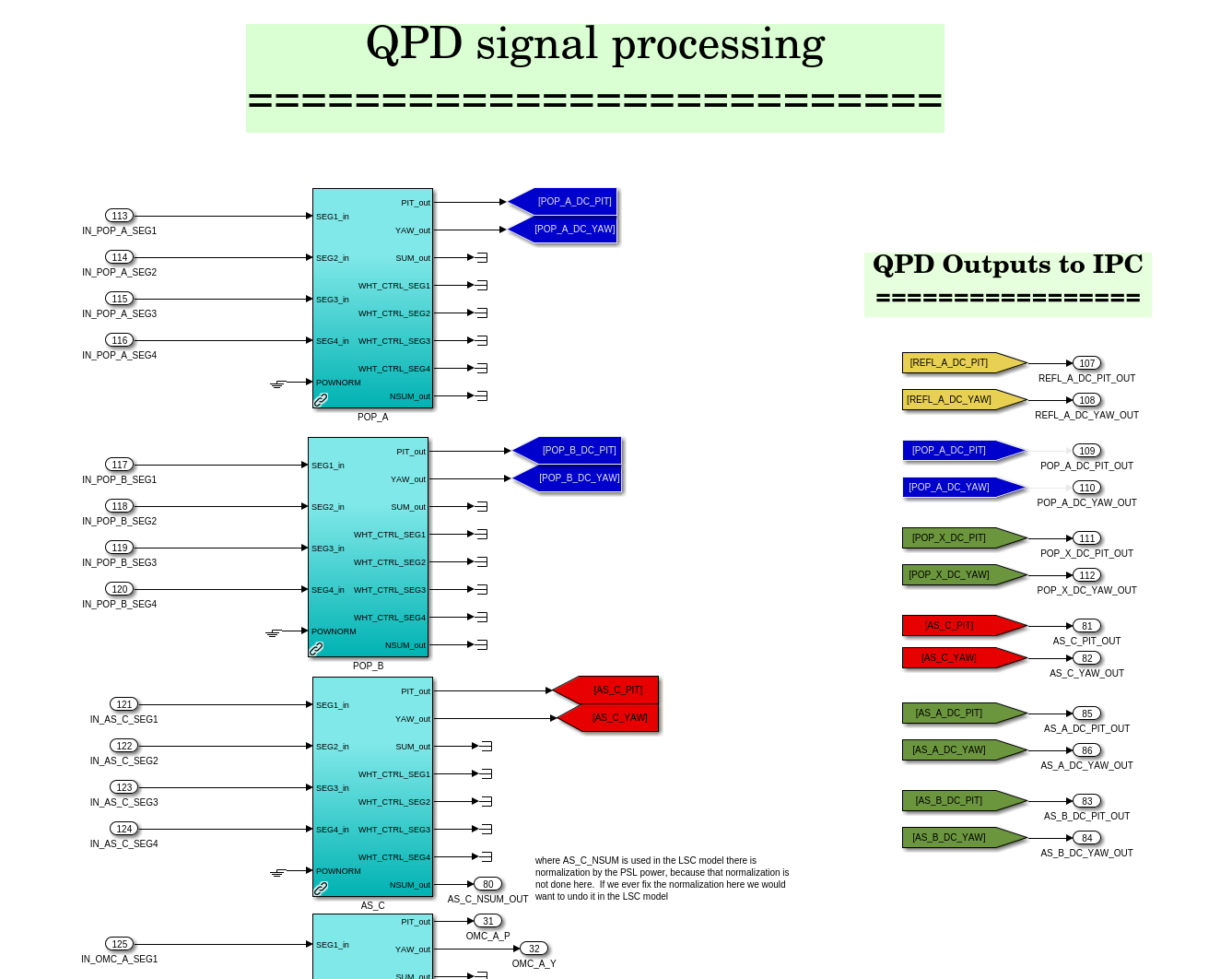
    (1) Screenshot #1 Added pick-off and top-level output bubbles to REFL_A_DC PIT/YAW, POP_A_DC PIT/YAW, POP_X_DC signals. AS_C already has them. In the process of doing this, I cleaned up the use of output bubbles vs. gototags; now all the above mentioned QPDs that are sent to the top level are done in a segregated group, taking advantage of the goto-tags rather than ramming the output bubbles in as pick-offs right next to the output of the signal processing block.

    (2) Screenshot #2 and Screenshot #2 At the top level, add PCIE dolphin IPC senders for these signals to broadcast them out onto the dolphin fabric for anyone to consume. AS_C already had *shared memory* IPC for consumption by the SQZ alignment system, but Dolphin PCIE senders are needed to get them to SUS.

RC_MASTER library (committed to r35939)
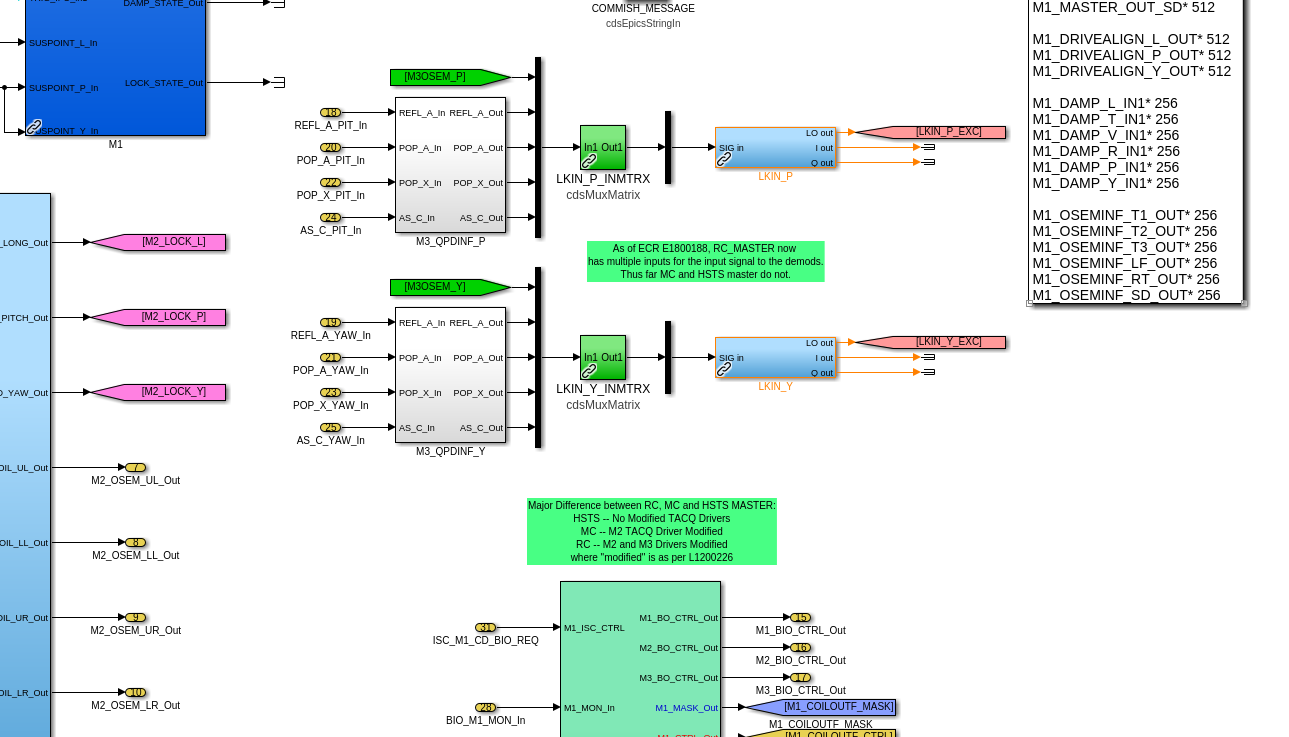
    Screenshot #4 Expanded the options as SIG input the LKIN_P and LKIN_Y demod blocks to include the QPDs, with the M3 OSEMs and the 4 QPDs as the 5 inputs to a 5x1 matrix. Those new input bubbles create to input ports to the library part that appears at the top level of each individual suspensions' top level model. I intentionally chose to have the inputs be in the middle of the list of inputs so that signals group better at the top level. This has the consequence of needing to redo the top-level connections in the all the instantiations, but I'll be in there already and I'm willing to take the extra five minutes per model now in order to have a more legible model for the next 3 years. The input is then fed into some input filtering in case that's needed. the banks resolve with channel names like H1:SUS-PRM_M3_QPDINF_P_REFL_A_IN1.

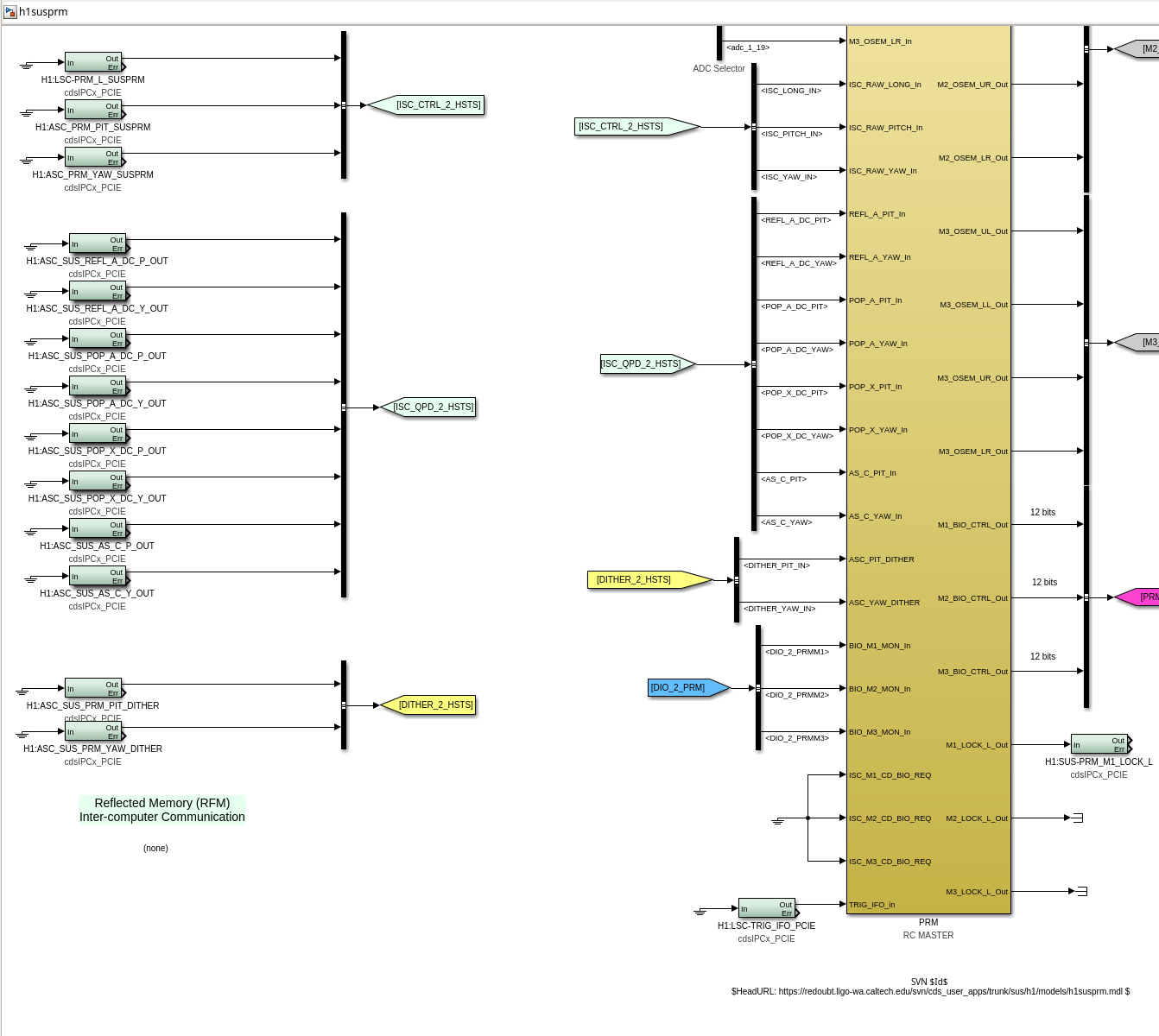
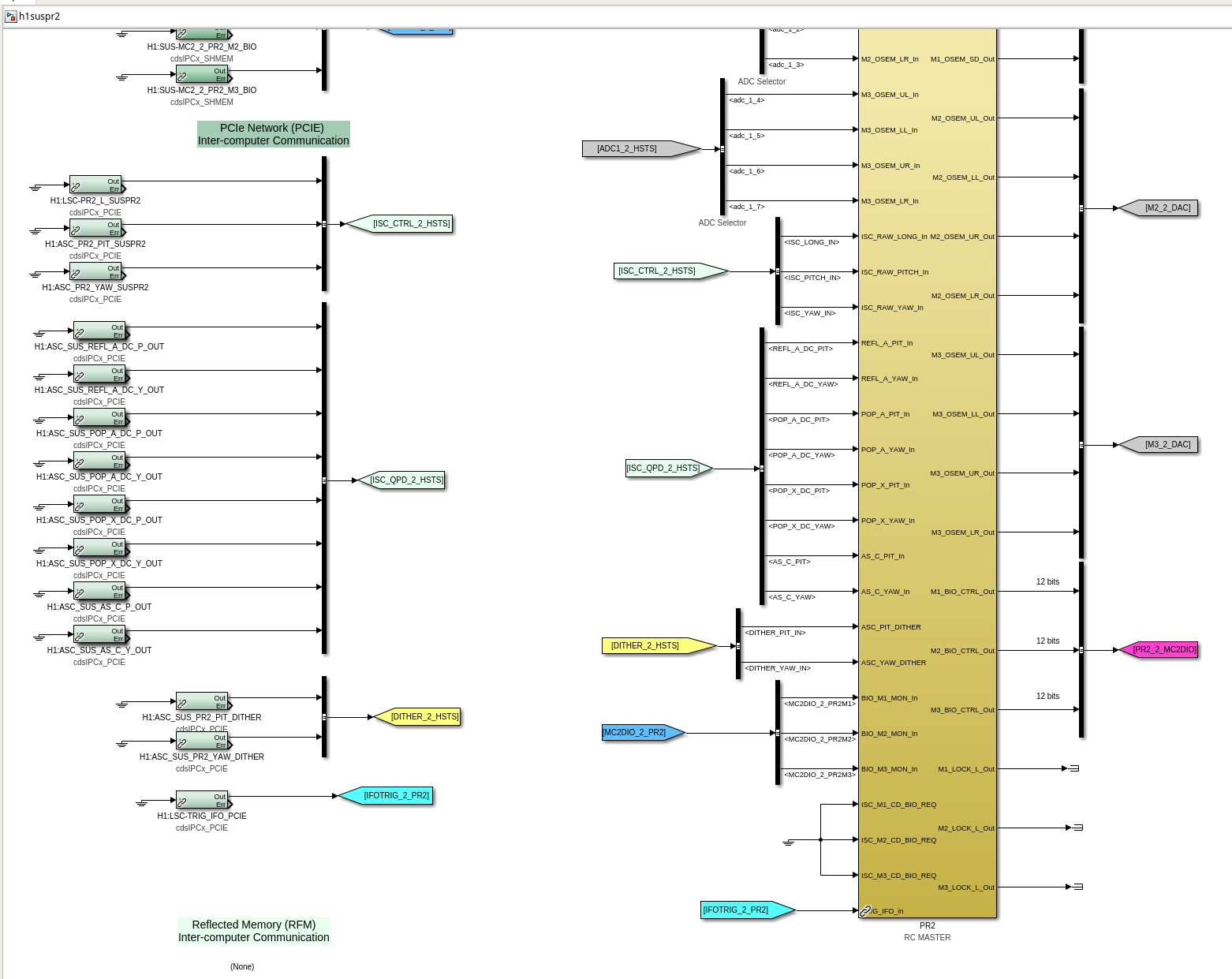
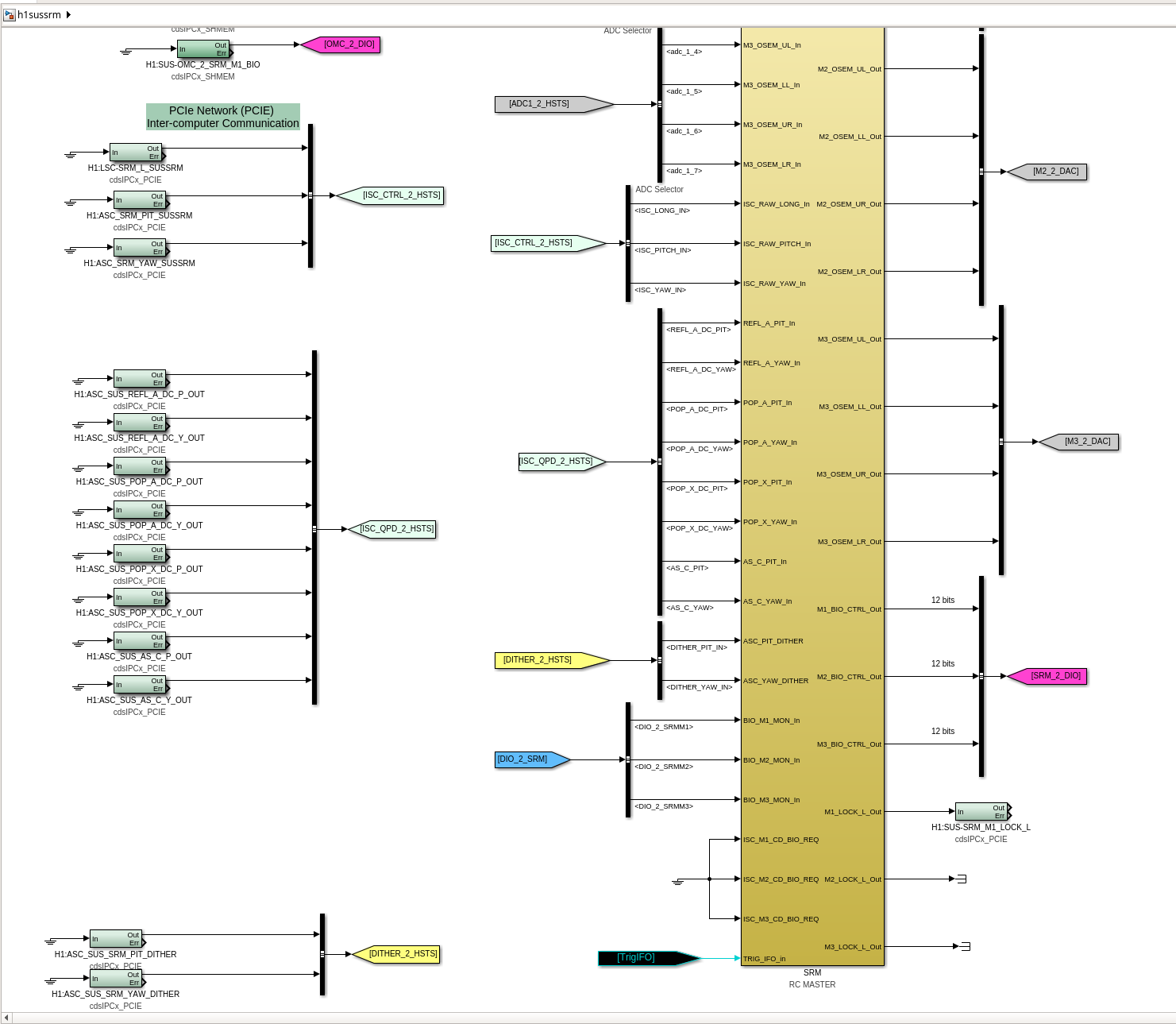
Top level of h1susprm, h1suspr2, h1sussr2, and h1sussrm (committed to r35937)
    (1) Re-sized and re-connected the inputs to the RC_MASTER library to account for the 8x new inputs in the middle of the block.

    (2) Installed Dolphin PCIE IPC receivers that match the senders in the h1asc model described above

    (3) Bussed up the signals, sent them over to the library block instantiation and connected it. In the process, I renamed the existing "ISC_2_HSTS" goto tag to "ISC_CTRL_2_HSTS" allowing for the new signal bus to be tagged as "ISC_QPD_2_HSTS."

The above top-level models as shown and at svn revs mentioned above have been test-compiled successfully on the build machine.


Images attached to this report