(This is the alog for measurement proceeded at beginning of August)
Summary
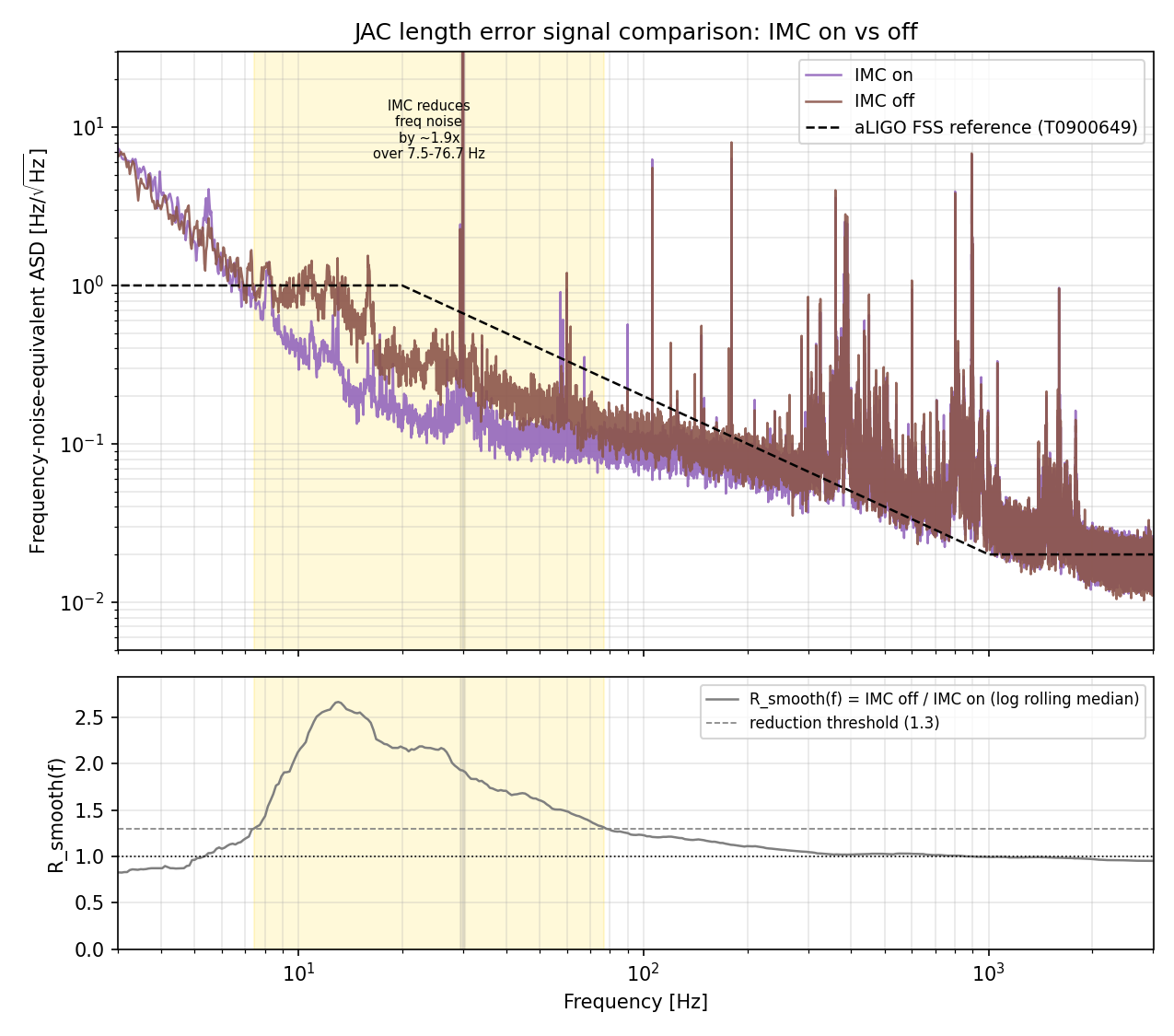
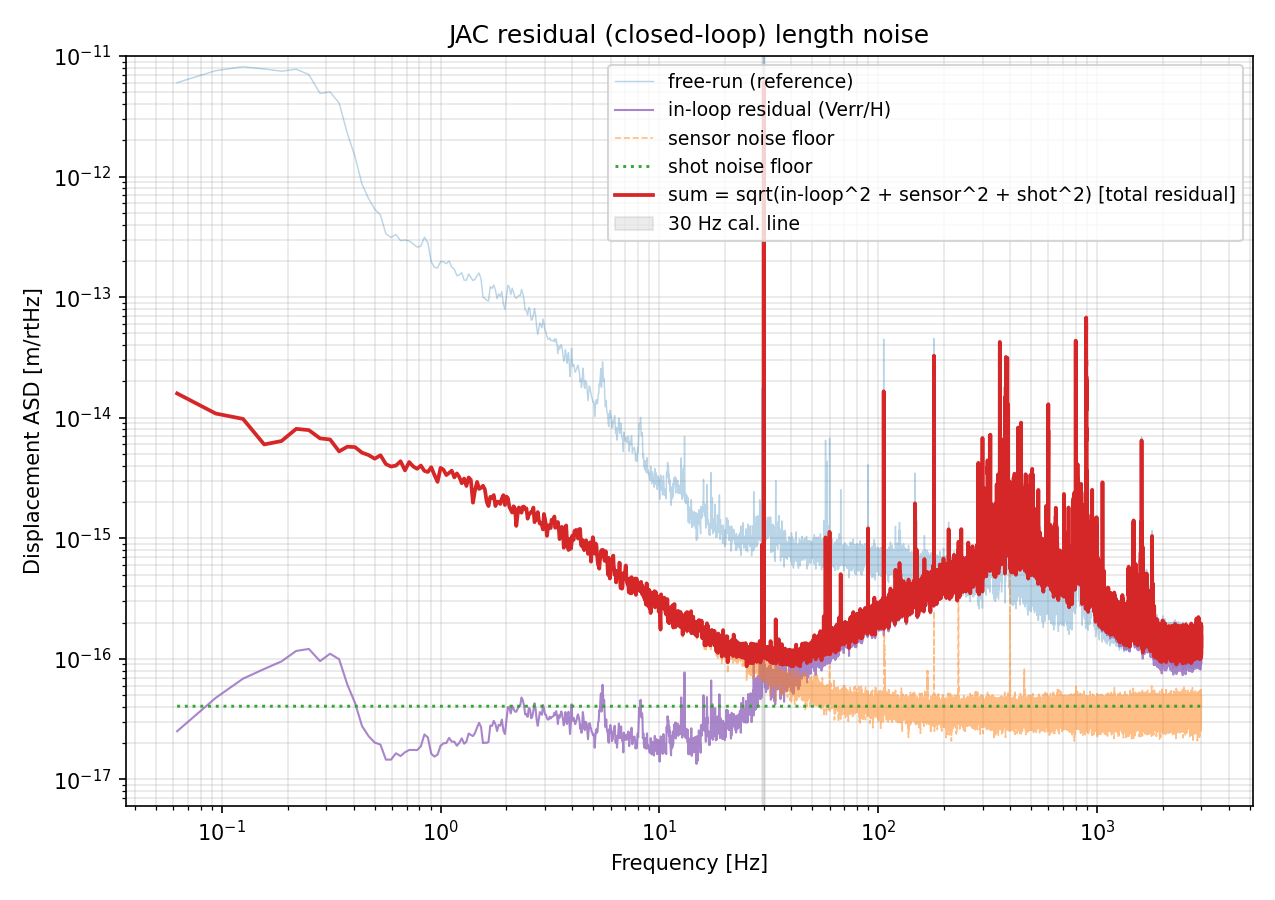
We measured JAC's LSC in-loop error signal (JAC-L_SERVO_IN1) across the 2–62 W power sweep, calibrated each dataset from its own 30 Hz line, and built a residual length-noise budget (in-loop residual, sensor floor, shot floor). IMC locking reduces the equivalent laser-frequency noise by ~1.9× over 7.5–76.7 Hz (peak ~2.6× near 12 Hz); above ~30 Hz the residual is sensing-floor-limited. This budget is the input to the excess intensity- and frequency-noise coupling estimates.
Measurement
- Data:, 2 / 35 / 62 W input (plus an unlocked set), each carrying a 30 Hz
JAC-L_SERVO_EXCcalibration line. - Error signal:
JAC-L_SERVO_IN1 - Main comparison: 35 W IMC-on vs 62 W IMC-off — both high-power, single-FSS-stage, each with its own directly measured optical gain.
Analysis
- Open-loop gain
G = A·F·H.A(actuator) andF(servo filter) imported from the OLG fit and treated as power-invariant. - Optical plant
H(f) = optical_gain / (1 + if/f_pole), withoptical_gainmeasured fresh per dataset from its own 30 Hz line.f_pole ≈ 593.9 kHz(ring-cavity FSR). - A is found in alog 89399
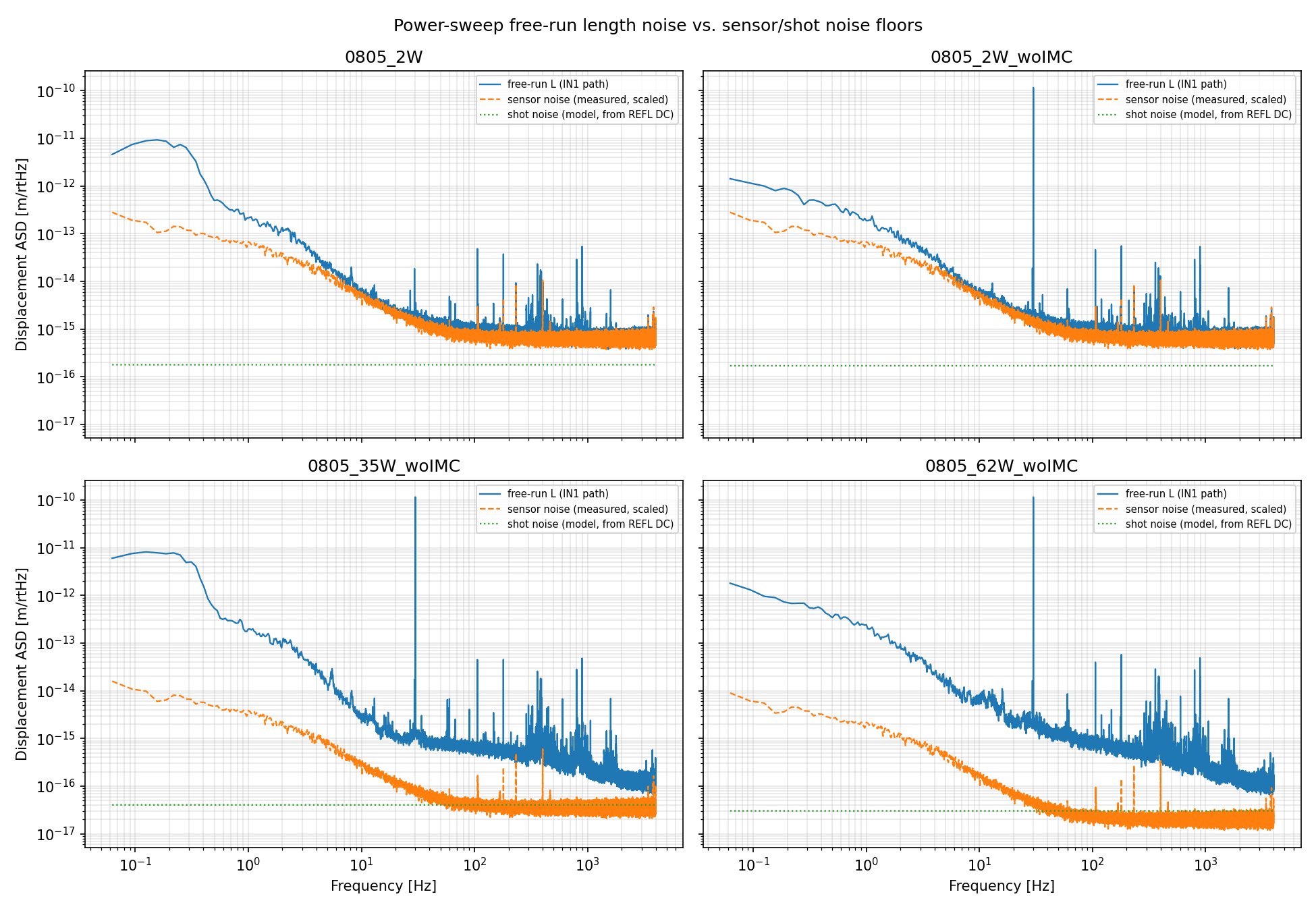
- Free-run length noise:
L_free = (IN1)·|1−G|/|H|. - In-loop residual (closed-loop, as sensed):
(IN1)/|H| - Sensor floor: current-configuration dark reference, re-scaled per dataset by PSL power and
|H|. Shot floor:sqrt(2·e·I_dc),I_dc = R_PD·P_reflfrom each dataset's own REFL DC. - Total residual:
sqrt(in-loop² + sensor² + shot²). - Frequency-noise equivalent:
δν = L_free·ν/L_cav(ν = c/1064 nm,L_cav = 2.02 m).
Result
- IMC on vs off: reduction of ~1.9× over 7.5–76.7 Hz (peak ~2.6× near 12 Hz), extracted data-driven from
R(f) = off/on(log-frequency rolling median, threshold 1.3), not an assumed band. - Residual budget: above ~30 Hz the in-loop residual sits at the sensor / shot floor (sensing-floor-limited); below that it is above the floors.
- OOL cross-check: the WFS
SUM_Aout-of-loop sensor, calibrated in situ from the same 30 Hz line, was used to cross-check the residual errors. At low frequencyes, it has a higher sensor noise then residual, and it can't be good sensor for those frequencies
Next
- This residual budget (m/√Hz, per dataset) is the direct input to the excess intensity-noise (RIN) and phase/frequency-noise coupling estimates for JAC.
Figure: free-run length noise with the sensor noise
Figure: residual noise budget — in-loop residual, sensor floor, shot floor, and their quadrature sum
Figure: equivalent laser-frequency noise, IMC on vs off,