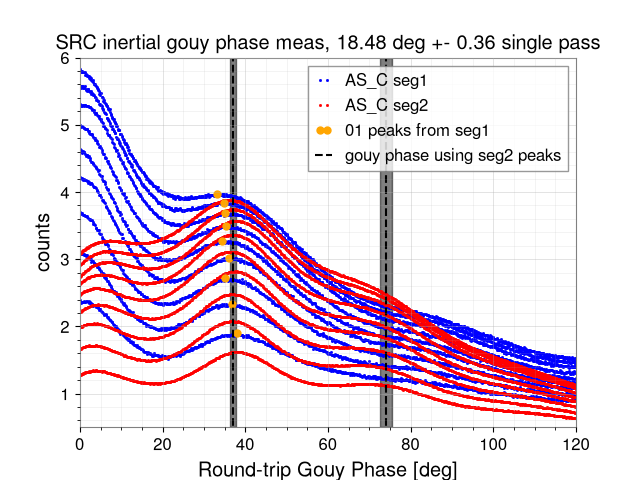
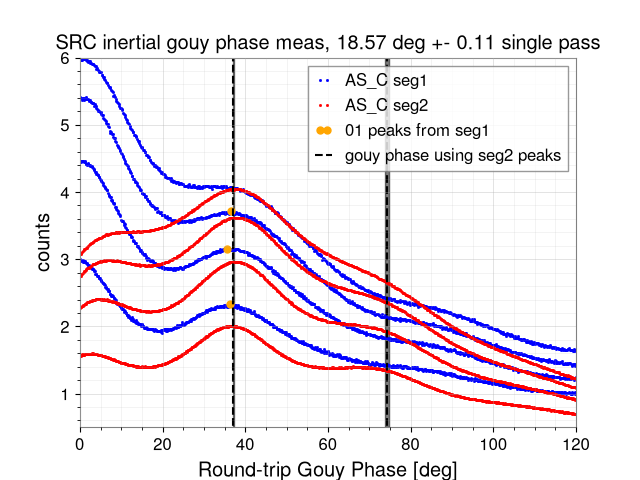
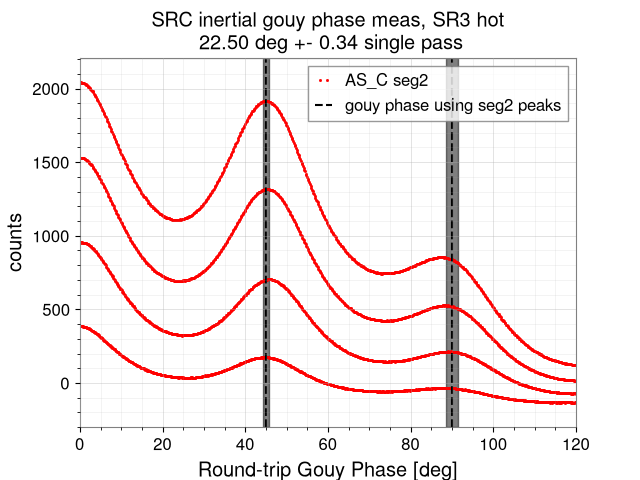
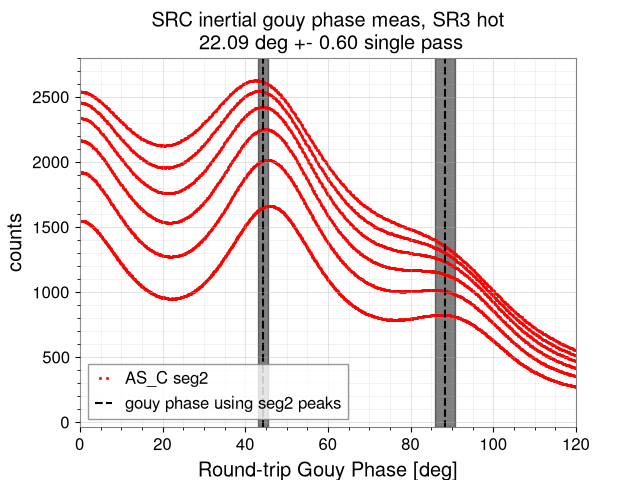
TL,DR: We measure SRC gouy phase with no ring heaters, no ifo heating, no SR3 heating to be 18.5 +-0.4 deg. With SR3 at 4 W we measured 22.1 +-0.6 deg.
Louis and I measured the SRC gouy phase using the inertial gouy phase measurement technique previously performed by Stefan. Here is a list of reference alogs: 66211, 52639, 52658 52504
Before O4, with no ring heaters, IFO heating, etc, Stefan measured the SRC single pass gouy phase to be 19.5 +- 0.4 deg.
Measurement procedure:
- I carefully aligned the beamsplitter on the MICH dark fringe, and SRY. I also ran an SR2 align to center us on AS_C
- We ensured PRM was misaligned, and IFO was aligned in an SRMI configuration (but not locked)
- I disengaged all whitening and dewhitening on AS_C
- there is still some fixed whitening filter that we have to compensate in the analysis with zpk([40],[0.4],1,"n")
- Louis and Sheila set up a SRCL trigger on AS_C with upper threshhold 0.0120 and lower threshhold of -100. I placed an offset in SRCL2 of -1e6
- Louis looked at where the troughs in AS_C were to ensure that we trigger on the darkest point of the fringe, where the SRC finesse is maximum
- We set up a dtt with IOP channels at the 65kHz rate, as well as the SRCL trigger channel so we can determine when the trigger occurs
- H1:IOP-ASC0_MADC6_TP_CH8, H1:IOP-ASC0_MADC6_TP_CH9, H1:IOP-ASC0_MADC6_TP_CH10, H1:IOP-ASC0_MADC6_TP_CH11 correspond to AS_C segments 4, 3, 2, 1
- Louis and I ensured we properly captured the trigger by having me start the dtt template and then counting "one mississippi, two mississippi" in unison before Louis set the trigger element
- later we realized we could just trigger when we saw that the template starts reporting that it is recording data
- It took several tries to get it right, and then we collected this measurement 5 times each: one set with ITM ring heaters at zero power (cooled for >24 hours) and SR3 heater zero, and one with SR3 heater at 4 W (after 3 hours heating) with ITM RH cold
Data analysis procedure:
- We exported the AS_C data and the trigger data into text files
- I used GWPY to apply the anti whitening filter zpk([40],[0.4],1,"n") to the IOP channels
- I followed Stefan's analysis procedure to identify the 00 and 01 peaks, fit the 00 peaks with a cubic spline, and measure the difference between the 00 and 01 peaks
- Each measurement includes multiple fringes, so the result averages the calculated gouy phase and calculates the standard deviation
- Three of the five measurements from each of the cold and hot SR3 measurements were not very good, so they are not analyzed/analyzed but not reported here
- "not very good" means either the triggering or alignment was not good enough to create good fringes, or the behavior of the fringes is confusing so I'm not sure if the result makes sense
Measurement systematics concerns:
Because of the low finesse of the SRC, distinctly identifying the 01 mode with peak finding next to the 00 mode can introduce bias. Sheila and I think that the best way to manage this bias is to fit the 00 peak and subtract it from the data, then peak find the 01. This is WIP.
In the meantime, I followed Stefan's method, where I leveraged the different response of each AS_C segment to HOMs, and found that seg1 is the most sensitive to the 00 mode and seg2 is the most sensitive to the 01 mode. I used seg1 to find the 00 mode, and those locations are used for the cubic spline fit. Then, I used the seg2 to find the 01 modes, and calculated the distance between these two modes for the gouy phase. I averaged the distance for all the fringes found in each measurement.
Results:
For cold IFO, no ring heaters, SR3 heater or other heating, the SRC single pass gouy phase is about 18.5 deg. This is one less degree of gouy phase than reported by Stefan in O4.
For cold IFO with SR3 heater set to 4 W (heated for 3 hours before measurement), the SRC single pass gouy phase is about 22.1-22.5 deg.
Plots are attached to this alog showing the fringes and the measured phase.
Some hypotheses:
These results indicate gouy phase has been reduced in the SRC. This could possibly be explained by the new beamsplitter having a different lens than the previous beamsplitter. The reduction in gouy phase could also explain why we are having such a significant mode hopping problem in DRMI 92046.
It appears that the SR3 heater can be used to increase the SRC gouy phase at least back to the O4 level, which may help our locking procedure.
I write that these are hypotheses because several other people are working on related studies that can help us understand if we are correct. Namely, we are using finesse to study if the new BS parameters can explain the loss in gouy phase, we are using what we know about the SR3 heater to see if the increase in gouy phase makes sense (and what heater setting we would need to correct the loss in phase), and we are also looking at data from an inertial PRC gouy phase measurement to see if we measure the same loss in gouy phase in the PRC. Keep an eye out for more information!
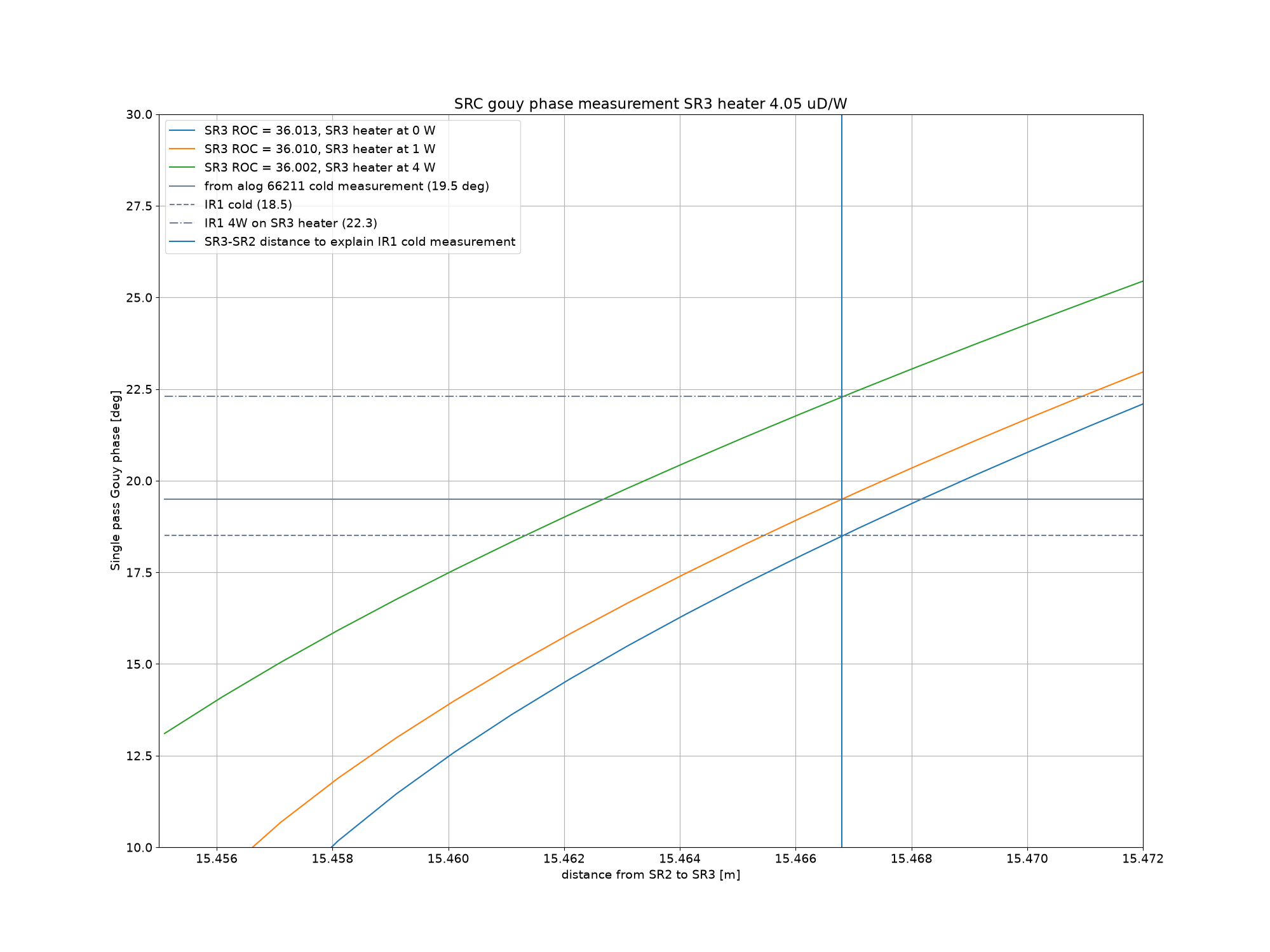
In the attached plot, the gray horizotnal lines show SRC gouy phase measurements with no ITM ring heaters on.
The vertical line is at the SR2- SR3 distance needed to explain the gouy phase of the cold measurement above. This is just a way to account for whatever unknown factors are setting the gouy phase, we are suspecting that the BS lensing may be different now than in O4 causing the decrease in the cold gouy phase, so this isn't actually the correct distance.
I adjusted the diopters per Watt value (4.7uD/W or 4.5uD/W is in 88413) to match the 4W SR3 heater measurement here. If we want to reproduce the cold gouy phase from O4, we would want to add 1W of SR3 heater. Elenna did turn that on this afternoon, in hope that this will help us avoid some mode hopping.