Jennie W, Marc
This morning I shorted the inputs of pins 5,6,7,8,18,19,20,21 on the input of the SPI AA interface chassis located on SEI-C2 in slot 27. I looked at the dark noise to determine if it was the AA chassis causing the QPD B noise problems.
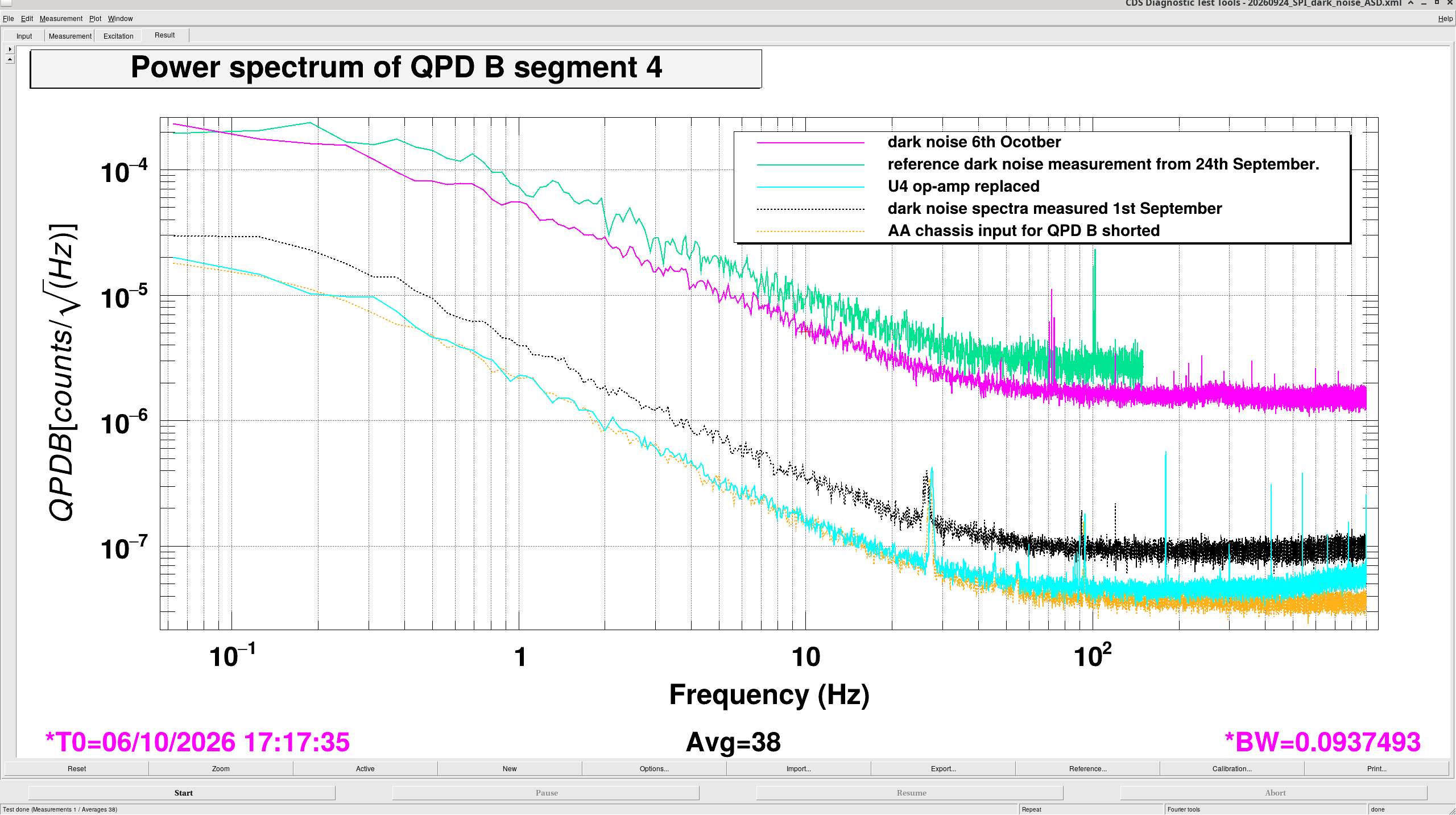
The noise on segment 4 looks low under this configuration (yellow dotted line) , whereas when everything is plugged in again segment 4 has elevated dark noise as we saw last week (pink solid line).
Following this the conclusion was that the problem is with the TIA chassis.
Marc and I pulled this chassis and he looked at the output noise of each cathode/anode output on the SR785.
Comparing all 8 differential channel outputs on this chassis, they all stabilised at -48dBVpeak resolution whereas segment 4 stablised at -40dBVpeak, indicating it had excess noise relative to the other channels. In this case 'stabilised' means the measurement was not saturating the signal analyzer.
He then replaced the op-amps U1, U5 and U3 in turn and no difference was observed in the output noise spectra. Once the U4 op-amp was replaced the SR785 stopped saturating.
Looking at its spectra it looks like this op-amp slowly went bad starting somewhere around the 1st September (black dotted line) and was much worse by 24th September(green solid line).
The measurement from after the op-amp was replaced (light blue solid line) shows the problem has been fixed.
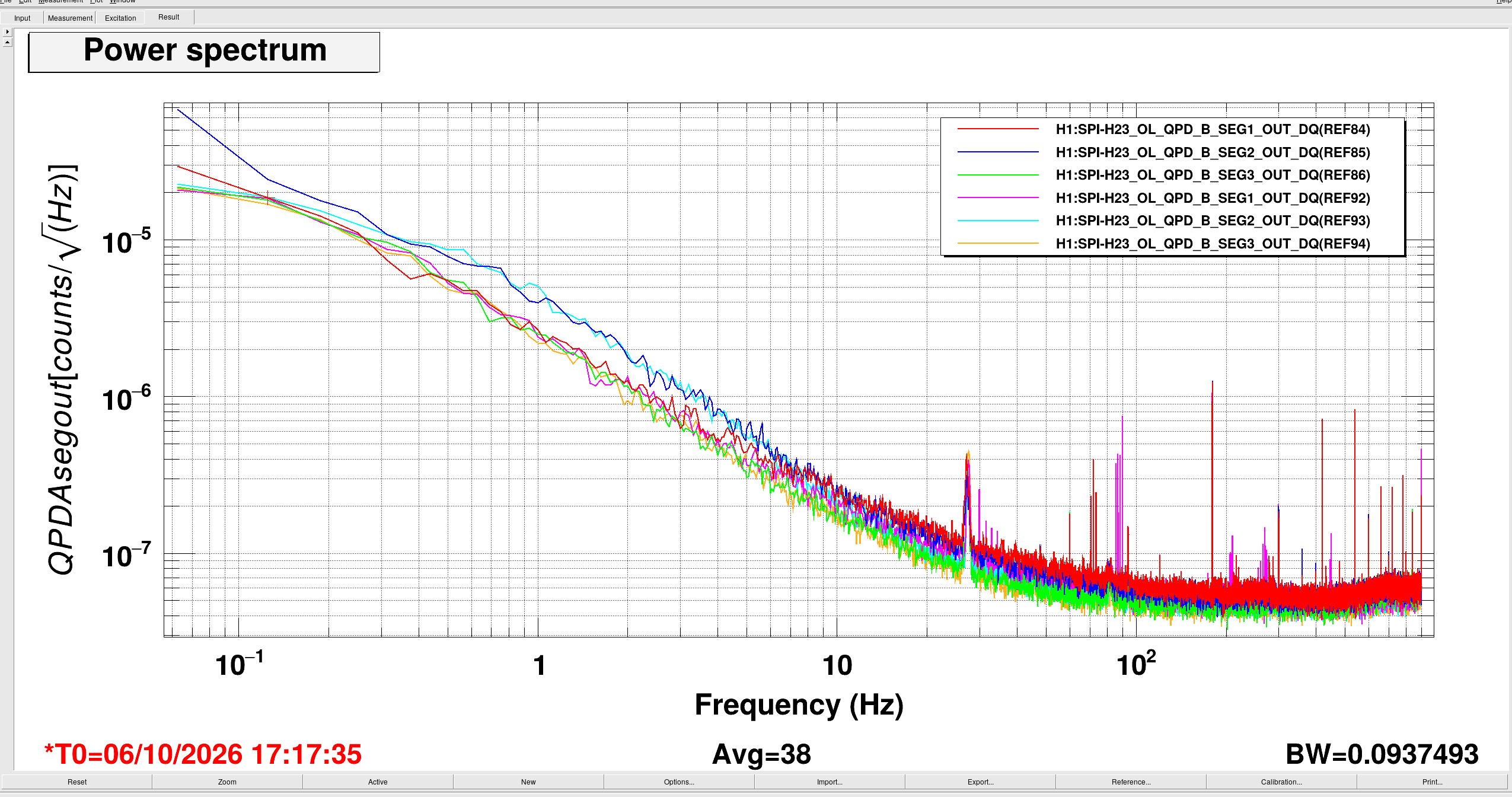
Also measured the other 3 segments before (first three traces) and after (last three traces) this change to check nothing was broken in the process of this fix and to show the baseline dark noise we expect.
Marc updated the E-traveller and dcc entry for D1002481-v4 TIA Chassis Assy variant 2 S/N S2500712.
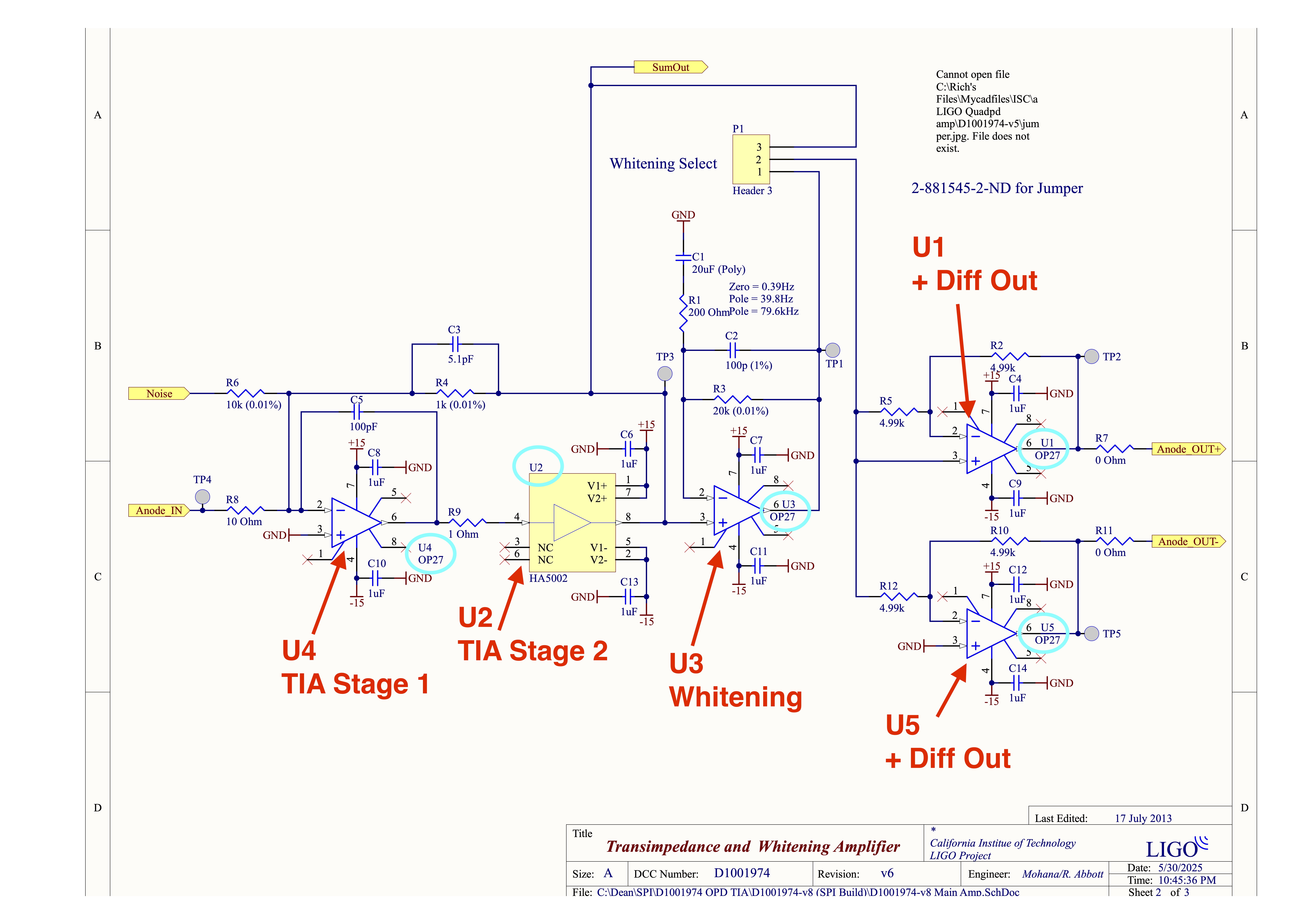
Just to add some context, following the drawing of the TIA circuit D1001974-v8, page 2 (annotated screenshot and then real image attached)
   - U1 and U5 are OP27's for the positive and negative leg differential output buffers, respectively.
   - U3 is the OP27 used in the whitening stage, and
   - U4 is the 1st stage of the 2-stage pair of opamps used for the transimpedance stage.

So, Marc was replacing components from the output toward the input, and found the issue once he got to the first opamp in the chain.

So, Segment 4's primary U4 TIA opamp was likely broken, oscillating and railing (hence the language of "stabilized" and "saturating"), causing the non-linear elevated noise floor.