jeffrey.kissel@LIGO.ORG - posted 12:29, Tuesday 06 October 2026 (92199)
ISI Fundamentals: A Journey through the Blend Filters -- HAM2 Y
J. Kissel

As we explore the relationship between HAM3 - HAM2 differential motion with the SPI, it's forcing us to re-understand some ISI fundamentals. Brian made claims that we *shouldn't* use the ISI super sensors as metrics for the real displacement of the platform in LHO:92129, and points us to some math in T2500279.

In LHO:92178, we walked through ISI HAM2's RX degree of freedom, as it is one of the simplest systems where there's only CPSs and GS13s, with no sensor correction, no global CPS diff, and the loop is almost entirely dominated by sensor noise.

Here, we increase the complexity by "1x" and look at the Y degree of freedom. Here, the CPS gets the global corner station sensor correction, and as we'll see the sensors are still measuring ground motion, well above their respective sensor noise. This is HAM2, so there's now ST0 L4Cs onboard, but they're feed-forward loops have not been turned on yet.

Remember, you can find plots of the current blend filters in use, in their dimensionless comparable form, from LHO:70527.
- the X/Y blend frequency is 0.18 [Hz] with broad gain peaking of around 1.5x to 2x from 0.03 - 0.6 [Hz].
- the RX/RY blend frequency is 0.375 [Hz] with more focused gain peaking of 4x from 0.1 to 1 [Hz].

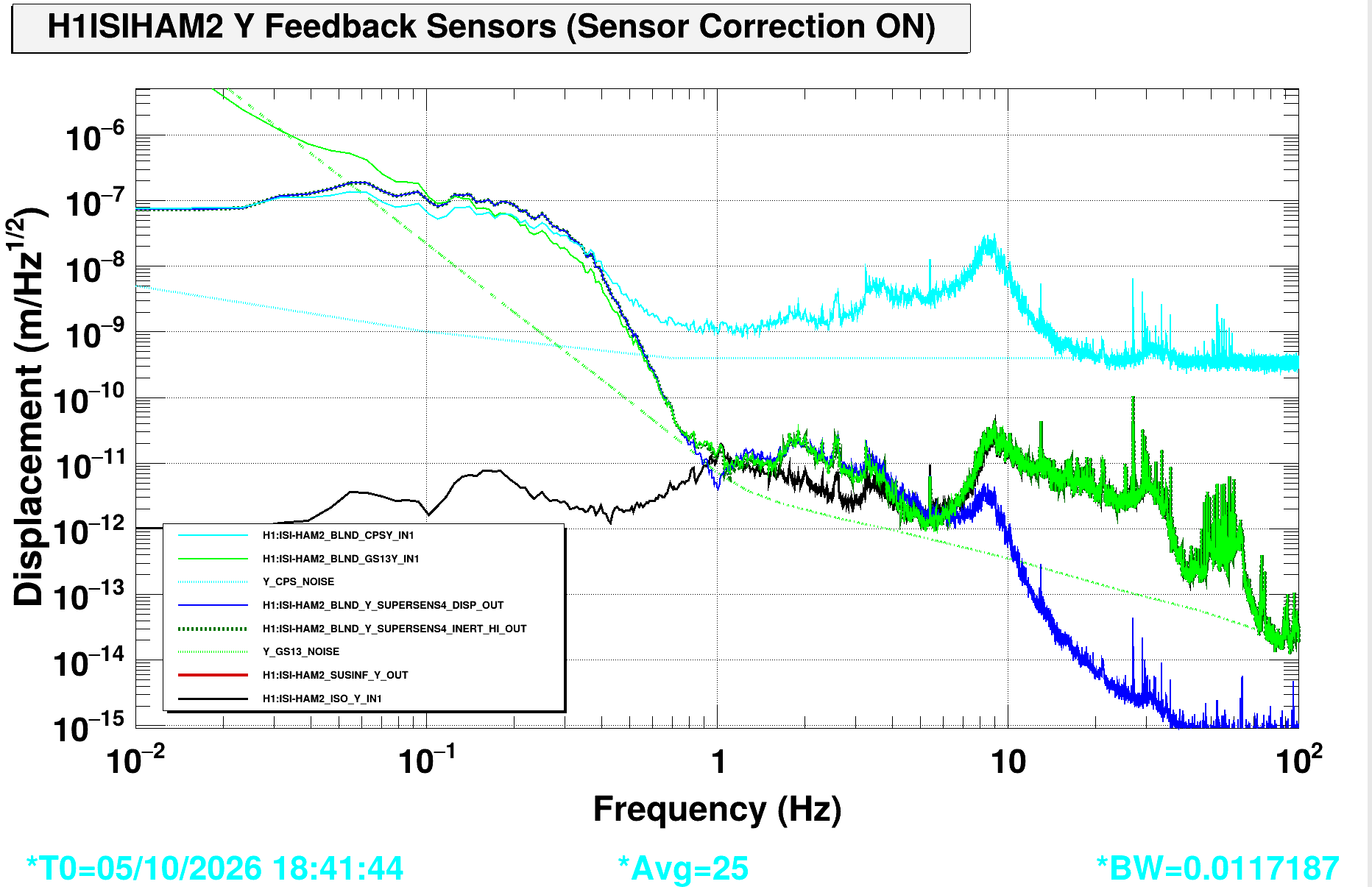
(Y-1) Y ASD (Blend Inputs vs. Blend Outputs vs. Super Sensor)
    - The input to the blend filters are shown in SOLID light blue (CPS) and green (GS13), compared with their sensor noise scaled to the RX degree of freedom (same color, just in dot-dot line style). Here, there's clear residual ground motion in both sensors from 0.05 [Hz] all the way up to 30 [Hz] in the CPS, and up to the measurement frequency limit for the GS13s.
    - We see the broad, but only ~1.5x - 2.0x factor of gain peaking in the *blended* CPS and GS13. Here, unlike RX, where the GS13s matched the CPS entirely below 10 Hz as the feedback loops where impressing the RX CPS sensor noise on to the platform, the GS13s and CPS are measuring different things, in pockets between 0.8 Hz and 8 Hz.
    - Below 0.8 [Hz], we'll see that the coherence may argue that while the CPS and GS13 agree -- it's not entirely sensor noise, because the coherence is non-zero.
    - The sum of the two blended outputs is "essentially zero" again -- BUT LESS SO -- it's amplitude is an order of magnitude or more that the RX ISO channel, implying that the signals that are added (and because, as we'll show 180 [deg] out of phase) aren't as identical.
    - In red, as a bit of foreshadowing, I start to show the H1:ISI-HAM2_SUSINF_Y_OUT channel, but it's identically zero (in the mathematical sense), as there's no SUS offloading, CPS DIFF subtraction, or SPI input.

(Y-2) Y TF COH (Blend Outputs vs. Super Sensor)
    - This shows the linear coherence between each output to the blends and the super sensor.
    - Here, instead of mostly zero, the blended CPS output coherence with the super sensor is hovering around 0.5 below 5 [Hz]. assertion It's clear from the ASD that the CPS is NOT limited by sensor noise, so I *think* this means that blended CPS is measuring some fraction of real motion above its sensor noise. I'm not sure if that's a feature of a sensor corrected CPS or not...
    - At 1 [Hz], the ASD makes it clear that the blended CPS signal drops below the blended GS13 signal, due the intended feature of the CPS blend that has a notch at 1 [Hz]. As such, the coherence between the blended GS13 and the super sensor -- because it's not limited by sensor noise -- "pops up" to nearly 1.0.
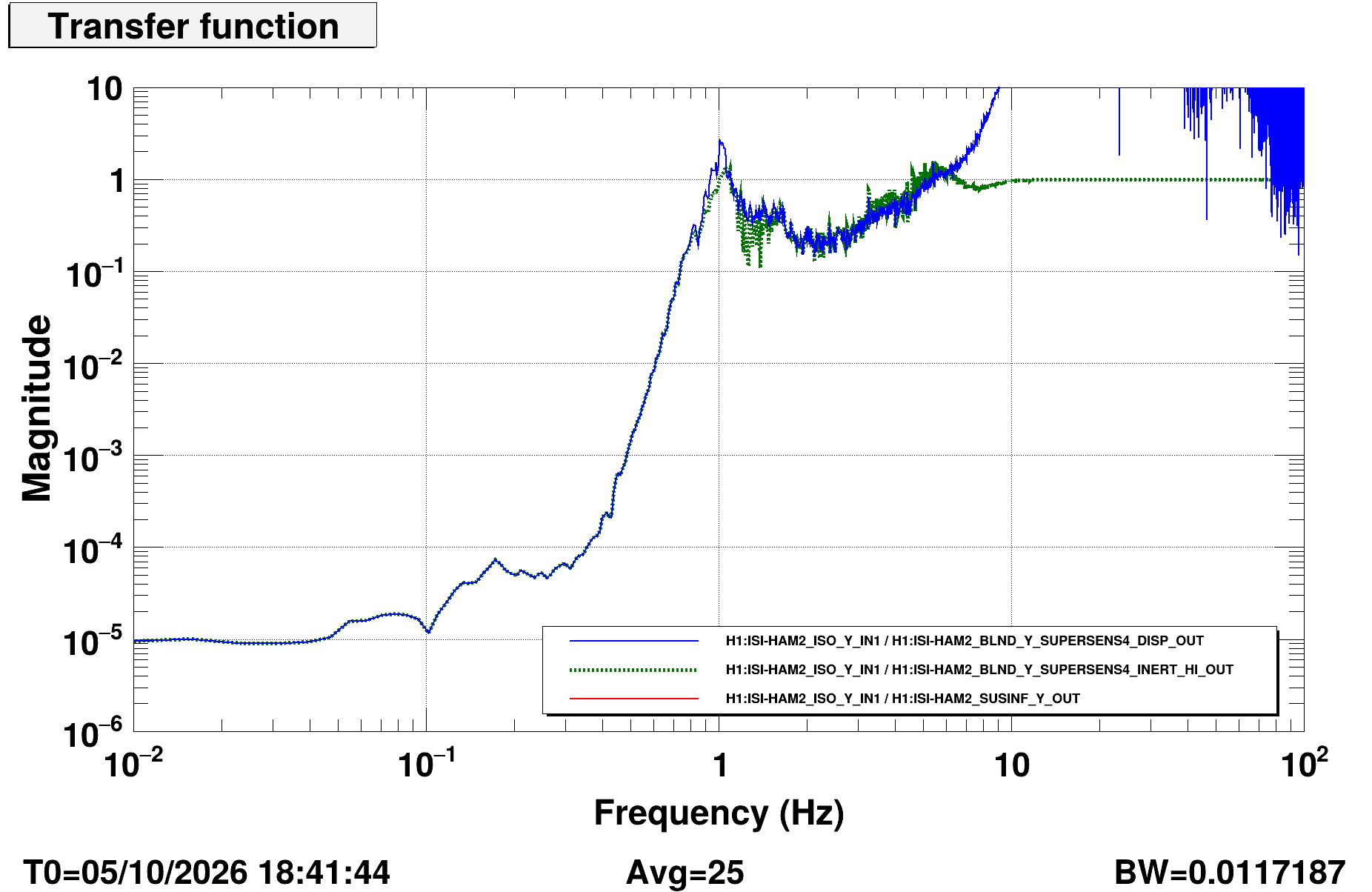
    - As the TF magnitude will show, the loop suppression at this frequency is actually not suppressing the motion at all. assertion In this 1 [Hz] region, the loop is "gain limited" rather than "sensor noise limited."

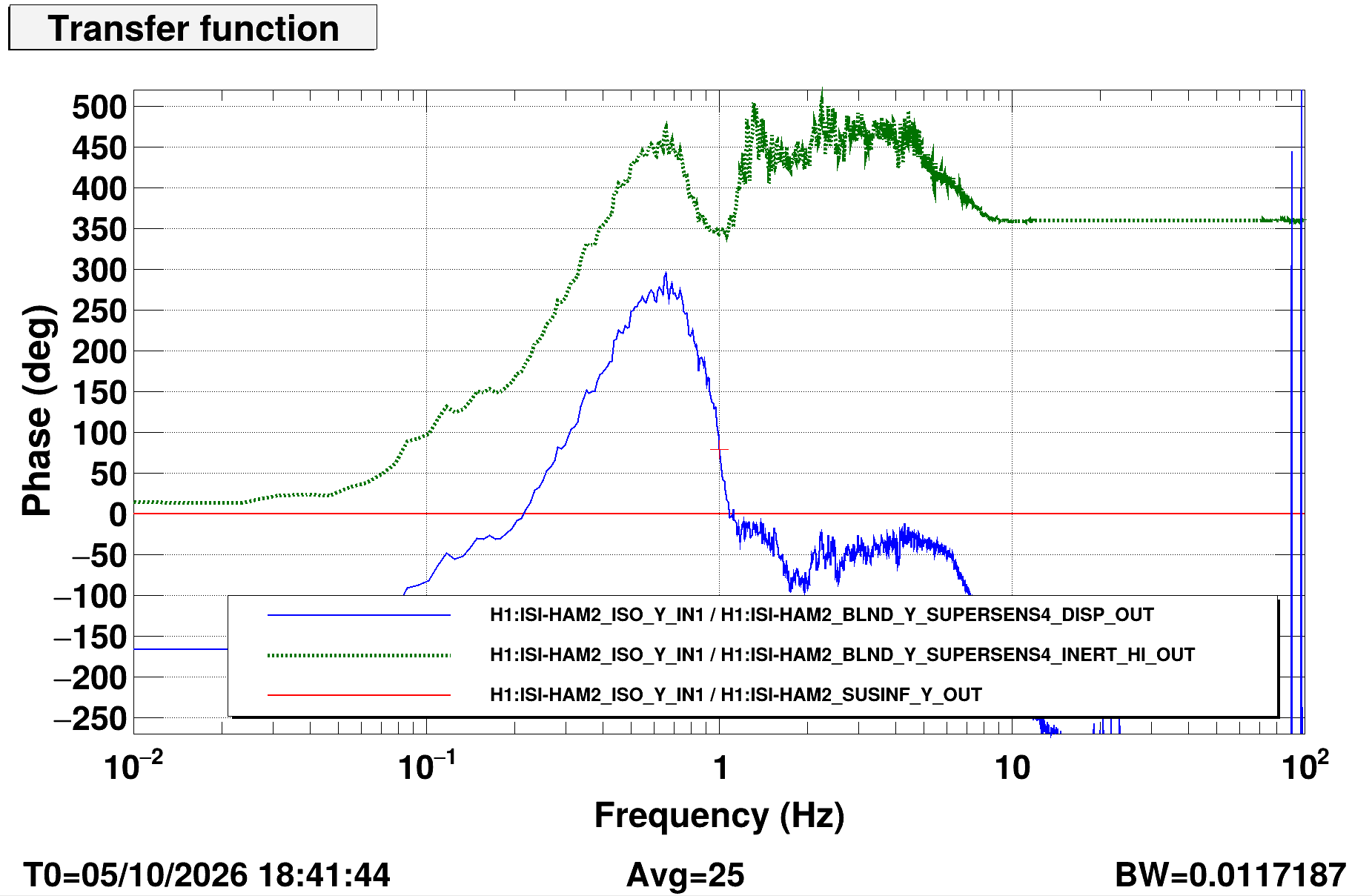
(Y-3) Y TF PHA(Blend Outputs vs. Super Sensor)
    - This shows the (unwrapped) phase of the TF between the CPS blended output and the GS13 blended output w.r.t. the super sensor.
    - As with RX, the phase between the blended CPS and GS13 is almost identically 180 [deg] below 0.8 [Hz]. But you may have to be careful (i.e. offline, do the math, and actually add the phases together), because as we know, the X / Y blend filters are not exactly complementary.
    - In the 1 [Hz] region, the phase between the two blended signals evolves to ~270 [deg] apart. I have intuition as to why this interesting, but I do know it is.

(Y-4) Y TF MAG (Blend Outputs vs. Super Sensor)
    - This shows magnitude of the TF between the CPS blended output and the GS13 blended output w.r.t. the super sensor.
    - assertion Where the sensors are 180 [deg] out of phase, this transfer function is a measure of the loop suppression.
    - That *may* be true at all frequencies, and comparing this TF against the performance ASD agrees, but I'm not so sure.
Images attached to this report