jeffrey.kissel@LIGO.ORG - posted 10:20, Wednesday 07 October 2026 - last comment - 15:04, Wednesday 07 October 2026(92227)
ISI Fundamentals: A journey through the Blend Filters -- HAM2 X; CPS Diff was/is Confusing Things for SPI and Super Sensor Interpretation
J. Kissel

As we explore the relationship between HAM3 - HAM2 differential motion with the SPI, it's forcing us to re-understand some ISI fundamentals. Brian made claims that we *shouldn't* use the ISI super sensors as metrics for the real displacement of the platform in LHO:92129, and points us to some math in T2500279.

In LHO:92178, we walked through ISI HAM2's RX degree of freedom, as it is one of the simplest systems where there's only CPSs and GS13s, with no sensor correction, no global CPS diff, and the loop is almost entirely dominated by sensor noise.

In LHO:92199, we walked through ISI HAM2's Y degree of freedom, as it has sensor correction involved in the CPS signal, and more importantly the loop is *not* limited by sensor noise -- so there are regions where the transfer function between blended outputs of the CPS and GS13s *are* (at least semi-) coherent with the super sensor, as one might have naively expected.

Here, in this aLOG, we walk through the same set of plots for the ISI HAM2 X degree of freedom.
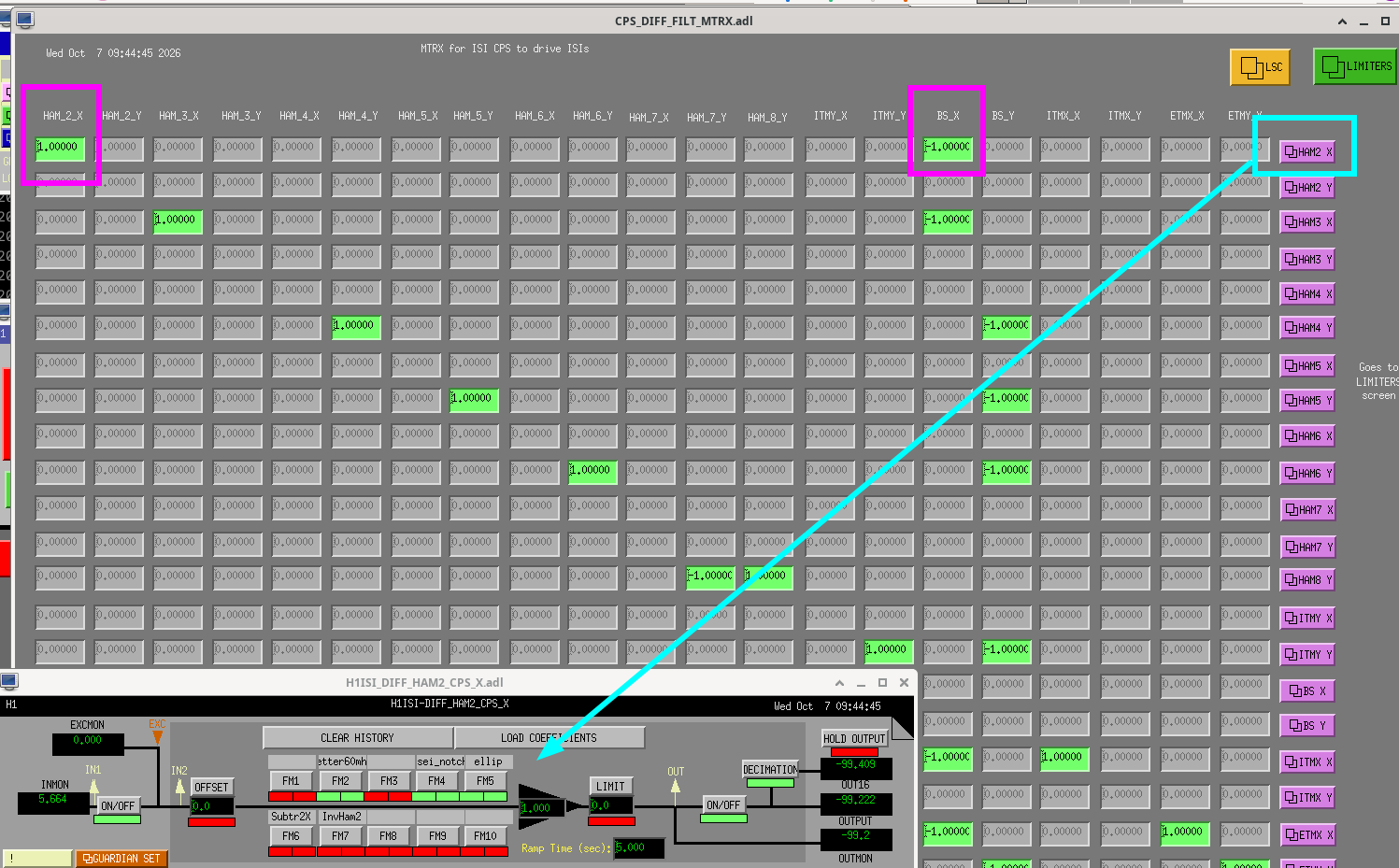
This X DOF has one more -- and important for SPI -- added layer of complexity than the Y DOF: so-called "CPS DIFF," which
   - takes the *sensor-corrected* ISI HAM2 CPS, subtracts off the *sensor-corrected* ISI BS (the same GND sensor correction signal is sent to both platforms)
   - filters it through a band-pass filter (which you can think of like a blend filter), because that's then
   - added to the input of the ISO bank super sensor.
As the CPS DIFF is bringing the beam splitter ISI into the mix, it completely distorts the naive interpretation of not only the super sensor, but the platform motion in general.

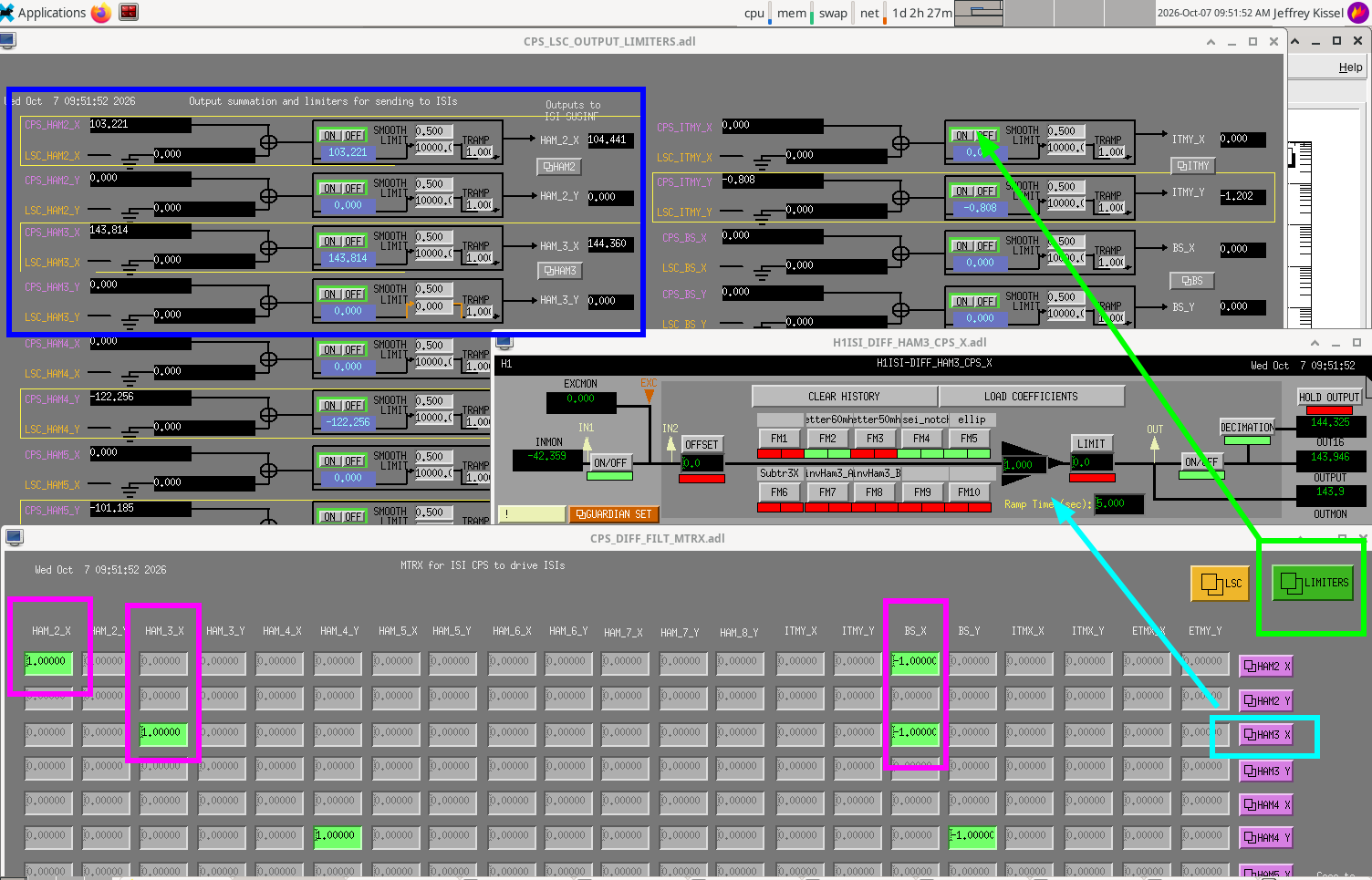
An equivalent signal (i.e. (HAM3 CPS X - BS CPS X)) is also added to ISI HAM3 X.

I suspect this is why comparing *either* the "raw," local input to the CPS and GS13 blends to the super sensor and the SPI signal made little-to-no sense to anyone at first look.

So let's get into the plots.
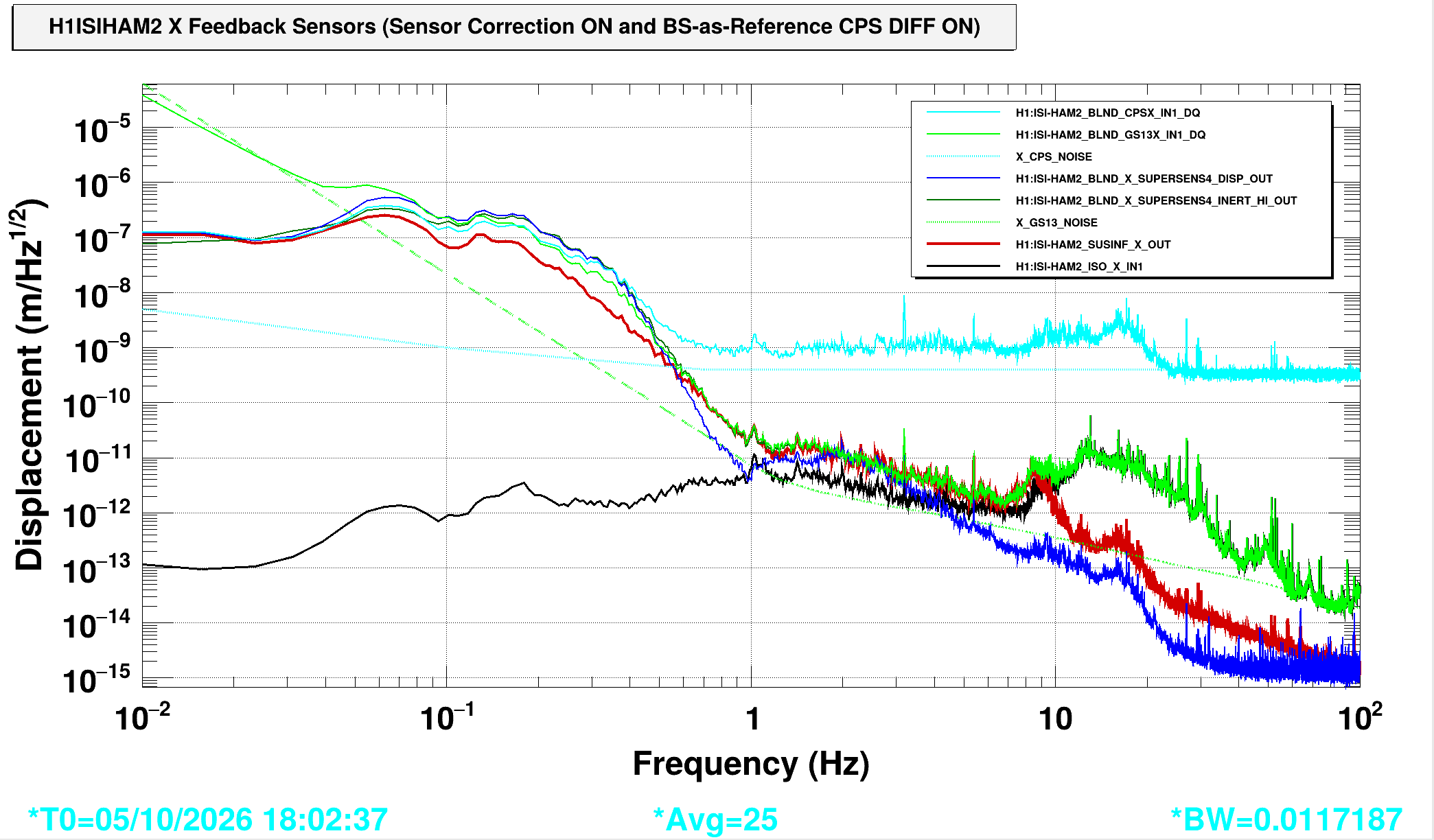
(X-1) X ASD (Blend Inputs vs. Blend Outputs vs. Super Sensor)

(X-2) X TF COH (Blend Outputs vs. Super Sensor)

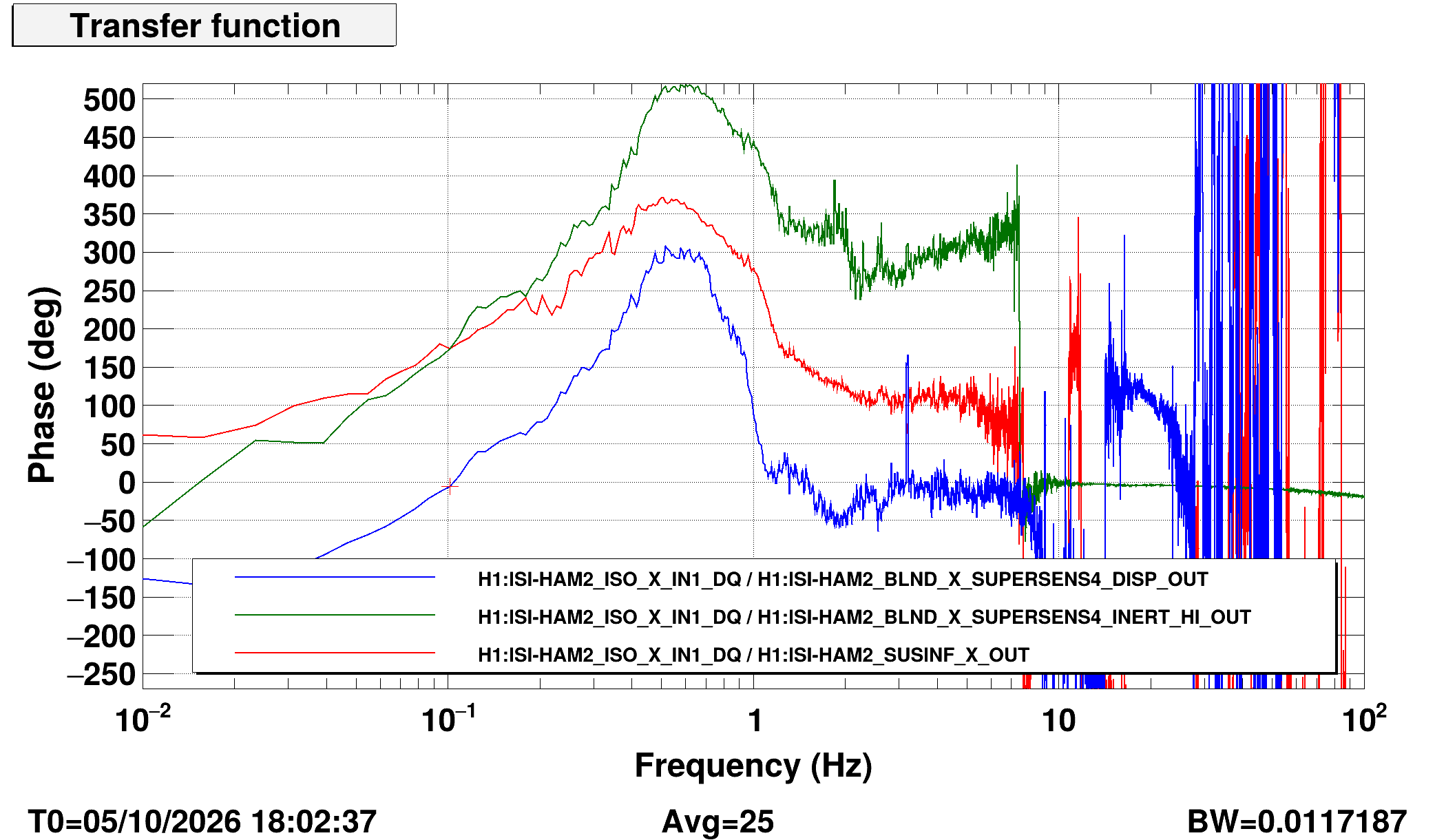
(X-3) X TF PHA (Blend Outputs vs. Super Sensor)

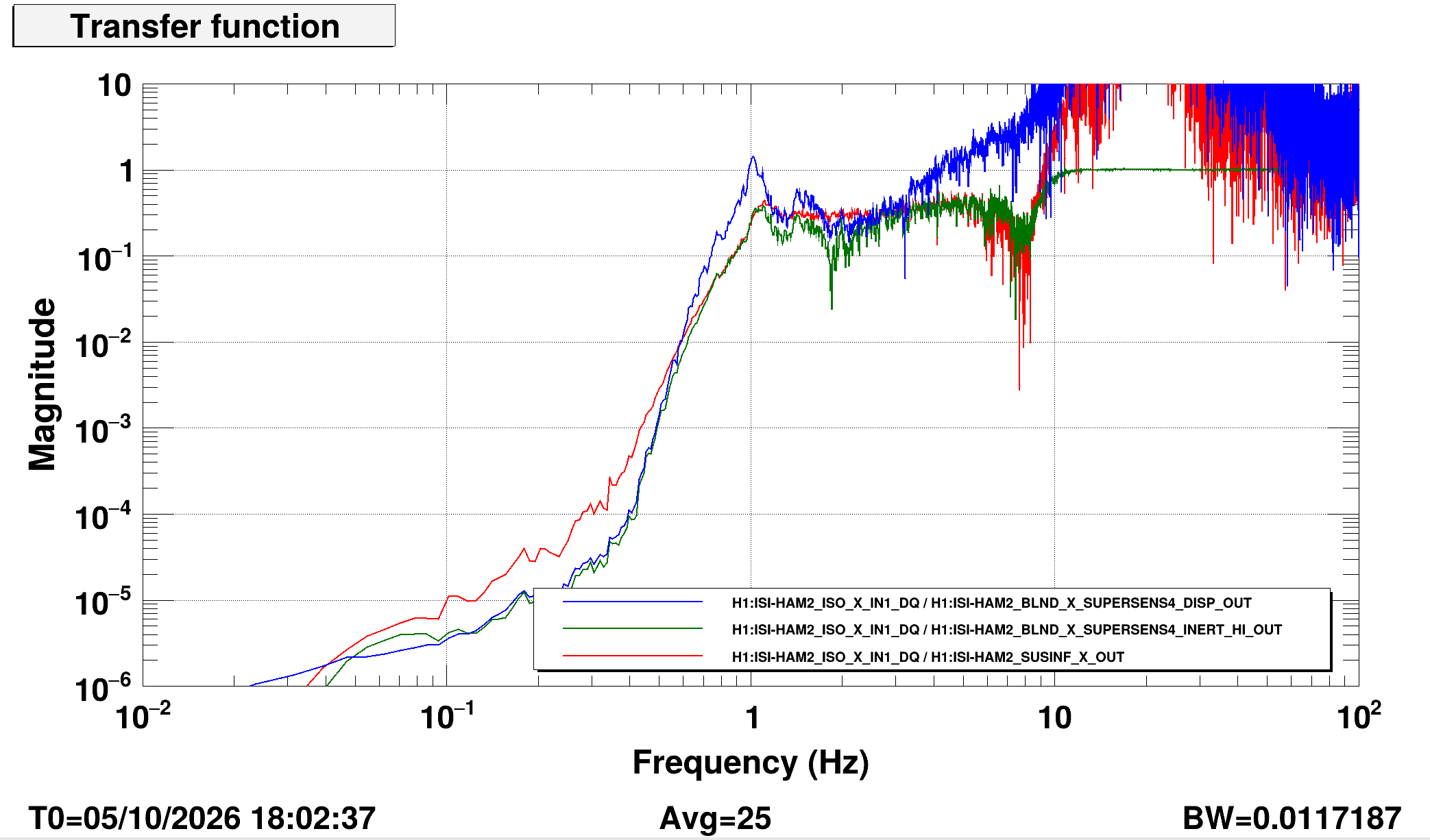
(X-4) X TF MAG (Blend Outputs vs. Super Sensor)

I'm going to leave interpretation of these for a later date, since I'd like to discuss these with the SEI team before making conclusions.
But, I think we need to turn off, if not definitely consider, this ISIBS CPS DIFF if we want to be able to compare the HAM2 and HAM3 local sensors, or the difference of HAM3-HAM2 against SPI.

The rest of the attachments are showing the details of how to find the details of the CPS DIFF control system; it's pretty hard to find.
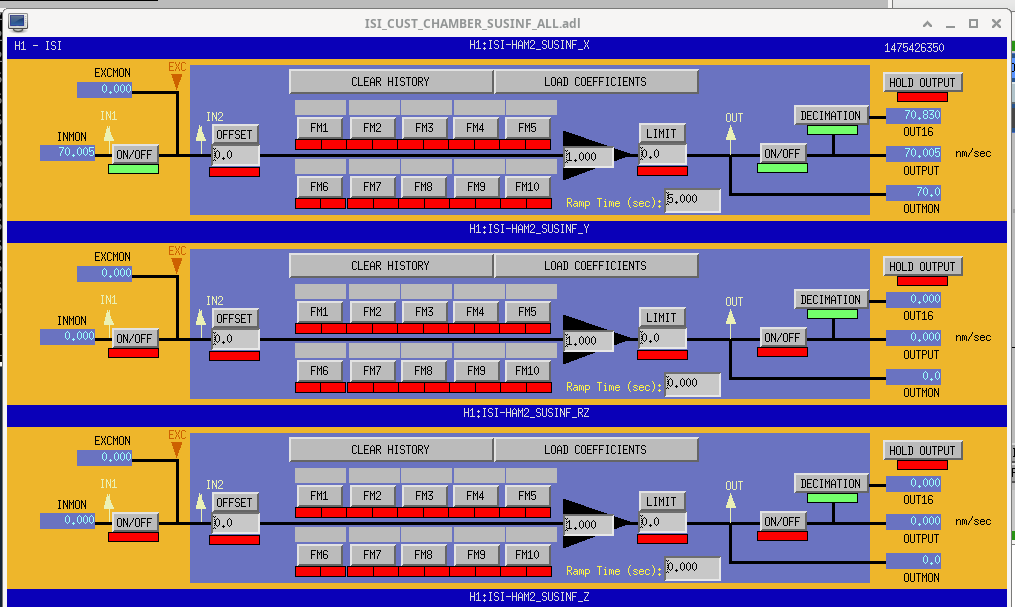
    (A) HAM2 OVERVIEW: this is how I first was reminded that CPS DIFF was a thing -- I saw some input on the bottom right corner, showing up in the X DOF of the SUSINF block.
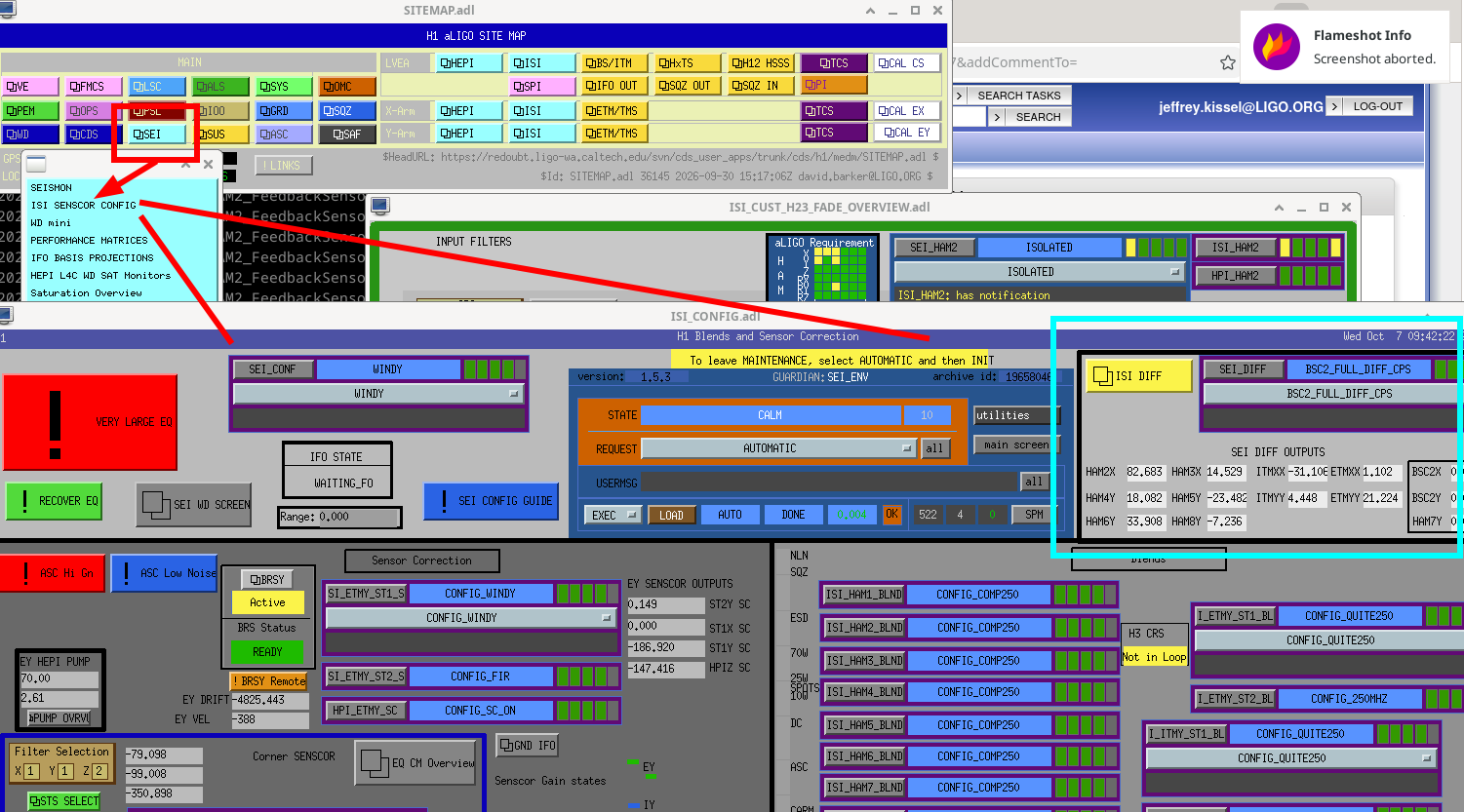
    (B) MEDM Journey taking you from the sitemap to where one can find the CPS DIFF user interface infrastructure.
    (C) HAM2 CPS DIFF matrix elements and output filter.
    (D) HAM3 CPS DIFF matrix elements and output filter. Here I also show the CPS DIFF limiter block to show that both HAM2 and HAM3 are being sent their CPS DIFF signals into the ISO back via the SUSINF bank.
    (E) Bode Plot of the (identical) HAM2 and HAM3 CPS DIFF band-pass or "blend" filter.
    (F) HAM2 SUSINF bank, just to show that there's no extra filtering there.
Images attached to this report



Comments related to this report
Jeff, I agree it would be good to keep any CPS diff control driving HAM2 or HAM3 off until we have completed the commissioning of SPI and CRS.
We should also reassess the performance of any of the CPS diff signals before the run.